The industry overview
After a year characterized by weak volumes, shifting consumer preferences, and continued margin pressure, consumer-packaged-goods (CPG) companies entered 2025 facing the challenge of returning to sustainable growth. Many brands have been seeing demand soften in legacy categories at the same time that consumers have been trading down, reassessing brand loyalty, and changing how and where they spend. Taken together, these constraints have made volume growth harder to sustain, establishing volume pressure as the defining force shaping today’s CPG M&A environment.
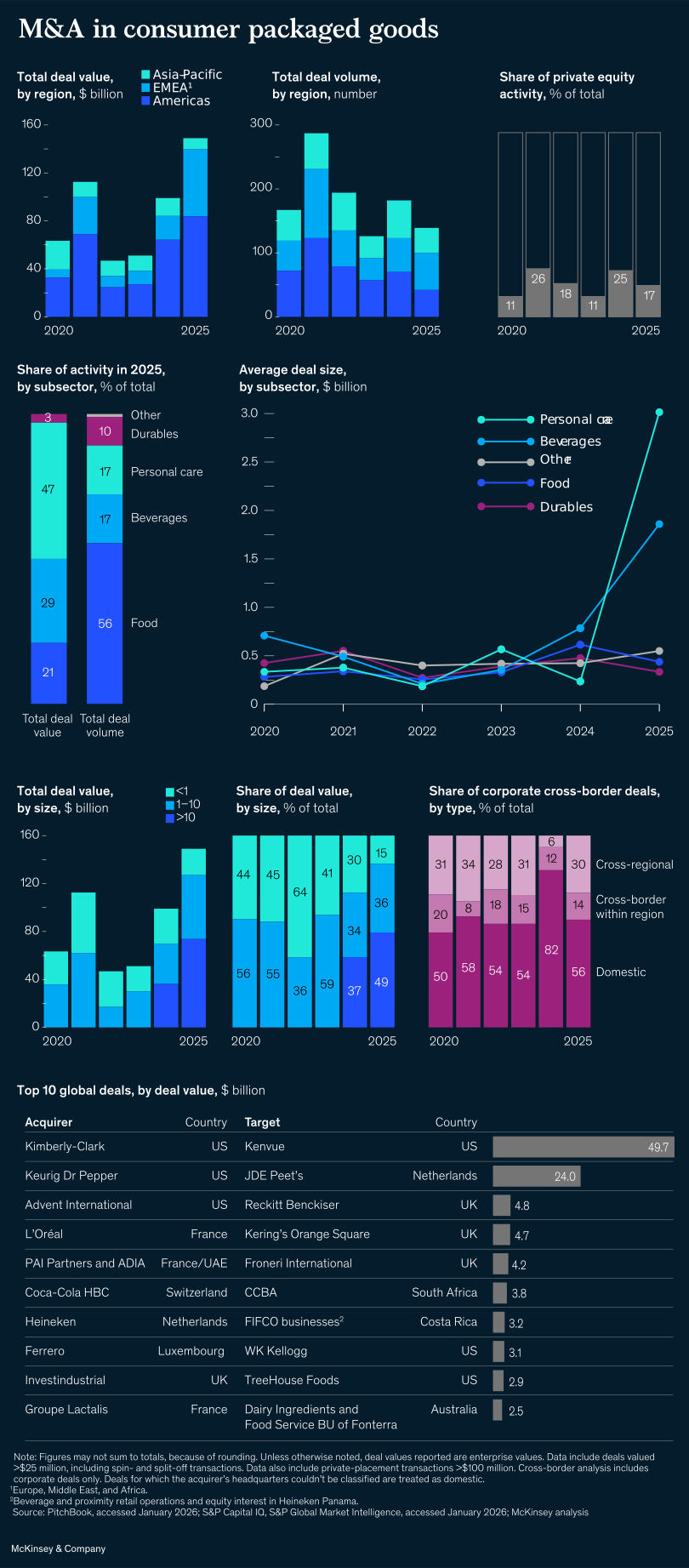
The industry’s M&A activity over the past 12 months has primarily been about realigning portfolios. The total number of M&A transactions1 was down, falling to 140 transactions in 2025, from 180 in 2024. But deal value grew by over 50 percent to approximately $152 billion in 2025 compared with approximately $99 billion in 2024.2 This overall increase in deal value was driven by a handful of megadeals in the beverage and personal-care subsectors.
This shift toward larger and more selective transactions was most pronounced in Europe. The European CPG sector saw a small uptick in deal count, while deal value there nearly tripled to approximately $56 billion in 2025, from $20 billion in 2024. Relatively large transactions drove the change, with six deals above $2 billion occurring in the region in 2025, compared with only one such deal in 2024. This pattern reflects buyers’ renewed appetite for category leaders and assets with strong competitive moats in Europe.
Globally, CPG companies have been using acquisitions and divestitures to refocus on core categories, exit businesses with relatively weaker growth prospects, and free up capital to reinvest where demand is clearer. And several CPG companies around the world have been pursuing scale to improve operating efficiency and protect margins.
These shifts are unfolding amid a mix of modest tailwinds and persistent headwinds. Interest rates are beginning to stabilize, but consumer confidence remains uneven, tariffs continue to add pressure, and macroeconomic uncertainty remains. As a result, CPG companies are turning to M&A both to defend performance today and to position their portfolios for growth over the next cycle.

2026 M&A trends: Navigating a rapidly rebounding market
Subsector activity
There were a handful of CPG megadeals, such as Kimberly-Clark’s approximately $49 billion acquisition of Kenvue and Keurig Dr Pepper’s approximately $24 billion deal for JDE Peet’s, in 2025. These large deals have drawn the most attention, but they sit within a broad and diverse wave of acquisitions and divestitures as CPG companies continue to move beyond a period of caution and once again use M&A to actively shape their portfolios.
Food: Continued momentum
Food saw an overall decrease in both deal activity and deal value in 2025. There were 79 deals with a total value of approximately $35 billion in 2025, compared with 92 deals with a total value of approximately $67 billion in 2024. However, when excluding 2024’s outlier $36 billion Mars–Kellanova deal, total food deal value increased by nearly 70 percent in 2025. A new wave of transactions of $1 billion or more, including Ferrero’s $3.1 billion acquisition of WK Kellogg, propelled this surge. After a year of “wait and see,” buyers appeared to reengage with M&A in strategically important categories in 2025.
Beverages: Reshaped by megadeals
Sizable moves in 2025 indicate a higher deal appetite in the beverage sector than seen in recent years. Keurig Dr Pepper’s approximately $23 billion acquisition of JDE Peet’s helped increase 2025’s beverage deal value to $43 billion, more than doubling 2024’s beverage deal value of $20 billion. Strategic buyers in the subsector have been moving to secure leading positions in high-growth subsegments while rationalizing exposure elsewhere.
Private equity: Consistent activity, but megadeals shifted to retail
Private equity (PE) activity in CPG was stable in 2025 relative to 2024, deal count decreased slightly (46 in 2025 compared with 52 in 2024), and total deal value was nearly identical ($25 billion in 2025 compared with $24 billion in 2024).
It’s interesting to note that, unlike in previous years, the most substantial PE transactions in the overall consumer industry in 2025 weren’t in CPG at all. PE firms reentered the market to buy large-cap assets on the retail side of the equation. Deals of note include 3G Capital’s $11.3 billion acquisition of Skechers U.S.A., Sycamore Partners’ $23.7 billion acquisition of Walgreens Boots Alliance, and CD&R’s $13.5 billion acquisition of Wm Morrison Supermarkets. Overall, the average deal size for retail PE transactions more than doubled between 2024 and 2025. PE’s shifting interest from CPG to retail appears to be driven by two factors. First, retail assets enable PE firms to deploy large amounts of capital to businesses with meaningful value creation opportunities. With the right operational expertise, PE has demonstrated that it can create substantial value in the sector. This is particularly true amid the emergence of new revenue streams in retail, including adjacent services and customer data monetization.
Supply chain volatility, input cost risk, and margin compression remain challenges in CPG. PE firms are remaining relatively active in the niche, premium, and “better for you” CPG spaces. But lately, they appear to be viewing large CPG acquisitions as riskier than in those spaces, particularly where recent cost-cutting efforts limit the scope for further operational improvement. PE firms may also see more risk in large acquisitions because they usually don’t have the same operational synergies that a strategic buyer can achieve.
Opportunities for 2026—and beyond
With top-line growth challenged across most CPG categories in 2025, companies are deploying M&A to reshape portfolios and reallocate resources toward core business and higher growth categories.
Shifting consumer and investor trends prompt portfolio realignment
Persistent volume headwinds and shifting consumer preferences have caused CPG management teams to reevaluate business unit fit and capital allocation, often after pressure from investors who spot misalignments. As a result, there have been separations and corporate restructurings: Kraft Heinz announced a plan to split into two separate public companies (Global Taste Elevation, which will include Heinz and Kraft Mac & Cheese, and North American Grocery). And Keurig Dr Pepper announced a plan to split into two independent entities (Beverage and Global Coffee) in conjunction with its announced acquisition of JDE Peet’s.
Across the sector, the message is clear: Some sprawling CPG portfolios built for the past decade no longer align with how consumer tastes are trending, so capital must be redirected.
Rotation into high-growth adjacencies continues
CPG companies are also using M&A to access growth pockets that have remained resilient, particularly in premium, better-for-you, and creator-led brands across consumer categories. An influential factor in the strength of these brands is likely the purchasing habits of Gen Z consumers (those born between 1997 and 2012).
McKinsey research suggests that Gen Zers are about three times more willing to splurge than both baby boomers (those born between 1946 and 1964) and silent generation members (those born between 1928 and 1945), particularly on apparel and beauty.3 Younger consumers contribute to over two-fifths of annual wellness spending in the United States despite making up just over one-third of the US adult population.4
Several M&A transactions that have occurred over the past 12 months exemplify this trend. One example is L’Oréal’s announced approximately $4.7 billion acquisition of cosmetics and fragrance brands from Kering to strengthen its position in the fast-growing luxury-fragrance market. Another is e.l.f. Beauty’s $1 billion acquisition of rhode, enabling it to enter the premium skin care segment.
Operational-performance improvements fuel investments
In addition to helping focus portfolios and tap growth pockets, acquirers used M&A in 2025 to improve the shape of their P&L statements through cost synergies, freeing up capital for growth investments.
CPG M&A in 2025 provides several examples of seizing this area of opportunity. Kimberly-Clark announced $1.9 billion in run rate cost synergies from its acquisition of Kenvue, principally through cost of goods sold and G&A optimization. That figure represents nearly 16 percent of Kenvue’s cost base. Keurig Dr Pepper expects roughly $400 million in total cost synergies over three years as a result of the JDE Peet’s acquisition, of which $200 million is supply chain savings.
The continuing emphasis on scale, efficiency gains, and other cost synergies marks a rebalancing. Growth deals are occurring, and deals enabling substantial synergies are regaining momentum. Meanwhile, some large CPG companies that haven’t yet engaged in major deals are undertaking transformational cost-cutting efforts, underscoring the broad recognition of the importance of cost discipline in the current environment.
M&A market becomes more active
Looking ahead, we expect CPG M&A activity to remain elevated, propelled by the following factors:
- More separations and spin-offs: Companies are likely to continue shedding noncore assets to free up capital for reinvestment into core and high-growth categories. These exited assets and brands could become meaningful additions for other players seeking to double down on their core business and increase scale.
- Continued push from activist investors: As organic growth and shareholder returns continue to wane in CPG, we may see more of these investors taking large positions across the sector and agitating for change. Demands for portfolio streamlining, different uses of capital, more focus on core business, and investment in growth categories could lead to increased M&A.
- Greater consolidation for efficiency: With ongoing margin pressures and limited volume growth, acquirers will likely pursue profitability through organic initiatives (including revenue management, cost transformation, innovation, analytics use, and AI-enabled efficiencies where possible). They will likely also use M&A (including deals that target consolidation to achieve operational scale and cost synergies) in that pursuit.
- Demand reshaped by greater adoption of new medication: The impact of the blockbuster glucagon-like peptide-1 (GLP-1) drugs used for weight loss has already been felt across the food and beverage sectors. Inflation-adjusted growth for packaged foods (0.3 percent) fell below population growth (roughly 1 percent) between 2023 and 2025. Changing tastes and habits could potentially widen the current misalignment between consumer preferences and the portfolios of large, traditional food and beverage players, requiring further reshaping through M&A and divestitures.
- Continued value seeking from consumers: In 2026, consumers will likely keep focusing on value because of ongoing price sensitivity, higher living costs, and growing trust in the quality of private-label brands. This continued trend could fuel CPG M&A aimed at scale efficiencies, cost synergies, and category leadership. Deals will likely favor buyers that can integrate assets to improve pricing power, supply chain efficiency, and value tier offerings.
- Retail transformation: Retailers are tapping into new value pools beyond omnichannel retail, including adjacent services and customer data monetization. As a result, the dynamics between retailers and suppliers could become more challenging. For example, retailer capabilities in customer data monetization will increasingly mean that CPG companies no longer “own the consumer” as they used to. They will face deciding how to protect or rebuild consumer access, bargaining power, and economics in a world in which retailers increasingly control the data and the relationship.
The past 12 months have marked a turning point in CPG M&A. A sector defined by incrementalism in the late 2010s and early 2020s has again been making bold moves. It has been shedding legacy assets, doubling down on core and high-growth categories, and refocusing on operational efficiency and growth areas.
Recent M&A activity suggests that portfolio reshaping is becoming a central theme in the CPG sector. As growth slows in core categories and consumer loyalty becomes less predictable, companies are using acquisitions and divestitures to restructure their portfolios and reallocate capital. Those that decisively use M&A as a mechanism for focus, scale, innovation, and growth will be in the best position to lead the next chapter in the CPG industry.
Read the full report on which this article is based, 2026 M&A trends: Navigating a rapidly rebounding market.