The industry overview
M&A activity across the technology, media, and telecommunications (TMT) sector continues to reflect profound structural change rather than cyclical adjustment. Shifts in tech adoption, evolving competitive dynamics, and capital reallocation priorities are reshaping deal rationales, asset valuations, and the balance between scale, specialization, and strategic control.
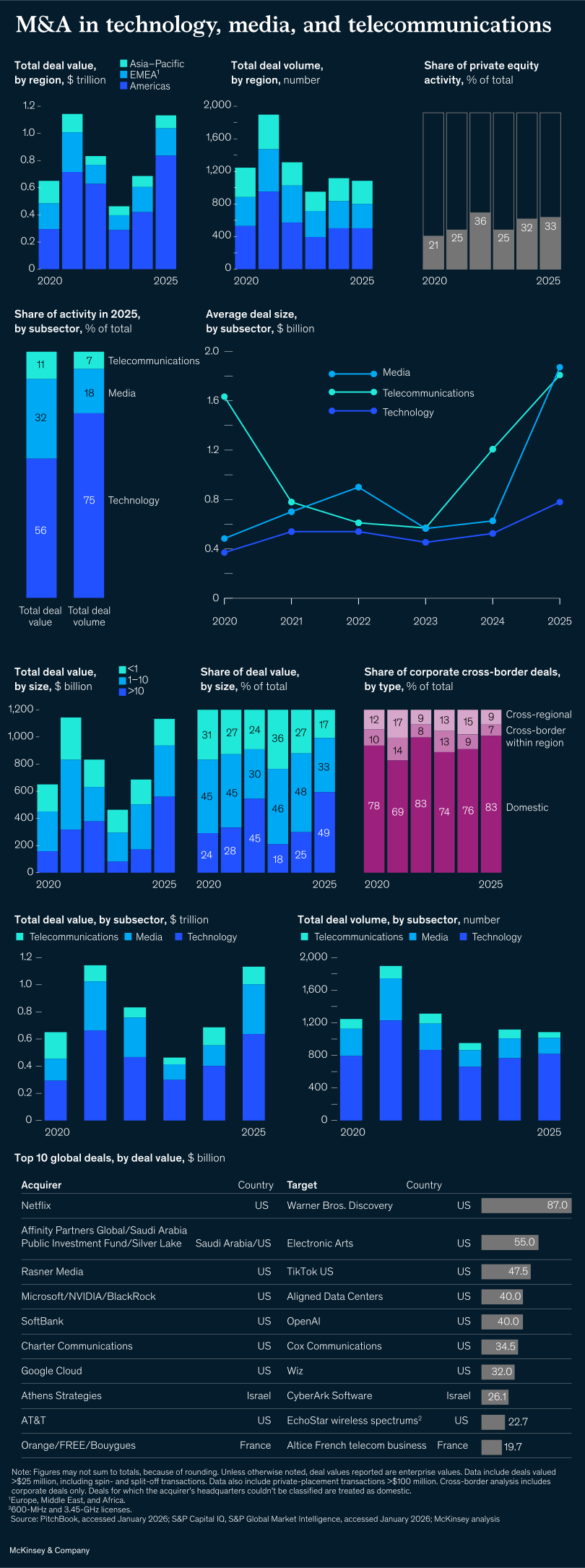
Recent deal activity highlights how these forces are translating into action. In 2025, TMT M&A was shaped by a relatively small number of large, high-conviction transactions, with deal value concentrated in software, digital infrastructure, and scaled media platforms.1 North America continued to lead in global M&A value, while cross-border corporate deals remained measured, reflecting an increase in regulatory complexity and acquirers’ sharper focus on assets that could deliver resilience and strategic optionality.
Private equity (PE) remains an important force, but it’s increasingly targeting carve-outs, infrastructure-like tech assets, and platform buildups rather than broad sector exposure. Collectively, these patterns signal a deal market defined less by a cyclical rebound and more by deliberate repositioning on data, AI enablement, network scale, and long-term growth economics.

2026 M&A trends: Navigating a rapidly rebounding market
Subsector activity
Our analysis of each subsector reveals key differences in their dealmaking, the relative impact of AI and other technologies, and the size and scope of deals—although consolidation remains a critical objective for most.
Technology
M&A in the tech subsector continued to outpace dealmaking in media and telecommunications in 2025. In the past 12 months, tech deals represented 56 percent of total M&A value in TMT. The total value of announced tech deals was more than $630 billion, driven by more than 800 transactions. The average deal size increased from $525 million in 2024 to about $779 million in 2025, underscoring a clear shift toward larger, more strategic acquisitions.
Within IT services, M&A teams are now focused on acquiring specialized domain expertise and service models that can be deployed as commercial products rather than pursuing deals that simply provide expansion. PE now accounts for roughly one-third of total deal value in the tech subsector and has helped to accelerate this transformation, with investors favoring bolt-on acquisitions that provide recurring revenue and create new or bolster existing intellectual property.
Other emerging M&A themes for tech players include focusing on data infrastructure and smarter cloud spending, reconfiguring cybersecurity players, investing in computing power and semiconductors, shifting toward vertical AI and product-led services, and continuing focus on portfolio management.
- A focus on data infrastructure and smarter cloud spending: As companies across industries begin to deploy AI, they’re expressing concerns about its cost and complexity. The businesses that can help make digital infrastructure faster, cheaper, and more efficient will likely be the focus of deal activity going forward. These include data management platforms, cloud-based cost optimization tools that can help leaders control rising computing expenses, and hybrid-cloud solutions that can help businesses balance cost, performance, and sustainability.
- Reconfiguration of cybersecurity players: Cybersecurity is undergoing a rapid reconfiguration driven by the emergence of platforms, the obsolescence of products and solutions, and the continual formation of new companies. In this context, M&A is serving as a primary instrument for strategic repositioning, allowing leading vendors to redefine their role in the security stack and accelerate control plane ambitions. The crucial question is no longer who offers the most software, analytics, or services, but which platforms those capabilities ultimately flow through.
- Investments in computing power and semiconductors: With computing demand still outpacing supply, there’s likely to be a wave of investments in semiconductor design, advanced packaging, and hardware optimization software in 2026. Tech giants and sovereign investors (for instance, state-owned development funds) alike are eyeing deals involving AI chipmakers, data center energy management software, and edge-computing platforms to reduce their dependency on a few global suppliers. Cross-border scrutiny of such deals will remain high, but the overwhelming demand for computing efficiency will keep M&A in this subsector alive.
- A shift toward vertical AI and product-led services: As generative and agentic AI applications mature, companies will want to embed them directly into workflows. This shift portends an increase in acquisitions involving industry-specific software providers—for instance, in healthcare, manufacturing, financial services, and logistics—and “productized” services, such as consulting and implementation teams bundled with proprietary software. Such deals will allow acquirers to accelerate the adoption of AI and the generation of recurring revenue streams.
- A continued focus on portfolio management: Tech companies have been simplifying their portfolios for several years now—that trend will continue into 2026 as tech players divest slower-growth or noncore assets and reallocate capital to areas with the potential for higher returns (such as AI and infrastructure opportunities). Tech companies are likely to continue pursuing carve-outs of mature software divisions and selling support businesses to PE firms or strategic partners seeking steady, cash-flow-positive assets.
Media
M&A activity in the media space has fluctuated in recent years, given macroeconomic uncertainty and increased interest rates. Yet overall deal value remains resilient at about $360 billion. There was also a significant increase in average deal size (from about $620 million in 2024 to about $1.8 billion in 2025) as strategic players emphasized transformative acquisitions that could confer competitive advantage in this subsector rather than smaller, more opportunistic deals.
Our recent conversations with 40 senior decision-makers in media companies, investors, and industry advisers point to three emerging M&A trends in the media subsector: consolidation, separation, and partnership. Of the leaders we spoke with, 80 percent said they expect M&A in media to increase significantly in 2026 and beyond—so the companies that can factor these trends into their M&A strategies will be better positioned than most to grow and create long-term shareholder value:
- Consolidation: Leaders expect consolidation to continue as media companies seek scale amid fragmentation and an edge against global competition. These leaders say the most value will come from deals within their home markets or across core value chains, and they anticipate that regulatory scrutiny and integration challenges will persist.
- Separation: Divestitures and spin-offs are gaining traction with leaders of media enterprises as conglomerates look to streamline operations, focus on core strengths, and gain greater agility by separating noncore or underperforming assets. Such separations may be especially appealing to legacy media companies that want to clarify the value coming from mixed-growth portfolios (for instance, classified advertising versus digital media) or distinguish between legacy and digital-first assets (for instance, linear TV versus streaming broadcasts). The leaders we spoke with all agree that success in such transactions depends on having a clear rationale, robust execution, and effective communications with stakeholders.
- Partnership: Leaders say they’re increasingly attracted to strategic partnerships and joint ventures (JVs) instead of full acquisitions. Such relationships allow companies to access complementary capabilities and accelerate innovation—especially in tech development, coproduction of content, and market entry—while mitigating some of the risks of doing so. Leaders say that to realize the most value from partnerships and JVs, both sides must agree on the core objectives of the relationship at the outset and establish clear governance protocols.
Telecommunications
Total deal value in the telecom subsector rose in 2025, driven in part by an increase in large-scale transactions, such as Charter Communications’ announced $34.5 billion acquisition of Cox Communications in May 2025. At the same time, deal volume declined, resulting in a higher average deal size in the subsector.
Four M&A trends are emerging in telecommunications, a few of which are similar to those in media and technology but with their own subsector-specific spin: consolidation, portfolio optimization, expansion beyond the core, and investment in digital infrastructure:
- Consolidation: Particularly in Europe and Asia, telecom players are continuing to consolidate to gain scale and realize synergies, as seen in recent deals involving players in Eastern Europe and Southeast Asia. Consolidation is happening in the mobile market among both mobile network operators and mobile virtual-network operators, amid fixed-line industry players focusing on fiber as an area for growth, and among operators looking to capitalize on fixed–mobile convergence technologies to enhance their operations and boost their competitiveness.
- Portfolio optimization: Telecom operators are increasingly looking to reshape their portfolios by exiting challenging markets and strengthening their presence in markets with greater growth potential. Indeed, we’ve seen several notable exits over the past 12 months involving operators in Latin America and Southeast Asia.
- Expansion beyond the core: Today’s telcos are experiencing a significant shift in identity—from telecommunications to technology. Many are exploring growth opportunities outside their traditional core offerings, such as cybersecurity, cloud services, and AI solutions. Core connectivity providers are becoming customer-centric, platform-based tech companies focused on higher-growth digital services.
- Investment in digital infrastructure: Investors of all stripes—hyperscalers, frontier AI, and private capital—had digital infrastructure squarely in their sights in 2025, as the adoption of gen AI sparked the demand for data centers and other digital support systems. That trend is likely to continue in 2026, with a greater focus on fiber-related deals and a continued slowdown in tower-related deals.
These recent trends and changes in competitive dynamics suggest that TMT companies will remain important drivers of M&A as both acquirers and targets, fueled by further evolution across all three subsectors.
Read the full report on which this article is based, 2026 M&A trends: Navigating a rapidly rebounding market.