The industry overview
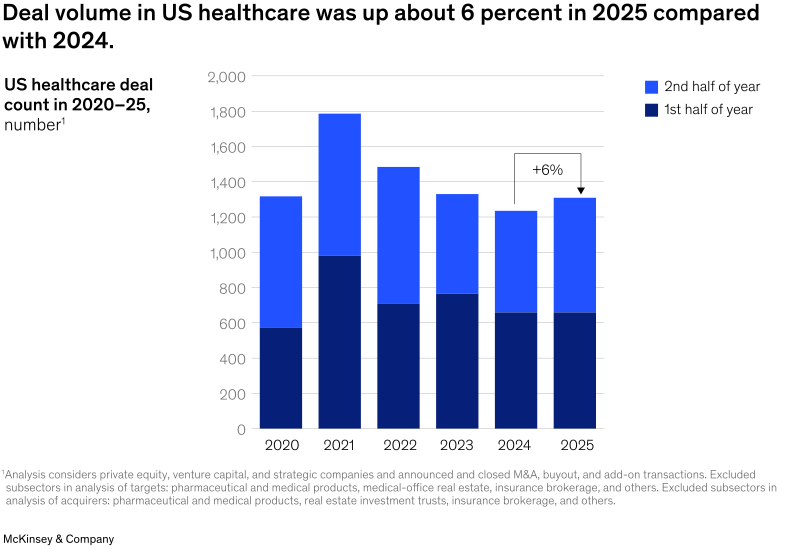
Dealmaking in US healthcare remained stable in 2025 relative to the sector’s M&A activity in 2023 and 2024 (Exhibit 1). According to our analysis, dealmakers continued to diversify, with a focus on obtaining new capabilities to improve their portfolios. In previous years, by contrast, organizations sought to diversify largely to access new value pools.1
M&A activity and motivations varied across different players within the healthcare ecosystem. More than 75 percent of deals by providers were focused on consolidation plays, with more than 15 percent of these deals focused on acquiring healthcare-services and -technology (HST) capabilities to maximize the worth of their existing assets. This provider group encompasses core subsegments such as hospitals, facilities for pre- and postacute (PPA) care, and physicians. Deal activity among payers remained limited (accounting for fewer than 15 transactions). The transactions that were completed focused on scaling up memberships and other core offerings.
For companies within the HST segment, deals that would help upgrade healthcare’s overall operating infrastructure—transactions involving, say, revenue cycle engines and enterprise data platforms—were of the highest priority, reflected in the fact that 80 percent of deals were like-for-like transactions. And our research shows that private equity (PE) investors continued to focus on physician services (accounting for 30 to 40 percent of healthcare deals), dental platforms, home-based care, and specialty pharmacy opportunities while also accelerating their investments in technology.2

2026 M&A trends: Navigating a rapidly rebounding market
What changed? Year-over-year shifts in healthcare M&A
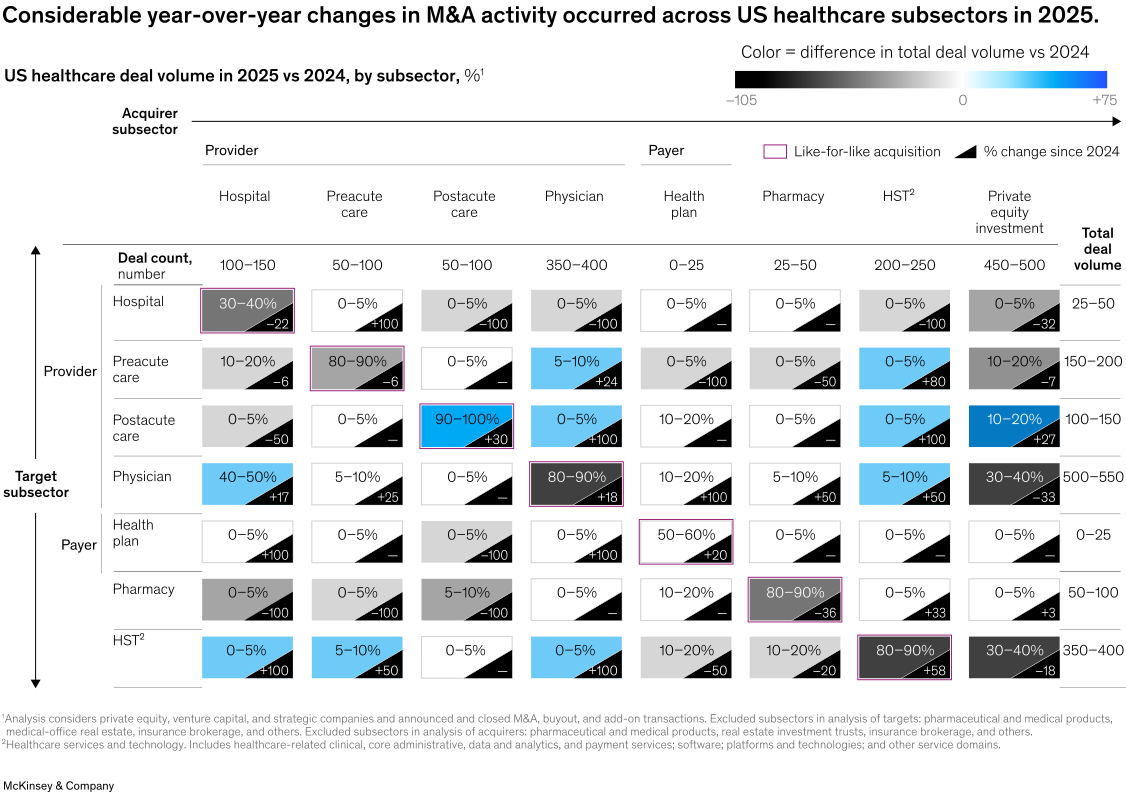
Compared with 2024, overall M&A activity in US healthcare in 2025 remained broadly stable. But several trends have demonstrated the degree to which healthcare M&A is evolving from a focus on expansion into new value pools to a focus on integration (Exhibit 2).
Hospital-led deals slowed down
Hospital-led deal volume declined by 7 percent overall in 2025 versus 2024 across almost all target segments: Like-for-like acquisitions fell 22 percent, and activity involving PPA-care organizations decreased between 6 percent and 50 percent, respectively. The lone area of growth was in physician assets, in which hospital acquisitions increased 17 percent. This is consistent with the sector’s shift toward outpatient care and clinical integration.
Payer-led deals remained flat
Transactions led by healthcare payers in 2025 were flat, with limited movement across most target sectors. While payer acquisition of physician assets increased 100 percent versus 2024, the rise started from a very small base, so it didn’t materially change overall payer M&A activity. Payer deals targeting hospitals, PPA-care, pharmacy, and HST assets were largely unchanged or modestly negative, reflecting a continued cautious posture.
Healthcare services and technology–led M&A increased
HST buyers stepped up their dealmaking in 2025, increasing like-for-like transactions by 58 percent. They meaningfully increased their year-over-year activity in nonhospital provider assets, including preacute-care targets (an 80 percent increase in activity), postacute-care targets (a 100 percent increase), physician targets (a 50 percent increase), and pharmacy targets (a 33 percent increase).
Pharmacy-led deal activity contracted
Acquisitions by pharmacy players dropped materially in 2025, with overall pharmacy-to-pharmacy deal activity declining 36 percent. Pharmacy buyers’ pursuit of HST targets also decreased modestly (down 20 percent), and their activity in the preacute-care segment disappeared. The only area of meaningful expansion was physician assets, reflecting a small but notable shift by pharmacies to create a tighter alignment between their dispensing models and broader clinical workflows.
Private equity acquirers remained active
In 2025, PE acquirers reduced their investments in hospitals by 32 percent, in preacute-care targets by 7 percent, in physician assets by 33 percent, and in HST by 18 percent. However, PE sponsors showed more interest in several other segments—for instance, pharmacy assets (an increase of 3 percent) and postacute-care targets (an increase of 27 percent).
Overall, PE sponsors supported similar levels of add-on transactions in both 2024 and 2025; these transactions typically created influence for sponsors and involved moves into adjacent areas rather than broad platform creation. The emphasis on targeted add-ons, operating leverage, and adjacencies reflects a more measured approach to M&A among PE sponsors.
A deeper dive: Dealmaking dynamics by segment
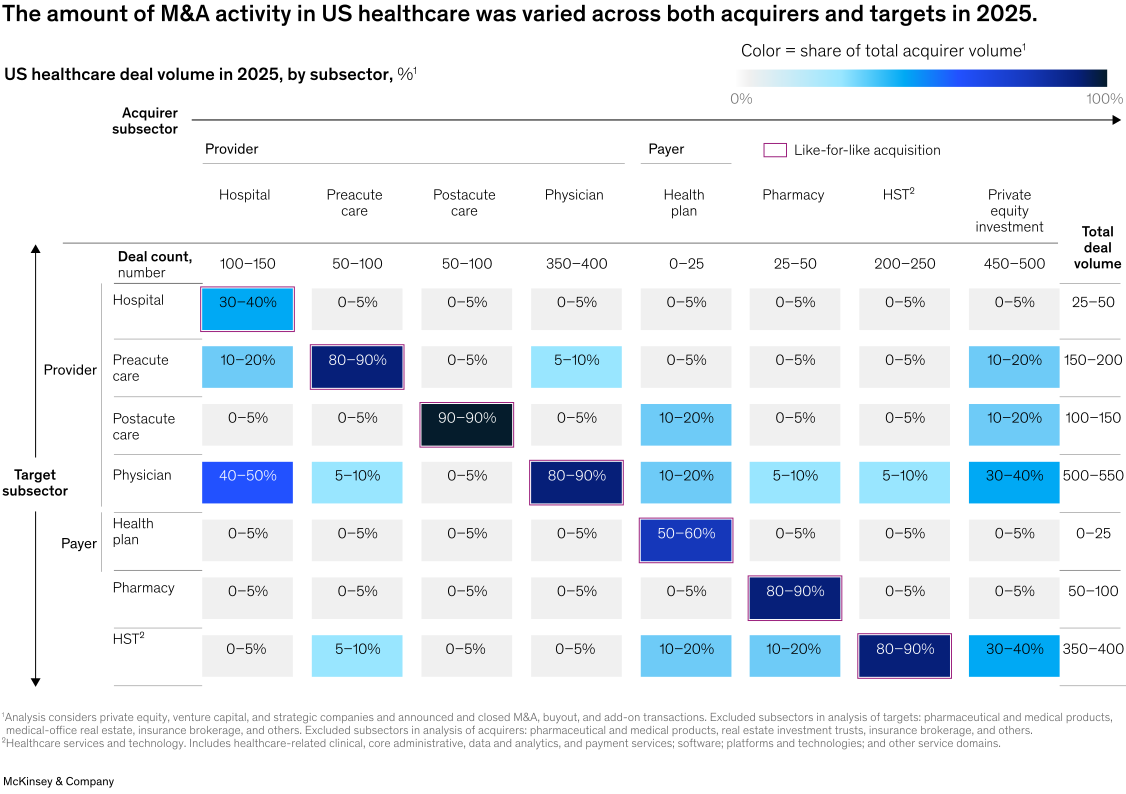
A closer look at dealmaking dynamics by segment reveals the degree to which these shifts have taken hold and created an environment in which integration and asset performance outweigh pure expansion (Exhibit 3).
Providers
Healthcare providers reinforced core capabilities while selectively expanding into new value pools over the past year. Consolidation was the impetus for a high proportion of M&A activity by providers in 2025, as it has been the past few years. Our analysis shows about 70 to 80 percent of providers’ overall deal activity was focused on like-for-like transactions. Among providers, roughly 30 to 40 percent of transactions by hospitals and health systems in 2025 were like-for-like transactions. The rest concentrated on core clinical extensions—primarily physician groups (which accounted for 40 to 50 percent of activity) and select outpatient preacute-care services (which accounted for 10 to 20 percent).
Within the preacute-care segment, 2025 M&A activity focused on both consolidation and diversification, a pattern most visible in the areas of behavioral health and imaging. Behavioral-health platforms continued their investment in multimodality outpatient models (for example, intensive outpatient programs, transcranial magnetic stimulation, and occupational, physical, and speech therapy) alongside selective inpatient and residential assets. Imaging and diagnostic players also showed meaningful activity, targeting traditional imaging centers, specialty labs, and AI-enabled diagnostic technologies that blend clinical and data-driven capabilities.
The postacute-care and physician service segments executed the highest share of like-for-like provider deals in 2025. Postacute-care organizations built denser regional healthcare coverage, strengthened continuum-of-care networks, and scaled workforce-intensive models. Physician organizations increased their breadth of services while offering patient care within a unified clinical platform.
Payers
M&A among payers was limited in 2025: Fewer than 15 transactions occurred in this space, and more than half of them involved acquisitions of other health plans to expand membership and strengthen core offerings. The remainder of deals involving payers focused on selective capability extensions aimed at improving the coordination of care and support for populations with complex health needs—for instance, deals involving comprehensive eldercare programs, dental medical-service organizations (MSOs), and data quality tools.
Pharmacy
Pharmacy-related deal activity in 2025 involved dispensing across retail, specialty drugs, infusion services, and physician and patient engagement capabilities. There were between 25 and 50 transactions in the retail, pharmacy, and specialty medication segments: Most of them focused on horizontal integration among assets in the pharmacy value chain. The transactions expanded the assets’ reach and capabilities across specialized therapeutic areas, specialty pharmacy, and infusion service providers.
Separately, acquirers directed roughly 5 to 10 percent of their deal activity toward physician-aligned assets, using MSO purchases to bring more pharmacy infrastructure in-house. Through these deals, acquirers were able to add essential plumbing to their existing assets—for instance, revenue cycle, group-purchasing, order-to-cash, and chargeback systems.
There were also several transactions focused on patient engagement in the virtual-prescription, digital-adherence, and remote-monitoring spaces. They focused on enhancing the customer experience and increasing speed to therapy.
Healthcare services and technology
HST dealmaking in 2025 sought to upgrade the financial systems, data architecture, and clinical-workflow engines that support day-to-day delivery of healthcare. Between 80 and 90 percent of HST-led transactions were like-for-like deals. Much of this activity centered on the administrative- and financial-infrastructure tech stacks, with buyers acquiring revenue cycle service providers, AI-enabled coding engines, prebill-auditing tools, payment integrity platforms, and a range of systems for claim processing and denial management.
A second cluster of acquisitions by HST players focused on strengthening enterprise data layers. They included population health and cost trend analytics, real-world-evidence and genomic platforms, interoperability engines, and referral and navigation intelligence tools.
There were also some HST acquisitions within the physician sector aimed at embedding clinical workflows into digital platforms. These were strictly capability extensions—focusing on home-based primary care, virtual maternity care, musculoskeletal rehabilitation through telehealth options, and other technology-enabled models—rather than geographic roll ups.
Private equity
PE remained a primary investor in healthcare in 2025, driving a large share of the sector’s M&A activity: roughly 40 percent of total deal volume (slightly below 2024 activity). However, the mix of deals by PE investors varied, especially at the add-on level at which portfolio companies execute PE-backed acquisitions. Here, investors pursued fewer physician roll ups and redirected capital toward postacute-care assets, particularly in the form of physical therapy and rehab centers. The HST segment was involved in approximately 30 to 40 percent of transactions led by PE investors. Meanwhile, the PPA-care segments accounted for roughly 10 to 20 percent of deals by PE investors, and physician services represented another 20 to 30 percent.
In the preacute-care segment, investors most often targeted ambulatory-surgery platforms, diagnostics, and behavioral-health assets; the latter was one of the year’s most active investment categories. In postacute care, investors prioritized deals involving senior living (for instance, facilities equipped for memory care) and home health and personal-care platforms.3
Opportunities for 2026—and beyond
The fundamentals of healthcare M&A remain strong entering 2026. A range of factors continue to pressure companies in the healthcare ecosystem to build new capabilities and achieve greater efficiencies. These include demographics and an aging population, emerging regulatory changes, persistent labor shortages, and the shift toward value- and home-based care. For the part of PE investors, they’re reckoning with older vintages in their portfolios and have the dry powder to further drive M&A activity in healthcare.
Simultaneously, advances in AI, automation, and interoperability are reshaping what acquirers are looking for in healthcare targets and how they generate value after deal close. These dynamics suggest that the next wave of healthcare M&A may be characterized by increased precision—relatively smaller, technology-enabled transactions designed to align clinical, digital, and operational capabilities—and companies’ overall goal will be to enhance their core businesses and existing portfolios.
Read the full report on which this article is based, 2026 M&A trends: Navigating a rapidly rebounding market.