M &A communication has always demanded clarity, cadence, and conviction. What’s new is the increasing intensity and speed with which change is taking place. In an age of fluid timelines, constant scrutiny, and ever-increasing expectations for real-time communication, leaders need to listen and communicate faster, with greater attunement, and across a more fragmented ecosystem.
Technology has transformed not only how information flows but also how trust is built. The borders between internal and external stakeholder groups have blurred. Such context collapse means communicators must operate in real time, with dynamic feedback loops and consistent alignment across all stakeholders. The goal is to communicate not just more quickly but more effectively.
In this article, we outline some of the high-impact moments across the deal cycle—the points where leaders can communicate to build the confidence, alignment, and momentum that turn M&A transactions into transformations with enduring value.
Before deal announcement: Forging strategy and governance
Even before a deal is announced, leaders must begin to consider how they will talk about the impending transaction. They will need to map the strategic journey and establish communication governance and ways of working.
Map the strategic journey
Given the urgency and uncertainty at the beginning of the acquisition process, communication teams often start drafting the announcement and subsequent milestones before they have an effective strategic overview. However, it’s well worth taking some extra time to think through the strategic imperatives and pressure points for the coming journey. This will make the process of communicating more effective and less risky from the start and ensure that the team has sufficient resources. Targeted actions include the following:
- Map out the phases, milestones, and pressure points. M&A is usually defined by two critical milestones: the deal announcement and day one (the official deal close). But there are other important phases to address, and each comes with its own specific legal and communication constraints. For example, additional integration announcements will be required for regulatory approvals, leadership appointments, restructuring and role changes for employees, integration of processes and systems, culture and values, and changes to product, brand, or client services. A common pitfall for companies during a new deal is to underestimate the volume and complexity of the communications needed and, as a result, not provide the communication team with enough resources. A realistic mapping of the most important touchpoints will help clarify at the outset what’s required and keep both leadership and the communication team on the front foot.
- Ensure that stakeholder analysis and messaging are aligned with the deal rationale. Make sure everybody is clear on which stakeholder groups are most integral to success, which may need support, and which may present a risk, in the context of the specifics of the deal. This is best achieved by creating a detailed initial statement of the deal rationale and including both communication and business leaders in strategic meetings on an ongoing basis.
Establish communication governance and ways of working
Starting with preannouncement, it’s vital to define how the communication show will be run. A lack of transparency on governance processes and accountability can quickly erode alignment and lead to duplication of efforts, rework, or misunderstandings that take up leadership’s valuable time.
The governance starts with controlling information flows preannouncement to avoid leaks and agreeing in advance on how to coordinate messaging, while maintaining the independence of both companies. Communication needs to be managed within strict legal guidelines before the deal close, with the communication team setting the guardrails hand in hand with legal. Targeted actions include the following:
- Decide ownership and scope of responsibilities. This would normally include leadership owning the messaging and engaging their teams directly, while the communication team owns the written communications going to all employees, and then coordinating tightly with relevant executives on specific stakeholders.
- Articulate the communication chain of command. Specify the sequence and level of sign-off needed for different types of communication—for example, CEO-level sign-off is common for sensitive topics such as restructuring, and for new external and all-employee communications, while integration management office (IMO) sign-off is sufficient for more routine communications to update or reinforce agreed-on messages.
- Outline the collaboration model and guardrails between the companies to coordinate messaging, while preserving independence. Agreeing on messaging and timing in advance is critical, including the messaging coming from the respective leaders of each company.

2026 M&A trends: Navigating a rapidly rebounding market
Deal announcement: A tightly coordinated launch
The announcement sets the tone for the entire transaction across both companies’ leadership groups, employees, customers, business partners, suppliers, and investors.
The press release tends to be the core communication, and while it’s designed primarily for external audiences, employees will also scrutinize it, so balancing the tone for investor and employee audiences is essential. It’s also important to issue communications dedicated to employees simultaneously. These should include a more personal voice, more granular information on what to expect, and assurances on future growth and positive career paths (where possible).
In parallel, it’s important to engage customers and suppliers on announcement day. While these stakeholders likely won’t experience material changes immediately, a proactive approach will ensure that they feel cared for during the process. This is the time to develop a tiered outreach with the commercial team, identifying key customers whose scale or sensitivity justify a call from a senior leader or the relationship owner, and a broader base who will receive a written message reassuring them on the customer benefits of the deal and continuity of service.
Announcement day calls for a detailed, minute-by-minute plan (Exhibit 1). This will start with confidential leadership calls just prior to the official announcement, then tightly synchronized communications internally and externally, followed by employee town halls (sometimes several, depending on time zones), briefings for customer-facing staff, and tailored customer outreach. By the end of the day, the team should already be gathering feedback.
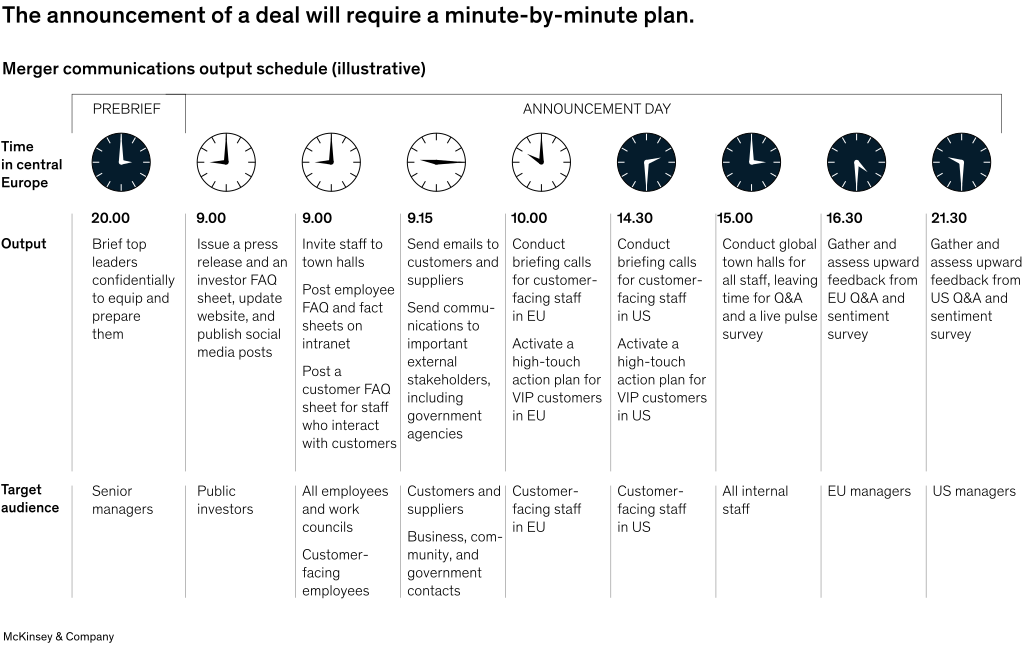
Targeted actions include the following:
- Approve messaging across all audiences and an hour-by-hour plan for announcement.
- Issue external communications, including press releases, social media and website updates, and customer, supplier, and business partner letters.
- Synchronize these with internal announcements, including a leader prebriefing with tool kit, messages to the employee groups of both companies, frequently asked questions (FAQs) and talking points for customer-facing staff, and a dedicated intranet space with FAQs.
- Create dialogue and engagement while gathering insights, including town halls for both organizations with plenty of time for questions, digital channels for submitting questions and comments, upward feedback meetings throughout the first week, and AI-enabled external sentiment monitoring.
Before day one: Building momentum and confidence
Once the deal is announced, but before day one, there are steps leaders must take to build momentum for and confidence in the transaction. Specifically, leaders will need to establish a regular cadence of communications and engage and equip individuals and teams to manage through the integration period.
Set off a regular drumbeat of communication
After the announcement, employees will be hungry for information, and it’s critical to keep the updates coming. As the communication team expands after deal announcement, its leaders will need to refine the core strategy and governance and quickly kick off a regular drumbeat of communication.
The strategic priority before deal close is to reduce anxiety where possible, build confidence in the new company, and prepare the ground for day one. Most target company employees will be worrying about their job security. If the acquisition is sizable, with significant overlap, a good proportion of the acquiring company may also be anxious. Leaders and employees alike will be asking themselves whether they believe in the vision and feel excited to stay. Communicating reliably and consistently through this period is essential.
A merger between two medical-aesthetics companies underscores that risks arise from communication gaps. As deal delays pushed back the planned deal close, leadership at the target company concluded that limited progress left little worth sharing at an upcoming town hall. However, by choosing silence, they inadvertently fueled employee apprehension and speculation. Transparent communication about what was known—and candid acknowledgment of what remained unresolved—could have preserved trust and mitigated anxiety during this critical transition period. Even assurances on what’s not changing, or that there will be no substantial announcements for a certain period, help employees refocus on daily work and reassure them they are taking part in a clear and transparent process. Targeted actions include the following:
- Kick off the full communication and change management workstreams quickly to ensure that priorities and expectations are clear.
- Establish the cadence of communications, building familiarity across companies by issuing regular integration updates, creating and maintaining a dedicated intranet space, and developing a tool kit that includes talking points and FAQs. Providing biweekly updates to the organization is typically considered best practice, though the updates may be less or more frequent depending on the pace of change.
- Deliver milestone communications, including leadership appointments, regulatory approvals, and shareholder vote approvals.
- Open ongoing spaces for engagement and dialogue: drop-in discussion sessions; pulse checks, surveys, and focus groups; and informal manager feedback loops.
Engage and equip leaders for the upcoming journey
Leaders are essential to unlocking the power of communication in M&A. The communication team will need to build leaders’ and influencers’ ownership and alignment around messaging and strategy, upskilling them in communicating about the deal and providing them with engaging, easy-to-use tools (Exhibit 2). This will help increase these key stakeholders’ understanding of the transaction and reduce workforce disruption before day one.
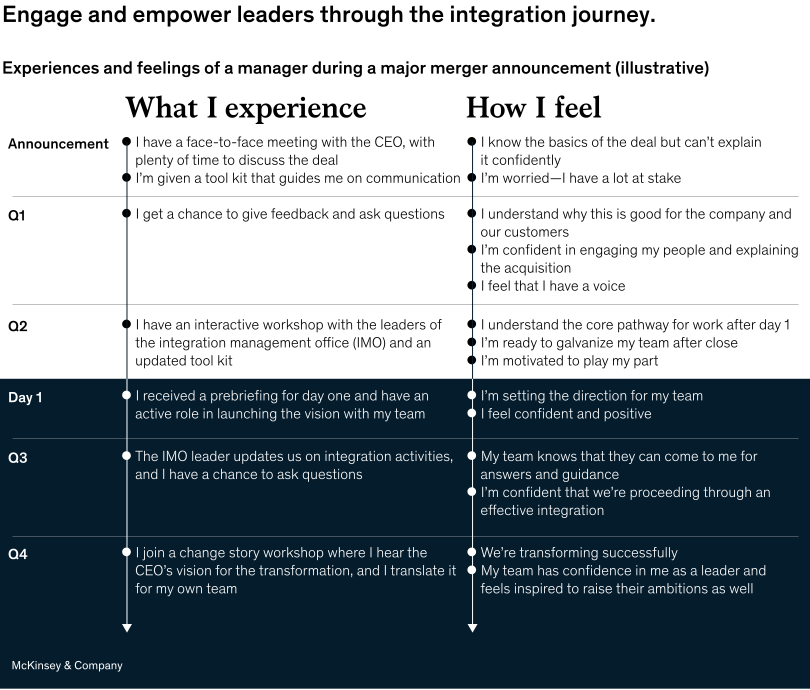
Targeted actions include the following:
- Create a robust communication tool kit for leaders and influencers; it should include information on messaging, FAQs, slides explaining the deal rationale, and general communication guidance.
- Design a communication road map, including interactive sessions in which leaders can hear directly from executive committee members, familiarize themselves with tools, take ownership of messaging, share feedback, and ask questions.
Day one: Set the tone for the journey
Day one, along with the announcement, is a peak communication moment. The strategic priority here is to launch the united company with the tone and direction that will inspire employees and key stakeholders on the upcoming journey. Leaders will need to cascade the vision throughout both companies, as well as present engaging forums for listening and dialogue.
Orchestrating the employee experience is crucial. If this is a growth story, day one can be a time to celebrate with fanfare, an inspiring vision, and multiple engaging ways to help new colleagues meet. If major redundancies and restructuring are happening immediately, an understated tone is more appropriate.
In almost all cases, communicators will be tasked with preparing important materials for the deal close, such as an extensive employee FAQ and onboarding pack. For a big acquisition, FAQs can run to hundreds of questions, some anticipated by central teams and others submitted by employees. The welcome pack can be extensive, too, covering everything from the core vision to branding, technology changes, welcome badges, and email sign-off instructions.
In most cases, each core message is sourced from around ten workstreams; developing a well-written, comprehensive day one support package can take months of work. However, generative AI is already reducing the time it takes to create and edit onboarding and supporting documents, and agentic AI has the potential to further speed and automate the entire production process for deal-close communication materials.
It will be vital for communication teams to actively listen and push for brevity, authenticity, and attunement when developing these materials. Streamlining the process and the materials themselves—through gen AI or agentic AI, for example—can, in turn, free up communication teams’ capacity, allowing members to shift their focus from drafting documents to checking AI outputs assiduously and engaging stakeholders in those outputs. Targeted actions include the following:
- Establish a clear strategy, tone, and vision for day one that’s attuned to the integration journey.
- Detail all day one and week one communications, tightly sequenced to ensure that all stakeholders are engaged:
- Internally, these can include the CEO memo and video; leader, influencer, and department-specific briefing packs to promote cascading the vision; an employee welcome pack; town hall materials, welcome gifts or swag, interactive celebration events, and product show-and-tells; customer testimonies; dynamic, cross-company sharing/welcoming/“getting to know you” events.
- Externally, communications can include a press release; social media engagement; customer and supplier communication such as letters, call scripts, portal updates, FAQs; and outreach events for public officials and business or community stakeholders.
After day one: Achieving the vision
The work doesn’t end after day one; in fact, after day one, communications become even more important for ensuring M&A success. In this phase, leaders will need to help build up the new organization and inform discussions about transformation.
Building up the new company
The strategic imperative after day one is often to guide the organization through structural and process changes. While this reorganization can bring huge gains, this is a time when safety, productivity, morale, and company credibility can be jeopardized if communications are ill attuned or if managers aren’t prepared and empowered to lead the changes effectively. The level of restructuring varies across deals. Some may require minimal changes, particularly if geographies and product lines don’t overlap. Many companies, however, will want to reorganize to capture synergies or rewire entirely to fuel a new growth arc.
People-related changes are often the most sensitive, with new announcements rightly scrutinized for their fairness and rationale. The top team tends to be announced before day one, which allows the new leadership team to launch the new company upon deal close. However, the pacing and nature of other people announcements can be more varied. One energy provider elected to inform all employees of their trajectory prior to transaction close, while another organization in the same sector communicated early in the planning period that people changes would be announced in a strategic cascade approximately one month after close.
There is often confusion around the best timing and principles for these changes. While legal and HR must be the final arbiters, there are core principles that communication professionals should try to follow whenever possible when communicating changes about people and their roles (Exhibit 3).
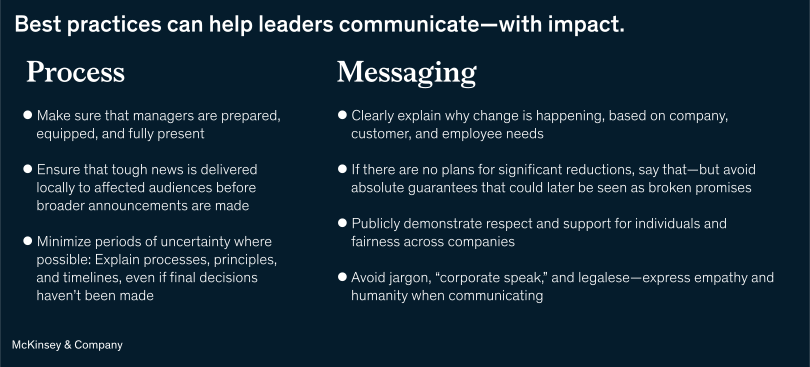
Targeted actions include the following:
- Integrate the two communication functions, taking the opportunity to modernize channels and lead on AI.
- Work closely with the executive committee, HR, and legal to align on the strategic approach and pacing of people changes.
- Agree on core messaging for people changes to build a strong “why.”
- Train and empower managers to have difficult conversations with team members.
- Enact changes with transparency and respect, minimizing unnecessary periods of uncertainty and proactively extending support mechanisms, updates, and rolling FAQs.
- Allow time for the organization to rebalance and reenergize.
Reignite transformation
View the period after day one as an opportunity; this is the time for true value-adding transformation. If restructuring is minor, then there may still be energy from the day one launch to kick-start the transformation. If employees have been through a cycle of redundancies, role changes, or reworking of teams and processes, they will need to reengage with the vision after this part is complete.
People will likely have the bandwidth and curiosity to learn new skills, to “form, storm, and perform” in new teams, to embed new ways of working and commit to evolved values and culture. This openness and goodwill can bring creativity, imagination, and innovative channels to the new workforce, especially if organized around a refreshed vision and powerful storytelling, free from the legal constraints and regulatory processes of earlier stages. This period is key to building the new value that may have motivated the acquisition. Yet it’s often neglected or wrapped too soon into business-as-usual communications. Targeted actions include the following:
- Launch a refreshed change story and vision-driven communications to reignite the organization.
- Launch new, forward-looking united communication channels and dynamic feedback and engagement mechanisms.
M&A deals are complex undertakings whose failure rates are often attributed to challenges like cultural misalignment, workforce disruptions, and insufficient planning. Effective communication is essential in navigating these complexities, as it helps align teams, dispel myths, and engage stakeholders throughout the integration process. By embedding communication at the core of integration efforts, organizations can mobilize and ignite teams toward a shared purpose, ensuring smoother transitions, stronger collaboration, and greater synergies.
Read the full report on which this article is based, 2026 M&A trends: Navigating a rapidly rebounding market.