As companies dust off their M&A playbooks after a prolonged slowdown in deal activity, many business leaders are asking how the best practitioners approach dealmaking today. To answer this question, we studied more than two decades of research on a group of “programmatic acquirers,” which are companies that pursue multiple small and midsize deals each year. These companies have consistently generated excess TSR. We found that when other companies pulled back from acquisitions during periods of uncertainty, these acquirers kept going, and their edge over peers has grown.
The latest McKinsey Global Survey on M&A capabilities1 finds that programmatic acquirers—the ultramarathoners of the deal world—have developed a set of capabilities that powers them through the deal cycle, from sourcing opportunities to integration. We believe others can build the same muscles. Just as endurance athletes are made, not born, aspiring acquirers can build the capabilities they need to turn M&A into a tool for implementing strategy and generating excess value. Below, we highlight five practical steps—a training plan, so to speak—that any company can take to get off the couch and strengthen its M&A capabilities.

Strategy and value in turbulent times: The four foundations that drive long-term performance
November 12, 2026, 8:30 a.m. ET / 2:30 p.m. CET Join McKinsey experts Andy West and Whitney Zimmerman for a discussion on what it takes to create and sustain value in an increasingly turbulent environment. They’ll explore four timeless foundations of strategy and how leaders can apply them to today’s hardest decisions.
The remarkably consistent value of programmatic acquisition
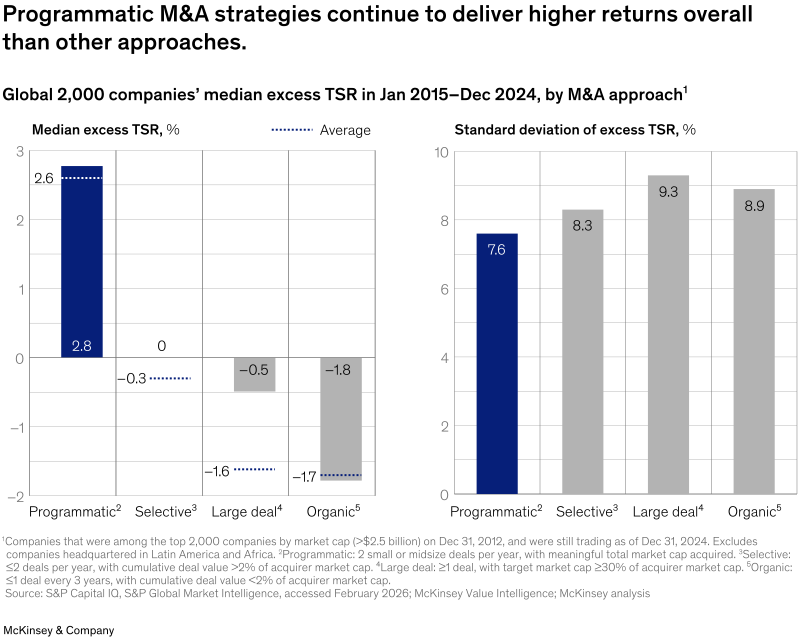
Our research, dating back to 1999, consistently shows that a subset of companies steadily makes acquisitions through all economic cycles. These programmatic acquirers continue to achieve higher returns than companies that treat acquisitions as one-off events, as well as those that rarely or never acquire (Exhibit 1). (For more about the different approaches to M&A, see sidebar, “Four approaches to M&A.”)
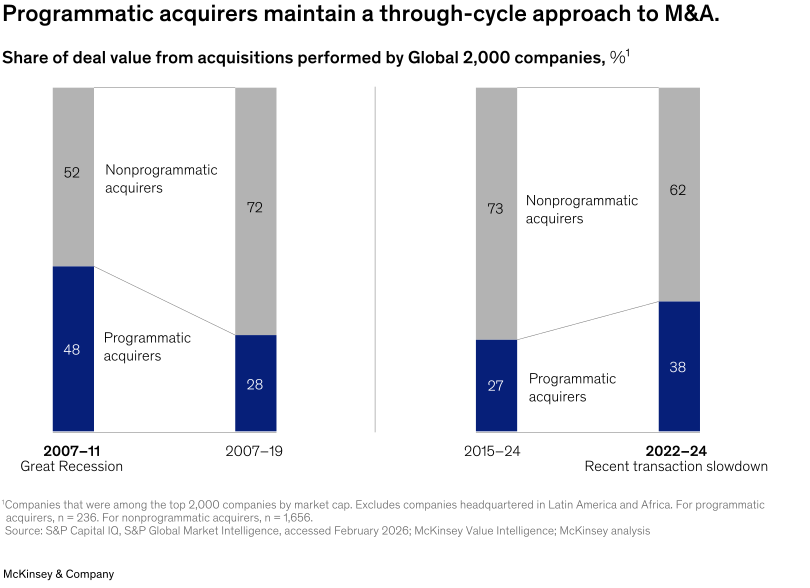
Furthermore, the data show that programmatic acquirers pursue M&A consistently. In our latest analyses of the world’s 2,000 largest global public companies (the Global 2,000), programmatic acquirers represented 12 percent of companies in the data set and accounted for, on average, 28 percent of deal value between 2007 and 2019, but this percentage jumped to nearly half of total deal value during the Great Recession (Exhibit 2). During the recent transaction slowdown, programmatic acquirers again accounted for a larger share of deal value than all those pursuing other M&A strategies.
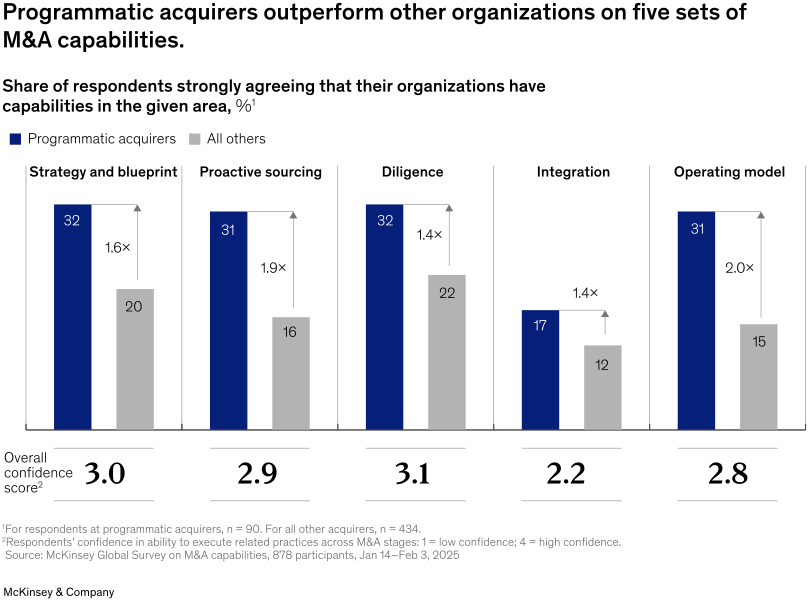
Our survey of nearly 1,000 executives and managers reveals that programmatic acquirers accomplish this high deal volume by tapping into a set of distinctive capabilities across the M&A process.2 The latest research shows a significant gap in capabilities between programmatic and nonprogrammatic acquirers, from the earliest stages of setting the M&A strategy and blueprint onward (Exhibit 3). What’s more, the gap in capabilities such as how companies institutionalize lessons from earlier deals and maintain repeatable processes has widened. For example, in our 2021 survey, respondents from programmatic acquirers were 1.7 times more likely than others to report that they had a set of strong operating model capabilities; now they are 2.1 times more likely.
How programmatic acquirers succeed at M&A
We believe that the capabilities for successful dealmaking can be developed by any company willing to make the investment. Fundamentally, business leaders need to view M&A as a capability to be honed rather than as a series of one-off events or projects. Below, we lay out five steps to develop or sharpen these skills.
1. Figure out where M&A could help you accomplish your strategy
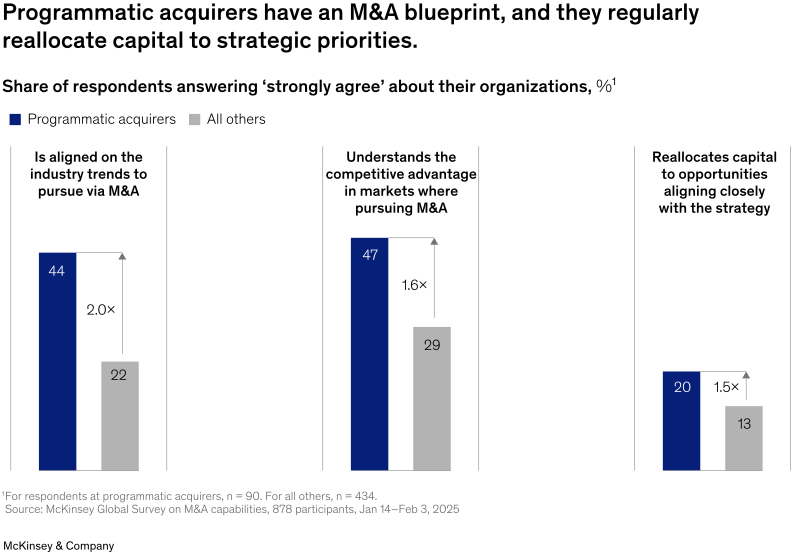
Programmatic acquirers start the M&A process with an advantage over others: Their organizations are twice as likely as others to be aligned on the industry trends they want to pursue via M&A and are 1.6 times more likely to have a clear understanding of their competitive advantage in the markets where they want to pursue acquisitions (Exhibit 4). They achieve this clarity by building an M&A blueprint and then ensuring that their top teams are aligned on it.
An M&A blueprint is meant to answer the question, “Where in our strategy can M&A advance our goals?” It allows organizations to focus on M&A themes linked to their strategic priorities. Without a blueprint, leaders are more likely to be reactive rather than proactive in their pursuit of M&A and to conduct deals not aligned with the company’s goals.
An effective M&A blueprint is built around four key components. First, there must be a clear view of where to grow (and not) that is linked to the corporate strategy. Second, understand the constraints: How much capital can you spend on deals in the next 12 months? Does the target need to be profitable or below a particular size? Can you accommodate a longer time horizon for returns? Third, align the executive team and the board on the strategic direction and evaluation criteria to avoid disagreements midway through diligence. And last, clarify the organization’s capabilities and capacity. For example, can the organization execute multiple diligence processes in a short time frame?
An M&A blueprint can also help identify areas to be deprioritized. Programmatic acquirers are not only 1.5 times more likely than others to regularly reallocate capital to opportunities that align with their strategy, but they are also 3.1 times more likely to have sold assets in the previous five years.
2. Start sourcing targets long before you’re ready to acquire
Having agreed on their M&A themes, leaders at programmatic acquirers proactively identify, prioritize, and cultivate potential target companies long before embarking on a deal—and often before targets are on the market. Respondents at programmatic acquirers are about twice as likely as others to say their companies proactively source deal opportunities and establish relationships with the most attractive target companies, regardless of whether they are on the market (Exhibit 5).
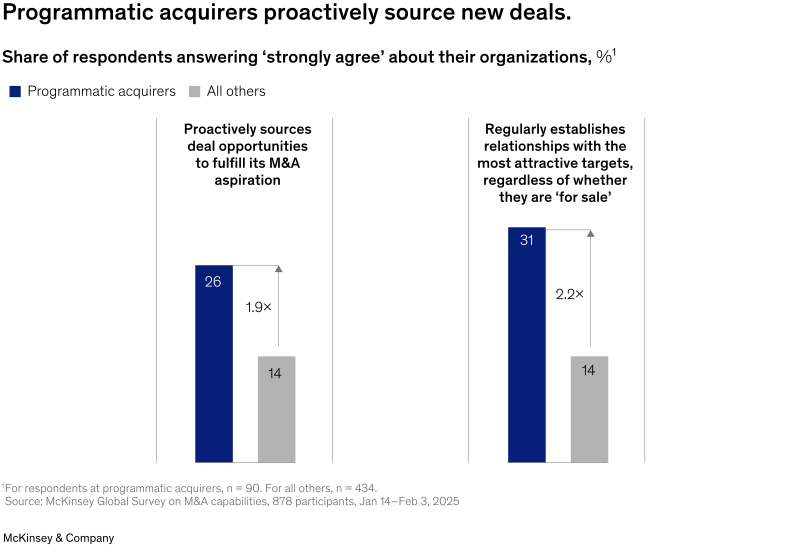
The goal is to identify desirable targets and establish relationships with them well before they may be “for sale.” Communicating to the target’s leaders how their company fits into your value creation story can help position you as the optimal buyer when the company does consider a sale. The survey results show that programmatic acquirers are 1.8 times as likely as others are to say their executives can articulate the vision for partnership with the target.
Three actions can help companies proactively source targets. First, use multiple sourcing channels (including banks, conferences, and partnerships) and AI tools to identify promising targets. Next, build a strategy for attracting targets, crafting the rationale for why you would be a logical and exciting owner, and laying out a compelling vision for value creation. Finally, empower a broad set of people within the organization to serve as deal hunters. M&A shouldn’t be the domain only of corporate development, strategy, and C-suite leaders, but should also include business unit leaders and midlevel individuals familiar with the local landscape.
3. Go beyond the obvious
Our survey shows that programmatic acquirers have bigger, often transformative, aspirations and realize better outcomes from deals than do other companies. Specifically, they are more likely to develop comprehensive business cases, deliver cost synergies in excess of initial plans, and keep integration costs lower than budgeted (Exhibit 6).
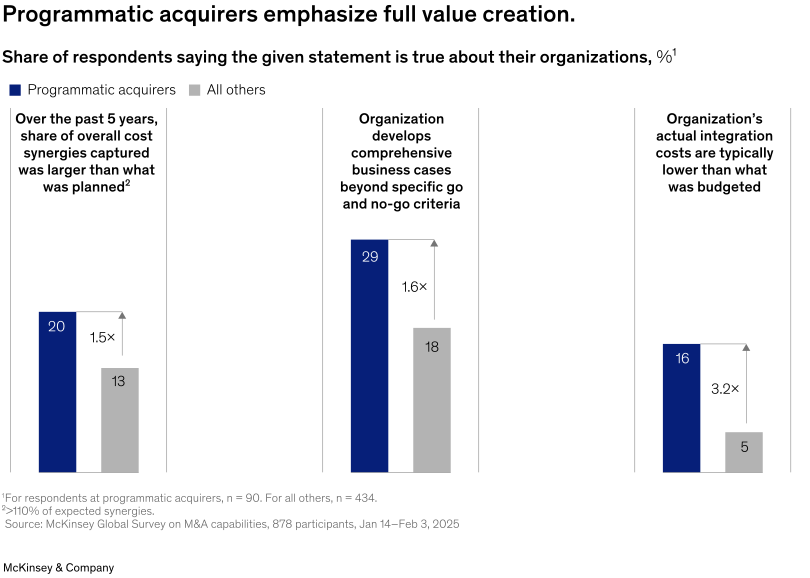
Acquirers looking to achieve better outcomes should consider three elements. First, avoid constraining yourself to typical cost or revenue synergies alone, such as vendor consolidation, real estate rationalization, or cross-selling opportunities. Deals can help realize transformational ambitions that companies have been unable to previously achieve. For example, could you rethink the operating model and set up shared service centers, redesign the go-to-market model, or develop integrated product offerings? Programmatic acquirers often use M&A to catalyze growth. They are 1.4 times more likely to use M&A to expand product or service offerings, and are 1.8 times more likely to acquire new assets or capabilities.
Second, with the opportunities identified, create accountability and confidence in the deal’s value by designating owners for specific initiatives, developing business cases, and closely tracking execution. Integration costs, in particular, should be carefully mapped during the diligence stage and then affirmed in detail during the integration. A clear approval process can help manage spending. For example, the integration office should closely oversee the potential impact of one-time IT integration costs.
Finally, companies should consider how the broader business case for the acquisition might affect integration. For example, we often see companies enter new markets with small acquisitions that require minimal integration effort because of little overlap between the two companies. As the acquirer makes additional deals in that market, however, the amount of integration effort increases. Thoughtful acquirers anticipate this potential for future deals.
They might, for example, avoid integrating the commercial functions of the first target if they expect to integrate those functions into another target acquired within a few years.

2026 M&A trends: Navigating a rapidly rebounding market
4. Manage culture and talent with rigor
Addressing culture through the M&A process, especially during integrations, is critical to ensuring consistent acquisition success. As was true in previous editions of this research, lack of management attention on cultural fit is the most common reason for deal underperformance. Cultural misalignment is cited by respondents nearly twice as often as disruptions to the core business and nearly four times more often than poor rationale for the deal. Even seasoned acquirers struggle with this issue. Only 13 percent of respondents from programmatic acquirers strongly agree that their organizations manage culture with the same rigor as other parts of the integration.
Best-in-class acquirers understand the specifics of management practices (that is, how work gets done) within both their own company and the target company. Invest in listening to what makes the target a successful company, recognizing similar strengths between the two organizations, and identifying potential points of friction. Diagnosing these differences and discussing them with the target can help prevent misunderstandings and operational friction. To improve the combined company’s management practices, leaders should treat culture like other priority integration work streams, with an accountable senior business sponsor, detailed initiatives, and tracking to measure impact.
Programmatic acquirers put strong focus on talent retention and engagement overall at the target company. For example, respondents at these companies are 1.7 times more likely than others to say their companies communicate with the target’s employees about organizational changes. Responses also show that programmatic acquirers are much more likely to identify key talent at target companies during diligence and offer financial retention incentives, as well as to develop bespoke talent retention plans. It’s important not to overlook nonfinancial incentives such as calls from the CEO or site visits by your top team, although these tactics are less common: Fewer than three in ten respondents from both programmatic acquirers and other organizations say their companies have employed them during most of their recent integrations. However, we know from experience that executives’ time spent with top talent is a powerful way to foster loyalty.
5. Invest up front, and as you go, in the operating model and supporting tools
A strong M&A operating model, supported by the right tools, underpins a company’s ability to achieve everything we discuss in the earlier steps. Respondents from programmatic acquirers are 2.5 times more likely than other respondents to say their companies have the right capabilities to execute their M&A strategy, and they hone those capabilities over time. For example, they are 2.5 times more likely to say they conduct postmortems after deals have closed, and they are much more likely to have playbooks capturing key lessons from past deals for each part of the M&A process (Exhibit 7).3
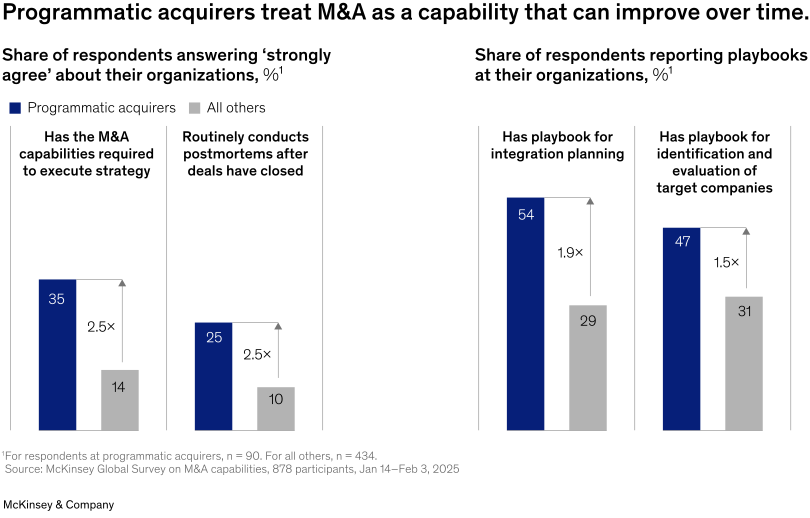
While a well-planned operating model improves the odds of M&A success, no single model is perfect for all companies. First, decide which part of the organization will handle the most critical work. For example, does M&A strategy development live within the central corporate strategy function or in the business units? Business leaders may find it necessary to create new roles within corporate development or integration leadership. Second, build integration expertise across functions. While programmatic acquirers are twice as likely as others to have a dedicated integration team, they also deliberately cultivate networks of talent across various functions that can be called upon to assist with deals. Also, demonstrating that high-potential colleagues can leave their day jobs for a year, play influential roles in an important deal, and then rejoin the organization in bigger or more visible roles signals that M&A is a top priority, encouraging top employees to join the work for future deals.
Finally, invest in technology that allows you to maintain your focus on delivering the value of the deal. M&A tools are evolving quickly. Cloud-based integration management software, combined with AI capabilities, can rapidly onboard new colleagues to integration work and create significant efficiencies in tracking and resolving interdependencies between functional integration plans.
Companies keen to use M&A to advance their strategies can start training today in preparation for the course ahead. To do so, they should set aspirations that go beyond the obvious deal rationales, proactively source deal opportunities and establish relationships with attractive targets, and prioritize culture and talent management during integration, all supported by the right tools and an operating model that can be strengthened through continuous improvement. They also should ensure that individual leaders and employees have the skills to follow through on the organization’s M&A strategy. M&A leaders can act as coaches who continually train colleagues across the business, providing them with the expertise to contribute to the team effort of generating value from M&A.
Read the full report on which this article is based, 2026 M&A trends: Navigating a rapidly rebounding market.