The industry overview
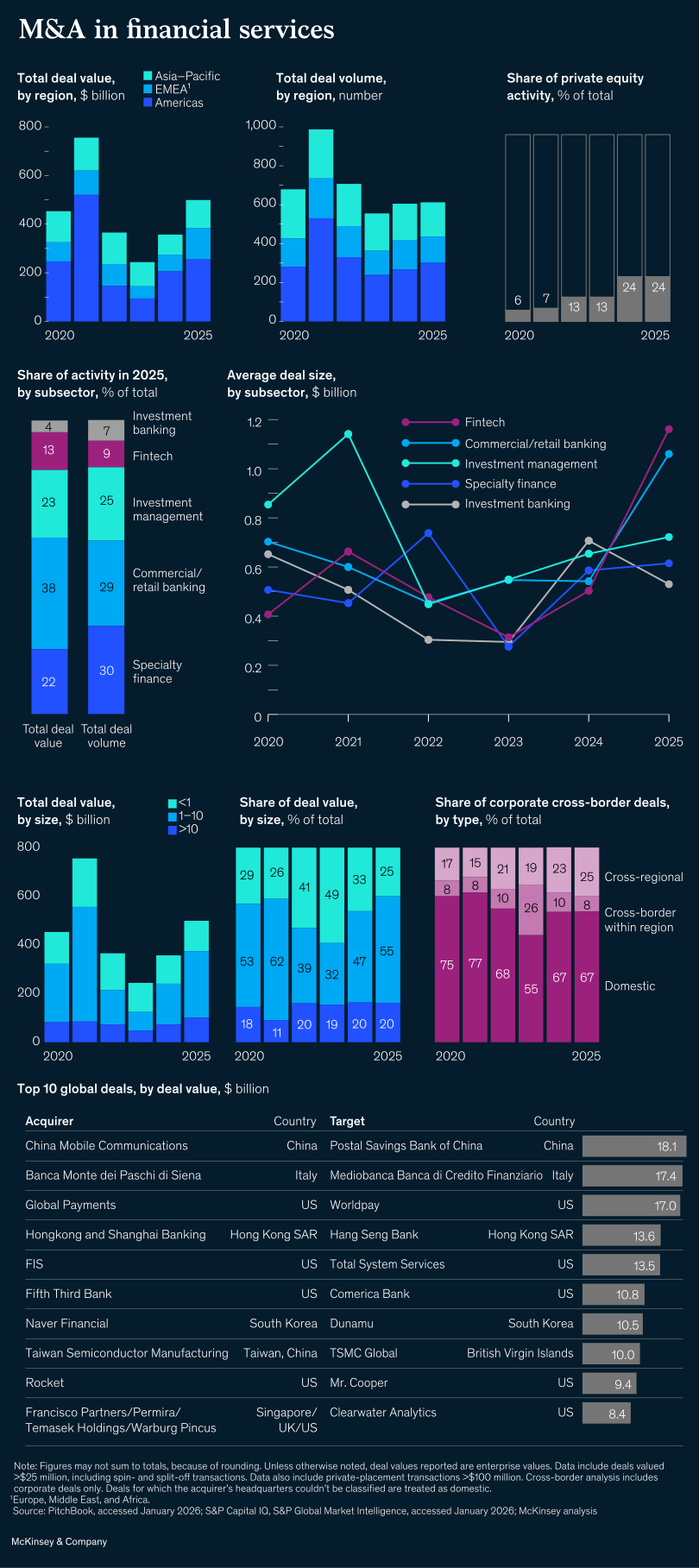
After a measured rebound in 2024, M&A in financial services continued its recovery throughout 2025. Deal value rose roughly 40 percent from 2024, reaching $499 billion despite relatively flat deal volume—612 transactions globally in 2025 compared with 605 in 2024. According to our research, the average transaction size in 2025 increased from $590 million to $815 million, and midsize to large transactions between $1 billion and $10 billion accounted for more than half of the total deal value. The analysis suggests that the industry is pivoting toward larger, more strategic transactions as banks and financial institutions look for opportunities to scale and modernize technology.
These trends are in line with the industry’s continued recovery from the global slowdown of 2023: Improved bank profitability and higher-for-longer interest rates strengthened banks’ balance sheets and created a more favorable backdrop for strategic banking combinations. Despite delivering the highest net income of any sector in 2024 (about $1.2 trillion), banks are still trading at only a 0.9-fold price-to-book ratio. When combined with the high levels of excess capital sitting on many banks’ balance sheets, this valuation gap is expected to be a significant accelerator of banking M&A in 2026.
The Americas expanded their share of deal value in this sector to about 51 percent of the global total (about $255 billion) in part due to favorable regulatory and macroeconomic conditions in the United States. Europe, the Middle East, and Africa (EMEA) recorded 26 percent of global deal value in financial services (about $128 billion). Activity in EMEA was driven primarily by domestic consolidation and noteworthy deals in Italy (which emerged as an epicenter of dealmaking), Greece, Sweden, and the United Kingdom.
As we noted in last year’s outlook, EMEA has entered what’s likely to be a multiyear consolidation phase as banks and financial institutions face a convergence of cost pressures, new regulations, and national champions seeking scale and enhanced capabilities. For its part, Asia–Pacific accounted for 23 percent of total deal value in financial services (about $116 billion), with lower average asset prices and a slow recovery in cross-border flows.
There were notable deals in China, including an $18.1 billion capital-raising exercise involving China Mobile Communications and the Postal Savings Bank of China, as well as further efforts by companies to consolidate and create stronger domestic powerhouses that could compete globally.
In total, about 33 percent of all banking deals in 2025 were cross-border transactions—by contrast, the average in other nonfinancial-services sectors was 19 percent. Within banking, commercial and retail saw M&A activity increase 129 percent compared with 2024, mainly because of a 96 percent surge in deal value in 2025. And deal value among fintech companies grew by 108 percent in 2025 compared with 2024.
M&A activity within wealth and asset management increased 15 percent in 2025 compared with 2024, slowing after a few years of consolidation; however, players in this space still left room for selective deals, such as ING’s purchase of a significant stake in Van Lanschot Kempen in July 2025. Similarly, there was a significant slowdown in deals involving capital market infrastructure after several years of consolidation in this subsector.

2026 M&A trends: Navigating a rapidly rebounding market
Subsector activity
A closer look at activity in key subsectors of financial services—commercial and retail banking, fintech and payments, and capital market infrastructure—reveals important differences in M&A motivations and mechanics among companies.
Commercial and retail banking
Traditional banking remained the sector’s primary area of focus for M&A in 2025. There were 179 deals with a total value of $190 billion in 2025; that marked a 129 percent rise compared with 2024. The average deal value in 2025 climbed to about $1.1 billion (an increase of 96 percent compared with 2024). There was increased consolidation among regional and midtier banks, fueled by the need to achieve scale benefits. As leaders in these banks have observed, successful execution of such deals requires speed in technology integration and capability building while also protecting an expanding customer base.
Fintech and payments
Fintech M&A activity accounted for 55 deals in 2025, with an overall deal value of $64 billion (an increase of 108 percent compared with 2024) and an average deal value reaching about $1.2 billion (up 131 percent compared with 2024). Some of that growth can be attributed to large transactions involving payments players. Meanwhile, as we remarked in last year’s report, banks continued to shift their focus toward the acquisition of selected technological capabilities to strengthen their technology stacks and product offerings—for instance, Allica Bank’s October 2025 acquisition of Kriya’s embedded finance platform, and Banca Ifis’s January 2025 acquisition of Illimity, a financial-services firm focused on lending to small to medium-size enterprises.
Wealth and asset management
Wealth and asset management players continue to consolidate—albeit at a slower pace than in the past. There were 345 deals between 2023 and 2024. In 2025, there were 156 deals worth a total of $113 billion (a 15 percent increase compared with 2024). Advances in AI and data-driven investment capabilities in Europe prompted more M&A in that part of the world, underscoring the convergence between traditional asset management and fintech innovation.
Opportunities for 2026—and beyond
The watchwords for M&A in financial services in 2026 will be “smaller” and “more strategic.” As we noted last year, dealmakers are prioritizing targets that offer thematic fit, technology alignment, and value that can be captured quickly. Our analyses suggest consolidation will continue; smaller transactions will also come into their own. AI (generative and agentic) will accelerate M&A activity by expanding the universe of addressable targets and making it easier for acquirers to integrate quickly and capture synergies sooner than expected. We also expect to see significant contributions from private capital, given the increasing pressure to deploy funds; such sponsors may be able to facilitate spin-offs and carve-outs of various assets as banks double down on their core businesses.
Commercial and retail banking
The subsector of commercial and retail banking is likely to remain the most active among all subsectors in financial services. Consolidation among regional banks in fragmented markets is likely to continue: Consider that the top five credit institutions account for less than 40 percent of total assets across Austria and Germany, with about 400 and 1,250 institutions, respectively. And they account for between 65 and 70 percent of total assets in Spain and Portugal, with about 185 and 135 players, respectively. There’s a clear regulatory shift to encourage well-capitalized domestic combinations. Smaller banks are struggling with funding and technology costs, management succession, and cost pressures from larger players, making them prone to acquisition. Larger banks are constantly looking to increase scale and efficiency, gain capabilities, and improve their resilience, which can also increase their access to relatively cheaper funding.
Geographically, M&A in the Middle East and Europe is likely to increase. Bank mergers are poised to take off in the Middle East as governments push to create regional leaders and national champions. And Europe is seeing signs of increased cross-border deals—albeit taking the form of targeted “friendly deals” rather than large-scale mergers that may court political resistance.
Fintech and payments
In 2026, fintech and payments M&A will likely center on capability-driven deals focused on fraud prevention, identity verification, and embedded finance; this would be a continuation of a trend started by the Perfios acquisition of Clari5 and other recent deals. The asset swap between Global Payments and FIS illustrates this trend at a global level: Global Payments acquired Worldpay for about $17.0 billion, and FIS acquired Global Payments’ Issuer processing unit for $13.5 billion, realigning both on core strengths.
Wealth and asset management
M&A in wealth and asset management is shifting toward capability-led deals, especially those that would strengthen the acquirer’s expertise in alternative assets. Managers are targeting firms that provide an edge in private markets, real assets, or advanced technology. Private credit now represents a $2.5 trillion market, and total alternatives are expected to keep surging in the coming years. Even in traditional wealth management, large mergers will likely target new distribution capabilities or digital platforms rather than cost cutting or an increase in assets under management.
The outlook for financial-services M&A in 2026 is strong. The sector is full of possibilities for the banks, fintech companies, and asset managers that can develop a sharp, well-articulated M&A strategy—and are bold enough to use it to create the next wave of transformation in their companies and across the industry.
Read the full report on which this article is based, 2026 M&A trends: Navigating a rapidly rebounding market.