The industry overview
Interest in M&A has increased substantially in the defense sector over the past year, especially in Europe. This has been true across the full value chain—from primes to suppliers, among companies in adjacent industries that offer dual-use equipment, and among financial sponsors looking for attractive investment opportunities.
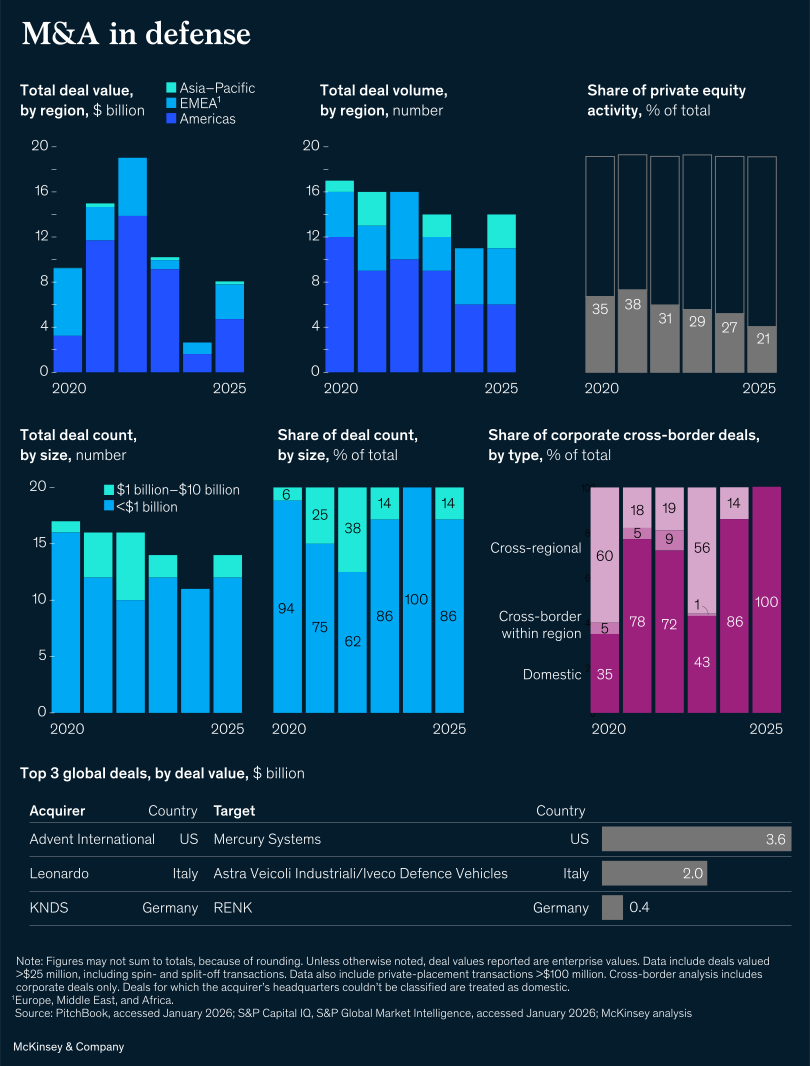
Given this increase in attention, we have seen an uptick in deal activity, but transactions haven’t increased substantially over the past 24 months, as we would have expected. Total deal value increased from $2.6 billion in 2024 to $8.1 billion in 2025, but that number is still far below the $19 billion in deal value in 2022.1
What accounts for the surge in interest? A rapidly evolving geopolitical situation is changing investors’ perceptions of the industry from a no go to a strong area of interest given the critical role defense companies play in national security and the substantial growth in defense budgets across governments after years of underinvestment. Our analysis shows that defense spending by NATO countries in Europe is set to increase by an additional €300 billion by 2030, reaching roughly €800 billion.2
Given these tailwinds, the defense industry presents considerable opportunities for multiple types of acquirers and sellers:
- Defense companies are turning to M&A to increase their production capacity, grow in scale, or acquire new tech capabilities, among other reasons. These companies are also exploring divesting civil businesses as they seek to refocus their allocation of capital and optimize their valuations.
- Private equity (PE) firms are conducting comprehensive evaluations to improve their understanding of the defense industry and identify the right opportunities for value creation, consolidation, and professionalization.
- Corporations with some exposure to the defense industry are taking one of two paths when it comes to M&A: They’re either looking at potential deals to increase their investments in defense and make it a more meaningful part of their business, or they’re considering divestments to capitalize on the high valuations the industry is experiencing currently.
- Corporations outside the defense industry—for instance, automotive, industrial, and telecommunications companies—are looking to move into what for many has been an untapped adjacent market, gain a foothold quickly, and increase utilization of their existing footprint.
Why hasn’t the interest in M&A turned into a flood of concrete announcements? We believe there are several reasons for the lower-than-expected activity. Chief among them is the low number of available targets: The industry hasn’t been in focus historically, so there are only a limited number of established pure players of relevant size. For those few targets that are available, sellers are expecting to see high valuations; this is underlined by the increase of average reported enterprise value/EBITDA transaction multiples from about 13 times in 2021 to above 20 times in 2025. Because many emerging players are still in the early stages of growth, it can be challenging to determine their fair value, especially considering prior funding rounds and high growth expectations factored into sell side valuations.
Complexity is another reason we’ve seen less dealmaking: Transactions in the sector attract greater government attention, and the push for national champions has further restricted cross-regional and even intraregional transactions. In fact, there has been a clear focus on domestic deals, which accounted for all deals in 2025. Given this complexity, it should come as no surprise that asset acquisitions and partnerships among companies within the defense industry were among the most common deal types. Such transactions are relatively flexible and less affected by high valuations and government scrutiny. We also see a recent increase in momentum for public listings, following RENK’s listing in 2024 and TKMS’s listing in 2025.

2026 M&A trends: Navigating a rapidly rebounding market
A breakdown of M&A activity
Our analysis revealed core differences in defense M&A across acquirer types and regions. For instance, there are important differences between PE investors and corporations when it comes to M&A themes and approaches. Defense M&A activity among PE investors has been primarily focused on markets adjacent to defense—for instance, targeting maintenance and repair service companies, given the high margin and recurring nature of those businesses, or tech companies (in particular, those with dual-use technologies).
By contrast, corporations are using M&A to gain access to new capacity, expand into new geographies, and access new talent. Their transactions have often been smaller bolt-on deals rather than transformational transactions: Consider that all of the defense deals done by corporations in 2024 and more than 80 percent of them in 2025 were less than $1 billion in deal value.
Europe has seen a major increase in defense budgets, which has prompted more M&A interest from global investors. It holds a growing share of regional deal value in the defense sector—from less than 10 percent of deal value in 2023 to 39 percent of deal value in 2024 and 38 percent of deal value in 2025. Meanwhile, there was a stable base of transactions in the Americas in 2025, dominated by the US market and targeting primarily domestic deals. Most of these transactions were focused on maintenance, repair, and operations assets.
Opportunities for 2026—and beyond
Looking ahead, defense companies are facing five critical challenges: ramping up production capacity, scaling and ensuring resilience of supply chains, achieving sufficient scale to realize operating efficiencies, capturing growth opportunities in other countries or in adjacent product areas, and building capabilities in new tech areas. We believe the urgency for leaders to address these challenges, as well as the availability of more private and public capital, will turn current interest in M&A into more announcements.
These transactions are likely to be focused on three concrete themes:
- Operations: Deals within this theme will help ramp up production capacity—either through the acquisition of existing production facilities from companies outside the defense industry or through deals with industrial companies to insource and scale up the production of critical components. Such deals can also help bolster corporations’ supply chains—for instance, by acquiring suppliers of critical components or raw materials.
- Growth: Deals within this theme will aid companies in capturing opportunities in other countries or adjacent product categories—for instance, the acquisition of a local company to gain local market access, suppliers moving vertically along the supply chain to get closer to customers, and the formation of program-specific collaboration structures, which has been quite common in defense in the past.
- Capabilities and people: Deals within this theme can help accelerate development through the acquisition of intellectual property or technologies in development.
Corporations will likely continue to pursue small to midsize deals; larger consolidation opportunities will remain limited because of industry dynamics and the political dimension. Activity among PE firms is likely to be focused on high-growth opportunities along the supply chain—for instance, the makers of the subsystems and electronics used in platforms; the castings, lasers, or other components used in rockets; or, looking even further down the supply chain, the suppliers of basic materials used in ammunition or missile production.
Other PE investment opportunities in defense companies, especially in primes, will likely remain somewhat limited because of political scrutiny, high valuations, and investment criteria constraints. There may be some exceptions for family-owned companies and other nontraditional structures that allow sponsors to fund required investments.
And public listings will continue to increase as PE investors and corporations alike look for ways to monetize or crystallize the value of shareholdings.
Defense companies are facing urgent challenges that M&A can help solve. PE firms are at risk of missing out on these early days of market acceleration.
The increased interest in defense M&A is great, but now is the time for acquirers to act.
They will have to adapt to new rules and find ways to conduct deals within boundaries established by governments. They will need to carefully balance their pursuit of deals across geographies, develop an in-depth understanding of national and political interests, and build a clear perspective on the synergies required to close the gap to sellers’ price expectations.
PE firms in particular will need to open themselves up to creative deal structures that may allow them to mitigate political constraints and improve their ability to engage with family-owned companies. Taking these steps—and moving from interest to action—can yield disproportionate benefits in the current market environment.
Read the full report on which this article is based, 2026 M&A trends: Navigating a rapidly rebounding market.