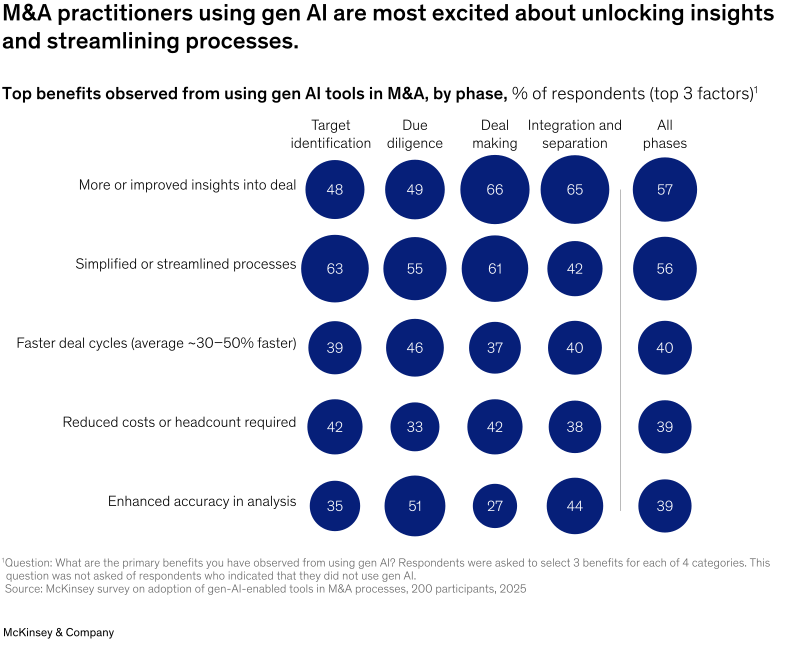
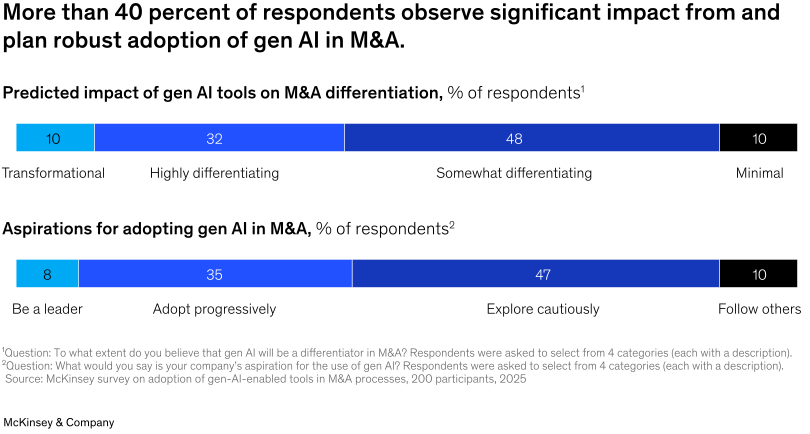
That didn’t take long. In 2024, the opportunities to apply gen AI to M&A deals were just emerging, and dealmakers were focused on learning about potential use cases. But since then, the number of gen-AI-enabled tools and capabilities on the market has exploded.1 In a survey we conducted last year, the respondents who say they are using gen AI in their M&A activities report an average cost reduction of roughly 20 percent. Forty percent of respondents report that gen AI enabled 30 to 50 percent faster deal cycles (Exhibit 1). Of all respondents, 42 percent say they believe gen AI has the potential to transform or to bring highly differentiating capabilities to the deal process (Exhibit 2).
Although excitement about gen AI is high and users report compelling results, our survey also finds that only 30 percent of respondents engage with gen AI at moderate to high levels. Even among avid users, the large majority of respondents currently rely on commercially available gen AI chatbots, not customized, proprietary tools. Respondents across industries and company sizes identify a lack of expertise as their main challenge to AI adoption.
Given the rapid pace at which gen AI is advancing, it may be tempting for some M&A teams to take a “wait and see” attitude toward tools and capabilities. However, we suggest the opposite approach. As this article describes, teams can benefit by recognizing what tools are already on the market and how companies are currently using them to identify M&A targets, accelerate diligence, and augment integration planning and execution. By engaging with the current tools and understanding how they are evolving, M&A teams can develop the necessary documentation, inputs, and systems they will need when the next wave of innovation arrives.
Gen AI is moving fast, and forward-thinking M&A practitioners are already embracing it. The next era of M&A will be defined by teams that don’t wait on the sidelines but learn to surf the gen AI wave as it gains speed.
Target identification tools, present and future
Of respondents reporting moderate to high gen AI adoption, the majority use it for target identification and due diligence (Exhibit 3). Gen-AI-enabled tools customized for M&A combine large language models (LLMs) trained on a company’s deal history and strategy materials with machine-learning algorithms that cluster thousands of potential targets by attributes such as business model, growth profile, and market adjacency. Specialized AI agents can read and summarize diligence files, extract insights from internal data, and draft search criteria automatically. Over the past roughly 12 months, many of these tools have improved as the underlying LLMs have developed stronger reasoning and analytical capabilities.

For example, a fast-growing business software company used a third party’s advanced AI-powered scouting platform to rapidly accelerate the target identification process. The tool combines gen AI with a proprietary database of more than 40 million public and private companies and uses semantic search (which understands meaning, not just keywords) to find businesses that align with a buyer’s strategy. Among the tool’s outputs is a table that awards scores across the categories that matter most to an acquirer, as well as comparative overall target company scores (Exhibit 4). In less than a day, the tool helped the team identify and score more than 500 potential targets that fit a long set of requirements (including CAGR, customer segment targets, employee culture, market size, and region). After a few rapid iterations, the corporate development team prioritized 15 deal leads, a process that culminated in three completed acquisitions only a few months later.
Gen AI tools are evolving toward performing as strategic partners. Envision a tool that can analyze a company’s strategy; identify its top M&A opportunities by assessing factors such as earnings calls, stock price changes, and patent activity; and then identify potential targets. We estimate that within the next two to five years, accurate and dependable end-to-end gen-AI-powered M&A tools will be available.
To prepare, companies can document their corporate and M&A strategies and the specific criteria that make deals attractive. They can identify which public and private sources are most relevant for scanning potential targets so that they can eventually train AI tools to gather data from them. These moves will help position M&A teams to capture full value as soon as more advanced tools arrive.
Diligence assistance, today and tomorrow
Once an organization has a list of potential targets, an M&A team typically scrutinizes them to ensure they fit the strategic rationale for the potential deal. For example, the target may open new growth channels or geographies, create synergies, or bring new capabilities. This time- and resource-intensive process requires that practitioners acquire a detailed understanding of the targets. During this phase, acquirers and targets can spend hundreds or even thousands of hours conducting meetings, exchanging emails, and creating and reviewing process documents and data.
Become a member of McKinsey on Finance
Receive McKinsey’s quarterly publication for CFOs and finance professionals, including a special 25th anniversary issue coming out this summer. Members will also receive occasional bonus content that showcases the best of our experts’ corporate finance perspectives.
A suite of gen AI tools available today can accelerate this process while ensuring nothing is missed. For example, one tool enables M&A teams to search a large library of expert interview transcripts (recorded conversations with thousands of industry and functional specialists) using natural-language questions to uncover insights into companies, industries, and products. Another tool can access virtual data rooms, using gen AI to search, summarize, and organize thousands of diligence files. It can analyze financials, respond to common diligence questions, and enrich findings with public and proprietary data on factors such as customer and employee sentiment.
Our survey revealed a strong appetite for tools that aid in the diligence process. We estimate that within the next two years, gen AI tools will improve enough to make diligence a continuous and connected part of the deal cycle. They may be able to automatically feed insights from diligence into target screening and postclose integration planning, as well as learn from each deal to inform the next. To prepare, companies can start structuring their deal data and linking gen AI capabilities to their existing M&A systems.
The future of integration planning and execution
Integration planning and execution are critical to realizing an acquisition’s objectives. Poorly managed, these phases can quickly drain value due to irritated customers, frustrated employees, or regulatory penalties. In deals involving large companies, integrations typically require dozens of teams and hundreds of employees and take two to five years to complete. The large investment in time and resources can often distract from a company’s organic growth prospects.
Today, tools exist that can help automate some integration tasks. A well-trained gen AI agent (including off-the-shelf products and products companies develop in-house) can analyze a deal’s context and produce a day one readiness and postclose integration plan (admittedly, of varying levels of accuracy and excellence) in a matter of minutes. Gen AI agents can be trained to produce communication materials, such as day one letters for customers or suppliers, deal close press releases, employee-change-management manuals, and integration update newsletters. At present, these tools eliminate some of the intellectual and manual labor of organizing and executing an integration plan. However, they require abundant human judgment and oversight.

2026 M&A trends: Navigating a rapidly rebounding market
Based on the current trajectory, we estimate that in two to three years, there will be gen-AI-enabled tools that automate more than half of all integration-related tasks. To prepare, companies can focus on refining their integration playbooks and documenting their approaches to a variety of integration decisions and tasks. When the next generation of tools arrives, prepared companies will be well positioned to upload their approaches into them and immediately benefit from their automation capabilities.
How M&A teams can adapt to gen AI and prepare for the future
Our survey revealed that a large majority of respondents identified a lack of expertise as their company’s top challenge in adopting gen AI (Exhibit 5).

Companies can choose from the following steps to integrate gen AI into their current M&A processes and develop more expertise. The more actions they take, the better positioned they will be to benefit from future technologies:
- Assess current M&A processes, capabilities, and tools to identify the workflows (such as deal speed, insights, and integration) where automation could be most helpful. For example, if the company is in a market with players of many sizes scattered across geographies, gen AI might have the greatest impact on deal scanning; however, for companies that belong to a narrow sector where talent or intellectual property is crucial, executing a successful people or operational integration may be more important.
- Build AI fluency across M&A teams. Encourage teams to explore existing tools and request live demonstrations where possible. Organizations can also evaluate which capabilities can be developed internally by leveraging existing LLMs.
- Secure executive sponsorship. Establish clear ownership and a senior champion to guide the gen AI agenda.
- Formalize M&A playbooks. Analyze and document the company’s M&A philosophy. For example, what percentage of value capture does the company typically seek within the first six months of an acquisition? Do the same for the company’s methodology. For example, does the talent selection process in an integration differ from the usual process for identifying talent?
- Develop a one- to two-year road map for making gen AI part of the company’s M&A operations. A wait-and-see approach risks falling behind in the process; realizing the benefits of gen AI requires deliberate planning, change management, and sustained commitment.
Gen AI is no longer just theoretical in M&A. Leading teams are already using it to identify targets, accelerate diligence, and enhance integration planning and execution. The next generation of tools will be even more capable, linking internal and external data, automating larger parts of a variety of processes, and learning from each deal. Companies that begin building AI fluency, formalizing their M&A playbooks, and creating a one- to two-year road map for gen AI adoption will be best positioned to capture the value of the innovation wave still to come.
Read the full report on which this article is based, 2026 M&A trends: Navigating a rapidly rebounding market.