A merger provides an exceptional moment for executives to reflect on the performance of a company’s operating model—the structures, processes, talent, and behaviors that make up an organization. Does the existing model serve the objectives of the combined companies? In most large-scale mergers or acquisitions, meaningful and swift operating model redesign will be necessary for one or both of the merging companies to achieve these objectives.
In our experience, leadership should focus on five priorities when designing an operating model during a merger:
- quickly defining end-state and interim operating models for the combined company
- using the integration to selectively transform the organization
- announcing leaders quickly
- building an operating model that enables the aspired culture
- managing change to ensure that employees are equipped to do their jobs at all stages of the transition
This article suggests how company leaders can approach these priorities to ensure successful operating model design during a merger.
Quickly defining end-state and interim operating models for the combined company
Designing the right operating model for the future company will strongly affect the ability of company leaders to realize their deal goals. Thus, it is important to be comprehensive in designing all elements of how the organization will run to achieve the most important goals of the combined company. Quickly deciding on an operating model aligned to the rationale of the merger will help leaders ensure that the integration is tailored to deliver on the strategic and value creation objectives of the merger as soon as possible. This will, in turn, guide priority integration decisions, which will need to be made early on and then pressure tested as day one approaches.

Strategy and value in turbulent times: The four foundations that drive long-term performance
November 12, 2026, 8:30 a.m. ET / 2:30 p.m. CET Join McKinsey experts Andy West and Whitney Zimmerman for a discussion on what it takes to create and sustain value in an increasingly turbulent environment. They’ll explore four timeless foundations of strategy and how leaders can apply them to today’s hardest decisions.
Elements of the operating model
Operating model design covers structure, process, talent, and behaviors.1 Together, these elements enable an organization to deliver on its strategy. We define these categories as follows:
- Structure encompasses how accountable units and mission teams are organized to enhance prioritization and accountability in the postmerger organization. This includes reporting lines, value creation streams, governance structures, role scoping, functional support for business lines, and geographic focus.2
- Process focuses on workflow design, which often requires a deep redesign to align with the new company’s strategy, especially with the growing role of data and AI.
- Talent encompasses how the company attracts and develops its people to ensure that the right capabilities are available to meet value creation goals.
- Behaviors reflect how culture is lived—the unique “secret sauce” that creates value for employees and customers.
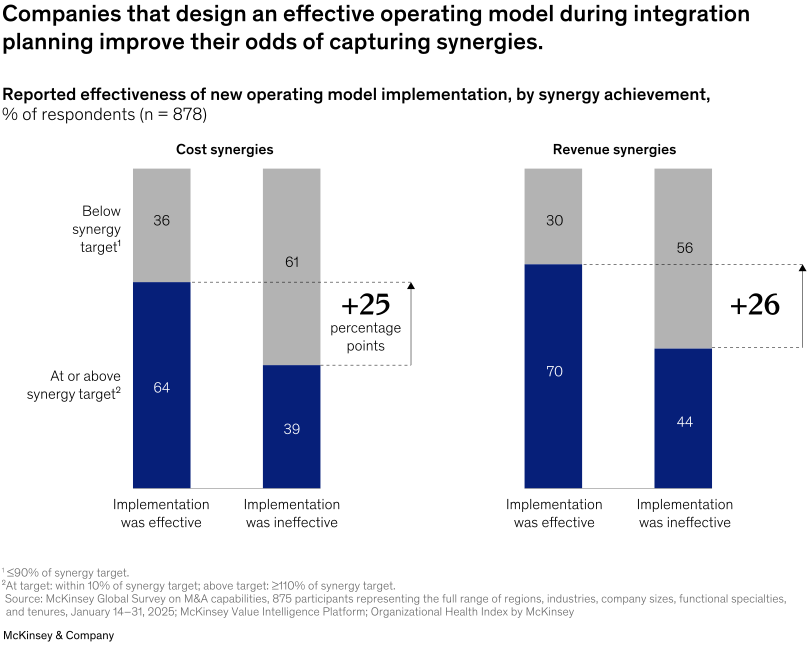
Addressing these operating model elements holistically during a merger is essential to getting operating model design right and capturing the value promised to investors and employees. Our research shows that organizations reporting effective implementation of the combined operating model postmerger are more likely to meet or exceed cost and revenue synergy targets (exhibit).3

M&A Annual Report: Navigating a rapidly rebounding market
Steps between model design and end state
Unlike classical operating model design in which a company moves directly from the current state to the end state, operating model design during a merger often requires interim steps that can be different in various parts of the organization. For example, a day one operating model (that is, immediately after deal close) might be in place for one to two years across the combined organization, or parts of it, before the end-state model is implemented. This interim step can arise because of the need to balance value capture goals with business continuity over the course of the integration. We have seen this in several mergers. One example involved two consumer beverage players, for which the complexities of the merging organizations’ sales and marketing business units precluded their ability to transition to an end-state operating model on day one. Such interim-state operating models are particularly common in commercial business units due to preclose regulatory constraints on data sharing.
Depending on the issues encountered during the integration, leadership usually must work quickly to align not only on an end-state model for the new company but also on at least one interim model. Speed is of the essence in making these decisions, given the impact that they have on all integration planning activities. When designing both the end-state and interim operating models, leadership should prioritize opportunities to selectively transform the organization to enable the deal rationale. While doing this, it is also critical to ensure that the value of the merger is not diluted in the transition process, particularly in the context of protecting the distinctiveness of an acquired company.
Quick alignment on a day one interim operating model is essential to enable planning in support of business continuity. However, this interim operating model should be driven by the end-state goals. It needs to enable a seamless transition as layers of the organization are designed and rolled out, often over phases. The first phase toward a seamless transition is the announcement of the first layers of the organization.
Using the integration to selectively transform the organization
To determine the future operating model, leaders can align on a clear set of design principles that will shape the objectives, outcomes, and guardrails for the end-state design. This will help integration teams design the details of the new operating model to achieve specific outcomes.
Considering the strategic goals
The future CEO leads the development of the operating model’s design principles in line with the combined company’s strategic objectives. The principles can vary depending on capacity and context. For example, when integrating a much smaller entity into a larger one, a CEO may choose to make only targeted changes to the acquiring company’s existing operating model. This will allow the integration team—the group of employees selected to fully dedicate their time to planning the integration of their respective business units—to preserve value and move as efficiently as possible, with minimal disruption to the broader organization. When a company is acquired for its unique capabilities or talent (such as in R&D acquisitions), the acquiring organization’s leaders may choose to ring-fence and nurture that organizational unit. And in an integration of two large companies with a focus on full-scale transformation, leaders may choose to double down on centralization and scaling of efficiencies. Even in such full-scale transformations, priorities should be set so as not to overload the organization, ensuring that change is navigated effectively. As an example, this may mean focusing on SG&A costs at the start, before focusing on operations, to reduce disruption.
Developing the preliminary end state
After designing the top-level elements of the future operating model, more leaders can be brought on board to fully design the details of the end-state operating model. These leaders will need to be open to meaningful change in designing the end state, as the new company will likely follow an organizational model that neither of the companies’ leaders has experienced. For example, the end-state operating model may include transformational operating model elements, such as the use of AI or other technologies across the business.
Full implementation of a new operating model rarely occurs by day one, as organizational units will typically move toward their end states at different paces. For example, functions like HR and finance often move to their end states more gradually because they need to retain excess capacity in the months after close to support the rest of the organization’s transition. On the other hand, a sales force may transition to its end state on or immediately after day one to streamline customer points of contact and to minimize the risk of damaging the customer experience.
Given varying transition speeds, integration leaders will have to develop a detailed, consolidated plan to reach the end-state operating model. This should include a day one and interim structure, governance model, and transition plan that details the strategic decision-making taking place across the merging organizations. The transition phase can also provide an opportunity to test lower-level structures as well as a detailed process and governance design.
Announcing leaders quickly
Announcing the first layers of the organization quickly unlocks both day one and future state planning. This is for three main reasons.
First, providing clarity about the top-level future design enables integration planning teams to address processes on day one and plan for the future state, both of which are often heavily influenced by the structure of the organization and how work gets done. Providing this clarity early on improves the speed and quality of integration planning.
Second, announcing leaders quickly creates accountability. New leaders making decisions about the future state (for example, on the organization’s structure and processes) can take ownership and provide clear direction to their teams, which, in turn, helps prevent plans from having to be revised and reimplemented (as can happen if leaders are not announced and put in place until later).
Third, announcing leaders early on is a way to signal the new organization’s culture and how the integration will be run. For instance, having representation of both organizations in the announced leadership team and managing the announcement well can positively affect talent retention.
Building an operating model that enables the aspired culture
In most mergers, decision-making governance is a critical first step for embedding the future aspired culture. In our experience, top-team decision-making requires an early, structured approach.
How leaders define the governance structure is one of the most critical contributions to accelerating the speed and improving the quality of important decisions in an organization. Boxes and lines may establish the management of—and hierarchical relationships among—employees, but they do little to help an organization understand how decisions will be made. For example, the executive team should not make all decisions; some decision-making should occur through a defined process or by individual roles.
We recommend delegating decision-making responsibility as far into the organization as possible to maximize proximity to the work being done and thereby improve the speed and likelihood of making a high-quality decision. A top team should concern itself with defining the way that the organization will make its most important decisions (or “big-bet decisions”). The team should spend serious time laying out the architecture of committees, decision rights, and even meeting agendas that will force the organization to apply a data-backed, high-velocity approach to decision-making.
In thinking about the governance architecture of a company, it can be helpful to start by defining the appropriate level of centralization, given the desired organizational structure. Will the executive team handle most of the big decisions centrally, or will individual operating units have more autonomy? Regardless of where a new company lands on that spectrum, it is helpful to lay out all major decisions and clearly define the decision rights: who decides, who participates, and who receives information. We also endorse laying out the decision-making roles of key committees, as it is important to define charters for these committees early on, so that they can make decisions at the pace required to stabilize a new organization and avoid a productivity dip. Furthermore, as designers are creating the governance structure, they should ensure that governance reinforces cultural priorities and doesn’t conflict with them.4
Managing change to ensure that employees are equipped to do their jobs at all stages of the transition
Once there is clarity about the interim and end-state operating model, focus can turn to determining the operating model elements that will need to be changed on day one versus later. This distinction is important to avoid destroying value prior to deal close. Early definition and communication of what will change on day one of the combined company versus what will stay the same—either in the short term or permanently—will minimize distractions to employees, customers, suppliers, and other stakeholders in the planning period leading up to day one.
Once day one changes have been defined, leaders and integration teams will need to ensure that employees understand the future operating model and have confidence in it, so that they can be ready to transition to their future roles, responsibilities, and new ways of working. Doing this will foster emotional investment in the future company among employees, in addition to ensuring they will be equipped to do their jobs on day one and through the whole transition.
Communicating with stakeholders
Mergers affect stakeholder groups in differing ways; employees, managers, and customers, for example, will be eager to learn about the decisions that the merging companies are making—and how those decisions will affect them. Leaders will therefore need to pay close attention throughout the integration to what is being communicated when, how, and to whom, to avoid business disruption.5
A thorough communications plan for all stakeholder groups can give special attention to integration milestones such as leadership announcements, major preclose events such as earnings report releases, and the lead-up to day one. The communications plan should incorporate salient employee feedback. This is often done via short, regular pulse surveys to all employees to gauge their understanding of and sentiment toward postclose issues, ideally timed around integration milestones. Documenting the evolution of employee responses over time will help integration leadership appropriately tailor ongoing communications, as well as run targeted interventions, if needed, for groups of employees who may be experiencing disproportionate dissatisfaction relative to other employees.
Managing change
On day one, employees may face not only a new employer but also new hierarchies, role descriptions, and work processes. Change management is therefore critical to a successful operating model shift, both during the transition and in the end state.
During a merger, employees experience two kinds of change: cultural change and operational change.
We recommend a fact-based approach to managing cultural change, one that leverages both quantitative data (for example, from employee surveys) and qualitative insights (for example, from interviews and focus groups). A robust fact base allows integration leaders to select culture priorities that will enable the goals of the combined company, and then hardwire these culture aspirations into the combined company’s business processes. The timeline for cultural change is typically gradual; integration leaders should put energy into ensuring that cultural shifts happen leading up to day one and beyond.6
To manage operational change, we recommend that integration leaders assess the degrees of difference between the interim and end-state operating models and the merging companies’ current states as documented in the baseline. To prioritize day one changes, integration leaders can build heat maps of operational changes detailing the number of people affected and the impact on value capture if the change is not addressed. This will ultimately help integration leaders identify the most critical changes for day one, as well as the training needs required to enable them.
Pressure testing cross-functional processes
In practice, realizing a new company’s operating model occurs through the execution of its processes. Leaders could select a handful of the most important cross-functional processes to design early on, in order to clarify the end-state operating model as quickly as possible.
Integration teams can benefit from scenario testing cross-functional processes—that is, simulating events likely to occur on or around day one that test the understanding of the future operating model. For example, members of the HR team could role-play how they would move a job candidate through the hiring funnel if day one happened in the middle of the interview process; the customer service team could pressure test their responses to legacy company customers confused about the impact of the merger on their products or services; and operational teams could simulate how they would support key business processes on day one, such as running delivery routes, fulfilling customer orders, or handling relationships with vendors.
Scenario testing key processes facilitates alignment on roles, responsibilities, and interactions in the future operating model. We have repeatedly seen that integration teams that role-play scenarios gain confidence not just in the details of the future operating model, but in their collective ability to execute it.
Implementing a new operating model in the context of a merger is a complex undertaking, and day one is just the first step. In our experience, it is critical to design a future operating model that best enables the goals of the combined company as early in the planning process as possible in order to guide and shape all elements of the integration. After this, focus can move to identifying what will need to change on day one versus what can be left until later, and ensuring employees are equipped to do their jobs on day one. This approach will best enable leaders to achieve a positive outcome not only for the integration but also for the future combined company.
Read the full report on which this article is based, 2026 M&A trends: Navigating a rapidly rebounding market.












M&A insights





Related Articles


Time to revisit your M&A strategy