The industry overview
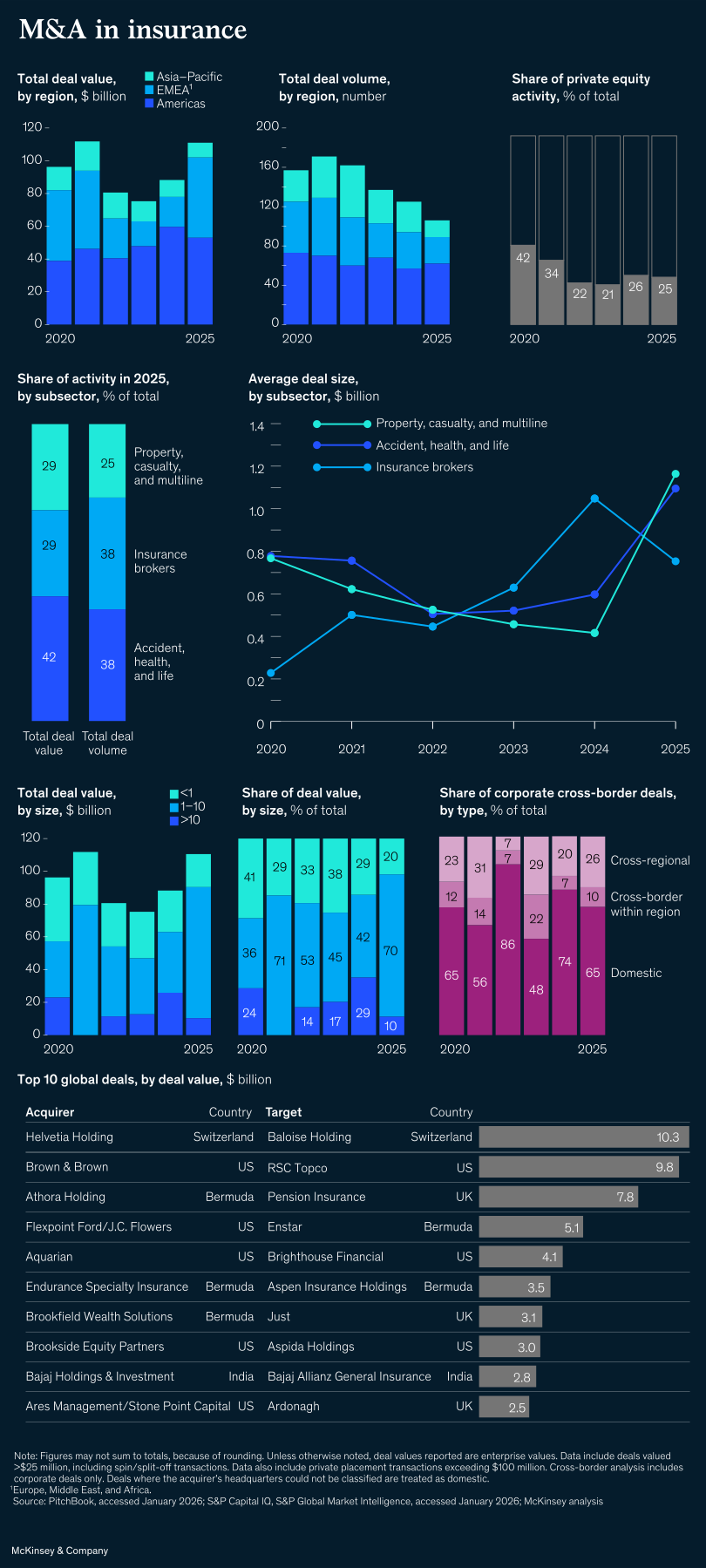
After several years of decline, M&A activity among insurance players has started to climb again, with deal value in 2025 reaching approximately $104 billion, up from $88 billion in 2024. Dealmaking in this sector reflects some major shifts in strategies, archetypes, and markets, and three stand out:
- US-led deal volume has declined over the past few years, as large US brokers are still digesting large deals from 2023 and 2024.
- Life insurance and property and casualty (P&C) insurance carriers in Europe have increased their domestic and cross-border acquisitions as they seek to address mounting costs, new regulatory requirements, and the need for scale.
- Asian and other global P&C carriers are pursuing cross-border M&A as they continue to look for returns in fast-growing markets.
Our research shows that insurance carriers continue to find it challenging to create value through M&A. Fewer than 40 percent of insurance carriers with deals of over $50 million performed better than the index over the past ten years. In many of these cases, the complexity of integrations as well as capital and regulatory constraints overwhelmed carriers’ integration capabilities and diluted the benefits of scale.
By contrast, a few large insurance brokers have outperformed, in part because of their investments in M&A capabilities. These companies follow a programmatic approach to M&A (pursuing more than three small or midsize deals a year) and, according to our ongoing research on what really works in M&A, have delivered total shareholder returns that are, on average, 3.5 percent above the industry benchmark1 (see “Five steps to strengthen M&A capabilities, no matter the starting point”).
We expect M&A to continue to accelerate in 2026 as companies reset their M&A strategies and prepare to deploy capital in what’s still a very fragmented market. The key question is, to what extent will this next wave of deals perform better than past transactions?

2026 M&A trends: Navigating a rapidly rebounding market
A closer look at deal trends
Value creation is just one of the essential M&A themes insurance players are wrestling with. Our research points to noteworthy shifts in the types of companies that are most often pursuing deals, the locations in which they’re focusing their efforts, and the technologies and dealmaking approaches they’re using to capture deal synergies as quickly as possible.
A shifting use of M&A: From brokers to carriers
Deal value in insurance reached a low point in 2023 but, in contrast to other industries, has been recovering consistently in the years since. The market continued to expand in 2025, and the average deal size grew to $1.1 billion, from about $700 million.
In 2025, the number of deals led by carriers increased, while the number of megadeals and large deals led by insurance brokers in the United States declined compared with 2024, as several major acquirers are still digesting their transactions from the past two years. Consider Aon’s acquisition of NFP in April 2024, Marsh & McLennan’s acquisition of McGriff Insurance in November 2024, and Arthur J. Gallagher’s acquisition of AssuredPartners in August 2025—all still in various stages of integration.
In Europe, however, broker-led transactions increased in both number and value in 2025 compared with 2024. As attractive programmatic targets become increasingly scarce, it remains an open question for how long this momentum can be sustained.
Europe leading the surge in volume
Insurance M&A in Europe increased substantially in 2025 compared with 2024, driven by insurers’ use of inorganic strategies to respond to cost pressures, rising capital requirements, and a wave of portfolio-restructuring transactions. Most insurance players pursued one of two types of deals: acquisitions within the core business and acquisitions in adjacent areas or new business models.
Good examples of acquisitions within the core business include the announced April 2025 merger between Helvetia Holding and Baloise Holding to create the second-largest Swiss insurance group; the March 2025 acquisition of German insurer Viridium by a consortium led by Allianz; and the July 2025 acquisition of Pension Insurance by Athora Holding. In all cases, the acquirers were largely doubling down on core P&C and life insurance segments in their home markets.
In highly fragmented European markets—such as the United Kingdom, Italy, and Germany, where the top five insurance players hold less than 55 percent of the overall market share—these combinations can help create new leaders in the market.
For those insurance companies pursuing adjacent areas or new business models, dealmaking remains selective and shaped by regulations, geopolitics, and other external considerations. For instance, carriers continue to be attracted by the M&A opportunities linked to the Danish Compromise2 and insurance-technology-enabled distribution models (for instance, AXA’s July 2025 acquisition of Prima, a direct insurer in Italy). But their pursuit of such deals has more recently been tempered by macroeconomic volatility, capital efficiency pressures, and a heightened focus on investment performance. In this environment, insurers are prioritizing disciplined capital allocation and risk-adjusted returns.
Major European insurance groups, such as Allianz and AXA, have been not only exploring adjacencies but also recalibrating their portfolios, consolidating their capabilities, and redefining where expansion could deliver genuine strategic and financial advantage.
Trends affecting cross-border M&A
In Europe and northern Asia, insurance companies are deploying capital globally in search of new growth. They’re particularly focused on two niche areas—US specialty and excess and surplus (E&S)—that offer solid rate adequacy, resilient demand, and scalable underwriting opportunities. In fact, the US E&S market is continuing to expand at double-digit rates, so we expect that foreign insurers and investors will continue to be drawn to this space.
Other factors, such as businesses’ heightened exposure to catastrophic events, inflation, the rapid emergence of new risk classes, and the expanding role of managing general agents and specialty distributors, also reinforce the centrality of specialty underwriting in the United States. These trends helped shift M&A volume from the United States to Europe in 2025.
Insurance companies struggling to create value through M&A
Despite a clear strategic rationale behind many M&A transactions in insurance, our research suggests that achieving superior returns remains difficult—and that the quality of deal execution varies dramatically across players.
What differentiates top performers?
For insurance carriers, success hinges primarily on focusing relentlessly on three core drivers: technical and underwriting excellence, operational and cost discipline, and distribution effectiveness.
The top performers use M&A integrations as a catalyst for transformation, not just a means to consolidate people and operations. They aim to modernize and rewire core processes and infrastructure even as they rigorously define and obtain important synergies from the deal. One insurance carrier, for example, used an acquisition to completely transform its claims process. Another took a zero-based approach to reviewing its external spending and achieved savings that were five times larger than the projected first-year due diligence estimates. Other insurers have used a merger as an opportunity to rebuild their distribution engines, creating a single, AI-powered data platform to flag leads, route them to agents, and highlight cross-selling opportunities.
As mentioned previously, many of the top performers in insurance M&A also follow a programmatic approach to dealmaking. In fact, the top five insurance brokers in our research all follow a programmatic approach, acquiring an average of 80 targets over ten years and delivering TSR that’s, on average, 5 percent above the index.
Over time (and over the course of lots of deals), these insurance brokers have honed new capabilities: They have brought new producers or agents onto their platforms, captured efficiencies, and scaled their distribution and cross-selling capabilities. And they have routinely reviewed incentives—negotiating earn-outs and even posting earn-out milestones—so that they’re aligned with the deal thesis and value creation objectives.
Opportunities for 2026—and beyond
We believe that the art of integration in insurance will be reshaped by the rise of AI. Leading insurance organizations are already using integrations to launch generative and agentic AI transformations focused on claims, technology, underwriting, and distribution processes. They’re updating their platforms and improving the way work gets done at both parent and target companies. The application of AI is especially promising in claims, where it can help streamline intake, analysis, and documentation tasks and increase transparency.
AI is also helping M&A teams in insurance companies locate hard-to-find targets that are in line with acquirers’ strategic intents and cultural themes. Indeed, generative and agentic AI can expand the universe of viable targets—an increasingly valuable advantage in the US middle market, where high-quality assets are growing scarce. AI is also poised to materially reduce the time, cost, and complexity of IT migration and system consolidation, drawing on code produced through emerging agentic factory models.
While not every AI use case is fully proved, early signals point to meaningful opportunities, particularly in areas where traditional levers are reaching their limits. The insurers that learn to pair rigorous execution with the intelligent deployment of AI will be best positioned to break from the pack, converting deals into durable advantage and shaping the next era of outperforming in the industry.
Time will tell.
Read the full report on which this article is based, 2026 M&A trends: Navigating a rapidly rebounding market.