The industry overview
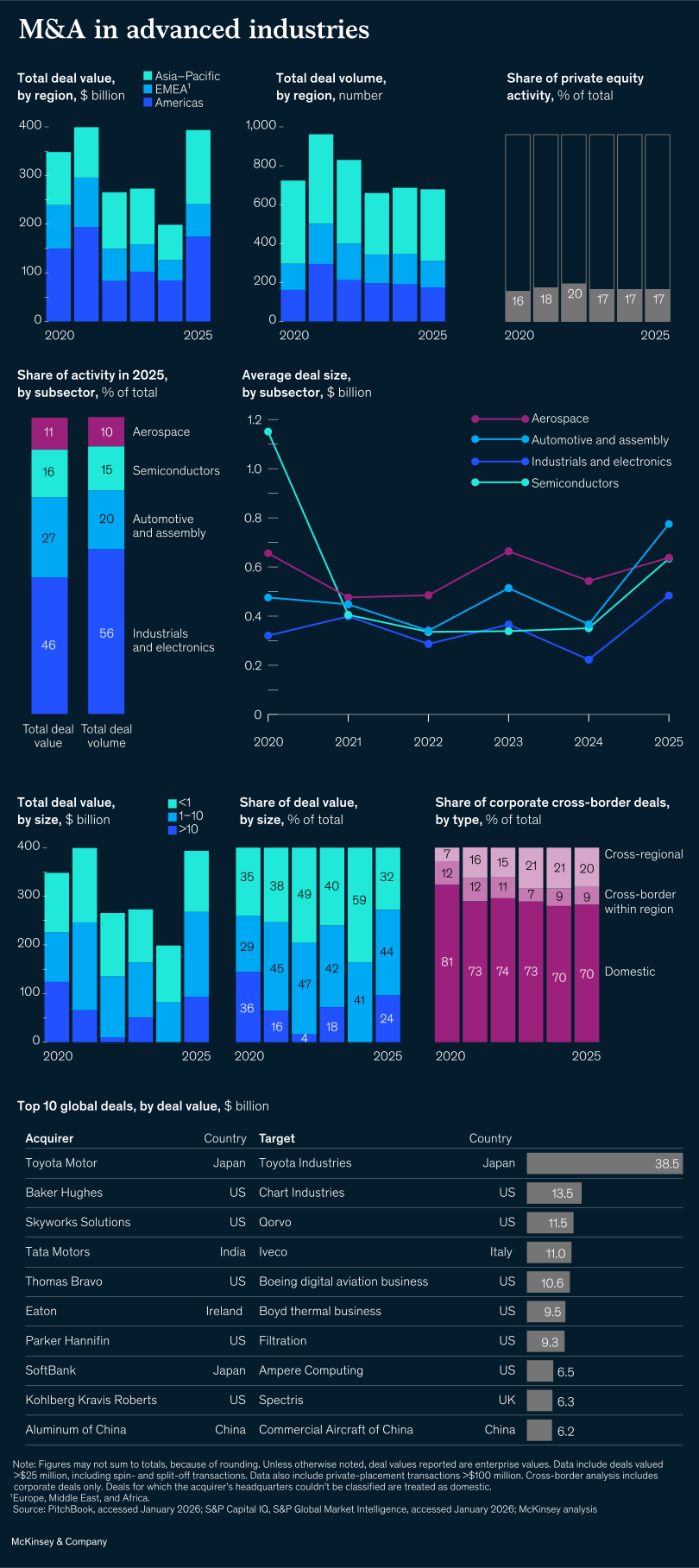
M&A activity in advanced industries increased in 2025, as we had anticipated in last year’s industry overview. Deal value nearly doubled in 2025 compared with the previous three years, although the number of deals remained steady. For the purposes of our analysis, the advanced industries sector includes companies across automotive, aerospace, industrials and electronics, and semiconductor subsectors.1 There were 679 deals announced in this sector in 2025, and $393 billion was invested overall. More than half of the total deal activity in advanced industries involved industrials and electronics companies.
Several key trends, including tech plays and continued consolidation among auto suppliers and manufacturers, suggest that the number of deals in this sector will increase in 2026, especially across strategic acquirers in automotives, industrials and electronics, and semiconductors. What’s more, private equity (PE) firms are likely to continue to propel M&A activity in advanced industries, given the substantial amount of dry powder available and the recent interest rate cuts in countries with sizable PE markets—think the United Kingdom, the United States, and countries across Europe.

2026 M&A trends: Navigating a rapidly rebounding market
Subsector activity
M&A activity and opportunities are varied across the four subsectors we analyzed. Geopolitical disruptions are likely to drive additional investments in aerospace companies. Margin compression will likely continue to prompt consolidation among auto suppliers, and the race to adopt leading-edge technologies should continue to propel M&A in the auto industry overall. Meanwhile, industrial companies are exploring deals that allow for vertical integration, and growth in AI is creating more appetite for M&A among semiconductor companies.
Aerospace
M&A activity in aerospace decreased a few years ago, but it has rebounded—from $35 billion in deal value in 2021, down to $25 billion in 2024, and back up to $42 billion in 2025. We expect this increase to continue in 2026 and beyond, given increasing interest in the autonomous technologies, such as unmanned aerial vehicles, drones, and space sector systems, produced by companies in this subsector. A good example is the $925 million acquisition of Edge Autonomy, a producer of uncrewed airborne systems technology, by space systems company Redwire.
Deals in aerospace may also increase because of companies’ renewed focus on protecting themselves against geopolitical disruption. As a result, there may be more domestic and regional deals, as well as acquisitions aimed at building resilience in supply chains and labor markets and at protecting margins. (For more, see “Defense: Shifts in geopolitics ramp up interest in M&A.”)
Another area for increased M&A activity comes from PE. PE firms’ investments in and roll-up of companies will continue in 2026 and beyond, especially in aerospace services.
Automotive
After peaking during the COVID-19-pandemic period, deal activity in the auto subsector has been limited over the past few years. Consider that a single large deal, Toyota Motor’s proposed $39 billion acquisition of Toyota Industries, accounted for much of the deal value in automotive in 2025—although the rationale for that deal was simplification of shareholding structures, with the added benefit of vertical integration. However, deal activity is likely to continue, given recent trends, such as consolidation among suppliers and continued investment in electric-vehicle (EV) infrastructure, connected-vehicle technologies, and autonomous-driving capabilities.
Auto suppliers continue to be under tremendous cost pressure from both tier-two suppliers and OEMs. As a result, they’re actively managing product portfolios and pursuing consolidation deals, especially in areas involving legacy components (such as drivetrains and powertrains). A good example is Allison Transmission’s acquisition in June 2025 of Dana’s off-highway business.
Three trends suggest increased M&A activity among suppliers in 2026. First is the continued reset among players in the EV space as companies continue to pursue partnerships and joint ventures. Second is the expected further investments in technology to support the development of software-defined vehicles (SDVs) and the electronics stack. Examples of such investments include those in advanced driver assistance systems, various forms of middleware, and over-the-air updates to accelerate growth in SDVs and lower the bill of materials in manufacturing. And the third is suppliers’ continued pruning of portfolios and selective divesting of nonprofitable or noncore units, given high margin pressures.
Meanwhile, M&A activity for auto OEMs isn’t likely to accelerate in the coming year—although some sizable deals involving commercial trucks and buses were announced (for example, Tata Motors’ acquisition of Iveco in July 2025 and Hino Motors’ integration with Mitsubishi Fuso Truck and Bus in June 2025). It’s more likely that OEMs will become selective acquirers, pursuing those transactions that can help them improve their competitive positions and support their transformations toward electrification and greater software usage.
Industrials
The industrials subsector has seen a large spike in overall deal value: It increased to $182 billion in 2025 across both strategic and PE transactions—double the figure from 2024. Average deal size was $484 million, although the number of deals remained constant. More than half of the deals overall in this subsector have been in Asia–Pacific markets, although those transactions demonstrated relatively lower value per deal.
What’s driving this increased interest among strategic and PE companies? It’s the ongoing acceleration of digitalization and automation through AI and other technologies. Indeed, an increasing number of companies are developing platforms and solutions to improve customers’ purchasing experiences across the entire life cycle. Think of Zebra Technologies’ August 2025 acquisition of Elo Touch Solutions, with goals of digitalizing and automating the frontline workflows (with touchscreens and self-service kiosks, for example) of customers in retail, hospitality, food service, and healthcare.
Semiconductors
In 2025, semiconductor companies needed to respond to strong demand for AI technology and data center construction; they also faced geopolitical pressures that affected their appetite for cross-border investments. In 2026, we expect to see more semiconductor companies invest locally to protect both their capacity and their capabilities.
Read the full report on which this article is based, 2026 M&A trends: Navigating a rapidly rebounding market.