Market analysts may disagree about specific trends and forecasts, but they typically share the same optimistic attitude about the semiconductor market. According to most assessments, the semiconductor industry was valued in the range of $630 billion to $680 billion in 2024 and is expected to reach $1 trillion to $1.1 trillion by 2030, largely fueled by the growth of AI and data centers.
This view—although positive—could be a significant underestimation of the semiconductor industry’s true worth. That’s because traditional estimates, which are largely based on sales volumes, may partially or completely overlook the value of chips created by OEMs with in-house design capabilities, captive chip designers, and fabless operators (for some advanced packaging technologies). This oversight could have meaningful consequences, as these categories are now demonstrating the highest growth rates. What’s more, current analyses often undervalue Chinese semiconductor companies because information on their sales is incomplete or opaque.
Accurate value assessments are more important than ever, as AI is expected to push the semiconductor industry’s average CAGR well above the 9 percent recorded from 2014 to 2024. To assess semiconductor value more accurately, we analyzed all company types, including those in China. Rather than relying on sales volumes, which do not accurately reveal value when companies are not directly selling chips on the market, we conducted customized analyses for each type of semiconductor company. For example, for OEM players with in-house chip design, such as smartphone manufacturers, we estimated their contribution to the market based on the cost of goods sold (COGS), combined with a typical gross margin for the product.
The main takeaway: The value of the semiconductor market totaled $775 billion in 2024 and could reach $1.6 trillion (ranging from $1.5 trillion to $1.8 trillion) by 2030—figures that far surpass other estimates. But not all semiconductor companies will benefit equally, because most growth will relate to leading-edge chips and high-bandwidth memory (HBM). A few highly innovative companies will likely account for the most value in these segments, given the semiconductor industry’s winner-take-all dynamic. In other market segments—such as advanced and mature nodes, or DDR1 DRAM and NAND memory—the top companies aggressively reduce costs, either by increasing scale or undertaking traditional cost excellence programs. They also strive to expand their presence in higher-growth segments and attempt to differentiate their offerings.
One important caveat: We created a range of estimates because so much uncertainty exists, as is the case with all forecasts. In our low-case scenario, for instance, AI demand is weaker than expected, translating into lower chip demand. The $1.6 trillion estimate reflects our middle-case, or base-case, scenario.
Reassessing market size
Historically, analysts have determined market size by measuring sales of semiconductor devices to electronics companies from fabless operators, foundries, and integrated device manufacturers (IDMs) that both design and manufacture chips. When direct sales data were unavailable—for instance, for nonlisted companies—analysts created estimates.
For many years, this traditional approach was a fairly accurate barometer of semiconductor market value because it correctly assessed the value of chips from the IDMs, fabless, and fully integrated players that dominated the market. But today, most of the growth is coming from captive chip players, OEMs with in-house design, and fabless companies, and an analysis based largely on sales does not fully account for the value of their chips. (For more information on how market share is changing among company types, see sidebar “The evolving semiconductor market”). Chinese companies, too, are growing—making it much more important to estimate their contribution to value, which traditional estimates don’t fully capture.
Beyond sales-based analysis
Our assessment methodology eliminates some of the gaps inherent in the traditional approach. Specifically, our estimates take into account the following players.
Captive chip design companies. Captive chip designers, which are typically hyperscalers operating data centers for cloud services, create chips for their own internal use. Captive demand is excluded from sales-based analyses because these semiconductors are not sold on the open market; instead, they are used in-house to deliver higher-performance cloud services at a competitive cost. Our approach estimates the value of captive chips by looking at internal R&D spend, COGS, and G&A expenses related to their design and manufacture.
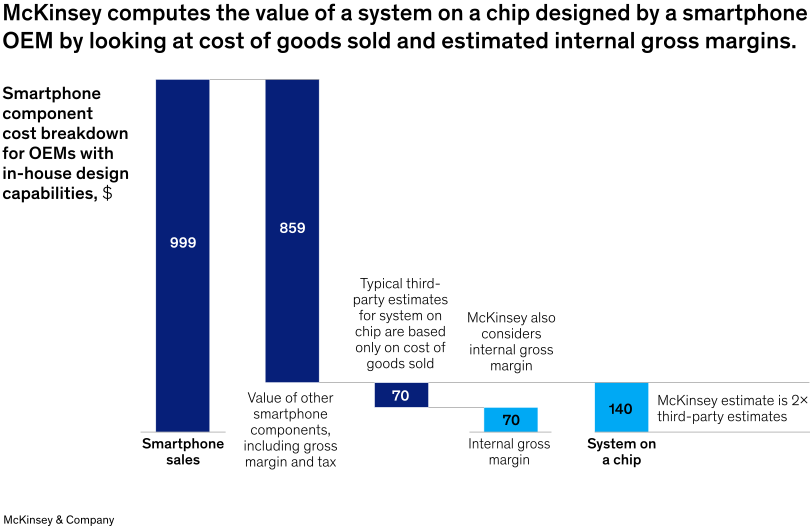
OEMs with in-house design. Most analysts assess the value of a system on a chip (SoC) designed in-house by looking at COGS alone (mainly by examining payments to foundries for chip manufacturing). Such analyses overlook estimated internal gross margins—the assumed profit that a hypothetical supplier would earn from selling chips to the end-product manufacturing unit—even though such margins are considered when quantifying the contributions of IDMs and fabless players. Our approach ensures greater consistency by considering both COGS and estimated internal gross margins for OEMs with in-house design (Exhibit 1).
Fabless companies. Fabless companies design chips and outsource manufacturing to foundries. While a sales-based assessment could accurately assess the value generated by fabless companies in the past, it now falls short for two reasons:
- Companies increasingly use modern packaging technologies to integrate separately manufactured components, such as processors and memory, into heterogeneous chips.
- Companies increasingly provide software, often for free, to enhance ease of use and allow customers to capture the full potential of the chips.
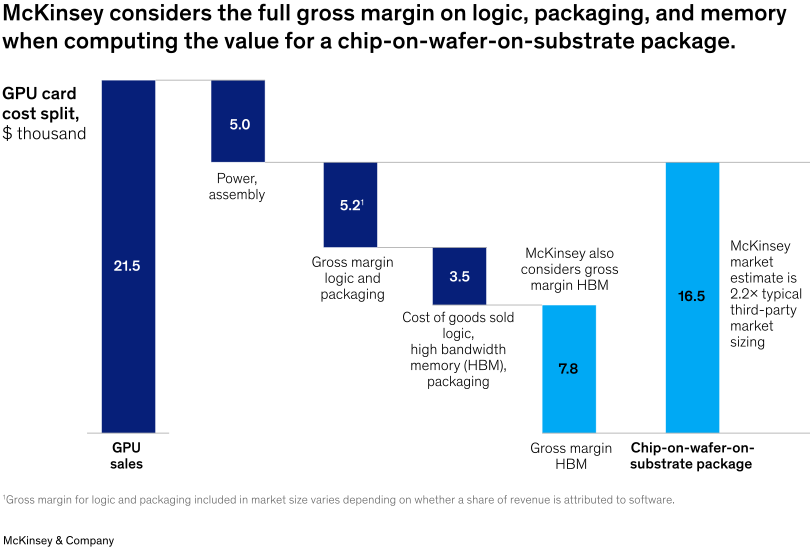
Typically, analyst estimates credit fabless companies with only a subset of the value of the entire chip-on-wafer-on-substrate (CoWoS) package, such as the COGS and gross margin associated with logic and packaging components. They do not credit fabless companies with any gross margin for HBM, instead allocating this to memory companies. In our analysis, we attribute the value of the full CoWoS package, including HBM, to the fabless company. We also take a different approach to software: While traditional analyst estimates subtract a portion of gross margin to account for the software bundled with a graphics processing unit (GPU), our method retains the full margin (Exhibit 2).
Regional underrepresentation. About half of the planned capacity expansion from 2024 to 2028 (as measured by wafer capacity) is expected to take place in China. The new facilities will focus on the manufacturing of advanced and mature nodes, and analyses could underestimate the size of this segment if data from China are incomplete. To generate a more accurate estimate of the value from Chinese companies, our analysis combines data for reported revenues, estimated revenues based on manufacturing capacity, and data from internal proprietary models. Our estimate is conservative and considers the fact that China is now operating at lower utilization rates, and some announced future capacity may not materialize.
A strong market with potential for future growth
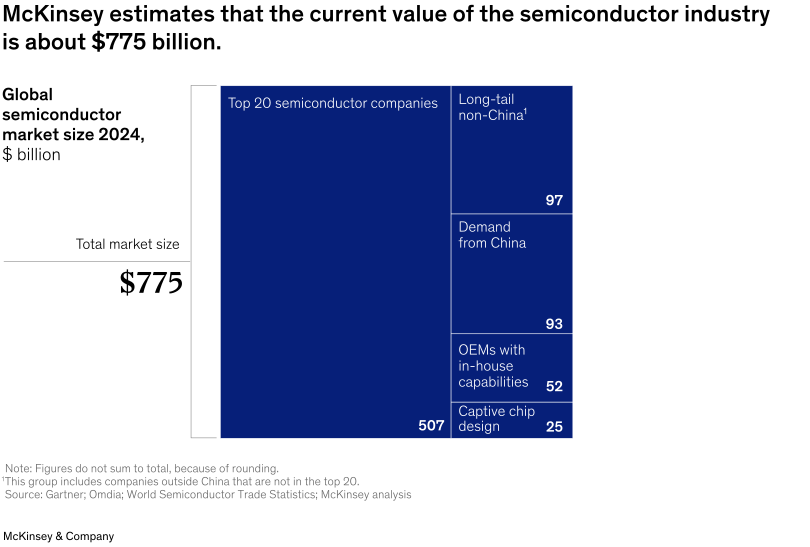
We estimate the 2024 value of the semiconductor market to be about $775 billion. This amount is around 14 to 23 percent higher than other market assessments, which range from $630 billion to $680 billion. Breaking down our estimate, value comes from the following sources (Exhibit 3):
- all semiconductor players outside China (around $604 billion, with $507 billion coming from the top 20 semiconductor companies)
- companies headquartered in China ($93 billion)
- OEMs with in-house chip design ($52 billion)
- captive chip designers ($25 billion)
A closer look at the 2024 valuation reveals that the largest verticals are computing and data storage ($350 billion), wireless ($200 billion), and automotive ($75 billion). Across verticals, leading-edge nodes have a value of $220 billion—equal to the combined value of all types of memory (NAND, DDR DRAM, and HBM).
A $1.6 trillion semiconductor market in 2030
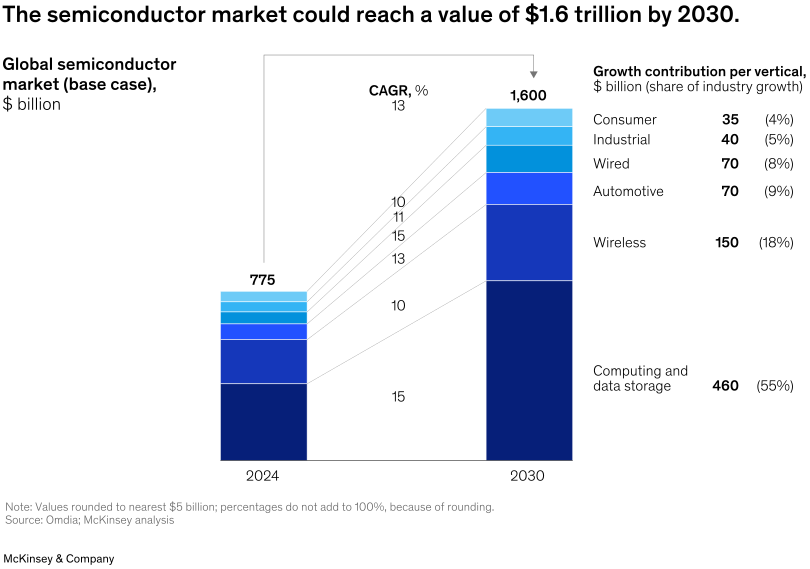
With so much uncertainty ahead, we developed three different scenarios to estimate future semiconductor demand. The major variable was the expected trajectory for AI adoption. In our scenarios, the estimated 2030 value of the semiconductor market ranged from $1.1 trillion to $1.8 trillion. The middle case, or base case, of $1.6 trillion represents an increase of $825 billion from our 2024 estimate and is significantly higher than traditional estimates, which typically range from $1 trillion to $1.1 trillion (Exhibit 4).2
We tested the validity of our estimates by examining projected changes in other independent variables that were not factored into our original analysis, such as industry capacity, projected revenues, and capital expenditures. The results from these analyses supported our estimates of $1.1 trillion to $1.8 trillion in value by 2030 (see sidebar “Validating our estimates through additional analyses”).
Future growth trajectories for leading verticals
The leading segments in 2030 will be the three that now dominate the market, but their growth trajectories and demand drivers will differ:
- Computing and data storage. This vertical is expected to grow from an estimated value of $350 billion in 2024 to $810 billion in 2030. The increase of $460 billion accounts for more than half of the $825 billion total expected growth in semiconductor value. Demand in the server segment, especially for AI servers, will account for most of the increase. In addition to greater unit shipments, the average selling price (ASP) for wafers will rise because of shrinking node sizes and greater HBM content. As AI servers become more connected to create large-scale, shared-memory, low-latency clusters, the wired segment will also benefit.
- Wireless. This segment is expected to grow by an estimated $150 billion through 2030, leading to a total value of $350 billion. Several factors are behind this shift. First, many consumers are switching to more expensive smartphones that require more sophisticated chips—a shift that will help compensate for the plateau in yearly smartphone shipments. Second, semiconductor content in other wireless devices is also increasing, partly because new connectivity standards require more silicon. Manufacturers are also transitioning to smaller node sizes in leading-edge wireless components, including SoCs, modems, Wi-Fi chips, and NAND memory controllers. While this shift raises component costs, it also improves connectivity, increases compute power, and helps manage energy consumption.
- Automotive. Chip value is expected to increase between 2024 and 2030. The transition to electric vehicles is fueling much of the market growth in this segment, especially for advanced and mature nodes. Additional automotive market growth comes from the increasing sophistication of advanced driver assistance systems (ADAS), such as improvements in autonomous driving that depend on chips that can accelerate data processing.
Uneven growth within semiconductor segments—and one big opportunity
Our estimated CAGR for the semiconductor market from 2024 to 2030 is 13 percent, but growth will vary significantly by segment:
- For nonmemory devices, the projected CAGR for leading-edge nodes is 22 percent. Demand for 3 nanometer (nm) nodes is expected to rise 25 percent, while demand for 5 nm and 7 nm nodes will fall. For 2 nm nodes, which just became available in 2025, demand is expected to soar 136 percent through 2030. If 1.4 nm nodes become available as expected in 2027, their anticipated CAGR will be about 314 percent.
- For advanced and mature nodes in nonmemory devices, demand is only expected to rise by between 2 and 4 percent, depending on node size.
- HBM will have a CAGR of 20 percent, which is much higher than that for DDR DRAM (12 percent) and NAND (9 percent).
With such variations in CAGR, leading-edge nodes will represent a much higher share of overall market growth from 2024 to 2030 than the other major segments (Exhibit 5):
- Leading-edge chips, primarily for AI, will account for 62 percent of total growth. This momentum results from a combination of demand for compute power in new devices and the migration to smaller node sizes in next-generation products, such as advanced Wi-Fi chips. A winner-take-all dynamic is likely to persist in the leading-edge chip segment, with a few companies garnering most of the profits.
- The memory segment has recovered from its recent downturn and will account for 31 percent of growth, with almost half of that related to HBM, which has a higher sales price than other types of memory. As with leading-edge chips, a few companies may reap most of the profits.
- Advanced and mature nodes have a much lower growth trajectory than these two segments. This segment now accounts for more value than leading-edge nodes, but that situation will likely begin reversing in 2026. Many companies offer advanced and mature nodes, highlighting the need for a strong growth strategy to stand out from the pack.
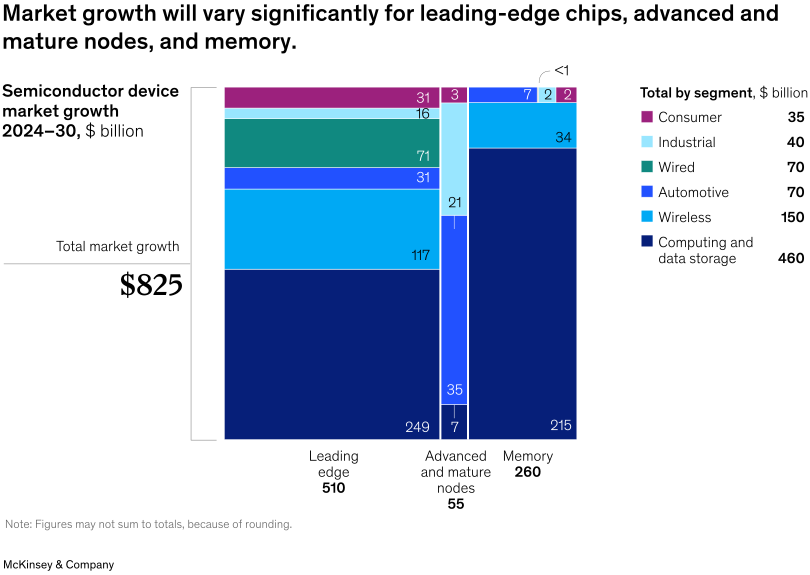
Across these three segments, trends in wafer sales volume and ASP could take different directions (see sidebar “Trends in wafer growth”).
Implications for semiconductor companies
Our estimate of the semiconductor industry’s value, as well as the prospect of uneven growth, suggests that companies may be underestimating both the challenges and opportunities ahead. To optimize their chances of capturing market share and economic surplus, they must understand the nuances of the market, including the areas where growth may accelerate most quickly.
Leading-edge chips and HBM
Our market breakdown clearly shows that HBM and leading-edge chips, especially the smallest node sizes, will experience the most growth. Their expected CAGR is more than 20 percent through 2030, largely driven by AI. Companies that are not already creating such chips could benefit by investigating whether they have the resources and capabilities to do so. Otherwise, they could miss out on the surest path to growth.
For companies that develop HBM or leading-edge chips, success hinges on constant innovation that will deliver faster, more energy-efficient solutions for compute-driven segments. For instance, companies are pursuing improvements for GPUs in data centers, chips for ADAS, and memory controllers, among other areas. By transitioning to smaller node sizes for these use cases, companies can improve performance without increasing chip size or energy requirements. These enhancements necessitate more mask layers and greater manufacturing precision, which increases costs. Customers may gravitate to the solutions that deliver the greatest performance improvements, especially if prices increase across the board, which will contribute to a continuing winner-take-all dynamic.
As with our other forecasts, some developments may materialize that shift our estimates. For instance, many players are investigating alternative chips to HBM to reduce costs, especially for inference, and to mitigate the impact of the current memory supply shortage. If companies do move to alternatives, demand for HBM could decline substantially.
Advanced and mature nodes
For advanced and mature nodes, performance improvements are occurring more slowly because the technology has already been continuously optimized for many years, and there are fewer opportunities to make further enhancements. This segment overall is expected to have a CAGR of about 3 percent from 2024 to 2030, which is much lower than that for leading-edge nodes. We still expect to find pockets of high growth in this segment, however, such as opportunities with optical connectivity chips and power semiconductors, fueled by increases in data centers and electrification.
In some cases, capacity expansion may outpace market growth for advanced and mature nodes, putting pressure on prices. That trend could be challenging for manufacturers in this segment, resulting in more competition. Growth, therefore, will come mostly from greater unit sales, rather than higher ASPs. To remain competitive, companies that manufacture advanced and mature nodes must increase production—potentially through M&A—to capture economies of scale and pursue additional cost reduction opportunities. On the product side, companies should differentiate their offerings and increase their presence in high-growth segments.
Creating a future strategy
Much of the semiconductor industry’s growth over the past few decades has been driven by a few leading companies in each segment. In a recent analysis, McKinsey examined their strategies to identify what sets the leaders apart from the pack.
One major finding: Top performers optimized their economic profit by implementing a combination of five big moves. Three involve the portfolio: programmatic M&A, dynamic resource reallocation, and out-investing competitors. The other two moves, which relate to performance, focus on improving productivity and ensuring strong differentiation from competitors to capture higher margins. (These strategies are described in detail in the 2018 McKinsey book, Strategy Beyond the Hockey Stick: People, Probabilities, and Big Moves to Beat the Odds, by Chris Bradley, Martin Hirt, and Sven Smit.)
While semiconductor companies today will also benefit from a comprehensive approach that incorporates both portfolio and performance moves, their exact strategies should vary. Those in high-growth and rapidly evolving segments, such as leading-edge chips, DRAM, optical communications, and power semiconductors, should monitor trends and adjust their portfolios quickly, as described in the seminal 1996 book on business strategy, Only the Paranoid Survive, by Intel cofounder and former CEO Andrew Grove. The book stresses the importance of moving quickly at strategic inflection points—those moments when the emergence of a new technology or massive market changes force companies to adapt. These inflection points may be difficult to detect during their early stages, requiring constant vigilance.
Companies in low-growth segments should double down on performance moves to build differentiated products and achieve cost advantages. For portfolio moves, programmatic M&A and dynamic resource management may be most helpful as companies strive to get more exposure to higher-growth pockets.
Our findings point to a semiconductor market that is both larger and more dynamic than traditional estimates suggest. But the opportunities will not be evenly distributed: Leading-edge chips and HBM will capture most of the new value, while other segments will compete largely on cost and scale. As companies refine their strategies, those that innovate quickly or achieve meaningful efficiencies will be best positioned to win. The next decade will reward players that understand where value is shifting—and act decisively to capture it.