The industry overview
Our recent analysis reveals renewed optimism and a sharper strategic outlook for dealmaking in the life sciences industry in 2026. After the volatility of the past few years, shaped by geopolitical and macroeconomic tension and regulatory uncertainty, leaders’ confidence in M&A is returning. The change is being driven by strong balance sheets and increasing urgency to augment pipelines.
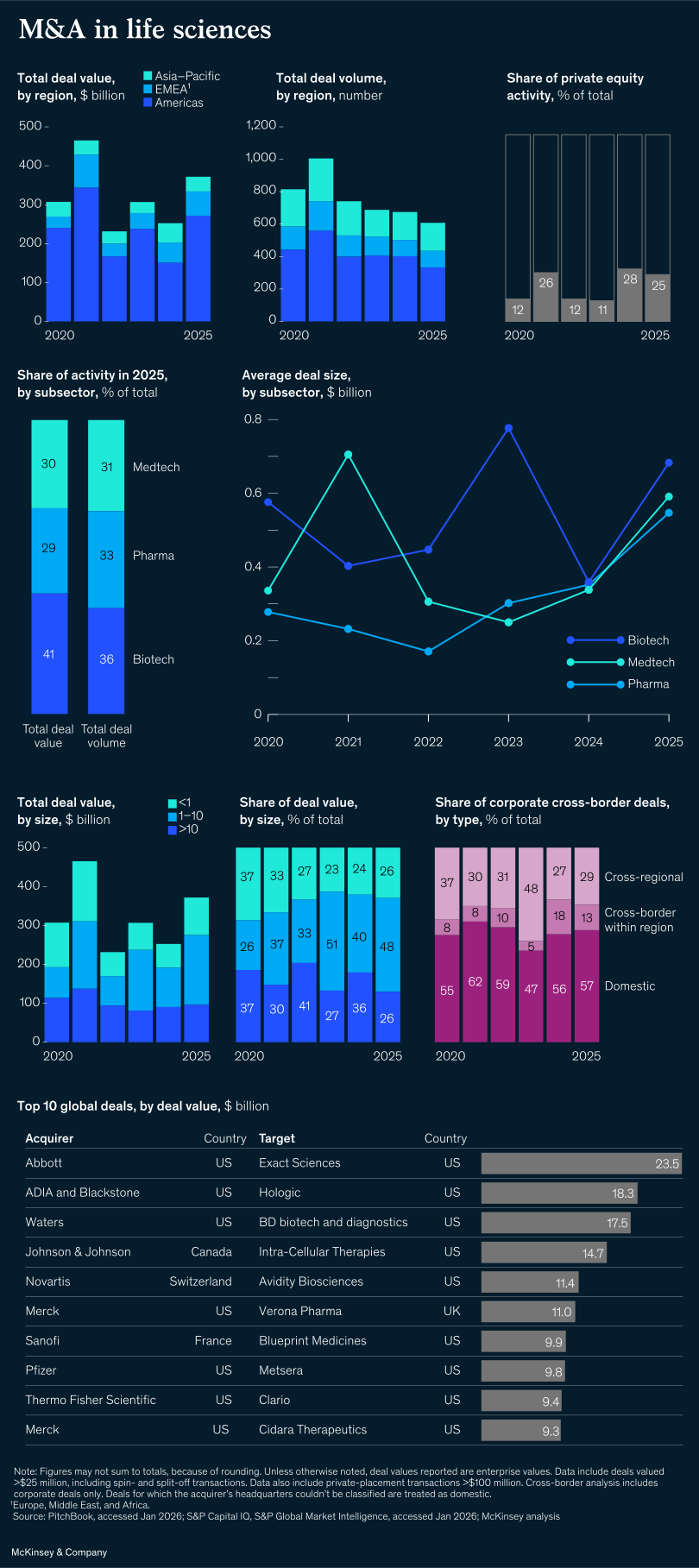
The market appears to be rebounding: Total deal value in the life sciences industry reached $372 billion in 2025. This increase of 47 percent year over year signals renewed confidence despite continued headwinds from elevated interest rates and evolving global trade policies. Overall deal volumes remain below the highs seen during the COVID-19 pandemic era, but the average deal size increased nearly 63 percent in 2025 compared with the prior year, illustrating a shift in the market toward fewer, higher-impact transactions.
Regionally, M&A activity in the industry remained concentrated in the Americas, which accounted for 73 percent ($272 billion) of total deal value in the sector in 2025. Europe, the Middle East, and Africa’s share of deal value was 17 percent ($62 billion), and Asia–Pacific accounted for 10 percent ($38 billion).
By sector, biotechnology, pharmaceutical, and medtech companies contributed equally, with each sector contributing about 30 percent of deal volume. Private equity (PE) firms’ share of sector deal value held steady—25 percent in 2025 compared with 28 percent in 2024.
Trends suggest that the M&A cycle in 2026 will reward precision: targeted bets on differentiated science, advantaged platforms, and assets that can materially affect growth trajectories. The central question for leaders is no longer whether to pursue M&A but rather how bold to be.

2026 M&A trends: Navigating a rapidly rebounding market
Subsector activity
A closer look at M&A activity within key subsectors of the life sciences industry suggests a focus on long-term value creation within biopharmaceuticals, active portfolio management in the medtech space, and strong evidence of market recovery within life sciences services.
Biopharmaceuticals
In 2025, biopharma M&A activity reflected a market characterized by changing financial and structural dynamics. Strategic investors’ cash reserves grew 10 percent between 2021 and 2024, providing continued high levels of dry powder to fund acquisitions. During the same period, the median holding period for PE firms extended to six years, from five-and-a-quarter years, signaling the likelihood of increased sell side activity in the near and medium terms.
Growth-focused M&A (or deals involving, for instance, early-stage assets and white space therapeutic areas) has remained dominant in this subsector: Between 2020 and 2025, 76 percent of deals were focused on growth, up from 34 percent a decade ago, reflecting a structural shift in how companies pursue innovation. This focus is becoming increasingly urgent as patent expirations are projected to eliminate nearly $300 billion in revenue by 2028. In response, more than half the deals in 2024 by top pharma companies targeted Phase I or earlier-stage assets, given the limited availability and prohibitive pricing of differentiated commercial assets.
China continued to emerge as an increasingly important origin of early-stage innovation. Indeed, a growing number of companies have pursued licensing and partnership structures to access Chinese assets for US and global development. In 2024, 28 percent of licensing deals executed by the top 20 multinational pharma companies involved Chinese companies, up from just 3 percent in 2020.
Meanwhile, deal premiums have normalized in line with broader pharma valuation resets, falling by nearly 40 percent in 2025 from the elevated levels seen between 2020 and 2024. This reset reflects a more disciplined approach to value creation, with acquirers prioritizing opportunities for long-term pipeline renewal, platform advantages, and technological leadership over transactions that may yield only short-term revenue increases.
Medtech
2025 saw medtech trade at its lowest valuations relative to the broader S&P 500 since the 2008 financial crisis, causing management teams and boards to reevaluate their portfolios and capital allocation strategies. As a result, M&A activity in this subsector reached its highest point since 2021, and divestitures were at their highest in the past decade.
M&A activity. Acquirers in 2025 pursued several types of medtech transactions. Companies like Boston Scientific continued to tuck in high-growth assets in core markets, while those like Abbott and Stryker pursued larger acquisitions in white space, high-innovation adjacencies. Pursuit of digital offerings and capabilities accelerated, as seen with one of medtech’s largest-ever AI deals in GE HealthCare’s $2.3 billion acquisition of Intelerad.
These acquisitions all shared a common value creation strategy: Gain leading positions in large and innovative segments that will accelerate top-line growth and improve returns through a more leveraged cost base and acquisition synergies. They also reflected consistent takeout multiples of around sixfold revenue, in line with historical averages.
Going forward, we expect the competition for medtech M&A to intensify. Industry trends such as stagnating venture capital investment and decades-long M&A of small-cap and midcap companies have left fewer attractive and actionable assets available for interested acquirers.
Divestitures. Divestitures gained prominence in medtech in 2025, reflecting a renewed focus on portfolio strategy versus pursuing growth at all costs. As investors have continued to reward companies with clearer portfolio strategies, companies with attractive but noncore business units have increasingly turned to pruning their portfolios. Total revenue divested in 2025 ($22 billion) was more than all revenue divested from 2019 to 2024 combined.
Most announced exits followed one of two strategic rationales. The first was spinning out a business unit into a stand-alone entity for a more tailored capital allocation strategy and narrower management focus. This is best exemplified by deals from Johnson & Johnson’s orthopedics business and Medtronic’s diabetes business. The second rationale was selling a business unit to a more natural owner, as happened with Solventum’s filtration and purification business and Organon’s postpartum hemorrhage business.
Life sciences services
Life-sciences-services companies are experiencing a recovery. Funding, R&D activity, and outsourcing to contract development and manufacturing organizations (CDMOs) and to contract research organizations have all been rebounding to prepandemic levels. In fact, CDMO sites have expanded, given the growing importance of having a US footprint.
But overall M&A activity remains stable within the subsector as sponsor motivations evolve. Pharma and biotech buyers are prioritizing acquisitions that deliver operational excellence, digital- and AI-enabled execution of clinical trials, flexible manufacturing capacity, and expertise in modalities such as mRNA, radiopharmaceuticals, and viral vectors. Meanwhile, PE is accelerating platform roll-ups.
Opportunities for 2026—and beyond
Multiple forces are converging to create a favorable environment for life sciences M&A activity in 2026. Four themes are likely to define the next phase of dealmaking in this sector: The loss of exclusivity (LOE) cliff and asset scarcity will force sharper portfolio decisions, China will remain a core source of innovation, policy and regulatory forces may catalyze larger-scale transactions, and capabilities will become the ultimate differentiator.
Sharper portfolio decisions
The accelerating LOE exposure and a shrinking pool of differentiated scalable assets will combine to inform the direction of M&A in the life sciences sector in 2026. While capital remains abundant, the universe of assets capable of meaningfully offsetting revenue erosion is narrowing in both pharmaceuticals and medtech. Valuation dispersion among top-tier and LOE-exposed players will continue to widen, increasing pressure on the latter to act decisively. Success in the next cycle will depend on them deploying capital only where assets clearly reinforce future strategic positioning, platform optionality, and sustainable competitive advantage, including in areas that may redefine where a company competes over time.
China as a core source of innovation
As the availability of assets tightens, China has emerged as an increasingly important source of early-stage innovation. The share of multinational pharma companies actively pursuing or engaged in licensing and partnership structures to access Chinese assets is likely to continue to grow out of competitive necessity.
Larger-scale transactions
Evolving policy dynamics, such as most-favored-nation agreements, are likely to have uneven impacts across the sector. Companies with greater exposure to pricing reforms, concentrated portfolios, or limited pipeline depth may face disproportionate pressure, increasing the strategic rationale for reshaping portfolios. While recent years have been characterized by incremental and early-stage dealmaking, 2026 may see renewed momentum for larger transactions as some players seek to rebalance risk, diversify sources of revenue, or accelerate strategic repositioning.
Capabilities as differentiators
Excellence in execution is becoming a decisive advantage in M&A. Companies that invest in end-to-end M&A capabilities—with dedicated teams to execute integrations, repeatable playbooks, and governance that supports rapid decision-making—will be best positioned to convert strategic intents into sustained performance. Already, leading acquirers in life sciences are embedding AI-enabled forecasting, scenario modeling, and data-driven pipeline assessment into their deal processes so that they can better anticipate future therapeutic battlegrounds and pressure test value creation theses.
For most life sciences players, 2024 brought its fair share of geopolitical tensions, supply chain constraints, and regulatory uncertainty. Then 2025 delivered greater clarity about regulations and policies, some stabilization of capital markets, and renewed dealmaking momentum. In 2026, the window for transformative M&A is open for those life sciences companies that take time to refine their priorities, sharpen their deal blueprints and M&A capabilities, and act with focus and resolve.
Read the full report on which this article is based, 2026 M&A trends: Navigating a rapidly rebounding market.