Value creation in life sciences tends to come in waves. The life sciences sector—including pharma, biotech, and medtech—has historically delivered solid long-term returns and has recently corrected from its COVID-19-era spike (Exhibit 1).

Life sciences companies face challenging structural realities such as long, high-cost innovation cycles; rigorous regulatory standards; and complex supply chains. In pharma, developing a new molecule now costs more than $4 billion (including the cost of failures), and only 13 percent of candidates entering Phase I trials reach approval.1 Those numbers feed into market uncertainty and the wide forecast spread—the widest of any industry—between upside and downside performance scenarios (Exhibit 2). What distinguishes pharma is that its R&D pipelines consist of consequential products with clinical outcomes that are highly uncertain and often binary.
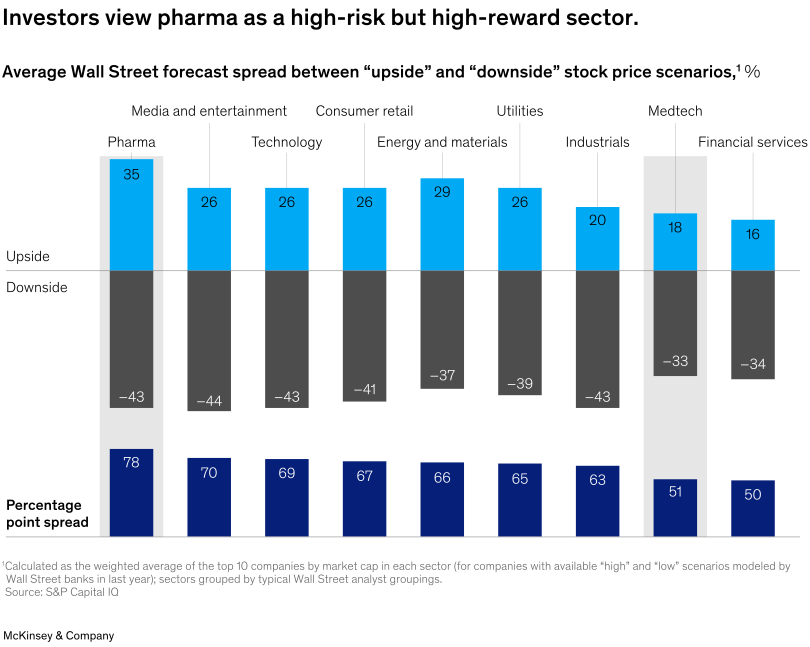
Although analysts view medtech as less risky than pharma, they are not as bullish about its upside. This dynamic puts pressure on medtech companies to innovate and operate more efficiently. With slowing growth as well as rising labor and raw material costs, investor expectations have only heightened for these companies to deliver sustainable performance and improved margins.2
At the same time, new pressures are complicating the funding environment for both sectors. In pharma, competition is increasing across crowded therapeutic areas, and in some segments of medtech, such as cardiovascular, innovation and funding are concentrated toward select disease segments, narrowing the path for emerging technologies to scale. Across both sectors, inflation, geopolitical uncertainty, and evolving regulatory and reimbursement landscapes are adding further strain.
Amid these challenges, effective investor engagement has never been more critical to ensuring that market valuations reflect the sector’s intrinsic value. A strong investor relations strategy can close the valuation gap—and reduce exposure to activist pressure—by grounding communications in data-backed proof points, explaining how the business is addressing external pressures, and framing short-term challenges within a credible long-term growth narrative.
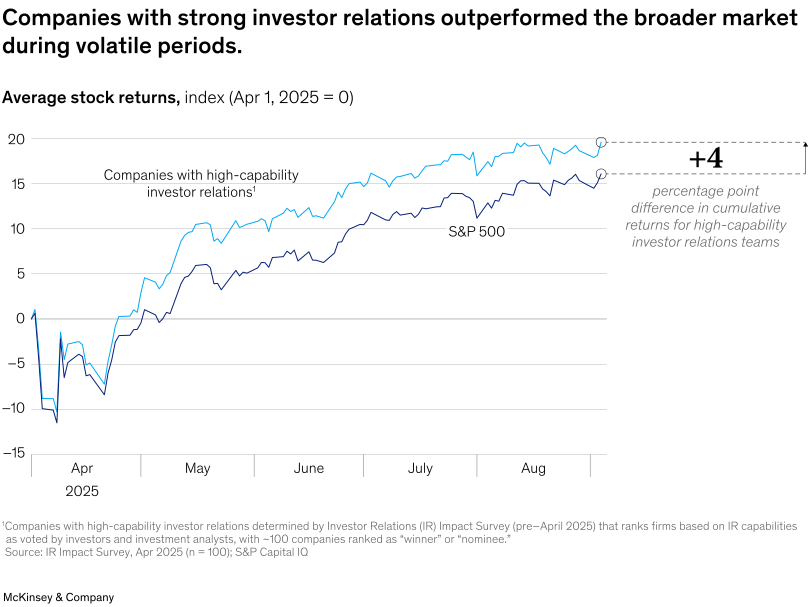
During recent tariff-driven volatility, for example, pharma companies that demonstrated strong investor relations were better able to sustain investor confidence and stock performance, even as broader market sentiment fluctuated (Exhibit 3). The same dynamic holds across sectors: According to the 2024 McKinsey Investor Survey, 82 percent of investors say a company’s equity story strongly influences their decisions,3 and most expect that story to be consistent across all communications. While investors still rely on financial performance and the strength of the balance sheet, they also assess management quality, strategic clarity, and responsiveness to industry trends. Investor relations at its best effectively weaves these elements into a cohesive equity narrative.
This article outlines six essentials of effective investor engagement that can help companies sharpen their equity story, reinforce credibility through proof points, and sustain investor optimism over the near and long term.
A flywheel of strategy, execution, and investor engagement
The challenge for an investor relations team is to align a company’s market value with its intrinsic value. Leading life sciences companies treat investor engagement as part of a “flywheel” that connects it to a company’s strategy and execution (Exhibit 4).
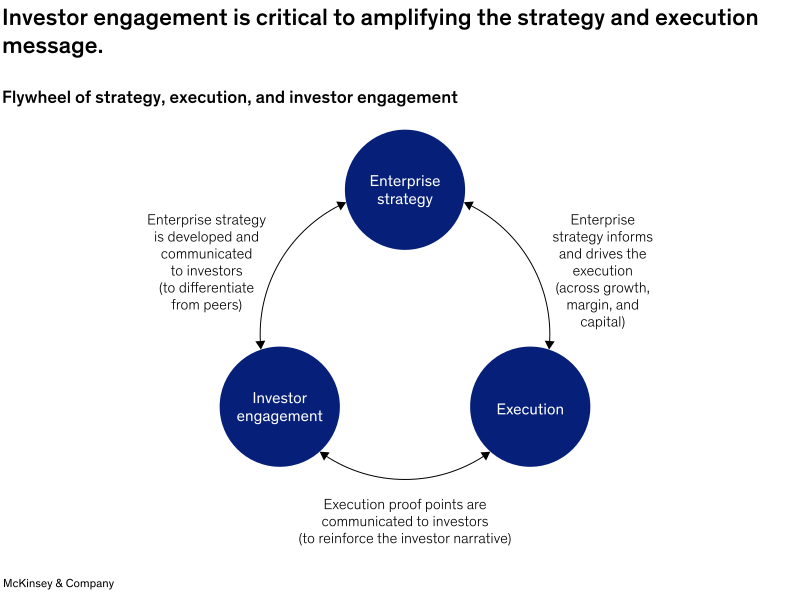
The flywheel turns through three interconnected components:
- Shaping enterprise strategy and sharing with investors. Clearly articulate to investors how strategic choices create long-term value and position the company favorably within its competitive context.
- Driving execution of the strategy (and updating strategy as informed by execution progress). Deliver outcomes across growth, margin, and capital that demonstrate progress and reinforce management’s credibility.
- Providing investors with execution proof points. Use each milestone to strengthen the equity story, close the gap between intrinsic and market value, and ensure that investor communications reflect both learned experiences and results.
The six essentials of effective investor engagement
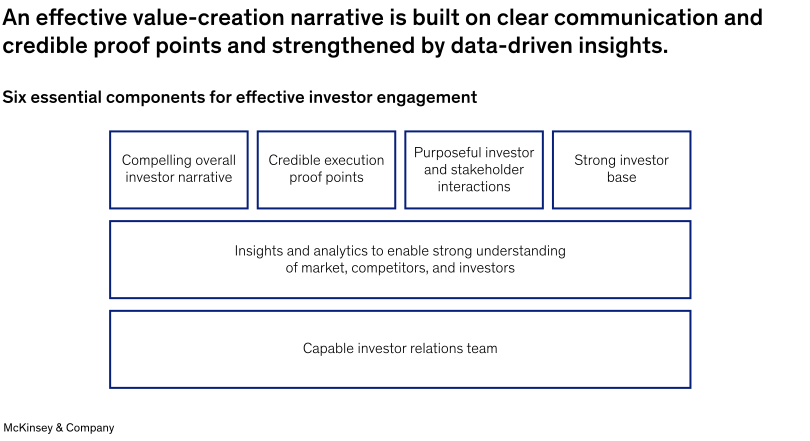
The flywheel illustrates the core factors that drive effective investor relations and explains why those factors matter. Six essentials of effective investor engagement can help companies build and sustain investor confidence (Exhibit 5).
A. Compelling overall investor narrative
More than 80 percent of investors say that an unclear or unattractive equity story reduces a company’s appeal.4 A strong narrative defines milestones, sets expectations, and provides a foundation for consistent messaging across all investor communications. The narrative should communicate the enterprise strategy, both in the near term and longer term, and what makes it distinctive. For pharma companies, this means explaining how their therapies address unmet needs, how their mechanisms differentiate them from the standard of care, and how regulatory and access paths support commercial success, including addressing patent cliffs.
AbbVie, for example, sustained investor confidence after losing exclusivity for its blockbuster drug Humira by charting a clear path for long-term value creation through newer immunology therapies such as Skyrizi and Rinvoq, and by demonstrating visible pipeline progress and consistent delivery against guidance.5 AstraZeneca has strengthened investor confidence in its long-term strategy by emphasizing launch momentum and patient impact across its oncology and respiratory portfolios, most notably through the rapid global uptake of Tagrisso and Farxiga.6 These therapies now serve patients worldwide and have driven double-digit revenue growth.
In medtech, where the focus is on connecting innovation to strong fundamentals, companies can describe how disciplined capital allocation, recurring revenue, and efficiency programs support growth. Stryker, for example, has built confidence through its robotics and trauma-device platform strategy—driving recurring consumables and service revenue tied to its installed base and delivering double-digit organic growth and margin expansion.7 A compelling narrative has a full package that clearly articulates the long-term enterprise strategy, execution progress, and link to value.
B. Credible execution proof points
Investors seek clear evidence that the strategy is translating into results. Not surprisingly, survey respondents rank financial performance and health as the strongest gauge of a company’s attractiveness,8 but a company can also demonstrate credibility by providing context and clarity for both financial and nonfinancial milestones. In pharma, value creation is often event-driven and tied to trial readouts, regulatory approvals, and scientific progress that signal future revenue potential. For example, successful late-stage clinical announcements trigger a 7 percent stock price reaction, on average, far exceeding the market response to product announcements in other sectors, including medtech (Exhibit 6).

Clinical trial outcomes—particularly those that alter a company’s valuation or strategic outlook—should be communicated as soon as possible after validation, with earnings calls and investor presentations then used to provide additional context and integrate trial developments into the broader R&D and financial narrative.
Pharma companies should also articulate other factors beyond traditional financial measures that they view as value drivers. For instance, Roche considers ability to address unmet needs, development feasibility and scalability, therapeutic differentiation, and path to value when evaluating assets for investments.9 In medtech, financial proof points in adoption, recurring revenue, and margin expansion connect disciplined execution to longterm value creation. For example, the strong organic growth of Abbott’s medical devices business, notably through products such as Structural Heart, demonstrates how disciplined execution in scaling innovation and sustaining product momentum supports recurring revenue and long-term value creation.10 Consistency across guidance, delivery, and follow-up builds trust. When results deviate from expectations, clear explanations can sustain confidence.
C. Purposeful investor and stakeholder interactions
Every investor interaction should have a defined purpose. Leading companies plan the rhythm of their communications such that each event reinforces the overarching equity story. Capital markets days, conferences, and site visits help investors see progress firsthand and build conviction over time.
Investors consistently value clarity and access; according to the 2025 survey, they rank the quality of materials and executive participation as the most important aspects of quarterly calls.11 Proactive investor engagement, organized around themes that matter most—such as pivotal trial progress, launch performance, and pipeline prioritization—can transform communications from one-way reporting into genuine two-way dialogue, strengthening both relevance and credibility.
To provide the clarity and access investors value, pharma and medtech companies often use R&D days and lab tours to explain complex science and highlight progress toward key milestones. Sanofi, for example, used a recent R&D day to highlight portfolio priorities and research advances in areas such as immunology and discovery-model transformation.12 Roche took a similar approach with its pharma day, emphasizing innovation excellence across core pipeline areas such as oncology and neurology.13 These sessions featured company leaders with scientific backgrounds, providing a high level of credibility and technical transparency that benefited investors and other participants. Lab tours also play a significant role in investor interactions. For instance, Agilent Technologies arranged a lab and factory tour to emphasize innovation across its portfolio following its latest investor day.14
D. Strong investor base
Leading investor relations teams map their investors by style15—for example, intrinsic, trading-focused, or quantitative—and tailor communications to engage current holders while attracting potential new ones. In life sciences, they also assess the scientific literacy of their investors to calibrate messaging, providing the appropriate level of detail when highlighting scientific differentiation. Companies such as Merck, Novartis, and Sanofi adapt their investor communications to meet audience needs, varying the level of technical detail and data format. Scientific forums (where investors are also present) feature in-depth, research-driven presentations, while investor events focus on concise, results-oriented messaging. Messages are timed to highlight near-term progress or long-term opportunity, depending on investor priorities.
E. Insights and analytics to enable strong understanding of market, competitors, and investors
Investor relations teams increasingly use analytics and gen AI to monitor sentiment, benchmark peers, and clarify messages. Thirty-one percent of investors now view technology use as a defining feature of well-managed companies.16 Investor relations teams are increasingly leveraging gen AI with example applications, including anticipating analyst questions, analyzing the language and tone of investors and peer statements, and drafting materials such as earnings scripts and presentations.17 In life sciences, analytics and AI can help teams turn complex R&D data into clear insights that link scientific progress to shareholder value. Teams can also use these tools to craft faster responses to investor questions and align internal and external messages more closely. For example, companies have begun integrating gen AI–based analytics into their investor relations and communications workflows to monitor investor sentiment across earnings calls and benchmark peer disclosures. These tools complement, rather than replace, human judgment by increasing speed, consistency, and data-driven insight in investor communication.
F. Capable investor relations team
Strong investor relations organizations have a team of leaders with both strong financial expertise and industry expertise. In life sciences, it is critical that leaders have a strong background and understanding of scientific concepts, their translation to financial outcomes, the patience required to realize outcomes, and how to clearly communicate to investors. For example, the heads of investor relations at Roche and AstraZeneca have strong science backgrounds, enabling them to translate clinical data into value narratives that resonate with investors.18 Leading teams are also closely connected to their company’s science, development, and medical affairs functions, enabling them to exercise sound judgment and communicate milestones with balance, context, and credibility.
Turning investor trust into a strategic asset
Investor relations is more than a communication channel. When investors can trust the company’s ability to deliver, short-term volatility becomes easier for leaders to manage. That confidence gives them room to allocate capital boldly and stay focused on innovation. For example, AstraZeneca’s decision to remain independent rather than merge with Pfizer was rewarded by investors because the company demonstrated credible progress and a clear long-term vision.19 Ultimately, effective investor relations creates the conviction and stability that enable companies to stay the course and invest for sustained growth.
Few industries have the same combination of deep scientific complexity, long R&D cycles, and rigorous regulation as life sciences. Yet these dynamics also create a powerful opportunity for differentiation through investor engagement. Companies that master the six essentials of investor engagement can shape a narrative that strengthens investor trust and position themselves to lead the next wave of sustainable value creation in the industry.