Even as tariffs and trade restrictions continue to proliferate, so do formal regional and bilateral trade agreements aimed at reducing barriers to international commerce. The trade deals are moderating the impact of recent US tariffs, which have risen from an average weighted tariff of approximately 2.0 percent in 2024 to one of 15.4 percent as of mid-November 2025.1 The agreements are also reducing nontariff trade barriers (for example, those covering sanitary and phytosanitary regulations,2 licensing requirements, and labor rules) and expanding market access.
The recent agreements’ impact on trade flows is already apparent. Some trade corridors (between Vietnam and the United States, for example) are deepening, while others (China–United States, for one) are shallowing as countries—and companies—respond to new geopolitical dynamics and economic incentives. Between the 2015–19 period and the 2022–May 2025 period, foreign direct investment (FDI) in China fell by 65 percent, while FDI flowing into the United States doubled.3 As much as one-third of global trade, worth $14 trillion, is projected to shift to new routes over the next ten years.4
The agreements, combined with industrial-policy measures, create significant opportunities for companies to access new markets. Many management teams of leading multinational companies are reviewing their long-term growth strategies, operating footprints, manufacturing and other capital investments, talent deployment, and supply chains to see where and how they can benefit. However, business leaders can no longer rely on an established framework of global standards. The complex network of bilateral and regional trade agreements requires new capabilities, along with triggers for action that can give companies a first-mover advantage when trade shifts occur.
Understanding the trade agreement landscape
Comparative advantages between countries—based on environmental conditions, talent, and infrastructure, among other factors—fundamentally shape trade dynamics, but trade agreements alter those advantages. While trade agreements date back to 2000 BCE, when Anatolians documented on cuneiform tablets the rights, duties, and protections of Assyrian merchants operating in their trade colonies,5 the contemporary form of multilateral trade agreements emerged as part of the Bretton Woods consensus after World War II.6 Conventions such as the General Agreement on Tariffs and Trade—later the World Trade Organization (WTO)—established rules for negotiating tariff levels, mechanisms for resolving disputes, and other protocols for managing global trade.
Most modern trade deals rest on six pillars with clear rules, phased implementation, and enforceable commitments to facilitate trade integration among parties to agreements:
- protocols for trade in physical goods, which hinge on negotiated levies or tariff rates and (often harmonized) mechanisms for establishing rules of origin
- implementation timelines, which stagger commitments over years or decades, balancing the parties’ shared ambitions with domestic priorities
- regulatory standards, which establish environmental, labor, sanitary, and intellectual property commitments
- services and investment protocols, which spell out broad market access rules, with select exceptions and use cases with special permissions for cross-border data flows
- dispute settlement mechanisms, ranging from state-to-state panels to investor-to-state arbitration, which ensure that the parties to the agreement can enforce their mutual commitments
- capital commitments, often informal, which aim to channel public and private financing toward agreed-upon priorities, such as digital infrastructure
Postwar trade agreements guided by multilateral bodies such as the WTO helped make roughly two-thirds of international trade tariff free by 2023 and contributed to a fivefold increase in global GDP between 1945 and 2000.7 However, since 2000, trade discussions have grown more contentious. Unilateral tariffs and ineffective dispute resolution mechanisms have eroded support for the WTO.8 By 2015, the WTO had acknowledged that a new approach to global trade negotiations was necessary.9
Public opposition to competition from lower-cost labor markets, deindustrialization, and related immigration policies, among other issues, resulted in US bipartisan rejection of the Trans-Pacific Partnership in 2016 and the United Kingdom leaving the European Union in 2020.10 With trade tensions escalating in 2025, the rule-based order that companies have relied on to plan business strategies has become more tenuous.11
Despite these setbacks, countries remain eager to engage in cross-border trade. In fact, between January 2017 and May 2025, the number of regional trade agreements increased by 30 percent, with a fivefold rise since 2000.12 Bilateral trade agreements are growing three percentage points per annum faster since 2000, at 7 percent annually (exhibit).
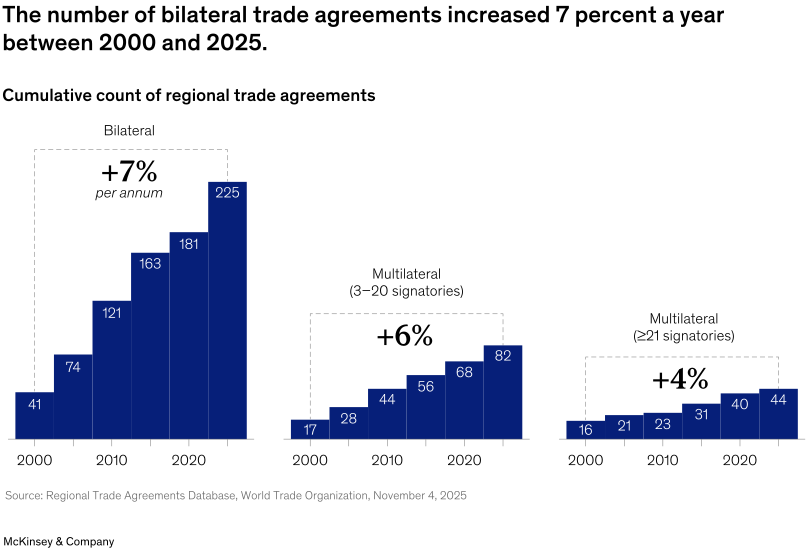
While trade agreements facilitate trade by synchronizing policies, global companies must now navigate five times as many trade agreements as they did in 2000. What’s more, each agreement entails its own interpretation and implementation challenges caused by translation differences; varied safety, technical, and labeling requirements for exports; and different dispute resolution and enforcement regimes. As a result, many business leaders struggle to monitor and capitalize on the opportunities that trade deals create.
Companies also need to adapt to shifts in trade corridors, which regional trade integration will accelerate. The Comprehensive and Progressive Agreement for Trans-Pacific Partnership (CPTPP), for example, now accounts for $15.8 trillion in GDP—14.4 percent of the global total—and more countries, including China, have applied to join the bloc.13 Vietnam’s exports to the CPTPP’s Latin American members grew by 56 percent between 2018 and 2023 in industries such as textiles and seafood.14 Meanwhile, by 2021, three years after the CPTPP entered into force, merchandise trade among Canada and its new partners (Australia, Japan, New Zealand, Singapore, and Vietnam) increased by 10 percent.
Modern trade agreements are complex, requiring business leaders to analyze the implications for their industries and strategies. Each agreement has a distinctive approach to sector carve-outs, implementation timelines, and dispute resolution mechanisms, among other elements (table).
Recent trade agreements have distinct approaches to key provisions.
| Comprehensive and Progressive Agreement for Trans-Pacific Partnership | United Kingdom–India Free Trade Agreement | European Union–Mercosur Free Trade Agreement | |
| Trade in goods |
|
|
|
| Implementation |
|
|
|
| Regulatory standards |
|
|
|
| Services and investment |
|
|
|
| Disputes |
|
|
|
| Capital commitments | N/A | N/A |
|
Source: The accession of the United Kingdom of Great Britain and Northern Ireland to the Comprehensive and Progressive Agreement for Trans-Pacific Partnership: Agreement summary, UK Department for Government and Trade, July 17, 2023; Comprehensive and Progressive Agreement for Trans-Pacific Partnership texts, New Zealand Foreign Affairs & Trade, accessed November 2025; Comprehensive Economic and Trade Agreement between the United Kingdom of Great Britain and Northern Ireland and India, UK Department for Government and Trade, July 24, 2025; “EU and Mercosur reach political agreement on groundbreaking partnership,” European Commission Directorate-General for Communication press release, December 5, 2024; EU–Mercosur: Text of the agreement, European Commission Directorate-General for Trade & Economic Security, September 3, 2025; “UK-India trade deal: Conclusion agreement summary,” UK Department for Government and Trade, July 24, 2025.
The impact of sector-specific trade agreements
Aside from bilateral and regional trade agreements, governments have recently been pursuing trade deals covering specific sectors. These include pioneering agreements centered on technology, energy, and finance:
- Technology: Since trade policies struggle to keep pace with technological advances, most trade agreements today include specific negotiations on digital trade. The CPTPP was the first major deal to set rules for cross-border data, barring member governments from curbing the movement of business data across borders and from requiring companies to store data within their domestic borders.15 More recently, the Digital Economy Partnership Agreement signed by Chile, New Zealand, and Singapore established for the first time common rules and cooperation frameworks for services companies in areas such as AI, data flows, and e-invoicing.16 The agreement helps companies, especially small and medium-size enterprises, expand abroad without needing to radically adapt operations for each new market. China and several Latin American countries are applying to join.17
- Energy: Trade agreements focused on energy increasingly seek to balance security and sustainability. For example, the United States–Japan Agreement on Strengthening Critical Minerals Supply Chains, signed in March 2023, promotes access to specialized raw materials needed for battery production and storage, while 2025 trade negotiations focused on expanding collaboration between the United States and on energy infrastructure such as liquefied-natural-gas exports investments).18 Similarly, India and Brazil recently signed six memorandums of understanding spanning renewable energy, agricultural research, and clean technology, with a bilateral trade target of $20 billion over five years.19 The partnership leverages Brazil’s clean-electricity grid and India’s expanding solar and wind capacity to advance joint research, technology transfers, and investments in biofuels, solar power, wind power, and energy storage. These two deals reflect the broader trends of greater trans-Pacific and South–South collaboration.
- Finance: Agreements covering finance increasingly focus on cross-border regulatory harmonization and reflect the importance of operational agility and global expansion in an interconnected digital economy. The European Union–Singapore Digital Trade Agreement, finalized this past May, streamlines licensing processes for fintech companies launching new payment services and digital banking platforms.20 Additionally, it reduces barriers to cross-jurisdictional data sharing, opens capital markets for trading in digital assets, and sets anti-money-laundering standards for decentralized finance.
Another area where governments often negotiate separate provisions is labor standards. In the decade leading up to 2020, roughly half of the trade agreements signed included labor provisions, up from 22 percent in the 2000s.21 Labor rules have long been contentious, given national differences in policies covering collective bargaining, workplace safety, and fair wages, among other factors.22 Debates on the standards and their enforcement have frequently held up negotiations for broader trade deals.
The United States–Mexico–Canada Agreement (USMCA) established the strictest labor commitments in any deal to date, giving trading partners the right to require a foreign government to investigate labor concerns.23 The pending European Union–Mercosur agreement, meanwhile, commits members to abiding by International Labour Organization (ILO) standards and requires EU importers to comply with the EU Forced Labor Regulation and the Corporate Sustainability Due Diligence Directive, which mandate that organizations apply comprehensive due diligence to their supply chains to prevent the use of forced labor in products entering the bloc.24 More recently, India committed to implementing ILO standards as part of the India–United Kingdom Comprehensive Economic and Trade Agreement.25
How businesses can seize opportunities in new trade deals
Before companies make capital deployment decisions based on trade agreements, it’s essential to understand how permanent the agreements are (see sidebar, “US priorities in trade agreements”). Early announcements leave wide scope for reversal or renegotiation. As talks progress, countries often sign frameworks for negotiation that provide more concrete commitments but still leave terms open. Only when the trade agreement is official, with terms finalized in writing and the agreement formally ratified (a process that can take years), do its provisions become legally binding. For example, the CPTPP entered into force after the national parliaments of six countries (Australia, Canada, Japan, Mexico, New Zealand, and Singapore) ratified the agreement.26
Even before the agreements are final, however, business leaders can consider ways to capture new opportunities. In particular, they can reimagine supply chains and operating models, identify potential new markets, explore M&A and joint ventures, and assess their ability to comply with digital, data, and talent regulations.
Reimagine supply chains and operating models
Companies should evaluate potential opportunities to manufacture in, or source goods or talent from, economies to which new trade agreements may provide favorable access. Business leaders can review upstream supplier networks, logistics flows, and distribution strategies. Procurement teams can consider dual-sourcing strategies and rapid supplier qualification to ensure flexibility under new tariff regimes. For example, Panasonic relocated several assembly facilities from China to Vietnam to leverage Vietnam’s participation in the CPTPP, and Nissan expanded production in Mexico by 9 percent.27 By aligning sourcing and manufacturing footprints with favorable trade regimes, companies can boost growth, improve service to key markets, and make their operations less vulnerable to geopolitical disruptions.
Given that regional and bilateral regimes often overlap, it’s not enough for trade compliance teams to merely answer questions from engineers. Companies should reimagine their operating models to enable compliance teams to collaborate with engineers on developing scenarios with designs tailored to specific component-sourcing strategies. This approach has enabled several automotive companies to gain competitive advantages in 2025.
Identify potential new markets
Business leaders should model potential entries into markets subject to trade negotiations even before agreements are signed. They can assess demand growth in areas covered by pending agreements, then develop scenarios exploring how reduced supply chain costs could fund strategic bets in new geographies or segments within those markets. Integrating heat maps of potential policy shifts into these projections can enable leaders to identify triggers for action and clear steps for sales, marketing, and logistics teams. For instance, after the CPTPP eased access to Southeast Asian markets, Canadian packaged-meats producer Maple Leaf Foods announced plans to expand in the Philippines, Singapore, and Vietnam.28 Canada’s overall pork exports to Japan were projected to rise 36 percent after the CPTPP came into force.29
Explore M&A and joint ventures
M&A and strategic partnerships can offer entry paths into new markets, solidify access to important trade corridors, and help companies leverage local expertise. For example, BMW partnered with a Vietnamese conglomerate last year to build an electric-vehicle assembly plant under CPTPP tariff preferences.30 The move helps the company serve Singapore, one of its primary Asian markets—its sales there grew 12 percent in the first quarter of 2025.31 It also facilitates access to Indonesia, another important market whose government has applied to join the CPTPP; BMW’s sales there rose to an all-time high in the first quarter. In addition, at a time when India started negotiating regional trade agreements with the United Kingdom and the European Union, the automaker launched a vehicle technology joint venture with an Indian company.32
Assess compliance capabilities around new digital, data, and talent regulations
Trade agreements often cover digital and data regulations, as well as labor mobility—including immigration and work visa policies. These factors affect not only companies’ manufacturing and revenue streams but also functions such as data management, IT, and HR. For example, the United Kingdom–India Free Trade Agreement includes provisions that enhance temporary labor mobility, expanding Indian workers’ ability to work in the United Kingdom.33 Conversely, Brexit exposed the risks of neglecting talent considerations: British companies faced worker shortages when they lost access to European workforce pools, leading some firms to restructure operations or pursue mergers.34 Others, such as those in the life sciences sector, faced broader challenges, given the specialized infrastructure the companies had established in the United Kingdom.35
Companies should develop compliance capabilities and workforce plans that account for the potential impact of new trade agreements and immigration rules on their access to talent in important markets. They should also build resilience across jurisdictions—for example, through mobility programs that allow groups to train with expert teams based in other regions. Such moves can help organizations shift talent among countries when new trade agreements loosen restrictions and when governments consider suspending trade agreements, which may reduce companies’ access to internal expertise in other countries.
Evolving digital-trade rules create another area for strengthened compliance attention. The CPTPP’s chapter on digital trade, for example, prohibits data localization requirements and promotes cross-border data flows while mandating cooperation on consumer protection and privacy standards. To quantify potential risks and savings related to shifts in data localization rules, companies can map data flows across borders and assess updates to privacy requirements. As with supply chain reviews, compliance teams should collaborate with data engineers and financial teams to define options for digital-trade strategies.
Additionally, during negotiations of data localization requirements, government relations teams should communicate (when appropriate) the importance of seamless, cloud-based services and data analytics across markets. This ability will offer a critical advantage to domestic companies as digital products and services become central to global growth. Some companies have established digital-trade governance functions to oversee compliance with data flow rules, privacy and localization requirements, and digital-services commitments.
As regional and bilateral trade agreements continue to evolve, they create opportunities for businesses to access new markets beyond those covered by global trade regimes. While the proliferating deals create additional complexity, business leaders who understand the shifting dynamics among countries and industries early can position their organizations to enter new markets first. Companies that remain agile, informed, and proactive will be best placed to thrive in an increasingly complex global trade environment.