In the highly competitive world of M&A, financial sponsors—institutional investors such as private equity (PE) firms, hedge funds, and sovereign-wealth funds—have had the upper hand over strategic buyers, paying premium prices for attractive assets. This has led to a valuation gap with the prices that strategic buyers—typically corporations acquiring companies to achieve certain objectives, such as entering new markets or gaining scale—are willing to pay. Financial buyers have gained ground because they are, on average, more specialized and professionalized in M&A and willing to take bigger risks. As companies that are often private and have limited public reporting requirements, they can set more ambitious transformational goals and be more radical in executing them.
The battle is far from over, however, and strategic buyers have one advantage that financial buyers often lack: synergies, or the potential efficiencies gained by combining two companies. These include cost synergies (such as operational savings), capital synergies (improved allocation and utilization of capital), and revenue synergies (including opportunities for cross-selling and accelerated growth).
This article explores how companies can recapture terrain by building a strong “synergy muscle.” They can do this by adopting elements of the financial sponsor playbook and pursuing disciplined delivery of ambitious synergy targets, positioning themselves to win deals and create lasting value.
A valuation gap has emerged, with financial sponsors outbidding strategic acquirers
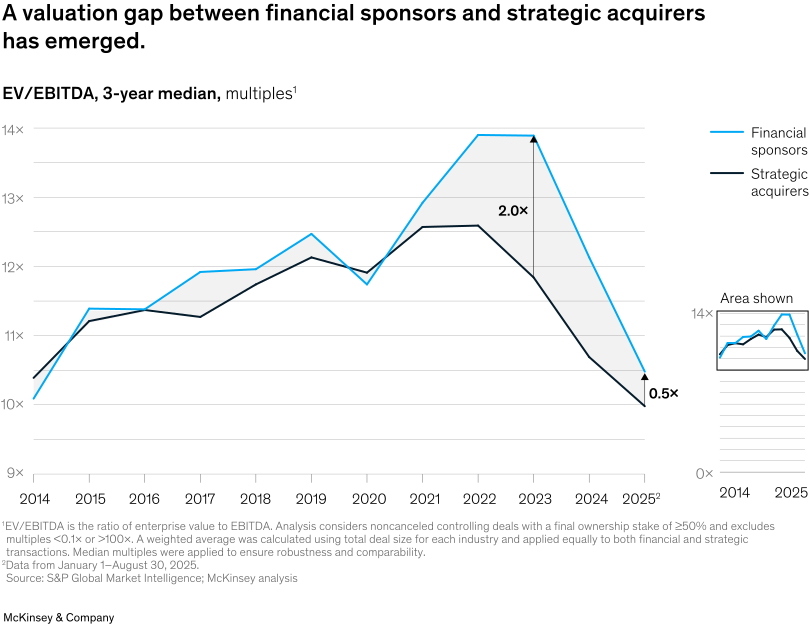
M&A is a highly competitive arena, with deal activity rebounding after the slowdown of 2022–23. Overall valuation levels remain high: Enterprise value to EBITDA (EV/EBITDA) multiples have climbed back to 10.5 times in 2025, in line with recent historical averages, reflecting renewed appetite for transactions. This trend has been largely fueled by strong multiple rebounds in 2025 across America (10.7 times) and Asia–Pacific (11.0 times), while Europe slightly lags behind with a multiple of 8.9, hovering near historical lows.

Strategy and value in turbulent times: The four foundations that drive long-term performance
November 12, 2026, 8:30 a.m. ET / 2:30 p.m. CET Join McKinsey experts Andy West and Whitney Zimmerman for a discussion on what it takes to create and sustain value in an increasingly turbulent environment. They’ll explore four timeless foundations of strategy and how leaders can apply them to today’s hardest decisions.
Initially, the EV/EBITDA multiples paid by financial sponsors and strategic acquirers showed no significant difference. However, starting in 2021, a valuation gap emerged, with financial sponsors maintaining high valuation levels (exceeding 12.1 times until 2024), while strategic investors adopted a more cautious approach (Exhibit 1).
This steadily growing gap in strategies peaked in 2023. At the time, financial sponsors were on average paying an 18 percent higher EV/EBITDA multiple than strategic acquirers—a twofold gap. Since then, the gap has narrowed but remains significant, with a current difference of 0.5 times, equating to financial sponsors paying approximately 5 percent higher valuation levels in 2025.1 This trend is particularly pronounced in industries such as energy and natural resources, industrials, consumer packaged goods, and retail.
Historically, investors viewed strategic buyers as the best owners of assets because of deal rationales such as scale effects and industry consolidation. Strategic acquirers were also able to pay higher multiples because of their ability to capture synergies. More recently, however, a critical hallmark of best ownership is the ability to maximize value creation, and sponsors have positioned themselves to benefit from this shift by focusing on transformation. They have realized operational improvements in portfolio companies by streamlining operations and support functions, creating commercial excellence, and maintaining a rigorous emphasis on growth. They have deployed flexible deal and governance structures. Leverage also remains an important tool for sponsors, enabling them to enhance returns and support higher valuations. It was particularly effective during the era of low interest rates and cheap financing, until early 2022. Since then, rising interest rates and macroeconomic challenges such as inflation have slightly tempered this effect.
At the same time, PE’s “dry powder” has more than doubled since 2014, creating pressure to deploy capital and intensifying the competition for attractive, cash-generative assets. Having proved that they can sustain high valuations, many sponsors are now leaning into synergy-driven plays themselves. These include rollups of portfolio companies and “string of pearls” strategies. Such strategies help them maintain their lead in value creation.
To ‘get the deal,’ synergies are crucial for strategic acquirers
For strategic acquirers to effectively compete with PE buyers, they must leverage their key structural advantage—synergies—and outperform in this area. That will mean adopting a broader view of the diverse types of synergies available. Traditionally, value creation through synergies has primarily been centered on cost reduction. However, the most successful acquirers create value by harnessing a combination of cost, revenue, and capital synergies, often within a single transaction. Strategic acquirers that excel in identifying, quantifying, and capturing a full range of synergies will secure a competitive edge in the evolving M&A landscape.
Cost synergies
Some players are already doubling down on cost synergies as a means to create value: Announced cost synergies as a percentage of the target’s cost base for 2024 and 2025 are significantly exceeding the historical average of about 16 percent (Exhibit 2). This signals a shift toward more aggressive synergy realization targets, topped only by the aspirations in 2020–21.
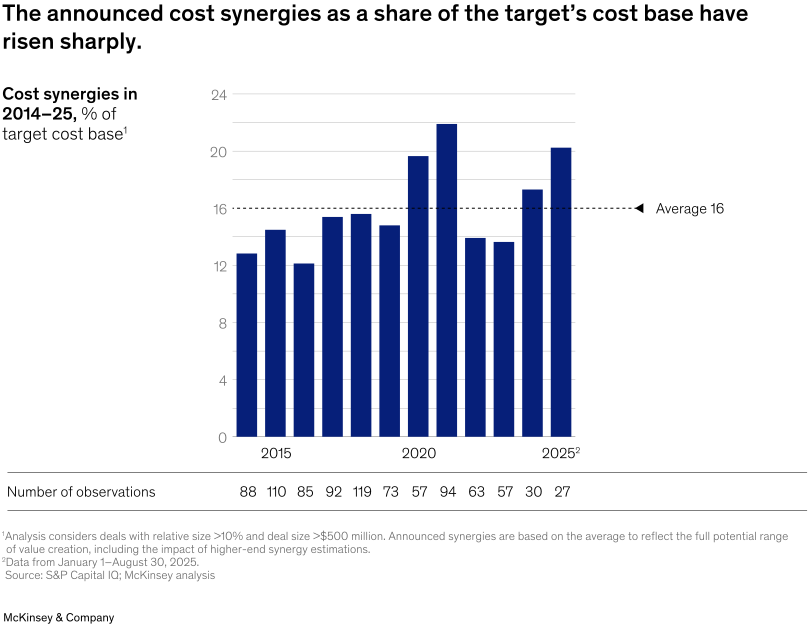
The push for more ambitious cost synergy announcements is not being driven solely by financial sponsor competition and the associated valuation gap. During periods of geopolitical and economic uncertainty, investors often demand clearer and more compelling deal rationales, rejecting transactions that fail to meet heightened synergy criteria. Higher interest rates can influence investors, as these raise the weighted average cost of capital and thus require greater synergies to make deal calculations viable. Furthermore, companies have become more adept in recent years at synergy-related value creation, which allows them to be explicit up front about their bolder aspirations. This is especially the case for programmatic acquirers; they align most closely with best-practice capabilities throughout the deal cycle, from strategy and sourcing to diligence and integration. Programmatic acquirers have shown that they can achieve higher TSR alongside lower long-term risk. Their approach, requiring more than two deals per year with meaningful market capitalization, allows them to continually refine their M&A playbooks and synergy blueprints2 (see “Five steps to strengthen M&A capabilities, no matter the starting point”).
Capital synergies
While companies can boost operational efficiency by targeting cost synergies, capital synergies enable the optimization of capital structures and support growth and transformation by freeing up cash. This helps create more resilient balance sheets with which to navigate uncertain markets. Capital synergies are less commonly emphasized than cost synergies and are announced even less frequently, which makes it challenging to conduct long-term quantitative analysis across deals.
Revenue synergies
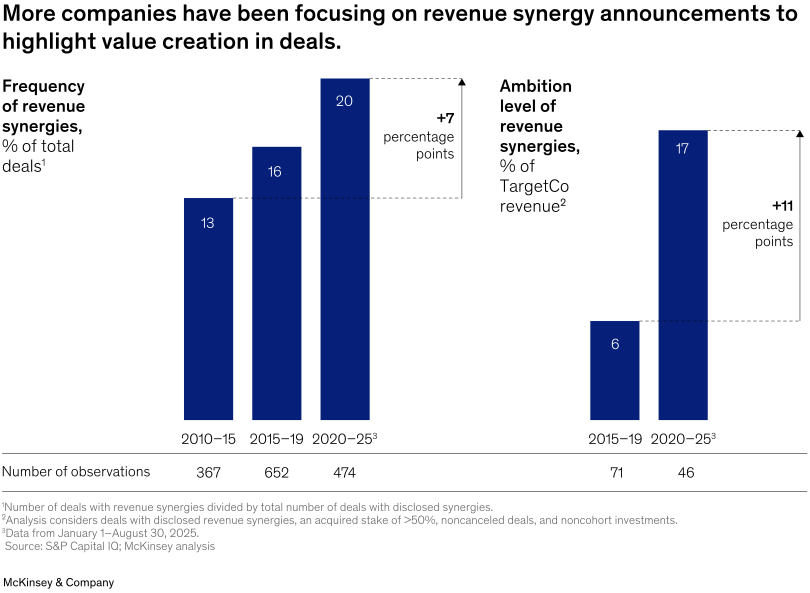
Revenue synergies, the third type, play an increasingly critical role in the value creation story for deals. This shift is partly driven by changes in deal rationales, with a notable rise in “step out” deals (in other words, deals outside acquirers’ core sectors) that often rely on significant cross-selling to be justified. It also reflects heightened demand from investors for clearer and more tangible deal theses: What are the combined companies’ growth vectors, beyond the traditional, quick-win cost synergy opportunities? By announcing growth expectations that are above those for historical deals, companies can show stronger conviction in their transactions based in part on the revenue synergies they can generate. They can also set bolder ambitions for incremental top-line impact.

2026 M&A trends: Navigating a rapidly rebounding market
Within the universe of deals with companies that have set public synergy targets, the share of transactions that included an initial view of potential revenue synergies has climbed from about 13 percent during 2010 through 2014 to almost 20 percent over the past five years. Furthermore, rather than anchoring on improved efficiencies, announced revenue synergies represented a median of 17 percent of the target company’s revenues from 2020 onward, nearly tripling the 6 percent of 2015–19 (Exhibit 3).
Following their initial deal announcement, companies have even placed additional emphasis on proving that they can deliver on their revenue synergy commitments by providing synergy performance updates and outlook revisions. A recent notable example includes FIS raising its external revenue synergy goal for its merger with Worldpay from $500 million to $550 million not even a year following its 2019 deal close.3 Another example is Chart Industries, which reported that it had generated $530 million in top-line benefits from its purchase of Howden, exceeding its original guidance by more than 50 percent.4
We observe a consistent trend of strategic acquirers not only raising the bar for synergy targets over time but also increasing both valuations and public synergy commitments during competitive bidding processes to secure a deal.
In some cases, the drive to complete the deal pushes strategic acquirers to surpass even their own original synergy aspirations. For instance, in 2021, Canadian Pacific Railway made an initial $29 billion bid to acquire Kansas City Southern Railway Company, which included an anticipated $780 million in EBITDA impact from potential cost and revenue synergies.5 Shortly after, Canadian National Railway Company countered with a $33.7 billion offer that featured an even higher $1 billion EBITDA synergy target.6 Although Canadian National Railway’s bid was ultimately unsuccessful because of regulatory challenges, Canadian Pacific Railway responded by revising its offer to match the $1 billion synergy outlook in its final $31 billion purchase price.
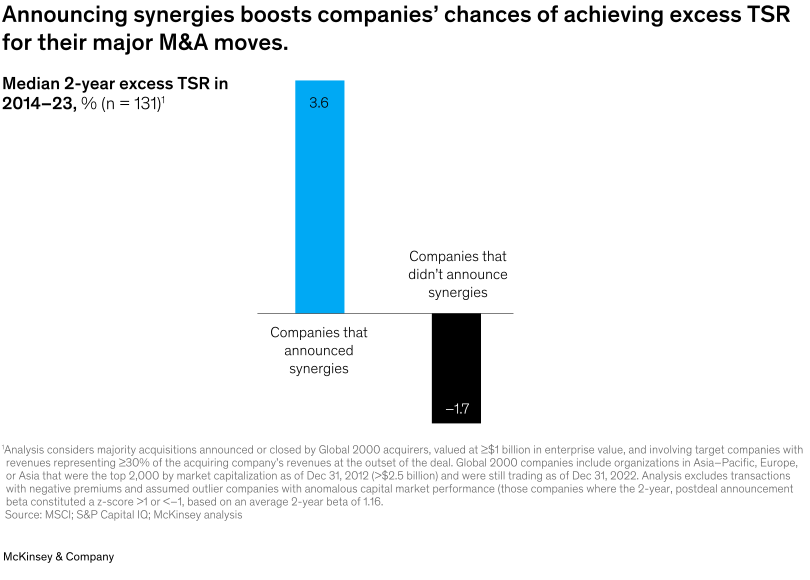
Making bold synergy commitments serves a greater purpose than simply helping strategic acquirers clinch the deal. Investors highly regard strategic buyers that pursue value creation in M&A with broader transformation as the goal, embracing ambitious synergy targets as part of their approach. Consequently, acquirers that publicly announce synergy goals for their major transactions outperform in TSR by approximately 3.6 percent relative to minus 1.7 percent of those that do not (Exhibit 4).
A transformation mindset enables strategic buyers to outperform
For strategic buyers, articulating the rationale for each transaction is an essential first step, as this identifies the most critical types of synergies for value creation. For instance, “tuck in” acquisitions often require more targeted integrations to deliver cost synergies in single business units, while industry consolidation plays tend to prioritize back-office cost efficiencies. Conversely, M&A deals aimed at geographic expansion typically generate substantial region-specific revenue synergies.
After clarifying how deal rationales influence synergy potential, companies should diligently apply best practices related to synergies in order to bid for the target’s true value, get the deal, and maximize value creation (Exhibit 5).
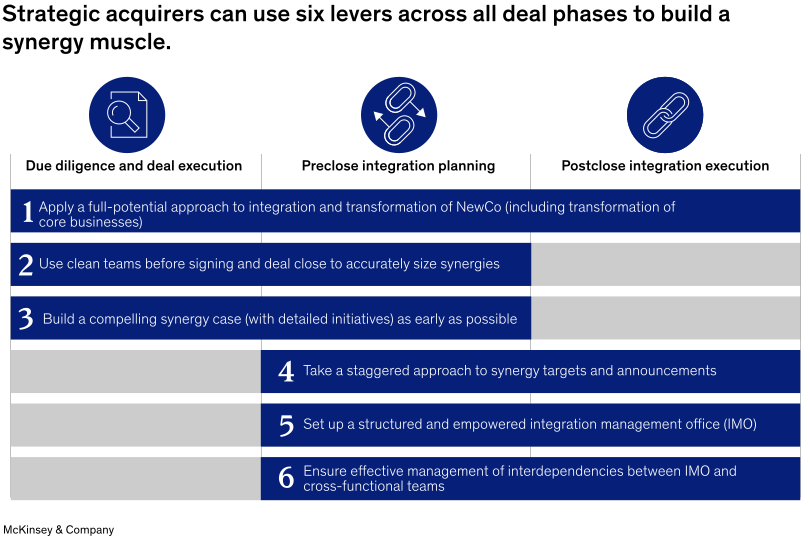
Applying a full-potential approach across the deal cycle with a transformational mindset
Synergies are not just about combining and improving revenue streams, cost bases, or capital; they can be a lever for true transformation for both target and acquirer. Financial sponsors consistently look at potential deals through a “full potential” lens, while many strategic buyers limit themselves to more narrow combinational synergies such as cross-selling possibilities or a footprint overlap. They often shy away from truly transformational levers, particularly when synergy capture is associated with high investments or larger transformation efforts. This means opportunities to fundamentally reshape and improve the target and the acquirer’s effectiveness often remain untapped, whereas the transformational mindset of financial sponsors maximizes value creation potential (Exhibit 6).
Take an automotive supplier consolidation: Rather than simply merging R&D budgets, the acquirer can use the integration to redesign R&D processes around automation, analytics, and generative AI. For instance, software testing can be rebuilt with higher automation shares from day one, creating faster cycles, better quality, and lower cost. That is a different level of value creation than just “adding up” existing teams.
Applying this full-potential approach means not stopping at consolidation and value creation with a focus on the target. Instead, every deal can be treated as a trigger for transformational change for the entire new company. That involves challenging how sales, operations, and R&D are run in both companies, leveraging proven playbooks from either company, and redesigning operating models for step change performance. A disciplined, technology-enabled approach avoids leaving value on the table—and creates a prime opportunity to bring transformational change to the entire organization.
Detailing synergies early on using clean teams and driving planning in the integration phase
A recurring challenge in paying for synergies is uncertainty about what is truly achievable. Clean teams are a proven way to reduce this uncertainty. They can be independent third parties or a carefully selected subset of internal employees, always cleared and overseen by legal counsel to ensure full compliance with antitrust rules. In practice, such teams analyze sensitive competitor data in a controlled environment and report only the results, such as quantified overlaps or synergy potential, rather than the details of the underlying analysis. Boards and decision-makers can use this information to help set deal pricing and integration plans without exposing or being exposed to sensitive data.
In sales and procurement, for example, a clean team can match customer and supplier lists from the buyer and target and report only the financial overlap without disclosing names. This provides clarity on, for instance, cross-selling opportunities before signing, while also forming the basis for day one customer approaches and supplier discussions. For strategic buyers, which face inherent conflicts when accessing competitor data, clean teams are often the only way to establish the same level of fact-based confidence in synergies as financial sponsors.
Clean teams help maximize value. They can be deployed early to validate the synergy case with hard facts and can then extend their role into bottom-up detailing and day one execution planning. The more granular and credible the synergy case, the better it can be communicated to capital markets, investors, and company teams. This credibility not only reduces risk but also sharpens deal decisions and creates the foundation for faster, more certain value capture. Clean teams are not a compliance checkbox; they are a strategic lever to derisk, accelerate, and unlock the full potential of the transaction.
Building a credible, actionable, and immediate synergy case unlocks maximum value in M&A
A successful synergy case is not solely built on top-down assumptions or benchmarks without sufficient context. It requires discipline early in the diligence process. Three factors need to come together: rigorous bottom-up planning, strong involvement from the top team, and clear prioritization of the highest-impact levers. While benchmarks can serve as useful initial indicators of priorities, a credible synergy case is built on functional deep dives and detailed bottom-up planning, especially in areas with the greatest value creation potential. Equally important, those responsible for execution will need to validate the results and refine them to direct leadership focus where it will have the most impact.
Instead of assuming a generic 20 percent savings for SG&A, functional teams should ideally size specific, actionable opportunities as the deal matures. In procurement, this could mean consolidating supplier bases, channeling volume into fewer frame agreements, and negotiating better terms. In functions, the different HR headquarters might be merged into one location, while finance shared services are reduced to a single hub. In the footprint, overlapping R&D or production sites can be consolidated or repurposed to create a leaner, more efficient network. On the top-line side, cross-selling opportunities through a complementary footprint can be quantified early to add further credibility. Buyers can reinforce this process with a “value capture summit” before day one, where clean-team insights, functional detail, and CEO-level attention come together to align leadership on priorities.
A bottom-up synergy case needs to be built early on with increasing levels of detail throughout the deal process, such as breakdowns per site. The synergy case needs to be owned by leadership, with the most important synergies grounded in evidence and execution reality, not just benchmarks. The focus should be on the few initiatives that truly move the needle, with the top team aligned on them from the start. Cost levers like headquarters consolidation, supplier integration, and footprint rationalization can be combined with revenue levers like bundling and cross-selling to create a complete story that’s credible in the market and actionable internally. Without this discipline, synergy cases would remain abstract wish lists. With it, they become the foundation for confidence, execution, and long-term value creation.
Creating a clear hierarchy of synergy targets balances market credibility with maximized value creation
The highest-value deals succeed because they carefully separate internal ambition, internal business case, and external communication. Internally, functional leaders, the integration lead, and top management set stretch targets that reflect the full potential of the deal, including transformational initiatives such as outsourcing, automation, or standardization. These internal targets form the basis of the business case. External communication is deliberately more modest and focused on quick wins. This tiered model ensures internal ambition, discipline in decision-making, and credibility with investors and stakeholders.
Internal management targets are set at full potential, reflecting the total opportunity if transformational levers are fully utilized. The business case then reflects this ambition, factoring in some implementation leakage and realistic timing. It is crucial to revisit and reassess these internal synergies once the business has been acquired. Too often, executive teams are unwilling to go beyond the synergies that they committed to during due diligence, effectively setting value with the brakes on. This lack of ambition can leave significant opportunities untapped. A postacquisition review of synergies allows leadership to challenge initial assumptions, identify new levers, and push for greater value creation beyond the constraints of the diligence phase.
External announcements focus on opportunities that come with a high level of certainty, such as overlapping functions or straightforward procurement savings. Financial sponsors push this model with far greater pace and ambition, particularly in the critical first year. They drive aggressive full-potential targets from day one, translate them into business cases with minimal leakage, and tie them to management incentives.
Rigorous application is called for. Teams need to be stretched to meet full-potential internal targets, translating them into a demanding but realistic business case and communicating only what can credibly be delivered. Above all, management incentives should be aligned directly to synergy milestones rather than generic EBIT or revenue metrics. Financial sponsors show what best practice looks like: They front-load value creation by driving more than half of synergies in year one, tie a significant portion of management compensation directly to delivery (often linked to equity), and embed operating partners to enforce accountability. Strategic buyers can capture greater value by adopting the same pace, ambition, and incentive discipline.
Driving synergy realization and long-term value with a well-structured integrated management office
An integration management office (IMO) acts as the control tower of M&A integration, providing transparency, alignment, and disciplined execution. Through structured governance—regular reviews, dashboards, and clear escalation processes—the IMO ensures accountability and keeps milestones on track. With fully dedicated resources from both organizations, it becomes the central engine for driving synergy realization and sustaining long-term value.
A best-practice IMO combines two elements. First, it provides a strong governance backbone: senior integration leaders, weekly reviews, and a clear escalation path. Strategic buyers can take a page from financial sponsors here, appointing an “integration CEO” with the mandate to make quick day-to-day decisions, mirroring the fast, empowered decision-making often seen in PE deals. Second, the IMO taps a dedicated value creation team to work hand-in-hand with functional leaders to size, track, and deliver each synergy lever. Each initiative has a named owner, measurable KPIs, and disciplined follow-through, ensuring that opportunities do not slip into vague intentions.
Such moves require building an IMO that is more than a reporting function. It needs to be the driver of value. It can be staffed with dedicated senior leaders who have the authority to act without waiting for biweekly or monthly steering committees. Empowering an integration CEO helps hardwire fast decision-making. A value creation team needs to push functional leaders to own their synergies, track them against KPIs, and deliver on time. Best-in-class acquirers leverage transformation best practices: Synergy-related initiatives are categorized by the maturity levels L1–L5 (for example, L3 includes a business case and implementation plan with a clearly defined timeline), while the IMO maintains a strong drumbeat to ensure initiatives progress through maturity levels on time. Above all, the IMO should be treated as the deal’s operating system: Without it, synergies drift; with it, they are captured early, and momentum is maintained for long-term transformation.
Establishing effective interdependency management and cross-functional collaboration
Most synergy levers do not sit neatly within a single function but depend on collaboration across multiple parts of the business. Procurement savings rely on R&D aligning specifications and the supply chain providing clean demand data. Commercial synergies call for product, pricing, and sales teams working in lockstep. Footprint optimization requires coordination among operations, HR, and finance. Without structured orchestration, these interdependencies slow down decisions, create bottlenecks, and lead to value leakage. Successful acquirers make managing these links and driving collaboration a central part of their integration playbook.
Leading buyers embed cross-functional collaboration into the IMO, which maps interdependence across functions, assigns clear joint ownership, and enforces sequencing with shared milestones and KPIs. For instance, a procurement workstream only moves forward once R&D has harmonized designs and the supply chain has validated demand forecasts. By making these dependencies explicit and ensuring teams plan and act together, value capture accelerates instead of stalling. Day one readiness is critical here: Joint planning sessions and cross-functional decision forums ensure that dependencies are addressed before they become roadblocks.
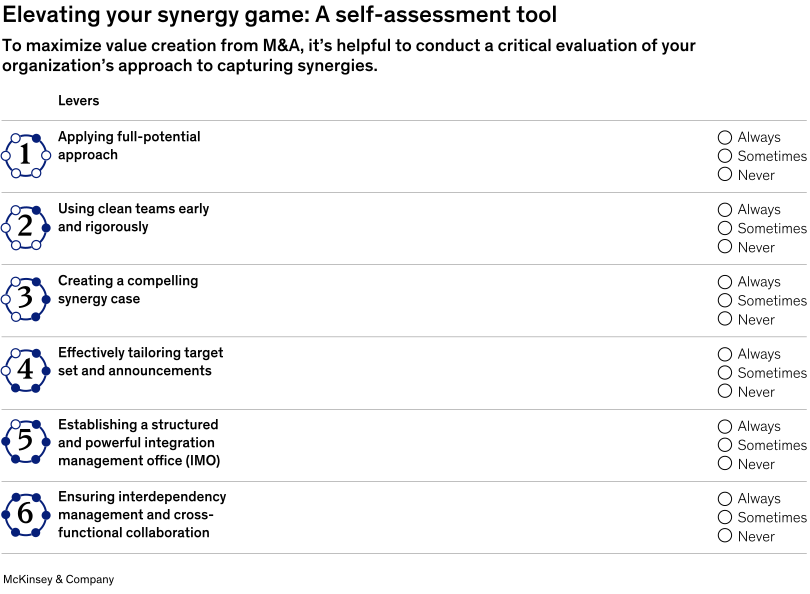
Bringing these elements together makes it clear that capturing synergies is not a single initiative but a system of reinforcing practices. Strategic buyers that elevate synergy delivery to a CEO-level agenda, with clear ownership and private-equity-style discipline, consistently outperform those not going beyond initial benchmarking or incremental approaches. Ultimately, the winners in M&A will be those that transform synergy delivery from a one-off exercise into an ingrained capability, a true synergy muscle. This will enable them to compete head-to-head with financial sponsors and create lasting value.
Read the full report on which this article is based, 2026 M&A trends: Navigating a rapidly rebounding market.