The industry overview
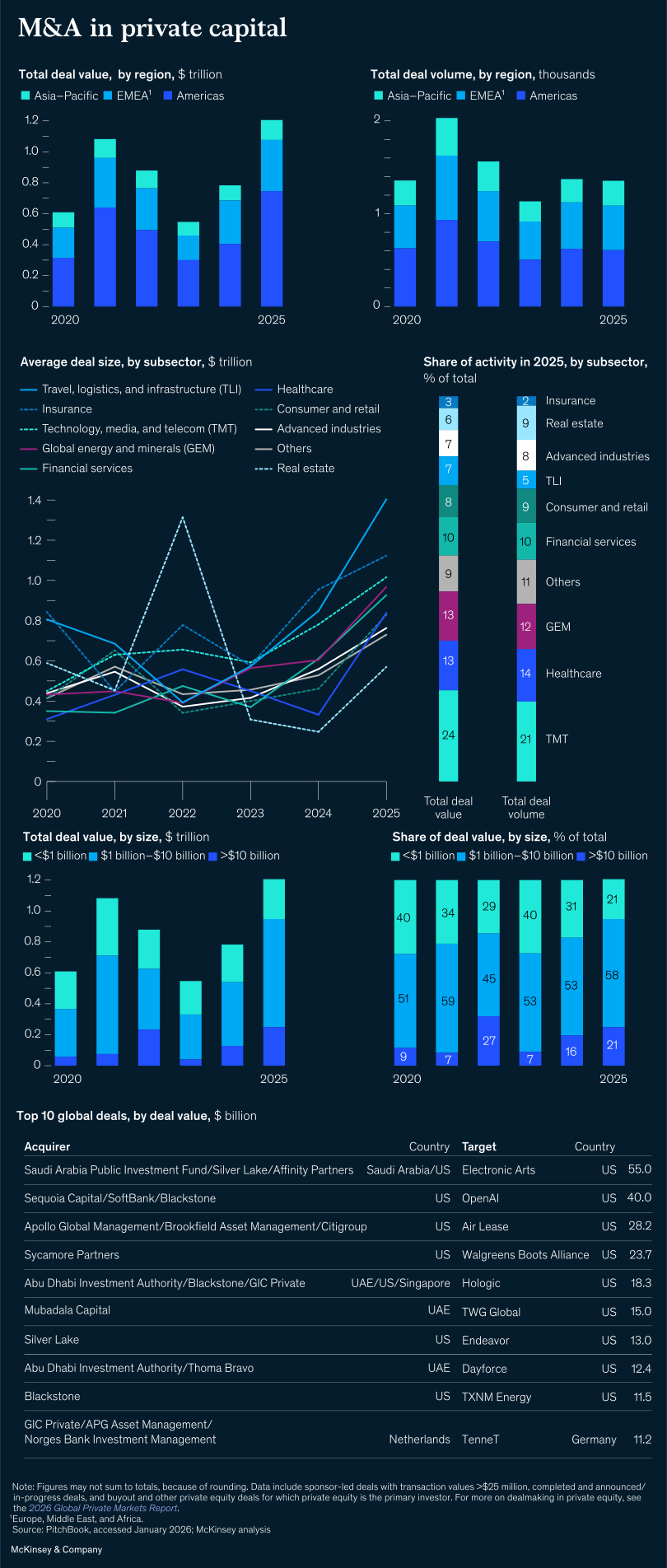
After the turbulence of the past few years, marked by rising interest rates, inflation, and geopolitical uncertainty, there was a cautious but clear rebound in 2025 in global M&A activity involving private capital. Over the course of the year, aggregate deal value reached approximately $1.2 trillion, up 54 percent compared with 2024.
The rebound continues to reflect guarded optimism among private-capital investors, given recent macroeconomic shifts: Inflation moderated, central banks paused or reversed rate hikes, and credit markets saw continued growth for leveraged transactions, with record volumes of loans for buyouts in 2025, according to data from PitchBook. What’s more, the continued expansion of private credit helped unlock deal activity by providing more flexible financing structures. Direct lenders increasingly filled gaps left by traditional banks through innovative combinations and partnerships—for example, UBS partnered with General Atlantic to co-originate private-credit loans in May 2025.
Private capital’s share of global M&A activity continued to grow in 2025. Sponsors accounted for roughly 26 percent of global deal value, an increase of two percentage points compared with 2024 figures and an increase of eight percentage points from 2023. The amount of dry powder available remained elevated at about $2 trillion, while the industry continued to cope with a historically large inventory of portfolio companies. Extended holding periods, averaging about six years, have compounded this situation. They put pressure on sponsors to actively manage portfolios, reassess exit readiness, and create paths to liquidity.
The Americas accounted for 62 percent of global M&A activity among private capital players in 2025 and registered $746 billion in announced transactions, an increase of 84 percent compared with 2024. Europe registered $331 billion in announced transactions (an increase of 18 percent year over year). Germany, Italy, and the Nordic countries recorded strong activity, offsetting slower M&A growth in France and Spain.
There was continued interest in 2025 in cross-border M&A among private-capital investors. The deal corridor between the Americas and Europe, the Middle East, and Africa remained active; Middle Eastern and Canadian funds expanded into Western markets; and Asian investors increased their outbound activity, particularly in Australia and North America.
The structure and nature of private-capital transactions also evolved. In 2025, 13 private-capital-led transactions above $10 billion were announced, marking a resurgence of large, transformational deals. Take-private transactions reemerged as investors sought listed assets trading below their intrinsic valuations. Carve-outs and spin-offs remained robust as corporates under pressure from activists simplified their portfolios. Simultaneously, the return of IPO markets and the growing use of continuation funds and net-asset-value-based loans enhanced sponsors’ flexibility to manage portfolios and recycle capital.

2026 M&A trends: Navigating a rapidly rebounding market
Subsector activity
A closer look at private-capital M&A activity in 2025 reveals the degree to which it was shaped by three cross-sector forces: digitalization and the rise of AI, the energy transition, and infrastructure modernization. Collectively, these trends steered private-capital investors’ dealmaking toward assets offering long-term growth and scalability.
The technology, media, and telecommunications (TMT) sector continued to shape the market’s overall direction. Deal value involving TMT transactions reached $285 billion (an increase of 33 percentage points from 2024) and accounted for nearly one-quarter of global activity—similar to the share of total figures seen between 2020 and 2022. Investors’ focus on digital infrastructure and cybersecurity kept pricing at elevated levels, with transactions typically valued at around 14.6 times enterprise value and EBITDA.
Technological advances also underpinned the exceptional performance of M&A deals in life sciences, which was the fastest-growing sector of the year. It recorded $155 billion in announced deals (an increase of 166 percent compared with 2024) at multiples near 14 times, driven by opportunities in digital health and AI-enabled biomanufacturing.
Meanwhile, the global energy transition accelerated capital deployment in global energy and materials, which climbed to $154 billion in recorded deals (an increase of 47 percent compared with 2024) and represented 13 percent of overall private-capital-driven M&A activity. Deals in this subsector typically traded around 16.8 times enterprise value and EBITDA and were partly driven by electrification requirements and decarbonization mandates.
Similar dynamics strengthened the travel, logistics, and infrastructure (TLI) sector, which benefited from organizations’ reconfiguration of supply chains and renewed investment in critical assets. TLI-oriented M&A deal value rose to $90 billion (an increase of 66 percent from 2024), with pricing levels around 12.3 times EBITDA, underscoring the strategic relevance of logistics and infrastructure to global resilience.
Digitalization remained an important factor in financial services M&A, where deal value reached $121 billion (an increase of 69 percent from 2024). Transactions in the sector exhibited the highest average pricing among all private-capital-driven deals, supported by the expansion of wealth technology, payment solutions, and private-credit platforms. In consumer and retail, deal activity increased to $99 billion (a 52 percent increase from 2024), though performance varied sharply across categories: Food and beverage assets continued to command valuations around 13 times EBITDA, while discretionary and fashion assets attracted softer pricing.
M&A in real estate increased about 166 percent year over year, to $68 billion, with an average multiple of 12.3 times EBITDA. As for M&A in other sectors, deal value in advanced industries grew to $82 billion (an increase of 35 percent compared with 2024), and deal value in insurance reached $37 billion (8 percent above 2024).
Opportunities for 2026—and beyond
Our research and discussions with industry leaders suggest that four themes will inform private-capital dealmaking in 2026.
Sustained tailwinds and favorable conditions are set to endure
Uncertainty remains a constant for private-capital investors, with the cost of capital still above levels from the 2010s. But it’s more likely that improving conditions and existing tailwinds will endure in 2026: Interest rates are stabilizing, financing is now more readily available beyond traditional banks, valuations have eased, and there has been a steady flow of corporate portfolio realignments. These conditions translate into opportunities to “buy the future” on favorable terms for those teams that blend analytical rigor with execution speed.
Large deals are being supplemented by more midsize opportunities, potentially due to deal timing
Investors observed a “two speed” dynamic when it came to dealmaking in 2025. Headline-grabbing megadeals, such as Apollo’s purchase of Air Lease in September 2025, helped lift overall deal value. By late 2025, however, sponsors were also focusing on midsize opportunities. Investors demonstrated greater discipline, more selective underwriting, and greater adaptation to a financing market that was supportive of smaller deals. Longer holding periods, which have increased from roughly four years to six years over the past 15 years or so, further intensified the pressure on funds to recycle capital. Beyond influencing deal size and pacing, the inclusion of midsize transactions will have profound implications for portfolio management, as sponsors need to continually re-underwrite assets, refresh equity stories, and double down on value creation initiatives to sustain momentum and preserve exit optionality in a more selective buyer environment.
AI and gen AI are must-haves in the next investment cycle
Technology, digital maturity, and AI capabilities have become defining criteria for target selection. As part of sponsors’ diligence processes, they’re increasingly assigning specialized data teams to assess the AI readiness of potential target companies, the quality of code, data governance, and the feasibility of use case deployment. In short, they’re treating AI (generative and agentic) as a means to create value from M&A rather than purely a source of disruption or disintermediation.
Deal structures are expanding—and getting more creative
A stronger link is emerging between private-capital and corporate M&A. As strategic buyers refocus on inorganic growth heading into 2026, corporates are expected to play a more prominent role as acquirers of sponsor-owned assets. Balance sheets are healthier, and corporates are increasingly viewing private-equity-backed platforms as derisked entry points for scale and capability acquisition. As a result, 2026 is becoming a particularly attractive vintage for sponsors seeking exits through trade sales alongside IPOs and secondary transactions.
Finally, IPO activity increased in 2025, reopening a critical exit channel for private capital across major markets. As an example, in the first half of 2025, the New York Stock Exchange recorded an increase of 40 percent compared with the same period in 2024. Landmark listings such as CATL’s $5.3 billion Hong Kong offering and Klarna’s $1.37 billion US debut illustrate the IPO trend. The variety of exit channels will persist in 2026, and the optionality will encourage even more exits.
Private-capital M&A is set to benefit in 2026 from stabilizing macroeconomic conditions, abundant dry powder, and increases in financing and exit options. Investors will need to prioritize precision over volume; focus on assets that are aligned with long-term themes such as AI, digitalization, the energy transition, and infrastructure renewal; and capture new sources of value with discipline and speed.
Read the full report on which this article is based, 2026 M&A trends: Navigating a rapidly rebounding market.











M&A insights







Related Articles