Key insights
- Execution over exposure: Intrasegment ROIC spread exceeds intersegment spread, so TSR is driven by a company’s operating model and capital deployment, not the end market.
- Scale has shifted from plants to procurement and pricing technology, with the scale premium now anchored by data visibility, digital quoting, and dynamic pricing.
- There is geography asymmetry; North American exposure correlates with higher TSR, but Europe underperforms largely when players are subscale or fragmented. Premium European models still show signs of success.
The past decade has created significant challenges and uncertainty for the building materials industry. The COVID-19 pandemic fundamentally altered the entire short-term supply-and-demand relationship, while supply chain issues, labor shortages, and raw materials price volatility have subsequently continued to disrupt the industry.1
Yet there were outperformers in the past decade. While forthcoming McKinsey work will look at current trends within the sector and the traits likely to determine which companies will thrive in the next decade, this article uses new data to answer two critical questions: How has the industry performed financially since 2015? And what success factors supported top-performing companies during that period?
Our analysis, which focuses on the financial performance of 102 publicly listed companies in North America and Europe between 2015 and 2024, finds the building materials industry as a whole has performed strongly. Value creation measured by TSR has been solid, with a CAGR of 12 to 13 percent for the decade. Much of this success was driven by an increasing number of new builds and renovations and higher prices after supply chain disruptions in 2021.
Two patterns stand out. First, dispersion within product categories meaningfully exceeds dispersion between categories, underscoring that operating model and capital deployment choices lead to value creation rather than just “what you sell.” After all, the building materials market consists of thousands of product categories, spanning raw materials, finished items, and everything in between (for more on our approach to analyzing the nuances of financial performance across categories, see sidebar, “Research methodology and segment overview”). For example, each light materials subsegment contains at least one company delivering a ROIC ten percentage points higher than the peer median. Performance gaps have also increased over time: Companies in the top TSR quartile of our data set—which includes companies from nine of our ten subsegments (nine light materials subsegments and heavy materials)—saw ROIC increase in the past decade, while bottom-quartile players saw a decline.
Second, the scale premium has evolved: The research shows leaders are seeing success from scale via procurement leverage, data visibility, and disciplined pricing systems rather than solely through manufacturing footprint. Understanding “how to play” is more important than “where to play.”
Together, these dynamics help explain why some companies compound TSR despite similar category exposure. The company-level factors most predictive of top-quartile financial performance—which we refer to as success factors—relate to scale and the level of M&A activity, the degree of focus on product segments, and the geographical distribution of revenue. This article concludes with an analysis of how three companies enhanced their financial performance by pursuing context-specific combinations of these success factors.
Understanding the industry’s financial performance
While the building materials industry as a whole has performed strongly over the past decade, the picture becomes more nuanced when looking at variation by company and—to a lesser extent—segment.
Company-level performance varies significantly—and the range is widening
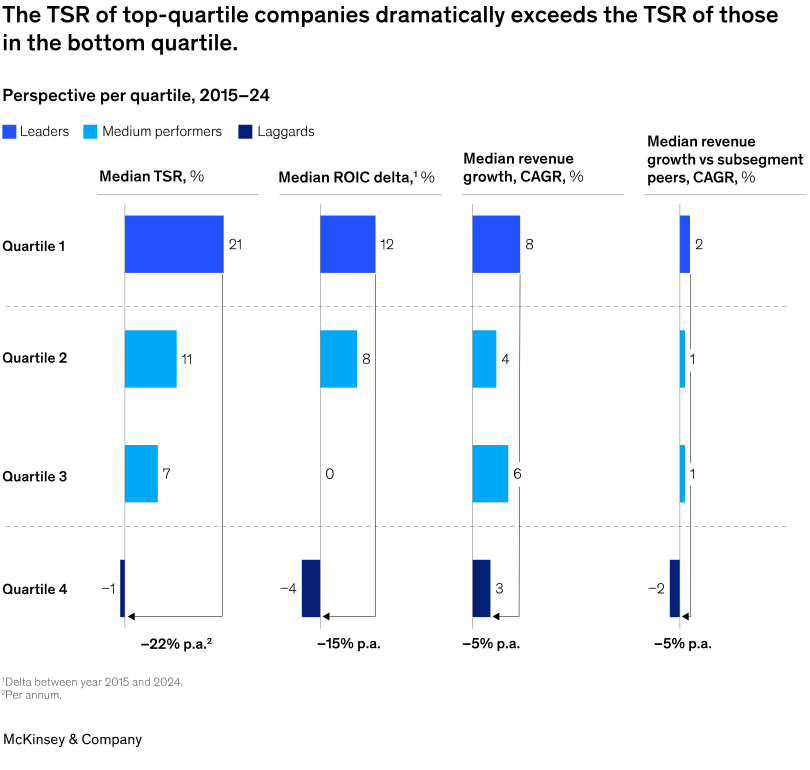
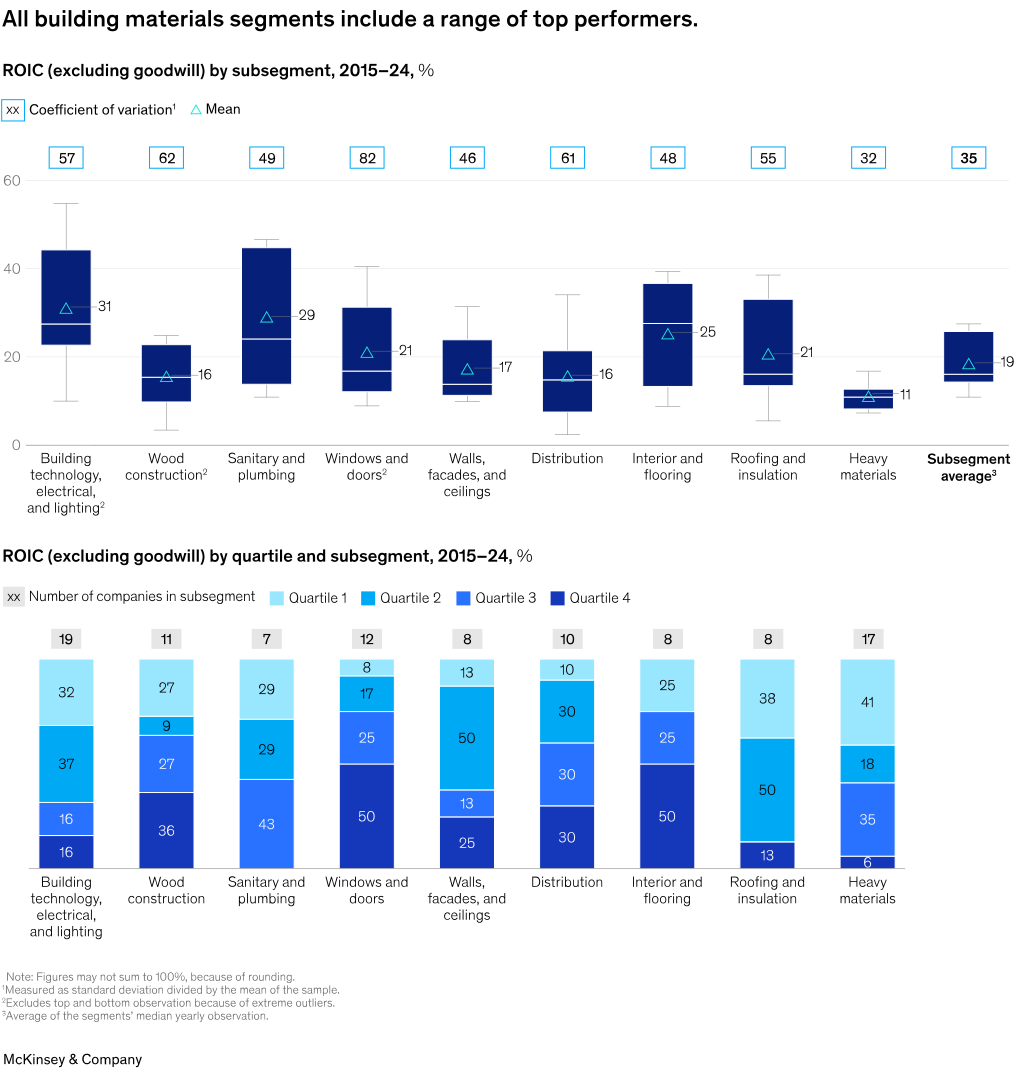
While absolute returns were healthy, the investor story is one of dispersion and widening spread. Within each subsegment we observed a broad ROIC range, often of more than 20 percentage points between lower and upper quartiles (Exhibit 1). This intrasegment gap outstrips most intersegment differences, implying that execution choices—pricing governance, SG&A efficiency, working-capital discipline, and reinvestment cadence—were the dominant differentiators. Performance gaps have also increased over the decade across a range of metrics:
- ROIC. The change in ROIC between 2015 and 2024 of companies in the top quartile of our data set was 16 percentage points higher compared with those in the bottom quartile (12 percent compared with –4 percent, respectively).
- Revenue growth. Top-quartile players saw revenue grow at a CAGR one percentage point higher than the median for companies in their subsegment and five percentage points higher than bottom-quartile players.
- Profit margin. The profit margin of top-quartile players was 6.2 percentage points higher than those in the bottom quartile (a 3.5 percent annual increase in profit margins compared with a 2.7 percent decrease).
Differences in performance across subsegments were generally comparatively small
Heavy and light materials segments differ slightly in financial performance. While public building-materials companies recorded average annual revenue growth of 6 percent from 2015 to 2022, revenue diverged between heavy and light materials from 2022 to 2024. Higher interest rates and increasing construction costs (which primarily affect light materials players, given the stability of public funding for heavy infrastructure projects) pushed average revenue slightly lower for light materials players, while revenue for heavy materials increased.
ROIC also declined for light materials companies and improved for heavy materials companies, although a higher baseline ROIC for light materials companies indicates a convergence in absolute performance. From 2022 to 2024, ROIC for light materials companies decreased by four percentage points from approximately 24 to 20 percent. ROIC for heavy materials companies increased by two percentage points, from 12 to 14 percent. (The next article in this series will look at the impact of external trends and how they affect value generation in the industry.)
When looking across all ten subsegments, however, what is most striking is the range in performance within each. There are top- and bottom-quartile performers present in nine of the ten segments, though the relative shares by subsegment vary (Exhibit 2).
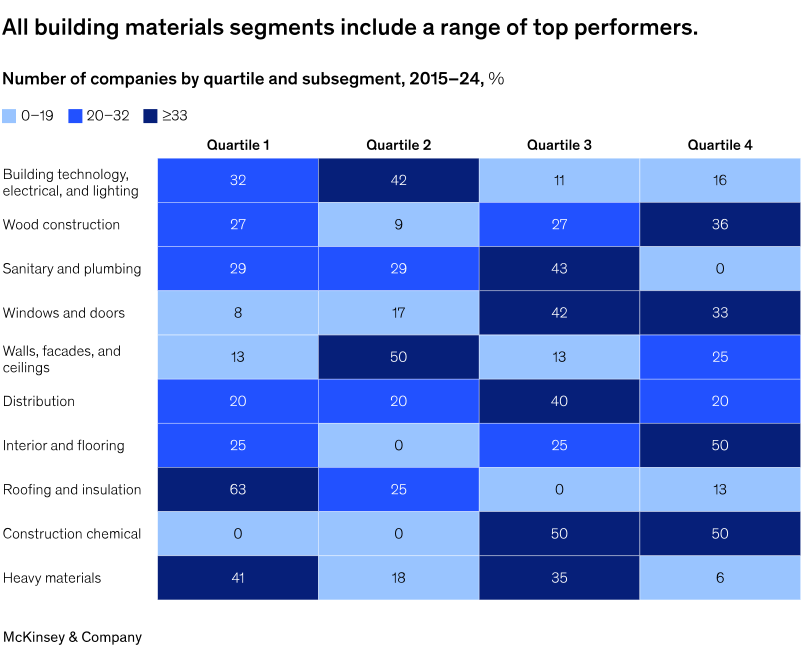
This suggests differences in financial performance across subsegments are generally significantly smaller than differences within subsegments. ROIC variation within subsegments such as the interquartile range—the difference between the lower bound of the first quartile and the upper bound of the fourth quartile—is often more than 20 percentage points (Exhibit 3).
Three success factors of industry leaders
Subsegments have not been a strong predictor of financial success in recent years for building materials companies. Nor does the strategy and commercial model of top-performing companies conform to any one archetype: Some companies achieved success through stronger top-line growth, while others prioritized margin expansion. Strategies varied significantly, even among companies that focused on improving margins. Certain players built a differentiated brand, enabling them to command higher gross margins; others, with more-commoditized portfolios and inherently lower gross margins, compensated through leaner SG&A structures, ultimately maintaining strong EBITDA profiles.
One commonality among high-performing companies is their ability to play to their strengths with discipline and consistency. In our experience, their superior ability to execute against their chosen strategy has typically been underpinned by strong capital allocation, operational rigor, and modern management practices. But are there other common factors beyond a clear strategy and strong ability to execute?
When we examined the share of TSR variance associated with scale and M&A intensity, product focus, and revenue geography, we found a combination of factors explain a substantial portion of cross-company TSR outcomes. In particular, scale and adjacent bolt-on acquisitions show the strongest association with sustained ROIC uplift, product focus correlates with higher gross margin resilience, and geography influences cyclicality and pricing power. We recommend interpreting these as practical “where to look” flags for diligence and capital allocation, not as deterministic rules. This list of success factors is not exhaustive, since we were only able to assess those factors for which we could get consistent quantitative data.
Scale and the level of M&A activity
Companies with more than $5 billion in revenue in 2024 were more profitable, on average, than smaller ones, making up 50 percent of our top-quartile companies (Exhibit 4). On average, large companies—defined as those with revenue of more than $1 billion a year—achieved both a greater increase in ROIC and faster revenue growth than their smaller peers.
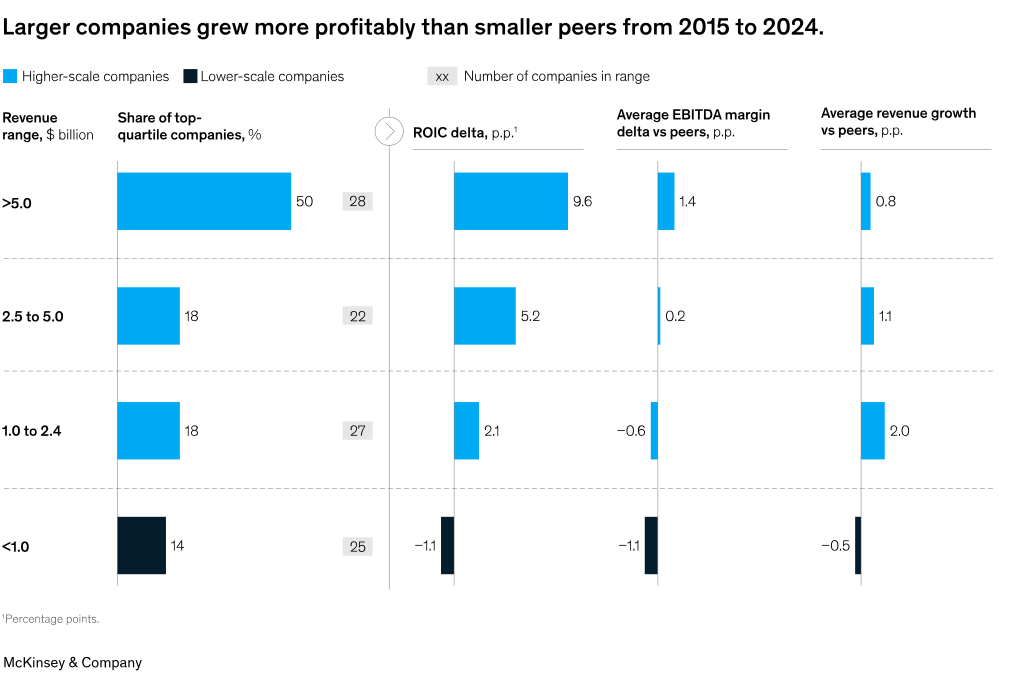
For investors, scale pays through three cash engines: procurement leverage and freight or network optimization that harden gross margin; commercial excellence with high price realization (such as digital quoting, price corridors, and mix management); and lower SG&A as a percent of sales, which is especially relevant in the building material industry given its complex stakeholder landscape spanning installers, architects, distributors, consumers, and others. Importantly, higher M&A activity translates to value only when paired with return discipline such as preset hurdle rates, rapid benefit realization from M&A (such as through procurement or SKU harmonization), and a clear postclose role for centers of excellence. In our data set, the strongest performers combined moderate-to-high deal velocity with strict reinvestment hygiene, while serial acquirers without integration rigor underperformed, despite similar spending.
Given that mergers and takeovers are one route to scale, it is not surprising that our analysis identified a clear M&A strategy as one success factor for building materials players (Exhibit 5). Companies with a high level of M&A intensity—defined as completing more than 18 deals between 2015 and 2024—had an average TSR of 13 percent for that period, some three to five percentage points higher than peers with lower M&A intensity.
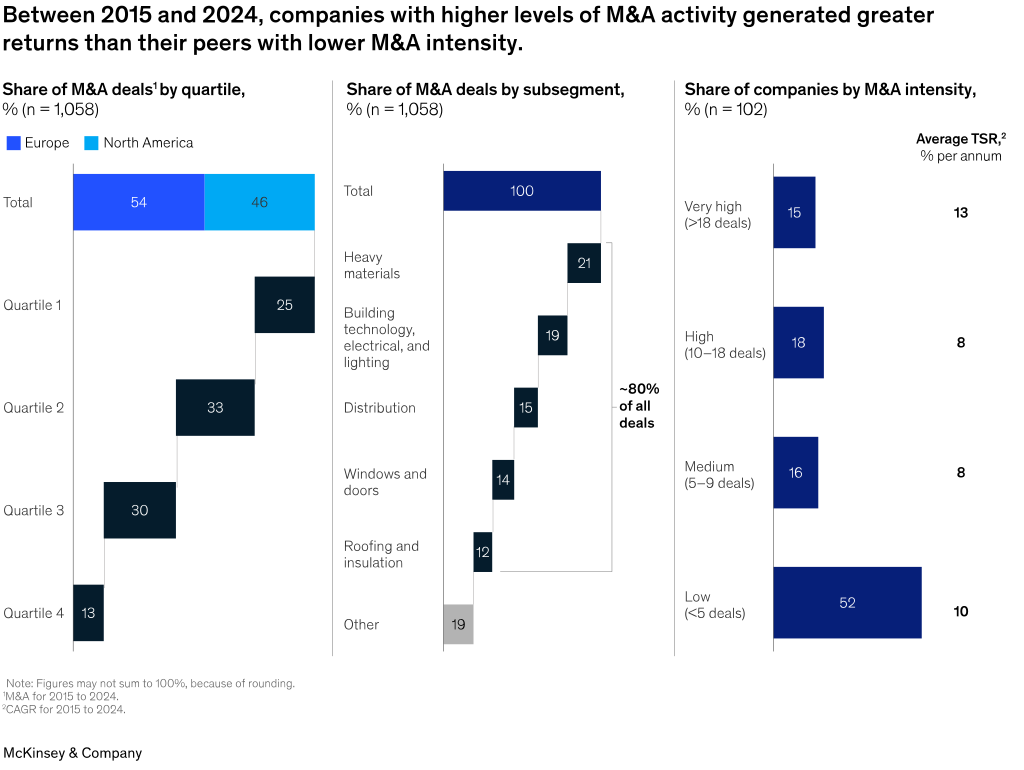
Of course, the extent to which any individual deal is likely to contribute to a strong financial performance (or the converse) depends on a broad array of context-specific factors. In our experience, M&A deals in the building materials industry are most likely to contribute to strong financial performance when focused on improving competitive positioning and strategic integration. For instance, a proactive focus on acquisitions within the same subsegment or closely related subsegments—such as a distributor acquiring a wood construction company—can be a promising strategy. Effective M&A generally also complements a thoughtful organic growth strategy in key markets and may be less likely to be successful when used defensively, even when aimed at ensuring stable access to raw materials.
Capital allocation separated the top quartile from others. The data shows that successful companies recycled cash with a balanced mix of targeted bolt-on acquisitions, organic projects with high internal rates of return (such as unblocking capacity and automation), and consistent capital returns when incremental ROIC fell below set thresholds. Companies in lower quartiles tended to chase volume growth via broad diversification or overpaying for assets lacking procurement or channel synergies. Investors should watch for disclosed hurdle frameworks, buyback through-cycle consistency, and postmerger operating cadence as leading indicators.
The degree of focus on product segments
A relatively high degree of product specialization is associated with a higher probability of financial success. Our analysis finds that the average TSR of companies active in just one subsegment and close adjacencies is six percentage points higher than companies active in multiple subsegments or that are also active outside the building materials market.2
Specialization wins when it reinforces a capability flywheel: Narrower portfolios enable deeper loyalty with channel partners, faster SKU rationalization, and tighter price-pack architecture.3 Diversification adds value only when adjacencies share procurement pools, manufacturing platforms, or routes to market. Otherwise, complexity increases SG&A and erodes pricing realization. One practical question investors can ask to assess specialization is if adjacencies share at least two of these three attributes: supplier base, production process, or channel.
The geographical distribution of revenue
Geography is a headwind only when coupled with a subscale structure and footprint. Our analysis shows a correlation between geographic distribution of revenue and a first-quartile financial performance (Exhibit 6). Building materials companies in the first quartile had a stronger presence in North America, with 76 percent of their revenue coming from this region in 2024. Companies in the fourth quartile had a stronger presence in Europe, with 61 percent of their revenues coming from the region in 2024. In addition, only first-quartile players increased their relative average exposure to countries outside Europe and North America—including growth markets in Asia and Latin America—from 2015 to 2024.
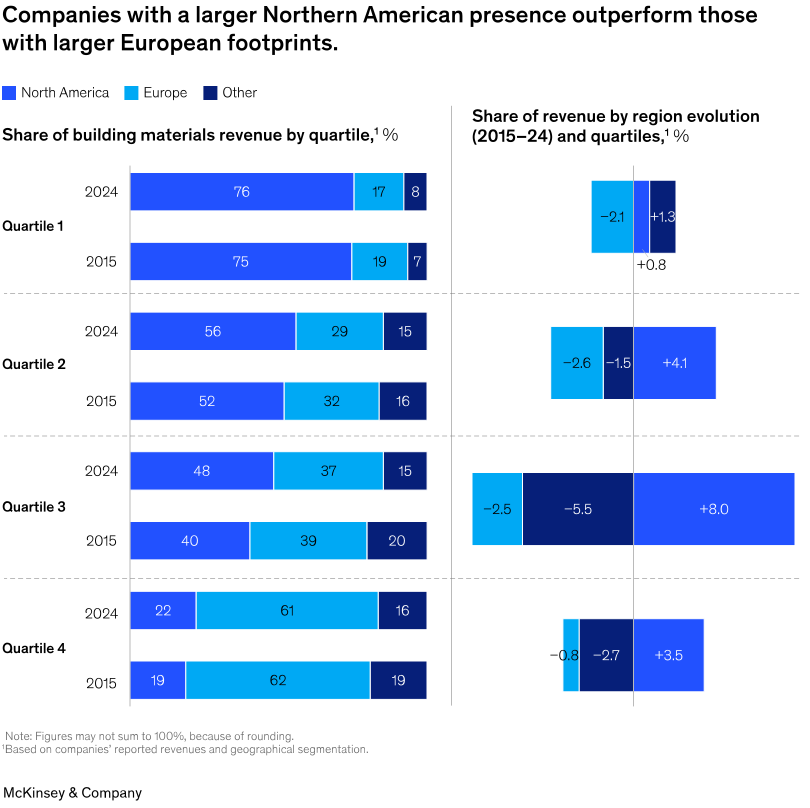
One reason for the differences in the financial performance of building materials companies by geographic focus is likely the relative aggregate economic performance of those regions in the time period examined, with the United States—and some emerging markets—growing consistently faster than Europe between 2015 and 2024.4 Scale also matters more for competitiveness than in the past, which can create disadvantages given the European market is more fragmented than the United States’, and Europe’s large firms have a third less revenue than those in the United States on a sector-by-sector basis.5
Geography mattered, but asymmetrically. North American exposure correlated with higher TSR, given stronger demand and faster price resets. Companies in Europe had weaker performance mainly where portfolios were subscale or spread too thinly across fragmented markets. Notably, scaled or premium-positioned European players, often with export or systems brands, outgrew peers.
Examples of top-quartile financial performance
So what strategies do leading building materials companies employ? This section looks at three companies that significantly improved their financial performance—entering the top quartile—during the past decade, as well as the differing combinations of success factors that enabled them to do so.
Growing organically through geographic positioning and a lean operating model
A North American drainage company increased its TSR eightfold between 2015 and 2024 while pushing its market capitalization beyond $9 billion. M&A was not a major feature of its strategy—the company made only one major acquisition—and it instead focused on organic growth. In particular, the company focused on positioning itself within domestic markets with the highest rates of home construction and migration and on securing agreements with top US homebuilders. To boost margins and TSR, the company also maintained a strong focus on cost management and execution, adopting a lean operating model, increasing capital expenditure efficiency, and optimizing procurement. This organic-first, geography-mix strategy paired with lean operations shows companies don’t need serial M&A if price realization, cost cadence, and market mix are compounding.
Boosting performance with a narrower product and geographic focus
A European HVAC company sold its building systems division to concentrate on core activities that shared the same infrastructure, then exited approximately 40 percent of the countries where it had operated over the preceding three years. It then pursued a targeted M&A strategy, acquiring competitors in core activities while continuing to divest noncore and underperforming parts of the business. The result was a more focused portfolio that accelerated the company’s ability to deliver higher margins and ROIC, driving TSR. This is a classic example of growing through shrinking by pruning the portfolio and using targeted M&A to recenter the infrastructure and raise through-cycle ROIC.
Driving TSR through specialization and scale—including M&A
A US-based building materials distributor focused on home repairs and new construction increased its TSR 11-fold between 2015 and 2024 as its market capitalization grew to $700 million. The core of its strategy was shifting its sales mix from structural products to focus on five key categories of specialty products, with the objective of increasing specialty sales from 70 percent to 80 percent of total revenue. This strategic focus on close-to-core segments—assisted by the acquisition of a competitor with $1.4 billion in revenue in 2018—allowed the company to drive innovation and sustain its competitive edge in the market. Its resulting strong market position enabled the company to capitalize on demand surge after the outbreak of COVID-19, driven by higher renovation activity and lower mortgage rates. This mix shift to specialty products plus scaled procurement created a pricing and cash conversion flywheel—the company’s 2020–22 demand surge simply accelerated a prebuilt engine.
For the building materials industry’s next cycle, we expect the same three success factors to matter—but through slightly different mechanisms. Scale premiums will increasingly be earned via procurement analytics and price governance rather than plant count. Product focus will favor platforms that can innovate and rationalize SKUs quickly to defend gross margin in a slower-growth world. And geographic advantage will accrue to footprints that are scaled in core markets and intentionally diversified in select faster-growth nodes. For management teams, this points to a playbook of disciplined bolt-on acquisitions, explicit hurdle frameworks for cash returns, and operating model upgrades in pricing, procurement, and working capital.
Related Articles