At a glance
- AI’s advance will leave few of us unaffected. It has been less than four years since the launch of ChatGPT, yet generative AI is already changing how people think and work—and where it goes from here is deeply uncertain. Will it improve our lives or take our jobs? Lead to unprecedented growth or upheaval? Who will benefit, and who might lose?
- Answering big questions about AI means seeing the whole picture, not just focusing on the technology. To help do that, we mapped the connections between AI and physical resources, institutions, businesses, markets, geopolitics, and people—all of which shape AI and change in response to it.
- Risks and bottlenecks arise because different parts of the AI system are moving at vastly different paces. AI capabilities are advancing exponentially by some measures. Progress in building data centers, power grids, chip factories, and mines is more linear. Redesigning how a business and its people work spans years. As one constraint eases, others can be exposed.
- In the AI era, leaders must therefore learn to manage at multiple speeds. Progress may slow when infrastructure or organizations cannot keep up, while risks can grow when adoption outruns safeguards, governance, or public acceptance. Sometimes the answer is to accelerate what is lagging; other times it may be to slow down. A systems view can help us navigate these choices.
AI may be the most consequential technology of our time. But how far will it spread, how quickly, and with what effects? The answers matter to almost everyone. Workers want to know whether predictions of mass job losses are credible or a scare story; one widely reported, admittedly extreme, forecast says AI could eliminate as many as half of entry-level white-collar jobs within five years.1 Investors want to know whether the enormous sums being spent on infrastructure will pay off—or leave behind the excess capacity and losses seen after earlier railway and dot-com booms.2 Policymakers ask how tightly to regulate AI’s risks without putting their economies at a disadvantage; China, the European Union, and the United States are following different paths.3 For CEOs and CTOs, the question is more immediate: We have rolled out the technology, so why aren’t we seeing it in our results?
None of these questions can be answered in isolation. They require analysis that cuts across disciplines and domains, just as the technology does. Whether jobs disappear depends on whether AI can do the tasks that make up a job as well and as cheaply as a person can, and whether new tasks emerge fast enough to replace the ones it takes over. Investment will pay off only if demand for AI services grows fast enough to fill the computing capacity being built for it—the chips, power, and data centers. Regulators face a trade-off: Move too slowly and risks may go unmanaged; move too quickly and lighter-touch rivals may pull ahead. And whether a company’s rollout produces results depends not only on the technology but also on its economics and, importantly, on whether the organization adapts to capture its full value.
To understand how these forces shape one another, we need to see the whole system and the connections among its parts. Drawing on our prior research and work with clients, we propose a general framework that connects factors often considered separately and reveals relationships that are otherwise easy to miss.
The paper begins by showing how AI’s components can fall out of step with one another and the bottlenecks and risks that follow when they do. It then brings those components together to show how they fit into a single system and how changes in one part can affect others. The framework is a starting point for thinking through the big questions AI raises: how rapidly improving capabilities may translate into higher productivity and economic growth, for example, or how infrastructure, organizational change, or public opinion may affect adoption. A systems view can help us understand the forces shaping AI’s path and where our choices can make a difference.
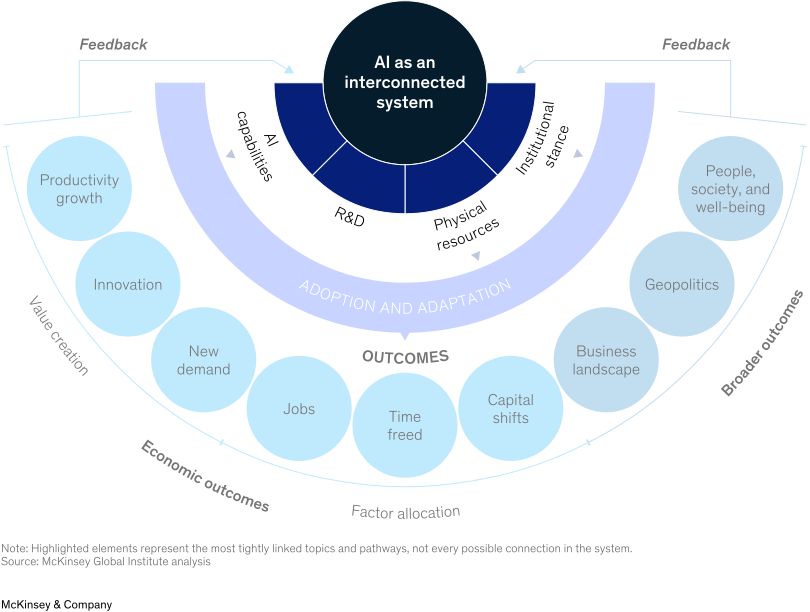
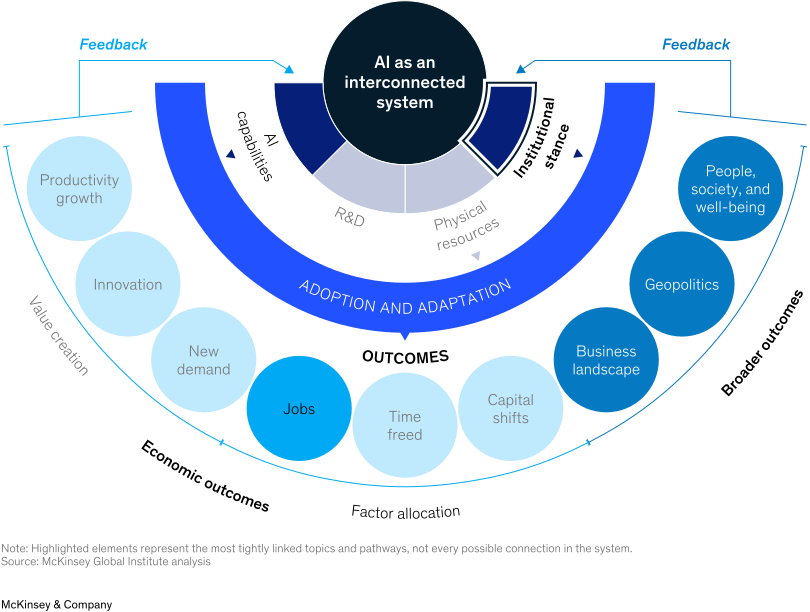
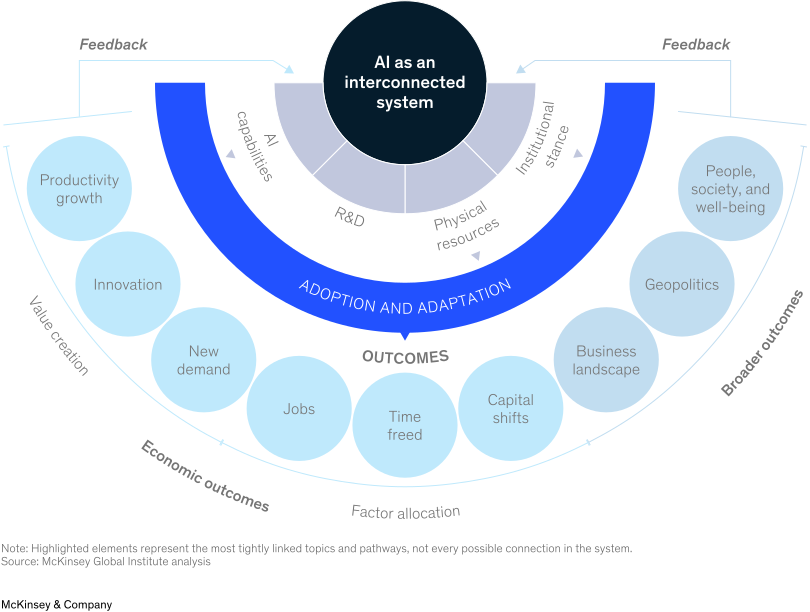
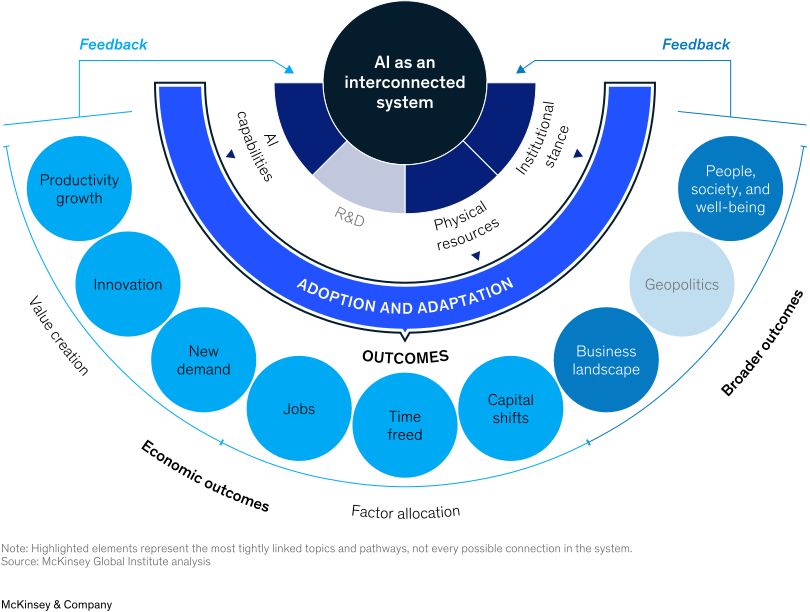
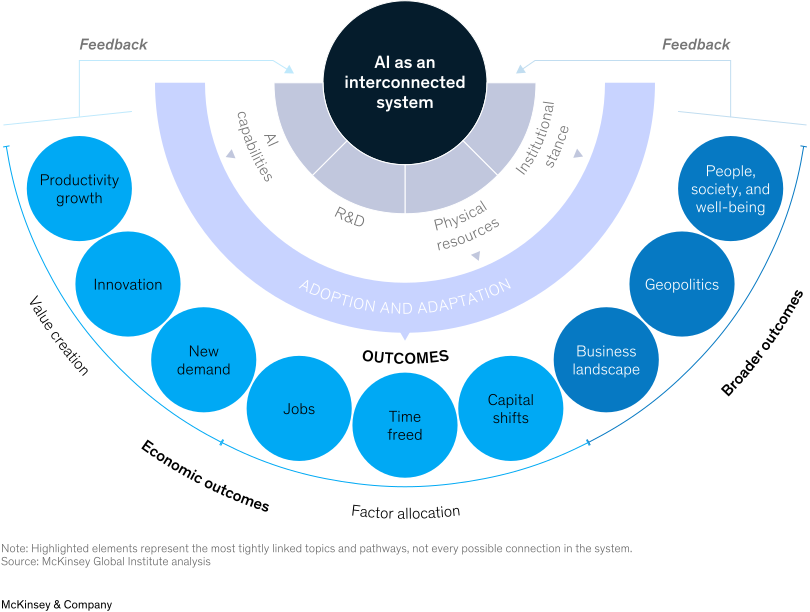
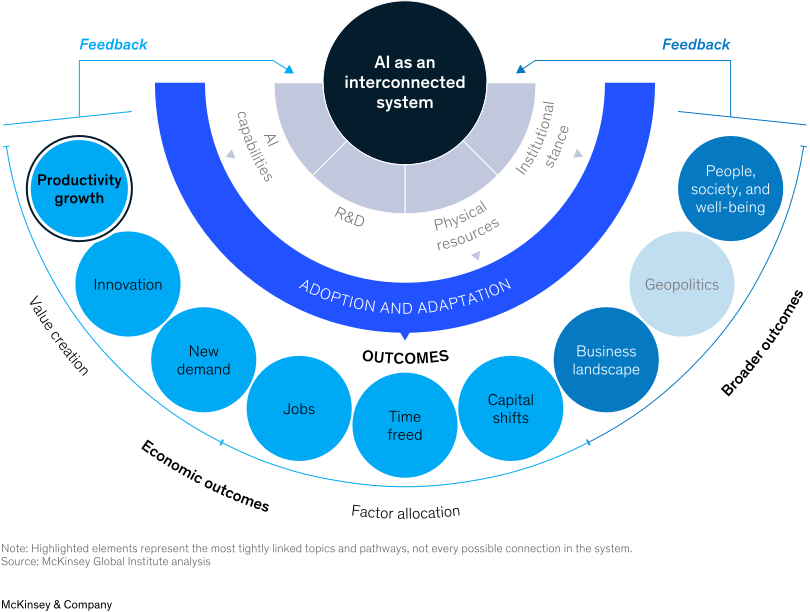
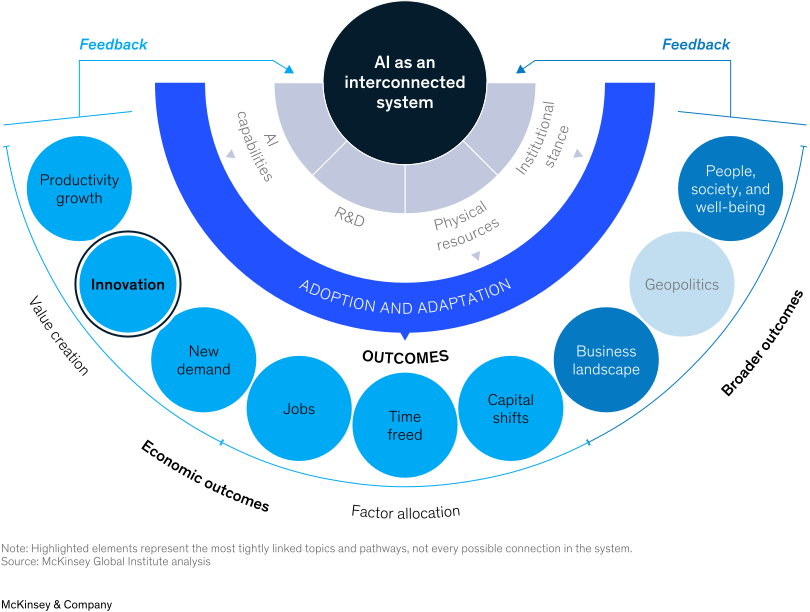
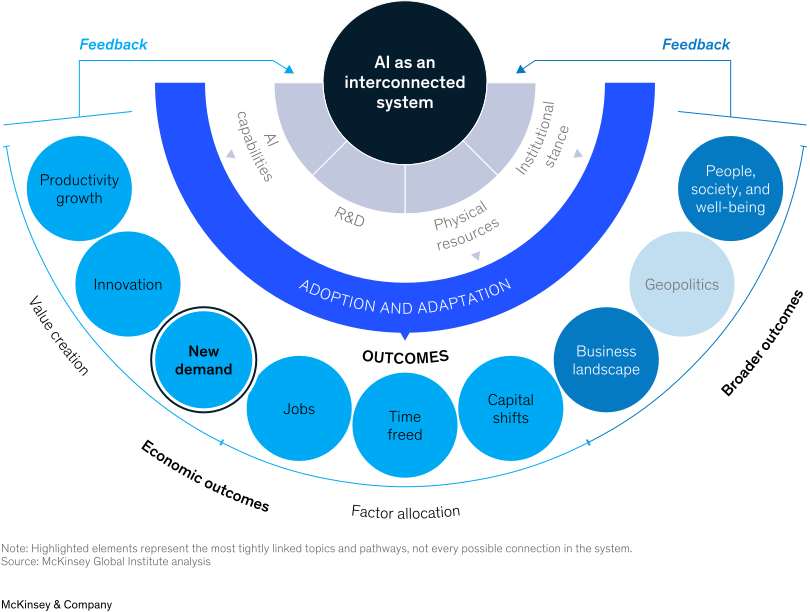
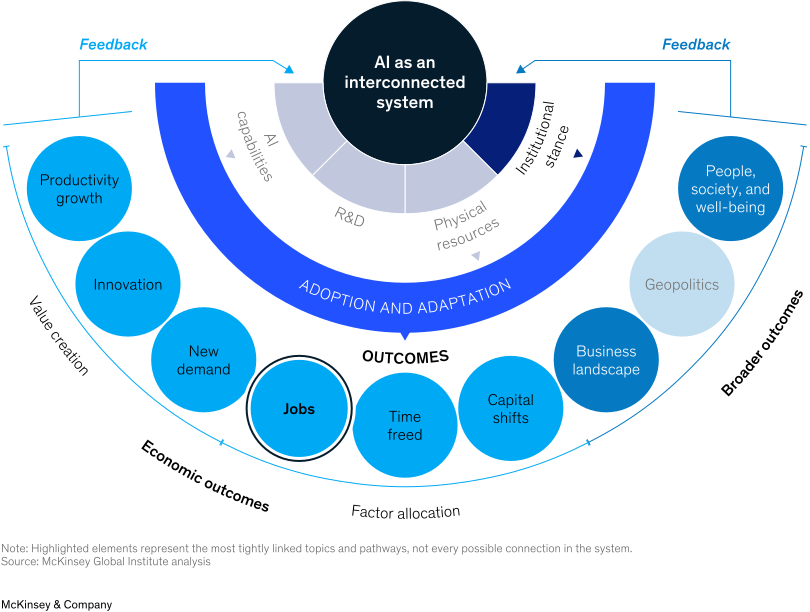
Chapter 1 looks at how fast different parts of the system are changing and what can happen when they fall out of sync. But first, explore the map below to get oriented (Exhibit 1). Click on any element for a closer look.
In the AI system, changes in one part can ripple through the rest.
Tap any part of the diagram to explore the system

Mismatched timelines: Bottlenecks, risks, and opportunities
General-purpose technologies can transform economies and improve lives, but realizing their full potential takes more than the invention itself. It requires complementary innovation, new infrastructure, new rules, capital, and people and organizations willing to change how they work. The pieces rarely arrive all at once, and the gap between a new capability and its full payoff has historically taken decades to close (Exhibit 2).
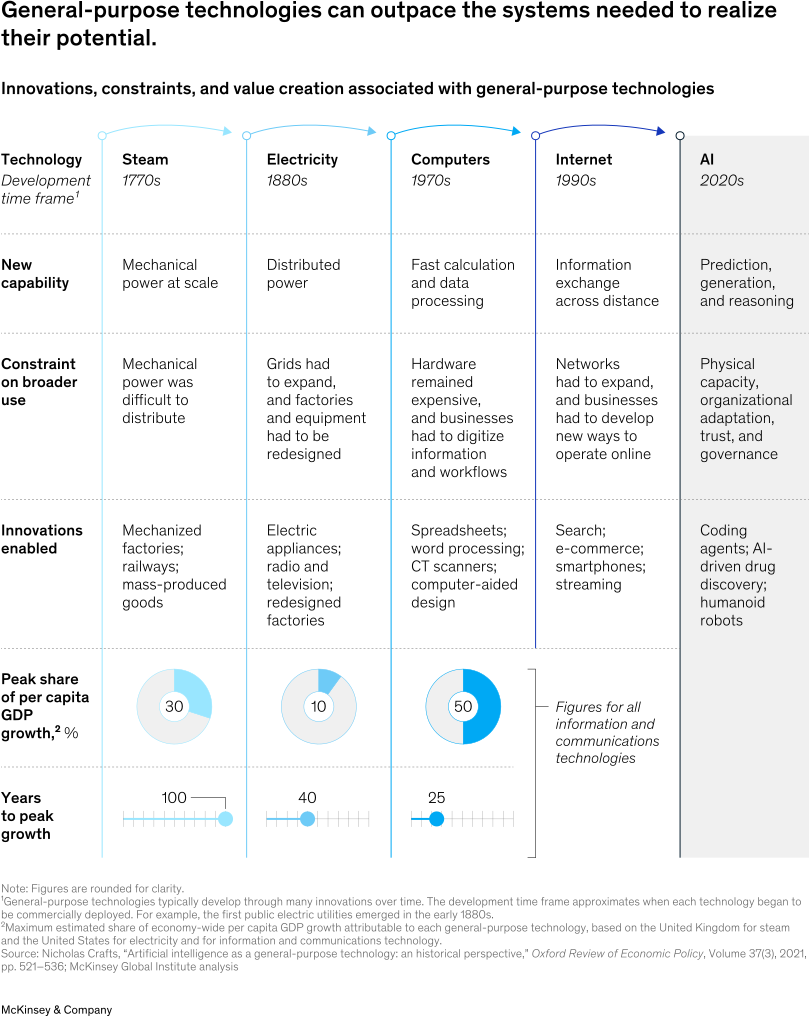
In the early decades of electrification, it was difficult simply to generate enough power to run factories and industrial machinery. Later, as that hurdle eased, the limits of the power grid became apparent. The big productivity gains arrived only once factories were physically redesigned around the electric motor, a step that came later still.4 The internet’s path was much the same: First fiber-optic networks had to be built, then new business models were needed, and finally companies had to reorganize around the technology.5
Mismatches
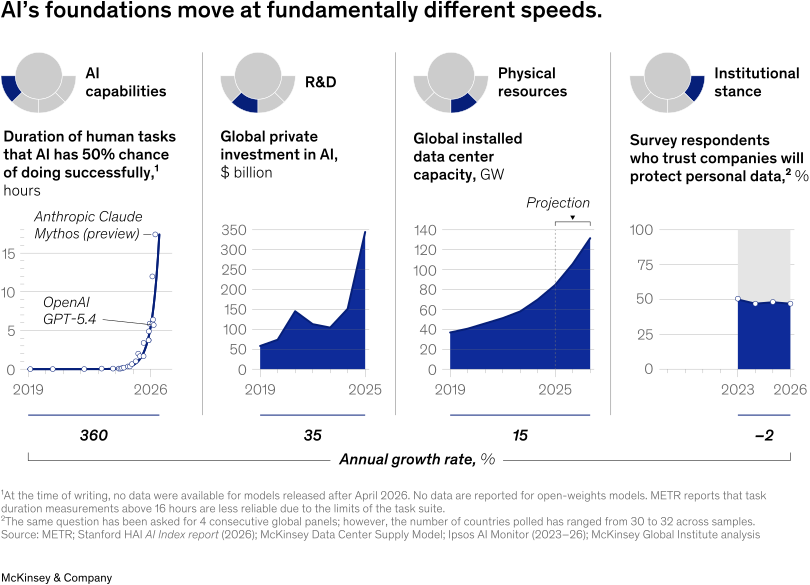
AI faces a similar challenge, with many necessary parts coming together on vastly different timelines and with different shapes of change. Model capabilities are improving exponentially, doubling every few months by some recent measures.6 Physical infrastructure builds out more linearly, often taking years. Change at companies may occur more unevenly and can take longer, as businesses develop new products and ways of working.
When the parts move out of step, it can cause bottlenecks that slow down technological advancement or deployment—such as when demand for AI chips outpaced the ability to manufacture them in 2023, discussed below. For organizations, a period of rapid adoption can just as easily be followed by a slowdown or reversal if a product fails or causes unintended harm, or if deployment of the technology does not deliver productivity gains soon enough. At other times, a mismatch can create risks, such as when corporate governance or cybersecurity lags behind the adoption of powerful new tools.
Early in the generative-AI build-out, one of the first hurdles was access to frontier chips and computing power. As those bottlenecks eased, attention shifted to electricity supply and grid connections.7 The next constraints are more likely to involve applications, workforce skills, and organizational workflows than hardware (Exhibit 3).
Bottlenecks
By 2023, only a year after OpenAI launched ChatGPT, demand for AI chips had outgrown the capacity to package them with the memory they require.
Nvidia, which designs most of the processors that frontier AI runs on, had built exactly the chip for the job, the H100. The problem was fusing it with memory in a single package, so that the hardware could work fast enough. Only one company could do this at the scale AI now demanded: TSMC, the Taiwanese firm that manufactures chips for most of the world’s major technology companies, including Nvidia and Apple. But in 2023, demand for that packaging outpaced even TSMC’s ability to keep up.8 Buyers reportedly faced lead times of up to 11 months for a finished H100-based server.9 The fix was more capacity, and TSMC built faster than it ever had.10
Other hurdles emerged in a completely different part of the system: electricity. Building and connecting enough power capacity—a challenge for utilities and grid operators, not chipmakers—is another constraint, one familiar from the early era of electrification. A single data center can consume as much power as a small city, and when local grids cannot handle that much new demand, the utility has to build new power lines and substations before the facility can turn on—construction that requires its own permits and land, behind a long queue of other projects waiting for the same thing. Several hyperscalers, the handful of companies building AI at the largest scale, have run into this wall. On an October 2025 earnings call, Microsoft’s CFO told investors that the company’s cloud computing platform, Azure, which is used to handle AI workloads, had been short on operating capacity for several quarters. Electricity was the obstacle. Microsoft had AI chips it could not deploy because it lacked powered, ready-to-occupy data center space.11 The median new US power plant now takes about five years from interconnection request to commercial operation, up from less than two years in 2008.12
Data center construction itself is now shaping up as a bottleneck, especially in the United States, which accounts for nearly half of global installed data center capacity.13 AI’s compute, power, and water costs per query have fallen as models get more efficient, but total demand is rising faster than efficiency gains or new supply can offset.14 Construction is expanding rapidly and still can’t keep pace. Many facilities are preleased even before they open.15
In some places, local communities are pushing back. Concerns about rising electricity prices and large, unsightly facilities have triggered backlash, leading to permitting delays and, in some cases, construction freezes. At least 75 data center projects worth some $130 billion were blocked or delayed in the United States by community opposition in the first quarter of 2026 alone—matching all of 2025 in three months, according to Data Center Watch.16 In July, New York’s governor signed the first-ever statewide permitting freeze on large data centers.17
Other potential constraints are emerging even as the data center drama plays out. Supplies of copper and other critical minerals needed for chips and wiring are showing signs of stress, but new mines and processing plants take years to permit and build. Unless current plans are accelerated, the world could face a sizable copper shortfall by the mid-2030s, according to the International Energy Agency.18 AI will be competing with many other industries for those materials. And physical resources are not the only constraint: Data center developers also report shortages of engineers and other workers, who take time to train.19
AI’s capabilities, meanwhile, are advancing on an entirely different timescale. The complexity of tasks that AI can reliably handle—measured by how long the same tasks take a human expert—has doubled roughly every seven months since 2019, and roughly every four months since 2023.20 This is partly because AI increasingly contributes to the research that improves it; existing models can now write the code, generate the data, and run the evaluations used to train the next generation of models. Technologies available today could, in theory, automate more than half of current work hours in the United States, Europe, and Latin America.21
So, the tools are here. But the reorganization is not. In a McKinsey survey of 1,719 respondents across 97 countries, conducted in May and June 2026, nearly nine in ten said their organizations regularly use AI in at least one business function. Yet outside a small group of AI high performers, representing 6 percent of the sample, only about one-quarter reported redesigning workflows around AI rather than inserting AI into existing ones.22
Risks
Governance is also lagging. A separate McKinsey survey of about 500 organizations on AI trust and governance, conducted in December 2025 and January 2026, found that only about 30 percent had reached level three or higher on a four-level maturity scale.23 Strategy remains underdeveloped as well. Only 22 percent of operations leaders report a fully developed and implemented enterprise AI strategy, even though more than half name strategy as the single biggest driver of AI returns.24
The problem usually stems from fragmentation. Responsibility for AI is split across IT, legal, data, HR, risk, and strategy, with no single owner. Day-to-day, oversight often defaults to the teams closest to the technology—IT or engineering—simply because no one else has claimed it. At the same time, 70 percent of global CEOs say they have the greatest influence on their company’s AI strategy.25 The gap between who actually runs AI and who is nominally accountable for it creates its own risk. Often, no one is positioned to answer basic questions about autonomous AI systems—which actions they may take, which decisions need human approval, who is accountable when something goes wrong.
Similarly, roughly one in three organizations still have no formal process to check AI systems for security risks before deploying them.26 Weak links may include smaller players, such as local governments, which may lack the resources for advanced security but remain connected to larger systems, creating vulnerabilities that extend beyond their own networks.27
As adoption increases, so does the risk of cyberattack. More AI systems in more places give criminals more surface area to exploit. The technology is also becoming a more capable tool for hackers. In April 2026, the UK AI Security Institute (AISI) found that Anthropic’s Claude Mythos Preview could autonomously execute multi-step attacks on test networks that would take human professionals days of work. Just two years earlier, the best available models in AISI’s evaluations could barely complete beginner-level cyber tasks.28 The risks extend beyond businesses and governments to individuals. AI-generated phishing and fraud are harder to spot because AI can produce personalized, convincing messages at a scale no human scammer could match.
Just as with a large governance failure—that causes or allows major financial or physical harm—a single large AI-enabled cyberattack could trigger public backlash and stricter regulation that slows adoption well beyond the companies directly involved.
Opportunities
Major breakthroughs could also change several of these timelines at once. A leap in model architecture—or in an adjacent field like quantum computing—could loosen several of AI’s constraints at the same time, the way the invention of the transistor simultaneously advanced computing, communications, and electronics. The benefits could flow the other way, too. AI-driven breakthroughs in fields like energy or biotechnology could unlock innovation and growth well beyond the AI industry itself.
AI as a system: How the pieces fit together
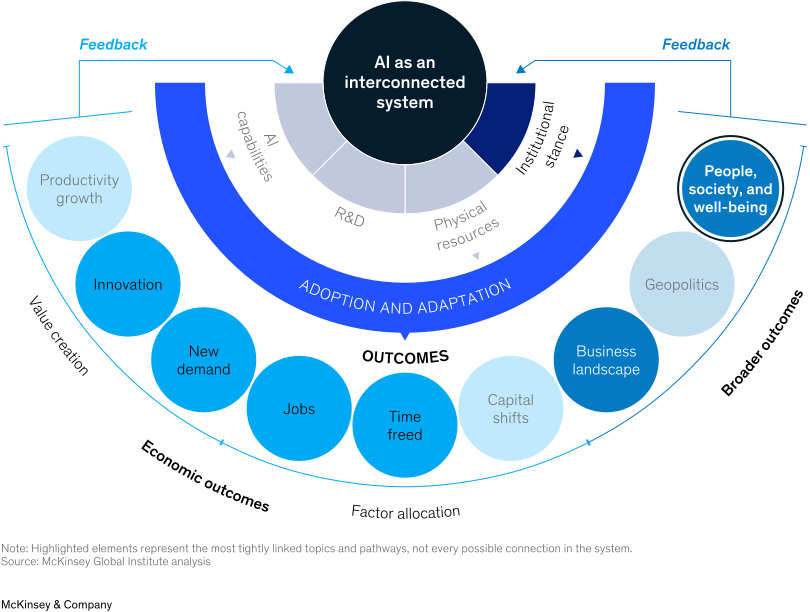
Many of today’s hardest challenges and most important developments must be understood as complex systems. This is the case for AI. Its effects come from the interaction of many interdependent parts, not from any one part alone. Capability, R&D, physical resources, institutions, and adoption each shape the others (see sidebar, “Why a systems view matters”).
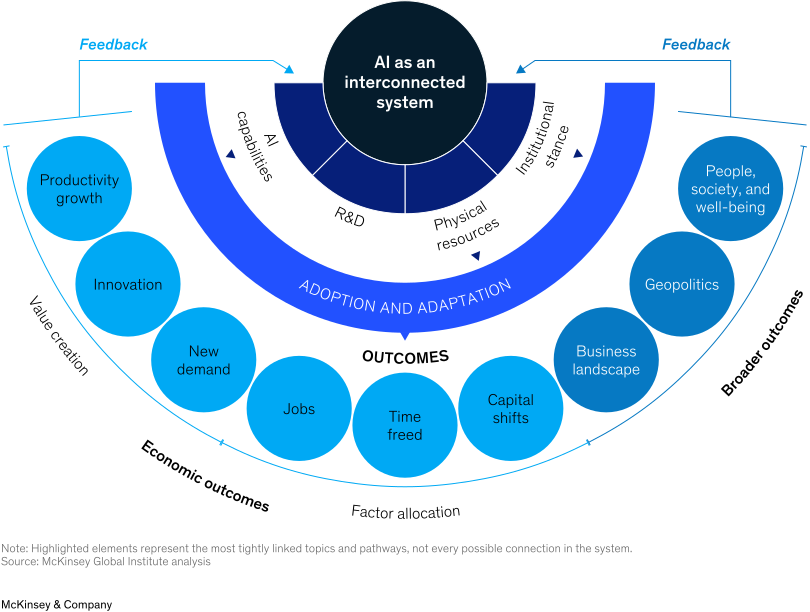
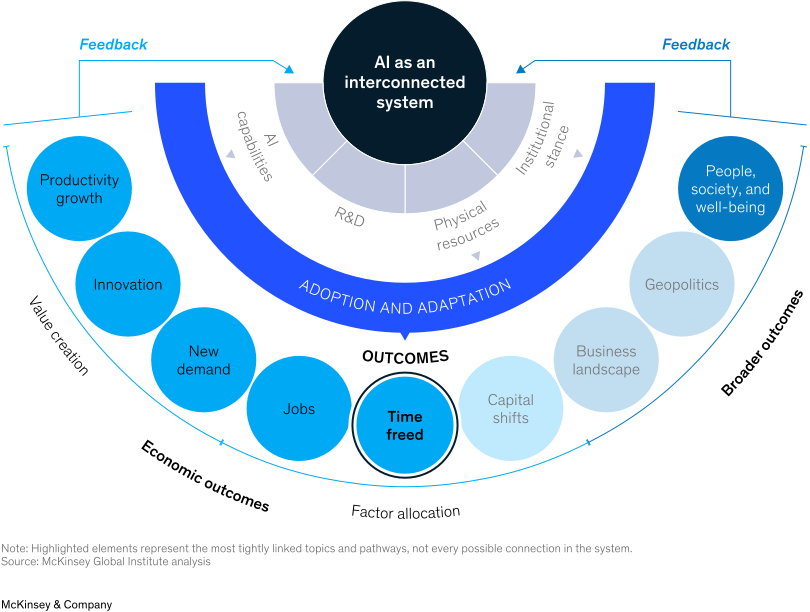
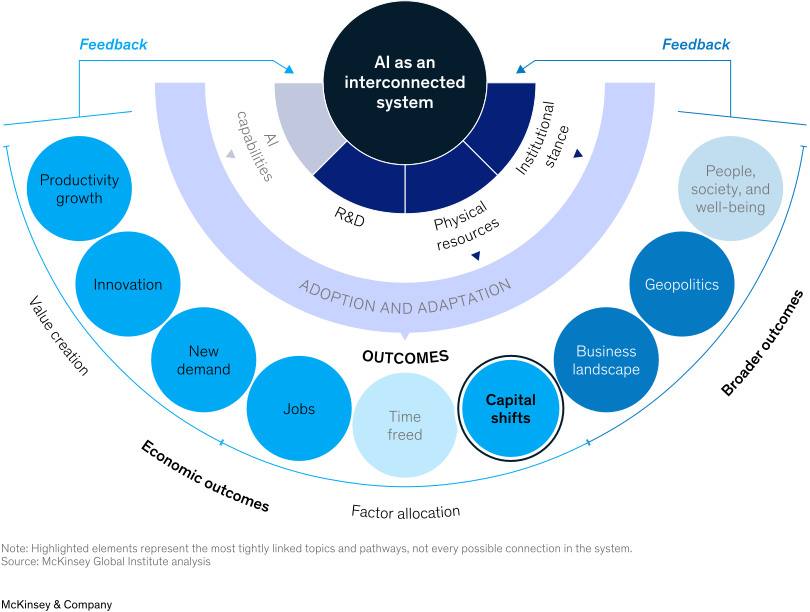
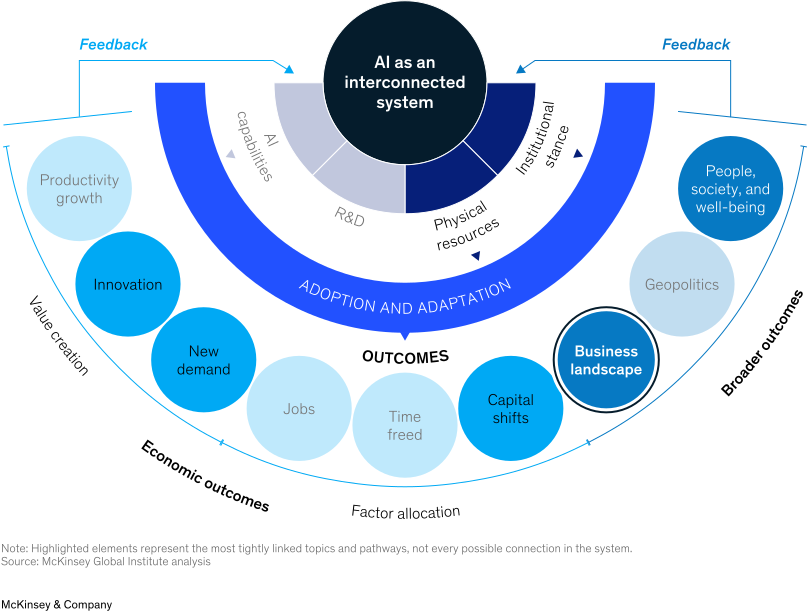
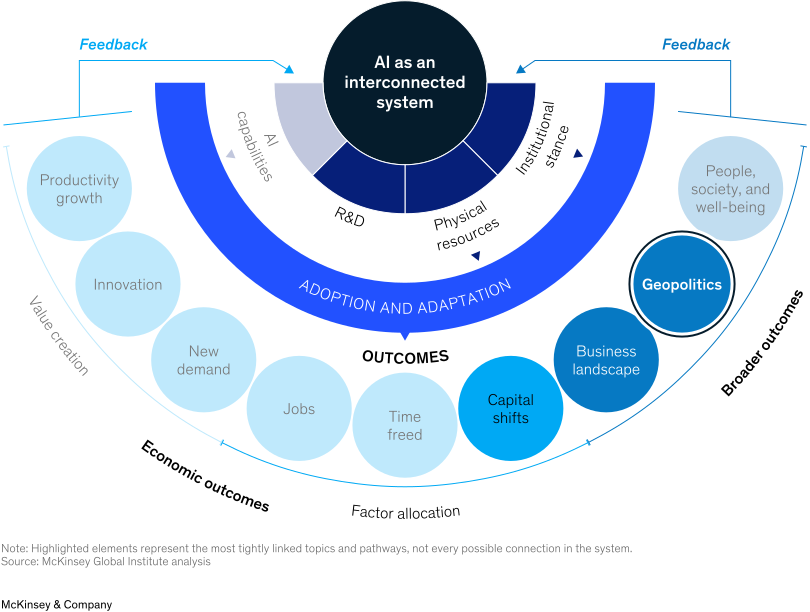
To make the system easier to visualize, we divide it into three analytical layers (Exhibit 4). Foundations shape what AI can do and the conditions under which it develops. Transmission is how people and organizations put AI’s capabilities to work. And outcomes are the effects that follow. The framework organizes the factors we think matter most; it is not a full inventory, and the categories overlap. Innovation, for example, is intertwined with new demand.
Better models can encourage adoption; adoption attracts investment; investment expands infrastructure and R&D, which in turn speeds up development of yet better models. Conversely, shortages of power, weak governance, or public concern can slow deployment. The system is in motion, with feedback running through every part of it.
Foundations
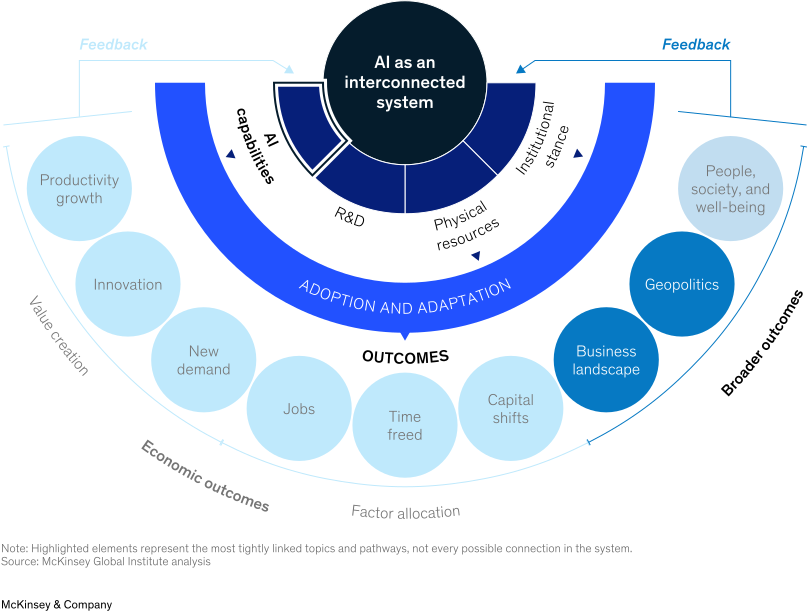
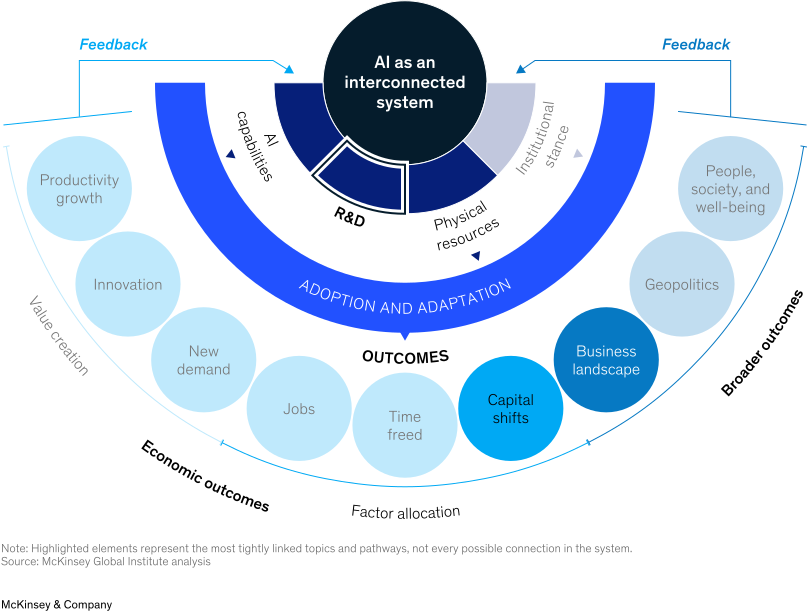
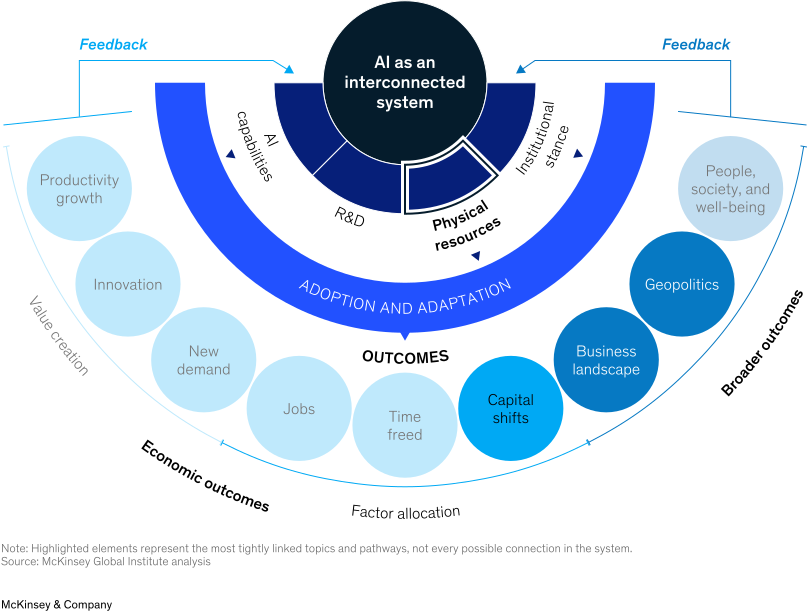
AI’s foundations—capabilities, R&D, physical resources, and institutional stance—determine what AI can do and how fast it can be built. Each shapes the others: R&D drives capabilities, capabilities require resources, and institutions influence how AI is developed and deployed.
AI capabilities
What AI can do extends beyond models and agents to embodied systems such as robots. Capabilities are the product of R&D, human expertise, data, computing resources, and the capital that funds their development. As they advance, new uses become possible, organizations reconsider what can be automated, and governments reassess AI’s risks. Whether the technology’s potential is realized depends on reliability, cost, public acceptance, and organizational readiness.
R&D
Research and development on frontier AI is mainly concentrated in a small group of companies in the United States and China.1 It improves model capabilities directly, and it makes physical resources go further by raising the efficiency of chips and data use. Progress is tied to private and public investment, computing power, data, electricity, talent, and government policy. Profits can fund the next round of research, and expectations of future profits attract investment; export controls can limit access to resources and affect what researchers work on or how they innovate; breakthroughs can shift markets and geopolitical advantage.
Physical resources
The list of physical resources needed to build AI data centers and keep them running is long: Chips, copper wires, cooling systems, land, electricity, and water are just some of the required ingredients.1 Strong AI demand, combined with this wide range of inputs, is reshaping global trade and supply chains, and sometimes provoking local disputes over utility costs and the visual impact of vast new facilities. At the global level, some key resources are geographically concentrated and can become instruments of geopolitical leverage, as China’s restrictions on rare earth exports make clear.2
Institutional stance
Institutions—the rules, norms, and organizations that govern AI—shape the technology at every stage. At the outset, export controls and rules on data, infrastructure, and safety can influence what gets researched and built, where, and at what cost. As organizations put AI to use, privacy and liability rules, professional standards, and company policies can shape how quickly and widely it is adopted. As the technology spreads, its effects feed back into institutions themselves, prompting new regulation and governance practices, influencing social norms, and building or eroding public trust. Many basic questions remain open: how much testing should be required before deployment, what incidents companies must disclose, and who is liable when the technology causes harm.
Transmission
Think of technological capabilities, physical resources, and institutional stance as the brains, brawn, and rules that shape AI’s development. R&D supplies the nutrients. All together, they determine what AI can do and at what cost. The next question is whether—and how—people and organizations put those capabilities to work.
Adoption and adaptation
Consumers, businesses, and governments are all adopting AI, but at different speeds. Individuals can pick up new tools right away, and millions experimenting with them almost immediately can help fuel innovation faster than institutional adoption often allows. Businesses move more slowly and often unevenly. Redesigning workflows around a new technology takes time, and not everyone inside an organization wants it to happen—workers may resist for fear of losing their jobs, for instance. Adoption is also uneven across companies of different sizes.1 Greater financial resources may help large companies invest in AI, while smaller firms can benefit from greater agility; midsize companies, with less of either advantage, may struggle to keep pace. As organizations scale AI, successes attract further investment in infrastructure and R&D, while failures expose weaknesses in governance, security, and skills that shape the next round of regulation and organizational change.
Outcomes
Putting AI to work changes economies, societies, and institutional stances. Some effects appear quickly, such as higher productivity in specific tasks. Others emerge gradually as organizations redesign work, investment shifts, new products appear, and governments respond. As with earlier general-purpose technologies, some of AI’s largest effects may come later, from innovations that are difficult to anticipate today. All of these outcomes, in turn, feed back into AI’s development and adoption.
Productivity growth
AI has already made many individual tasks more efficient, but turning those gains into higher productivity across a company or economy requires more. Companies must often redesign entire workflows around new technologies. To achieve economy-wide gains, those changes must then spread across many companies and industries. Growth must also be part of the equation. Without it, improvements in labor productivity could reduce employment and, in turn, consumer spending, which accounts for more than half of global GDP.1 Lower spending could reduce returns on capital, discourage further investment, and generate backlash.
The broad benefits of new technologies can take time to materialize. This is why transformative technologies can seem ever-present and yet leave little trace in macroeconomic data. That disconnect is familiar enough to have a name: the productivity paradox. Robert Solow famously captured the idea early in the digital era with his 1987 quip that “you can see the computer age everywhere but in the productivity statistics.”2 The paradox resurfaced with the internet and is being debated again with AI.
Innovation
AI is already speeding invention and discovery. AI systems that predict protein structures have compressed into hours parts of biomedical research that once took years, while models screening vast molecular libraries have identified new antibiotic candidates.1 Progress in materials science is accelerating in much the same way.2
Another important arena of innovation is commerce. AI could help suppliers better understand buyer intent, improving matches between products and users and spurring new solutions to meet hidden or latent needs. The internet transformed commerce by reducing search costs and enabling marketplaces that connected vast numbers of buyers and sellers globally. AI could take this further, shifting commerce from the internet era’s focus on attention toward a greater focus on intention.
History shows that technologies have often evolved far beyond their original uses. Steam power was first developed to pump water out of mines but later transformed shipping and enabled railroads. Electricity was initially sold as a replacement for gas lighting before powering homes and enabling factories to reorganize production. Consider also how electricity paved the way for entirely new products and industries. By making refrigeration possible, for example, it transformed how food could be produced, transported, sold, and consumed. AI could similarly enable new products, businesses, and business models that are difficult to anticipate today.
New demand
AI may generate demand through many channels. Building the AI economy creates a need for AI models and applications, robots and infrastructure, cybersecurity, and support for organizational change.
AI may also create markets for services that take on tasks people currently do for themselves, such as drafting letters, planning trips, helping children with homework, or managing household finances. Advances in robotics could extend this to physical household tasks such as cleaning, cooking, or yard work.
Automation itself could spur demand by simply making things cheaper and more accessible, echoing the logic of Jevons paradox, which shows why greater efficiency can increase total consumption rather than reduce it.1
Demand may also increase if productivity gains yield higher incomes and more free time, giving people more money and time to spend on goods and services. One well-known example of this dynamic played out in the US auto industry about a century ago, when the introduction of mass production was followed by higher wages and shorter working hours, culminating in a five-day workweek. Henry Ford explicitly argued that workers needed both the money and leisure to consume what industry produced—including automobiles.2
Jobs
What happens to jobs is the most worried-over consequence of AI. Yet history suggests that major technological change creates new jobs, even as it eliminates the need for others. About one-third of current US employment, for example, is in occupations that did not exist before earlier general-purpose technologies enabled them—truck drivers, car mechanics, electricians, software developers, cybersecurity analysts.1 Whether AI ultimately creates more jobs than it eliminates will depend on whether innovation leads to new kinds of work and generates enough new demand fast enough to offset losses from automation.
Within jobs, AI is already changing how work gets done as processes are reorganized around human-machine collaboration.2 Unlike earlier forms of automation, which mostly affected physical labor, AI is also changing knowledge work in fields such as computing, accounting, and law. As AI takes on more routine tasks, productivity may rise, freeing people to do more complex tasks. Skills where people may retain an advantage over AI, such as judgment, curiosity, and conflict resolution, could become more valuable. But the division of work between people and machines will continue to shift as AI becomes more capable. For some entry-level workers, the technology may already be making the first rung on the career ladder harder to reach.3 For other lower-skill workers, there is evidence that AI can narrow the gap with more experienced workers.4 AI-driven shifts in employment could favor higher-wage occupations over lower-wage ones, although some workers may struggle to move into the new roles.5 How broadly workers benefit from AI—or feel threatened by it—will help shape public support and, in turn, adoption and regulation.
Time freed
By making tasks faster or taking them over entirely, AI can free time from both paid and unpaid work. That time may be redirected toward more work, new tasks created by AI, learning, entrepreneurship, unpaid activities, or leisure and rest. Greater efficiency may also increase demand for existing work, absorbing some of the time initially saved.
Some freed time may be unwanted. People may work fewer hours because less of their labor is needed, even if they would prefer to work more. How freed time is ultimately used will shape both output and demand. Sustained economic growth will require people to have the income and willingness to buy the additional goods and services the economy can produce.
Capital shifts
The focus of AI investment has changed as the technology’s bottlenecks have shifted. When there was a shortage of computing capacity, capital poured into chips and data centers; as electricity and grid connections emerged as constraints, investment moved toward even larger infrastructure. As the need for capital has grown, the financing mix has broadened well beyond venture capital to include public equity markets, private credit, and public debt markets. Circular financing, in which AI companies invest in one another or make commitments that help finance one another’s growth, is also becoming common. These arrangements can accelerate the build-out but also make it harder to distinguish demand generated within the AI ecosystem from demand coming from outside it—and create interdependencies that can cause losses at one company to spread to others.
The scale of spending is enormous. McKinsey estimates that global investment in data centers will reach $7 trillion cumulatively between 2025 and 2030, much of it AI-driven.1 More than 40 percent is expected in the United States. In 2026 alone, US imports of AI-related goods are on track to reach around $750 billion—about as much as its imports of cars, oil and gas, and pharmaceuticals combined.2 That spending could come at the expense of investment elsewhere: Total private investment as a share of GDP has remained flat even as investment in data centers has soared.3 There is also a risk of overbuilding. Earlier railway and internet booms saw investment race ahead of demand, leaving excess capacity and losses for many investors even though the infrastructure ultimately generated substantial economic benefits.4
Business landscape
AI is changing relationships among companies, customers, and suppliers. Some businesses are bringing work in-house as AI reduces the need for outside help and increases the value of connecting data, workflows, and decision-making. Others are becoming more dependent on suppliers that control critical data, infrastructure, or access to customers. Meanwhile, AI is lowering barriers to entry for smaller firms and startups, allowing them to handle coding, marketing, customer service, and administration with fewer people or outside providers. Shifting boundaries can turn suppliers and customers into competitors.
As models improve and spread, access to the best technology may provide only a temporary edge because today’s leading model can be quickly overtaken or matched. AI can also commoditize capabilities, making skills that once distinguished companies widely available. That could shift advantage toward things AI cannot easily replicate or bypass—critical workflows, customer relationships, or even administrative requirements such as documentation needed for medical billing. Companies that control these choke points may capture outsize value even when they play only a small role in producing the underlying product or service. As a result, businesses that develop or make the best use of AI may not always capture the greatest economic gains from it.
Geopolitics
Companies are not the only ones competing for an AI advantage. The United States and China are racing to develop the technology, with the outcome likely to affect the balance of power between them. So far, the United States narrowly leads in frontier models and has more high-end compute, while China leads in open-weight models and industrial AI deployment.1 Whoever harnesses AI most effectively is likely to gain a real edge. Faster growth and innovation can strengthen a country’s economic influence and provide more resources for defense, while AI itself can directly enhance military capabilities.
Control over chips, compute, models, and standards could become a source of leverage, much as dependence on foreign oil and gas can leave countries vulnerable to pressure from suppliers. A country reliant on AI built and run elsewhere could expose sensitive data to outside access, and public services and critical infrastructure to disruption. In the worst case, these imbalances could spill into trade, cyber, or military conflict.
People, society, and well-being
AI’s effects extend to billions of people everywhere, changing how they think and the kinds of thinking they do. The technology can put forms of expertise that were once expensive or difficult to access—from tutoring and translation to help navigating health, legal, or financial questions—within reach of many more people. But relying on it for routine thinking may weaken the habits that build reasoning skills, a particular concern for children still learning to think for themselves.1 For workers, AI may take on routine tasks, freeing people to spend more time on work that calls for judgment, creativity, problem-solving, and human interaction. But as people produce more in less time, work may also become more cognitively demanding, increasing the risk of overload and burnout.2
How people feel about the technology matters, too; it shapes how governments regulate it and how businesses use it. Surveys of the general public suggest that people in advanced economies tend to be wary of AI. In the United States, some 70 percent of survey respondents say AI will make their personal information less secure. Roughly half of American adults under 30 expect AI to have a negative effect on society.3 Views are more positive in developing and middle-income countries, where people are more likely to expect AI to improve their country’s economy and the job market.4 A similar geographic divide appears in a study of active Claude users. Anthropic interviewed more than 80,000 users of its chatbot across 159 countries and found that people in Africa, South America, and much of Asia were more optimistic than those in Europe and the United States, with those in developing regions more often seeing AI as a source of economic opportunity.5
The value of a systems view
A systems view can help identify where action could have the greatest effect. For businesses, it can reveal what is holding back results; for investors, how opportunities and risks are shifting; for policymakers, where rules or public investment could help; and for individuals, which skills and opportunities may become more valuable.
For business leaders
- Look beyond efficiency for lasting advantage. AI can reduce costs and make existing work more productive, but competitors with access to the same technology may achieve similar gains, driving down prices and eroding any initial advantage.29 Long-term outperformance requires companies to combine AI with advantages that rivals cannot easily replicate, creating competitive moats.30 These can include proprietary data, scale, strong customer relationships, and access to scarce physical assets, combined in a business model that delivers greater value to both customers and suppliers.
- Build new things. The first uses of major new technologies are rarely the most consequential. Electricity began as a replacement for gas lighting before transforming industries and enabling entirely new forms of economic activity. AI may likewise give rise to new products, businesses, and markets that are difficult to anticipate today. Using the technology to automate existing work is a first step, but leaders should use the resources freed up to build new sources of growth. The potential impact extends beyond individual organizations: A small number of standout companies have driven a disproportionate share of economy-wide productivity growth, largely through shifts in strategy and moves into new businesses that reshape their industry segments, rather than by making existing businesses more efficient.31
- Learn to learn faster. AI capabilities can improve exponentially, much faster than many companies can change their technology, workflows, or organization. New businesses may have an edge because they can build around AI from the start, without having to adapt or throw out legacy systems. But established companies have an advantage, too: their scale gives them more customers, workers, and operations across which to test new approaches, gather feedback, and learn what works. To make that advantage count, they need to build the capacity to adapt their systems and ways of working quickly enough to keep pace with evolving AI capabilities.
- Give people a reason to support change. Whether employees, customers, and communities see AI as making their lives better or worse will shape their willingness to accept and use it. Leaders therefore need to deliver benefits that people can see and experience rather than simply explaining what they are trying to achieve with the technology. If people experience better products, services, or ways of working, they may be more likely to support change; if they feel that the harms outweigh the benefits—that their jobs, livelihoods, and privacy are at risk—resistance may mount. A systems view shows that despite technological progress, businesses may struggle to create value if societal resistance is high.
- Develop a view of how AI could reshape your industry. AI could change who has an advantage, how companies compete, and where profits are made. It may lower barriers to entry, shift power among companies, customers, and suppliers, or change the advantages of scale. Leaders should consider how these forces could play out in their industry—and what they mean for strategy.
- Watch the whole system. AI’s trajectory will depend on more than improvements in the technology itself. Changes in adoption, infrastructure, investment, regulation, and economic outcomes can reinforce or constrain one another. The framework in this report identifies metrics for tracking these changes across the AI system.
For investors
- Follow the bottlenecks. Constraints can create investment opportunities because they generate demand for solutions. When computing power was scarce, opportunities emerged around chipmakers and frontier-model companies. As constraints shift toward electricity, infrastructure, and putting AI to productive use inside organizations, new opportunities may emerge around solving those problems.
- Expect different growth paths. Exponential growth in AI capabilities or usage will not translate into exponential growth across every business that uses or supplies the technology. Model capabilities can improve rapidly, while physical infrastructure expands much more slowly and companies may take years to translate AI into productivity and profits. Investors should be clear about which of these growth paths their assumptions depend on and not mistake rapid growth in one part of the system for rapid growth in another.
- Look past adoption. A company can adopt AI, even on a grand scale, without changing its long-term prospects. For signs of lasting advantage, investors should ask: Are productivity gains supporting growth rather than cost reduction alone? Are new products, businesses, and markets emerging rather than simply improvements to existing ones? Is the company overcoming legacy technology and organizational constraints? And is it shifting resources from the existing business toward new opportunities?
- Look for correlated risks. The performance of investments in the AI system may be highly correlated even when the companies involved operate in entirely different industries. Investments in chips, data centers, power, and AI software, for example, could all be affected by the same slowdown in AI demand or investment. Investors should account for these connections when assessing how diversified their exposures really are.
For policymakers
- Address system constraints. What holds AI back will differ by country or region and will change over time, from electricity and digital infrastructure to permitting, skills, and institutional capacity. Policymakers should identify the constraints that matter most in their economies and focus their efforts on relieving them. As the constraints change, policy should move with them.
- Promote competition. AI may lower the cost of creating new products and services. To help make that opportunity broadly available, policymakers should ensure that rules do not unnecessarily favor incumbents or make it harder for new entrants to compete and grow. They should also broaden access to the skills, tools, and capital people and companies need to build with AI.
- Make policy responsive. Regulators need to protect the public from harm. But AI capabilities and applications can evolve faster than laws and regulations. Not every new use or risk can be anticipated and some predicted risks may never materialize. Rules therefore need to be adjusted as evidence changes rather than trying to settle every question in advance. Requiring the industry to self-regulate is a good first step. Staying close to businesses, workers, researchers, and the public to monitor impacts across the full system can help policymakers see when more substantive regulatory adjustment is needed.32
- Build trust and confidence. AI could support economic growth and improve living standards for decades, but realizing that potential may depend on public willingness to accept the changes it brings. Policymakers need to address legitimate concerns about AI’s potential effects on jobs, privacy, and safety while also making the case for what AI could make possible. As noted above, responsive policy can help build trust. Confidence also depends on whether people believe they can share in the economic opportunities AI creates. Proactive policies that expand access to skills, technology, and the resources needed to start and grow businesses can help.
- Foster investment. Decide which AI capabilities must be developed at home and where reliable access through partners is enough. Public investment, incentives, and partnerships can help strengthen computing infrastructure, energy, research, and talent without trying to replicate the entire AI ecosystem domestically. Some governments are already pursuing versions of this approach: the United Kingdom has established a Sovereign AI Fund, while the European Union’s InvestAI initiative aims to mobilize public and private investment in AI infrastructure.33
For individuals
- Cultivate AI fluency. As AI becomes a bigger part of work and everyday life, people will need to become increasingly fluent in using the technology. AI fluency also means knowing when to use the technology and when to rely on human judgment. Skills such as creativity, empathy, adaptability, and critical thinking may become more valuable as the division of labor between people and AI changes. That boundary will continue to shift, requiring people to keep learning and adapting.
- Be thoughtful about what you share. AI tools can become more useful when people give them personal information as context, but that can also create risks. Before sharing sensitive financial, health, or personal information, consider where it could end up, who might gain access to it, and how it could be used.
- Expand your ambitions. AI gives individuals access to capabilities that once required specialized expertise, substantial resources, or large teams. This can change not just how people do things, but what they can realistically attempt: learning a new field, creating a product or service, starting a business, or pursuing an idea that previously might have been out of reach. AI can allow people to think bigger about what they might accomplish—and give them the ability to pursue those ambitions.
History suggests that the economic impact of new technologies may be arriving faster with each successive wave. Steam power took about a century from commercialization to its peak impact on economic growth, electricity about 40 years, and computers and the internet about 25. It is too early to know whether AI will compress that timeline further. But the possibility adds urgency because businesses, workers, and governments may have less time to adjust.
AI’s trajectory will not be determined by the technology alone. Models will improve, costs will fall, and new uses will emerge. But what follows will depend on how capabilities interact with physical resources, institutions, organizations, markets, and people—all moving at different speeds. A constraint in one part of the system can slow progress elsewhere; removing it can reveal another. And as AI spreads, the changes it produces will feed back into the system itself.
That is why the whole system matters. The task is not to predict a single AI future, but to understand how the pieces interact, where mismatches may emerge, and how the choices people make can alter what happens next.
Related Articles

The new management playbook for AI: How to move faster and create more value