Electric vehicles are gradually overtaking roads around the world, and plummeting recharging times, improving batteries, and scrambled oil trading patterns are providing additional tailwinds. One in four new cars sold in 2025 were EVs, and they have the potential to account for the majority of sales by 2035.1 The EV industry is still absorbing losses related to intense price competition and high up-front platform and battery investments, and only a few original equipment manufacturers (OEMs)—such as Tesla, BYD, and Li Auto—have developed profitable EV business models. EV profitability is primarily driven by production economics, and automakers at large have challenges in supply chains, materials, design learning curves, and customer adoption.
Profitable EV leaders all share one differentiator: unprecedented development speed. For many incumbent OEMs, platform R&D cost and time to market have become major hurdles, as they struggle to make the right product and engineering choices, build necessary engineering skills, and align functions for faster execution. The outcome is longer development timelines that delay revenues and increase the risk that technologies are outdated by launch. While R&D accounts for only a relatively small share of total costs, the ability to develop and launch high-volume electric vehicle platforms quickly and efficiently becomes an important differentiator in who captures value in the next era of mobility.
This investment case is one of ten that are the foundation of the McKinsey Global Institute’s report, Catalyzing competitiveness: Where investment happens and why. The report examines how investment propels competitiveness, and vice versa, by analyzing reasons for the variation in costs across industries in regions around the world.
The shift to mass-market EVs necessitates a new platform R&D paradigm, centered on software, scale, and speed
An EV platform is the underlying architecture that integrates a battery system, electric powertrain, chassis, electrical and electronic (E/E) architecture, and software that make up a vehicle. One platform serves as the foundation for various vehicle models and body styles in different regions over an extended production lifetime. Unlike platforms in internal-combustion-engine (ICE) vehicles, EV platforms must accommodate large battery packs to deliver competitive range, electric drive units configured across one or both axles, and more integrated thermal-management systems to manage battery performance, power electronics, and cabin conditioning.
As EV architectures evolve, platform choices are having a greater effect on cost and performance
Greenfield EV platforms require between $1 billion and $3 billion to develop, according to research by the McKinsey Center for Future Mobility. Up-front engineering, industrialization, and testing and validation costs must be amortized over a platform’s lifetime. As a result, platform economics depend on utilization across multiple models and brands. Once developed, incremental vehicle derivatives can be launched at relatively low cost.
Demand for continuous innovation of EVs (and thus platforms) is being driven by improvements in battery and electric powertrain technologies that have made EVs economically viable at scale, reinforced by tightening emissions regulations and targeted government incentives. As EV adoption has moved from premium and early-adopter segments into the mass-market C/D (compact and mid-size mass-market car) segments, scalable and cost-competitive EV platforms have become critical.
Automotive manufacturers typically retain ownership of platform architecture, vehicle integration, and software. Suppliers have a critical role in codeveloping technologies that shape EV cost and performance. Tier-one suppliers contribute in areas such as electric drive systems, power electronics, and E/E architecture, while battery cell manufacturers influence platform economics and design through cell chemistry, form factor, and pack integration. Together, these suppliers help improve EV cost structures and push forward performance envelopes in areas such as energy density, efficiency, charging speed, and materials innovation.
China is setting the pace in EVs, while Europe and the United States race to catch up
Global investment in EV development has increased sharply over the past decade, reflecting OEM commitments to electrification and the need to replace multiple ICE platforms with larger-scale EV architectures to meet demand. Cumulative EV and battery investment commitments announced through 2030 total more than $1 trillion, with platform development absorbing a significant share of the investment for up-front engineering and industrialization.2
China produces more than 70 percent of EVs globally. Its leading brand, BYD, passed American Tesla’s global sales of battery-powered EVs in 2025.3 The growth of China’s EV business is linked to its unrivaled cost structure, dense supplier ecosystems, strong access to critical materials, strong policy support for EV adoption, and a disruptive development philosophy that finds an optimum between speed, cost, and quality (detailed later in this article).4 These factors enable companies like BYD and Xiaomi to lead in development times, which allows deployment of new technologies at an unprecedented rate, reducing time to revenue and increasing customer satisfaction.
Europe is home to several of the world’s largest and oldest legacy automotive OEMs. As a result of more stringent CO₂ standards and zero-emission mandates, these incumbents have shifted large parts of their portfolios to dedicated EV platforms. However, EV platform development is based on long-standing product and development systems, which lead to much slower development timelines than those of EV-only disruptors.
The United States features a mix of legacy OEMs and EV upstarts, which primarily produce large pickups, SUVs, and premium cars. Federal incentives under the Inflation Reduction Act have accelerated domestic investment in battery plants and EV assembly capacity, although these have been phased out for consumer EVs.5 However, customer adoption hasn’t met expectations, and overall EV production remains well below China’s, with legacy OEMs struggling to make investments in new EV architectures work.6
Beyond these economies, South Korea is home to competitive OEMs that work with world-class battery and component suppliers, shaping global benchmarks in battery integration and power electronics. Japan remains central to the global automotive industry through Toyota, the world’s top-selling automaker, and a broader OEM base that continues to influence global vehicle architectures. However, Japan’s electrification pathway has been more led by hybrids than by battery electric vehicles (BEV). Domestic hybrid sales exceeded two million vehicles in 2024, while EV and plug-in hybrid electric vehicle sales declined, reflecting more gradual BEV adoption and a continued role for plug-in hybrids.7
It is important to note that a platform may be engineered primarily in one country but assembled in several others. For example, an OEM may develop a platform in its home market, incorporating the design and various certification requirements across target sales geographies, and at the same time assemble vehicles based on that platform in multiple regions suitable for local demand. Automakers typically locate assembly close to major end markets to reduce logistics costs, manage tariff and trade exposure, and meet local content or policy requirements. This includes investments by Chinese carmakers in advanced economies, as well as more well-known cases where it is the other way around.8
Chinese EV OEMs demonstrate how faster innovation can reduce R&D costs
Our investment case evaluates the R&D cost of a global mass-market EV platform that supports multiple vehicle models. The case compares two archetypes, legacy OEMs and EV-focused disruptors, in China, Germany, and the United States. In this analysis, we split out the effects of drivers such as labor productivity, wage levels, and time to market to identify which are most important to competitiveness.
Assumptions about demand are held constant across geographies. Costs are expressed as the levelized R&D cost per vehicle manufactured. The platform is assumed to have a fixed life cycle that begins at the start of R&D, and yearly production volume is assumed constant across the remaining life cycle after R&D. In reality, production volumes may vary, and there are signs that some OEMs that specialize in EVs are breaking the traditional platform lifecycle through more incremental refreshes (see sidebar, “Methodology”).
The analysis covers platform R&D costs only, excluding industrialization, facilities, and manufacturing costs, to enable a more consistent comparison between established OEMs and disruptors. The costs of midcycle updates such as refreshes, derivatives, and facelifts are also excluded because they vary significantly across OEMs depending on platform life-cycle strategy and refresh cadence and can be difficult to attribute consistently to an underlying platform program. As a result of these choices, platform economics are driven by engineering and development activity rather than physical assets.
A Chinese EV OEM is our base case, representing best-in-class levelized R&D cost per vehicle. Chinese EV OEMs increasingly set the benchmark for development speed and cost competitiveness. Two broad archetypes stand out. The first includes more established OEMs, such as BYD, which combine rapid time to market with substantial in-house capabilities and vertical integration of key subsystems. The second includes EV-focused specialists such as XPeng, Li Auto, and, more recently, Xiaomi, which have often moved quickly by using supplier ecosystems selectively, limiting customization, and focusing internal resources on the technologies most central to differentiation. Our base case draws on the established model.
In the base case, labor costs account for the biggest share, roughly 40 percent, of levelized platform cost, reflecting the engineering-intensive nature of modern EV platforms. Software engineering represents the single largest slice of labor costs, because adoption of a software-defined vehicle program shifts development effort into platform-level software, including operating systems, foundational driver-assistance stacks, and over-the-air update infrastructure.
Prototyping and related tooling, which accounts for about 30 percent of levelized platform cost, includes building early test vehicles and parts as well as the tools needed to develop and refine them. This covers items such as prototype cars, battery packs, electronics mockups, and pilot tooling used before full production begins. Even with more virtual development, this remains an important cost because EV platforms still need real-world testing and repeated design fixes, especially for batteries, thermal systems, safety, and the way software works with hardware.
Software-related costs, accounting for about 15 percent, include high-performance computing, cloud computing and storage, and software licenses for simulation, software development, validation, and integration. These costs have increased markedly as EV platforms have become more sophisticated, requiring greater software functionality, tighter system integration, and expanded use of virtual engineering tools.
Testing and validation make up about 12 percent of levelized costs and include vehicle- and system-level activities spanning battery and E/E validation as well as a full set of certification and regulatory requirements, such as environmental, durability, and crash testing in all regions where a vehicle will be sold.
External engineering costs account for 5 percent of total costs and include codevelopment with suppliers, engineering service providers, and technology partners to supplement internal teams. In the base case, these costs are relatively low because Chinese OEMs are often more vertically integrated than their competitors. These OEMs typically launch platforms in 21 to 28 months, refining iteratively post-launch. This sets the benchmark for comparison (Exhibit 1).9
Wage differences and varying productivity are key determinants of the cost of developing an EV platform.
Note: Figures may not sum to 100%, because of rounding.
1Development of a platform to manufacture compact or midsize electric vehicles. The platform produces identical volume each year after launch and has a fixed end-of-life date.

R&D costs are three to four times higher for western legacy OEMs due to higher wages, lower productivity, and longer timelines
An EU or US legacy OEM’s levelized EV platform development costs are roughly three to four times as much as the Chinese benchmark, reflecting a difference of about $1,200 per vehicle. This variation in R&D performance can drive a significant share of overall competitiveness, with the best-performing EV OEMs reporting operating profits ranging from zero to $4,000 per car.
Labor, which includes wage levels, productivity, and working hours, is the largest factor in the cost gap between Chinese EV platforms and those made elsewhere. Comparing Chinese and advanced economy OEMs, wage levels account for 30 to 50 percent of the difference. While productivity differences between regions are small within the same OEM archetype, productivity is significantly higher for EV disruptors than for legacy OEMs. This gap drives 10 to 25 percent of the difference between EV disrupters and legacy OEMs.
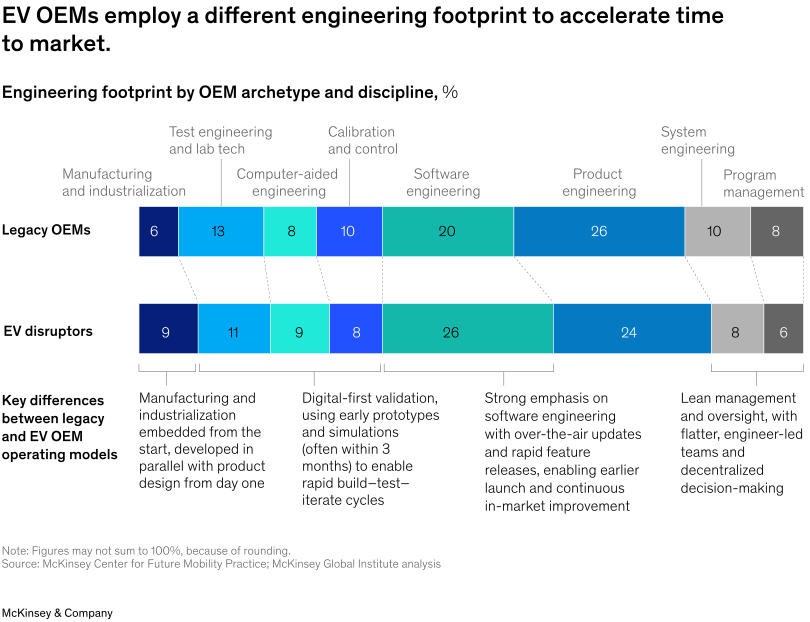
Legacy OEMs’ productivity is lower because they commonly staff engineers across multiple concurrent programs and because they have more complex and slower established decision-making processes, adding switching costs that are uncommon at EV disruptors that have less need to move teams among projects.
Three other factors also unlock productivity for EV disruptors. They typically have flatter, engineer-led structures than legacy OEMs, reducing management layers and meeting overhead. They also deploy more software, systems, and vehicle control engineers, which shifts work toward scalable code and centralized architectures rather than needing repeated mechanical customization. Finally, the disruptors’ much more extensive use of simulation and digital validation reduces late-stage rework and manual calibration. While legacy OEMs benefit from accumulated experience and established supplier ecosystems in areas such as interiors and infotainment, these productivity advantages are offset by the above factors. (Exhibit 2).
Time to market is the next largest contributor to the cost gap, accounting for 15 percent of the difference between the China base case and legacy OEMs in advanced economies, though that may understate this factor’s competitive importance. Legacy OEM platform programs typically have required much longer development timelines, often 36 to 48 months before production starts. EV disruptors in China and the United States can achieve faster platform development, typically 21 to 28 months or even less to start production. This is achieved primarily through the Innovation Execution operating model and supported by a tight-knit EV development ecosystem.10 In the Innovation Execution approach, design, validation, supplier tooling, and manufacturing readiness take place concurrently rather than sequentially. In tandem, small cross-functional core teams can make rapid trade-offs without multilayer approvals. Suppliers are embedded early as part of a development team rather than engaged only after specifications are locked. Finally, information is shared transparently across functions, enabling rapid feedback loops between design, testing, and cost engineering.
Earlier market entry translates directly into earlier revenue realization. Conversely, delayed launches shorten the effective competitive life of a given technology generation, reducing the time that a platform can capture full value before newer technologies and architectures emerge. Taken together, these effects materially increase levelized costs for programs with long lead times before production starts.
External engineering is the final major driver of difference, explaining 5 to 10 percent of the variation in levelized cost. Legacy OEMs rely more heavily on external engineering partners, especially for software integration, validation, and industrialization support. This provides flexibility but increases total development costs.
By contrast, some EV disruptors are more vertically integrated and do a larger share of development in-house or through tightly embedded suppliers, reducing reliance on external services. Additionally, external engineering capacity in China is often available at lower cost, particularly in the EV domain, thanks to a deep local talent pool and competitive service providers. Less reliance on outsourcing, combined with lower external rates, reduces overall platform development cost.
Other cost differences, such as for prototyping, tooling, testing, computing, and software licenses, are comparatively small. However, differences in prototyping approaches influence development speed and iteration cycles. EV disruptors make more extensive use of digital engineering tools, including simulation, virtual validation, and software-in-the-loop testing, which reduces the need for physical prototypes. In China, disruptors also benefit from dense local supplier ecosystems, particularly around Shenzhen. This makes it much easier to source prototype electric motors, battery cells, and power electronics more quickly than in ICE-based heritage ecosystems such as Michigan’s. Finally, legacy OEMs often retain conservative prototyping and testing practices linked to historical incidents or litigation rather than to current regulations, while EV disruptors often have leaner, requirement-driven validation approaches. While these advantages are not the main drivers of total platform cost, they do contribute significantly to development speed and the time-to-market advantage.
Overall, differences in organizational speed, labor economics, and execution models explain the majority of the gap in EV platform development costs. This is also substantiated by the fact that US EV disruptors can achieve productivity and time-to-market performance similar to Chinese EV disruptors. If legacy OEMs can replicate key elements of the Innovation Execution operating model and develop ecosystem advantages similar to China, they could feasibly close more than half of the current cost gap in EV platform R&D.
Legacy OEMs can narrow the gap by rethinking how they define ambition, make decisions, and structure accountability
Cost and timeline differences explain only part of the competitiveness gap. The deeper distinction is explained by how organizations set ambition, make decisions, and structure accountability.
Use of the Innovation Execution operating model involves targeting ambition in ways that encourage structural change, such as double-digit annual cost reduction and improvements that result in step changes in performance. These stretch targets are not always financial aspirations but rather operational constraints that inform engineering choices from day one. The targets account for forward-looking market influences like customer preference and potential moves by competitors, focusing outside-in rather than only on current internal capabilities.
EV disruptors anchor engineering in first principles rather than incremental optimization. Teams are encouraged to redesign subsystems from scratch, challenge legacy assumptions, and simplify architectures aggressively. This approach reduces complexity that can accumulate over time and leads to structural cost and performance gains. A famous example is Tesla leveraging its vision sensor to detect rain, thereby eliminating the need for a rain sensor.
Accountability is also structured differently. Small, fully dedicated teams have end-to-end responsibility for cost, performance, and delivery. If one subsystem misses its target, the full team is accountable. This eliminates functional silos and replaces consensus-driven alignment with team and employee ownership of decisions.
That’s not to say there’s no role for leadership. Senior executives are heavily involved in product definition and problem solving, as well as reinforcing urgency and removing organizational barriers. Culture is built around fast issue resolution, short feedback loops, and visible progress rather than formal approval rituals. Full transparency built through digital solutions makes this possible. If a team and management understand the current status at all times, they can more quickly jump into solving a problem rather than coming to a solution only after a series of updates.
Such differences are not dependent on geography. They are managerial choices. More than half of the competitive advantage in EV platform development is a result of how work is organized and overseen, not inherent technological or regional constraints.
The realization that time to market is a competitiveness driver should inform corporate action and policy design
Our research indicates that platform economics and competitiveness aren’t determined only by structural factors but also largely by execution capabilities that are specific to a company. The majority of an EV platform’s capital efficiency depends on an OEM’s or disruptor’s ability to compress development timelines, minimize organizational friction, and fully exploit software-centric architectures. As a result, comparisons of labor costs or regional incentives can be misleading if not paired with a granular understanding of operating models.
Businesses could prioritize the following:
- Short development cycles and rapid iteration, underpinned by parallel engineering and early supplier integration
- High software intensity and redeployment at the platform level, consistent with software-defined-vehicle principles
- Dedicated, accountable teams
- Tight ecosystem integration to enable rapid prototyping and fast feedback loops
Importantly, legacy OEMs that reform their governance structures, simplify validation regimes, and adopt Innovation Execution development practices may unlock substantial value. Conversely, those that fail to adapt risk structural disadvantages, even in markets where policy support is favorable.
For policymakers, the analysis highlights that financial incentives and industrial policy alone won’t ensure global competitiveness in EV platform development. While subsidies, tax credits, and mandates to localize can influence where investment is made, they don’t address organizational and ecosystem factors that drive speed and capital efficiency. As time-to-market is one of the key competitiveness levers, regulatory frameworks that inadvertently reinforce sequential development, excessive revalidation, or fragmented accountability may unintentionally disadvantage domestic OEMs relative to faster-moving global competitors.
Policies that could overcome these challenges include the following:
- Regulatory clarity and harmonization to reduce the need for conservative, legacy-driven validation practices
- Encouragement of digital-first development practices, including virtual testing and simulation infrastructure
- Talent mobility and skills development, especially in software, systems engineering, and digital validation
- Support for building out dense supplier ecosystems, particularly in batteries, power electronics, and software tooling
The next phase of EV platform development will not unfold evenly across regions or companies. New entrants have disrupted the market and raised expectations for speed from concept to launch. Automakers that want to remain competitive will need to adopt new ways of working that shorten development cycles and reduce costs, while policymakers can help create the conditions for faster innovation.