Steel is the backbone of the global economy. It is the skeleton of most of our infrastructure, buildings and factories, and a critical component of many products households rely on, from cars to dishwashers and bedframes. In industrialized countries, in-use stocks of steel range from 11 tons and 16 tons per capita.1
The global steel market is a game of costs, shaped by energy prices and persistent overcapacity. In 2024, the industry had capacity to produce more than 2.5 billion tons when demand was only about 1.9 billion tons.2 Much of this excess capacity is in China, which ramped up steel manufacturing to support its rapid urbanization and industrialization, compressing margins for steel producers globally. However, geopolitics, sustainability considerations, and advances in technology are changing the rules of the game. This is leading to a more fragmented industry increasingly determined by regional policies and resource constraints that are shifting the terms of global cost competition in the industry.
This investment case is one of ten that are the foundation of the McKinsey Global Institute’s report, Catalyzing competitiveness: Where investment happens and why. The report examines how investment propels competitiveness, and vice versa by analyzing the variation in costs across industries in regions around the world.
Different production processes predominate in China, the Middle East, and the United States
Globally, approximately 70 percent of crude steel is produced with blast furnace–basic oxygen furnace (BF-BOF) technology, which uses iron ore and metallurgical coal as inputs. Electric arc furnaces (EAF) can remelt prime scrap, a process potentially combined with direct reduced iron (DRI) (see sidebar “Steelmaking technologies”). However, the production mix differs significantly by region (Exhibit 1).
Electric arc furnace steel manufacturing is still an emerging technology.
1Blast oxygen furnace steel manufacturing.
2Electric arc furnace steel manufacturing.

The United States produces approximately 70 percent of its steel with EAF, partly using its abundant scrap resources. The Middle East is also a big user of EAF. For example, Oman’s steel industry operates entirely on EAF production, taking advantage of the country’s abundant natural gas resources. In European countries such as Germany and Sweden, BF-BOF technology still accounts for most production today, but EAF is gaining traction for environmental reasons. New European steel investments, such as Salzgitter’s Salcos facility in Germany, are going into DRI-EAF-based plants, which have a smaller carbon footprint, and BF-BOF capacity is gradually being phased out.
By contrast, BF-BOF facilities account for 90 percent of Chinese steel production. EAF technology mostly powered by coal produces 60 percent of India’s current output, although the country is shifting to BF-BOF production (see sidebar “Steelmaking technologies”).
The business case for DRI-EAF depends on natural gas prices and policy incentives
Investments in steel technologies are made based on the optimal production route in a location. Regions with low natural gas costs or strong policy support attract investment in DRI-EAF technology, and investment goes into BF-BOF technology in areas that are rich in coal and have strong growing domestic demand.
The investment case for DRI-EAF production depends on three factors. First, access to competitive low-cost natural gas for DRI and low-cost electricity to power the EAF is needed. Second, access to key metallic inputs, especially DRI-grade iron ore and scrap must be secure. Third, supportive policy and trade conditions can lower the investment hurdle, especially in regions where DRI-EAF is not the lowest-cost production method. DRI-EAF can play an important transitional role, but its long-term competitiveness may be constrained by competing demand for natural gas and limited availability of high-quality scrap.
The Middle East and the United States are thus attractive locations for selected DRI-EAF investments, given their low natural gas prices and, in the case of the United States, ample high-quality scrap supply. Oman, which in this research is a proxy for the Middle East, produced three million tons of crude steel in 2024, all of it using EAF. The United States produced about 80 million tons in 2024, four percent of global production, 70 percent of which came from EAF production.3
Investment in DRI-EAF steel manufacturing in Europe relies on policy support. EU-27 carbon pricing under the EU Emissions Trading System (EU ETS) increases the costs of BF-BOF. This makes DRI-EAF production more attractive once allowances are phased out and ETS is in full force, or before that, enabling capture of a “green” premium.4 Plans are already underway in Europe for more than 17 EAF and DRI-EAF steel plants that will produce roughly 40 to 50 million tons of low-carbon steel in 2030.5
Germany is at the forefront of Europe’s DRI-EAF steel transition, supported by heavy subsidies. Germany produced 37 million tons of crude steel in 2024, 2 percent of global production. Some 30 percent of that steel was produced using EAF.6 The Salzgitter Salcos project is an early test case for converting an incumbent BF-BOF flat-steel production facility into a DRI-EAF plant that will eventually be powered by hydrogen, although the project has been delayed.7 Sweden, a smaller steel producer at four million tons, is pursuing hydrogen-powered EAF via low-cost hydropower, though recent projects such as Stegra have struggled financially.8
In other regions, BF-BOF production linked to low-cost coal and strong domestic demand are a more attractive investment. This technology is dominant in markets such as India, China, and Southeast Asia, where natural gas and scrap availability are more limited. China accounts for around half of global output and is the main producer of the 600 million tons global overcapacity, so further capacity additions are likely to be modest.
DRI-EAF costs vary by half across locations, but BF-BOF in Asia undercuts all DRI-EAF costs
As part of our comparison of competitiveness across industries and regions, we isolate the drivers that explain why some regions are more or less competitive in a comparable technology. In this case, we recognize that actual steel investment decisions are influenced by a range of local factors.
For this purpose, we benchmark all locations against a common production route, DRI-EAF, and a common product, hot-rolled coil, in a plant with 2.5-million-ton capacity. This creates a like-for-like analytical baseline and allows us to compare the role of natural gas, electricity, raw materials, labor, logistics, and carbon costs in shaping regional competitiveness. In this benchmark, Oman is used as the base case because significant investments are underway there, including in Duqm and Sohar. We benchmark our base case against similarly sized factories using the same technology in China, Germany, India, Sweden, and the United States. Comparisons with other technologies and what drives actual investment decisions are addressed subsequently.
Benchmark: Middle East (Oman)
The levelized cost of steel production measures the average cost of producing one ton of hot-rolled coil over the lifetime of a project. Across the six locations, levelized costs range from about $495 per ton in Oman to about $750 per ton in Sweden (Exhibit 2). The United States and India are the second- and third-most competitive locations, with approximately 10 to 15 percent higher levelized costs, respectively, compared to Oman. In China, DRI-EAF costs would be 25 percent higher than in Oman—certainly one reason the country has largely stuck to BF-BOF. The cost gap is materially larger in Europe, where levelized costs are 45 to 50 percent higher, mostly driven by higher natural gas prices.
Oman produces DRI–EAF steel at low cost, thanks to its low energy costs.
Note: Figures may not sum, because of rounding.
1Direct reduced iron–electric arc furnace (DRI-EAF) production of hot-rolled coil (HRC).
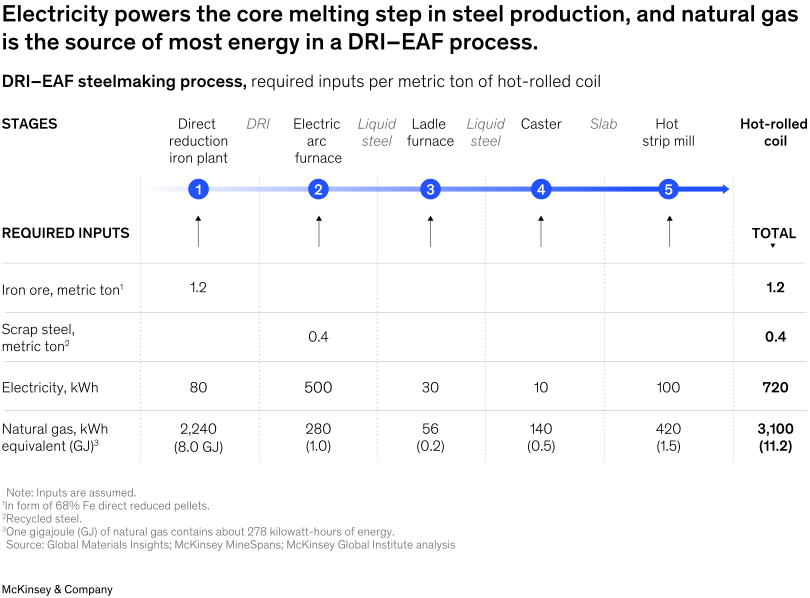
Energy costs (natural gas and electricity) are the main contributor to the gap in levelized cost between locations. For one ton of hot-rolled coil steel, about 11 gigajoules of natural gas is required, 70 percent of which is used in the DRI step. The electricity usage in the process is about 700 kilowatt hours, where about 70% is used to power the EAF. Overall, the DRI-EAF process uses about four to five times more energy from natural gas than from electricity (Exhibit 3).
- Gas costs: The United States produces gas domestically and so has low gas costs similar to Oman. In Europe, however, the gas disadvantage is pronounced. Sweden’s gas prices per ton were four to five times higher than Oman’s in 2024. That added about $250, or 50 percent of Oman’s levelized cost, to the price of Sweden’s steel, while Germany’s gas costs per ton were two to three times higher, adding about 25 percent (Exhibit 4). Sweden’s higher gas prices mainly stem from limited gas infrastructure and a low natural gas supply. China’s and India’s gas prices fall somewhere in the middle, with gas costs roughly double Oman’s, increasing their steel prices by about 10 to 20 percent.
- Electricity costs: The cost of electricity varies by location. Sweden has very low electricity costs, mostly related to its use of hydroelectric power, which gives it about a 5 percent cost advantage relative to Oman.9 Electricity costs in China, India, and the United States, are broadly in line with Oman’s. Germany is the outlier, with electricity costs nearly double Oman’s, adding a markup of $80 (15 percent) to a ton of its steel. This does not take into account subsidies for heavy industry in Germany, which lower electricity costs for individual producers.
Combined, Oman’s total energy cost (natural gas and electricity) is more than four times lower than Sweden’s and accounts for about 90 percent of the gap between the countries, or $230 of the total energy cost difference of $250 per ton of steel. Such a large difference is difficult to offset. Even when countries have other advantages, they cannot compensate for the energy cost gap.10
Labor costs also contribute to cost differences but to a substantially lower degree than energy because labor is a much smaller part of the overall costs in steelmaking. Salary differences account for most of the $20 to $30 additional cost of steel produced in Germany, Sweden, and the United States where salaries are roughly ten times higher than elsewhere. Chinese and Indian labor costs are consistent with Oman’s and therefore do not meaningfully add to their cost gap.
Materials for steelmaking, including DR-grade pellets and scrap, are globally traded. In Germany, Sweden, and the United States, the cost per ton of steel is $20 to $30 lower than in Oman because their larger steel stock meant that more scrap is available. Oman, India, and China have a smaller steel stock, meaning less scrap is available and steel producers rely more on imported pellets. This means that advanced economies have a cost advantage in materials though not enough to offset the difference in energy prices.
Carbon pricing affects the EU-27, the only region where material CO₂ costs apply. That translates to cost per ton about $10 higher than in other regions. These costs increasingly penalize BF-BOF production and create a relative advantage for DRI-EAF production, as exceptions under the EU ETS are phased out and the EU Carbon Border Adjustment Mechanism is put into force. The exact cost premium will depend on the future structure of the European steel market, the availability and allocation of emissions allowances, and the prevailing carbon price. Due to the uncertainty of the carbon price development, this modeling uses the 2026 carbon premium.
Other factors, including capital expenditures, construction time, and maintenance costs, are largely similar across the countries because DRI-EAF is a relatively new technology and plants are expected to be built by the same original equipment manufacturer regardless of the location.
Energy costs determine the competitiveness of DRI–EAF steel production.
Note: Figures may not sum, because of rounding.
1Direct reduced iron–electric arc furnace (DRI-EAF) producing hot-rolled coil (HRC).
BF-BOF facilities in China and India are more competitive than DRI-EAF facilities in the Middle East (Oman)
The cost structure of steel production has a direct impact on which technologies are likely to be deployed across regions. Where low-cost gas is available, such as in the Middle East and the United States, DRI-EAF plants can be competitive. Where it is not, countries default to BF-BOF as in China and, increasingly, India—unless forced or given incentives to decarbonize, as in Europe. Comparing the full range of technologies for Germany, the most expensive technology, hydrogen-powered DRI-EAF, is twice as expensive as the cheapest one, BF-BOF (Exhibit 5).
DRI–EAF steel production is about 50 percent more expensive in Germany than traditional BF–BOF production.
1Higher-quality scrap price and other necessary DRI inputs to create flat steel are likely not priced in and would increase levelized costs.
Oman is no longer the lowest-cost benchmark when BF-BOF is included (Exhibit 6). In India, BF-BOF production drops levelized cost by about 35 percent, from $570 ton to $380 per ton. Thus, Indian steel produced in a BF-BOF plant costs $120 less per ton than steel produced in Oman with DRI-EAF. Similarly, BF-BOF steel production in China reduces levelized cost by about 20 percent, from about $610 per ton to $480 per ton, making China’s steel about $15 cheaper per ton than Oman’s. India and China thus are the most cost competitive in steel in our benchmark.
In Sweden, efforts are underway to use low-cost hydropower for hydrogen-powered DRI EAF, such as in the Stegra facility currently under construction in Boden. Switching from DRI-EAF production powered by natural gas to hydrogen-powered DRI-EAF production could drop Sweden’s levelized cost from $750 to $665 per ton.11 Even so, steel produced in Sweden’s hydrogen-powered DRI-EAF plants costs $170 more per ton than steel produced in Oman and $285 more per ton than steel out of India’s BF-BOF plants.
For investors, these different technology paths imply three investment paths. First, investment driven by cost remains centered on BF-BOF in India and China. Producers there can deliver the lowest-cost steel, which comes with the highest CO2 emissions. Second, transition-positioned investment favors DRI-EAF in the Middle East and the United States, where gas economics work without subsidies. Third, policy-dependent investment centers on DRI-EAF or hydrogen-powered DRI-EAF in Europe, viable only as carbon prices rise and free allowances are phased out, or as equivalent subsidy, green-premium support, or both are secured. Each archetype implies different return expectations, risk profiles, and sustainability and policy exposure.
Methods of producing hot-rolled coil steel are most competitive in China and India.
Note: The chart features the dominant or illustrative production method for each country, including blast furnace–basic oxygen furnace, direct reduced iron–electric arc furnace, and hydrogen-powered direct reduced iron–electric arc furnace methods.
1Figures may not sum precisely, because of rounding.
Cost will drive steel investment, but policy will also determine where investment lands
Steel production will remain primarily a cost game. Purchases of flat steel are still driven mainly by price, quality consistency, and supply-chain reliability rather than by production method. However, policy is increasingly shaping investment decisions for geostrategic or environmental reasons. This is already altering regional investment patterns, especially in Europe and the United States. Lower-emissions steel will scale fastest where policy support, input economics, and technological readiness reinforce one another. Over time, technology could materially reshape the cost curve, narrowing the cost gap with incumbent production routes and making lower-emissions steel competitive across a broader set of regions.
In the United States, Section 232 tariffs increase import prices and so support domestic steel production.12 Products made entirely from steel—for example, steel coil—carry a flat 50 percent tariff, with a flat 25 percent of full value imposed on derivative articles made of steel such as steel kitchen stoves. In the EU-27, steel imports that exceed certain quotas are subject to a 50 percent tariff.13 In India, domestic preference rules prioritize locally produced steel in public projects, which limits imports.
Carbon regulations and subsidies are particularly important in Europe. The EU ETS system adds costs especially to BF-BOF production. Because the ETS benchmark is anchored in BF-BOF performance, low-emissions DRI-EAF plants can gradually improve their relative cost position and create economic surplus as BF-BOF allowances phase out over time and cleaner technologies scale. The EU Carbon Border Adjustment Mechanism is designed to level the playing field also charging carbon pricing on imported steel, but this will still increase the steel price in Europe.
The steel industry is heading into dynamic times. Cost competitiveness will remain the starting point, but energy prices, carbon regulation, trade policy, and technology will increasingly determine which production routes scale and where. Regions where energy is structurally expensive, like in Europe and advanced Asia, could relocate the production step requiring in the most energy to regions with more abundant energy resources. For DRI-EAF, this would mean relocating DRI production to lower-cost regions like the Middle East or the United States while maintaining the EAF step as well as rolling and finishing the product nearer to demand. How quickly producers, policymakers, and customers align on costs, carbon emissions, and demand will determine the competitiveness of steel produced with lower emissions.