Autonomous vehicles are on the on-ramp to full deployment. Recent years have seen the first Level 3 (L3) vehicle releases, more than 700,000 fully autonomous robo-taxi rides per week, and the first driverless demos for autonomous trucks. This ramp-up is global: Europe has been home to more than 35 autonomous-vehicle pilots to date, and the United States and China each see more than 450,000 and 250,000 commercial rides per week, respectively.1
With the industry charging forward, the race to win is far from over. Developers are working to overcome the next round of technological and investment barriers, and questions remain about how tech stacks will develop. In other words, advanced driver-assistance systems and autonomous driving have room to scale.
To understand trends in this fast-paced industry, the McKinsey Center for Future Mobility conducted its third biannual survey of industry leaders, coupled with a workshop to discuss survey results (see sidebar “Methodology”). This year provided some particularly notable insights, including expert updates on lengthening adoption timelines and increasing development costs, perspectives on regional progress, and ideas about what form of autonomous technology will win out. We break down these insights and more below.
Adoption timelines for autonomous vehicles continue to grow
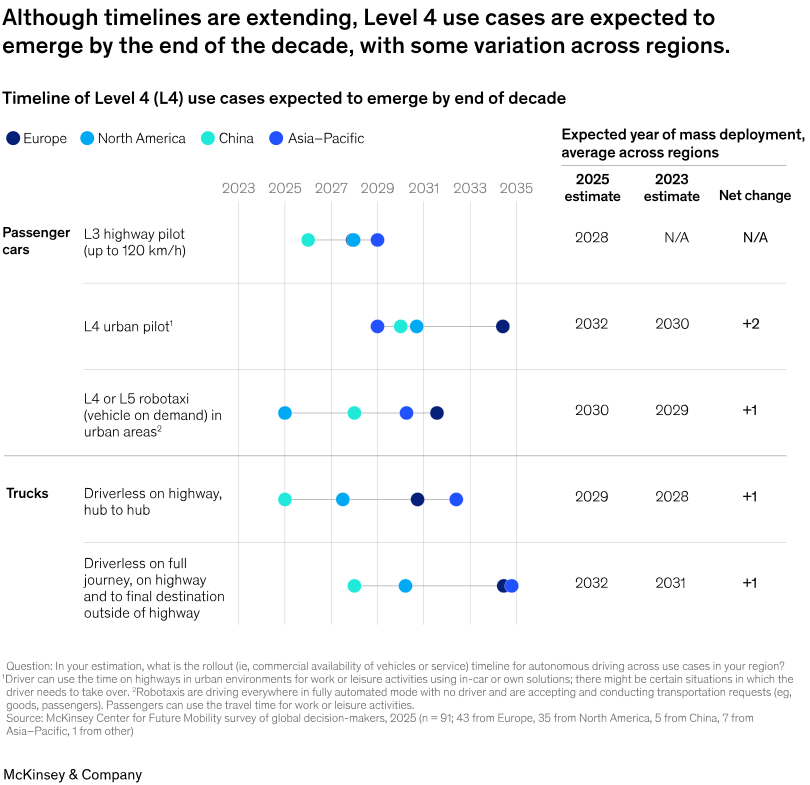
This year’s survey indicates that adoption timelines for autonomous vehicles have slipped by one to two years on average—relative to the 2023 survey2—across most autonomous-driving use cases. While L4 robo-taxis are now available in the first cities in the United States and China, the global rollout of robo-taxis is now expected to become reality at a large scale in 2030, rather than 2029 (see sidebar “Levels of autonomous driving”). Similarly, L4 urban pilots for private passenger cars are expected to be pushed out from 2030 to 2032, and fully autonomous trucking is expected to reach viability by 2032, not 2031. Overall, experts expect that robo-taxis will be the first commercial application for L4 in mobility—not privately owned cars.
The availability of autonomous vehicles is also expected to vary across geographies. As mentioned, the United States and China have seen the earliest rollouts of robo-taxis, but other geographies may see later deployments. Surveyed experts expect that it will take three to seven years for robo-taxis to be widely deployed commercially and available across all geographies. Experts predict similar rollout patterns for trucks and passenger cars. China and the United States are expected to lead, with most use cases launching significantly earlier than in Europe or the rest of Asia. A number of factors are likely contributing to this regional divide, including faster development cycles, agile commercial organizations and start-up cultures, regulatory support, funding availability, a strong available AI and software base, built environments that are more conducive to autonomous driving (versus crowded city centers), larger market sizes, and a stronger willingness to test new technologies at large scale.3
The mass-market focus for privately owned vehicles is shifting to L2+ functions
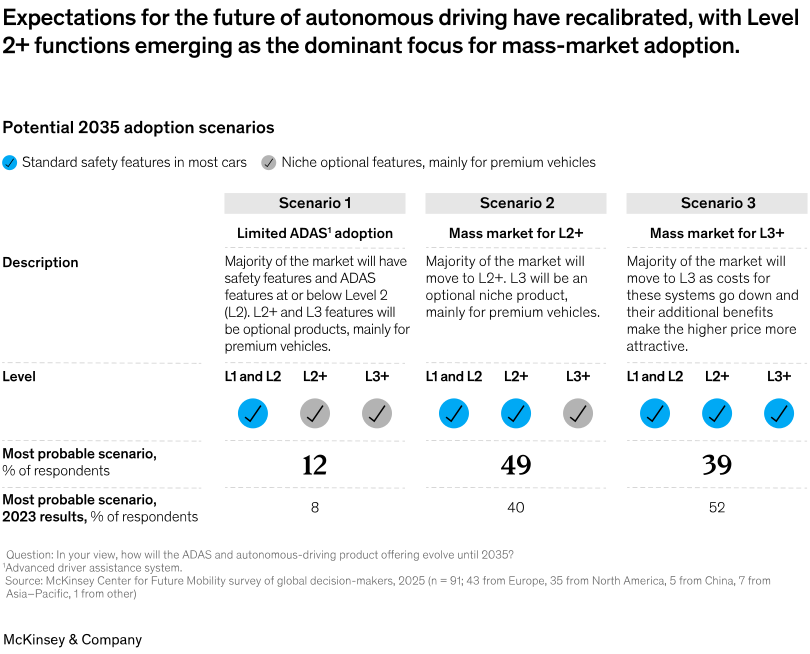
Out of the experts surveyed this year, the largest group (49 percent) now believes that the mass market for privately owned vehicles (not robo-taxis) will center on L2+ functions by 2035. This marks a shift away from the focus on L3 or higher functions seen in the 2023 survey, in which 52 percent of experts anticipated the market to move toward L3 or higher systems. These prior predictions were largely based on the assumption that costs for L3 systems would decrease and that beneficial aspects of L3 vehicles (for example, their ability to allow drivers to rest or perform nondriving tasks such as working or gaming) could enhance their appeal.
Today, only 39 percent of experts predict the market to focus on L3 or higher. This decline may be due to a lack of funding, high costs for development and validation, and slow technological advancements. Today, experts increasingly see L3 autonomous functionality as an optional, niche product, primarily targeted at premium vehicles rather than at the broader mass market.
Experts predict higher costs for more advanced autonomy levels
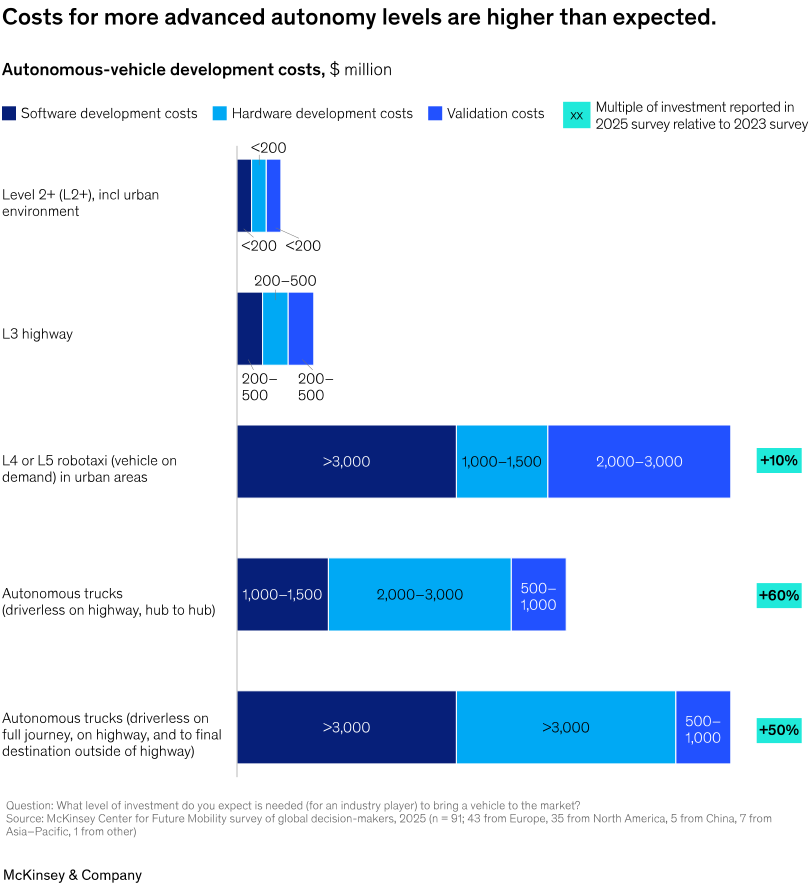
Compared with the 2023 survey, respondents reported greater estimated costs for higher autonomy levels despite additional breakthroughs in AI. This also might be because of an underestimation of costs required for moving from testing to commercial deployment—for example, industrialization of products, ability to handle the long tail of edge cases, and high costs for validation and verification. The survey bore this out: Cost estimates have increased only slightly for L4 robo-taxis, likely because robo-taxis are already being scaled up and leaders are more certain about what it will take for them to achieve commercial maturity. However, there is a greater upward correction in cost estimates for autonomous trucking—50 to 60 percent, depending on the application. This is likely because trucking is further from reaching commercial readiness at scale.
A few other factors contribute to greater expected costs for higher autonomy levels. Lower levels of autonomy typically require less sophisticated algorithms and a leaner hardware setup (sensorics and compute), which experts believe might result in software development, test, and validation costs four to seven times lower than higher degrees of autonomy (L4 and L5 robo-taxis and trucks). On the other hand, urban robo-taxis and other high-autonomy vehicles must contend with complex traffic scenarios and various edge cases. These technological thresholds mean that robo-taxis and “full journey” autonomous trucks are expected to need more than $3 billion in investments in software to achieve market readiness. Meanwhile, hardware development costs seem to correlate with the form factor (type of vehicle), rather than the degree of autonomy, with costs for autonomous trucks (regardless of hub-to-hub versus full-journey capabilities) significantly surpassing other modes of transportation.
High costs are a key pain point for autonomous players
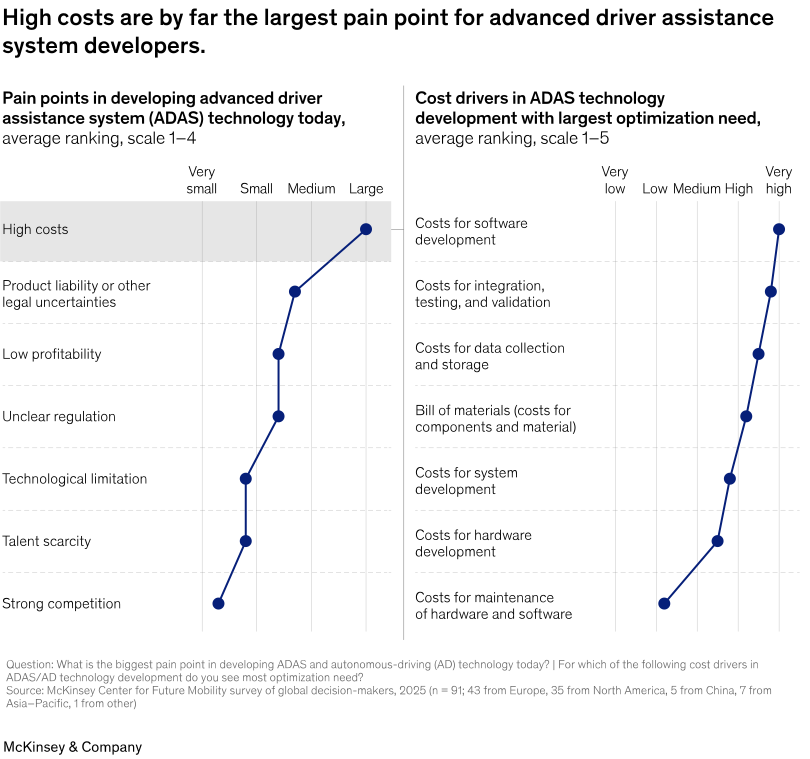
To assess what barriers remain to fully autonomous driving, this year’s survey looked into pain points in the development pipeline. Although one might expect liability or technology to rank first, high costs are clearly the biggest pain point in the ADAS development pipeline. This is a clear sign that the industry is moving from development to deployment. Indeed, cost estimates for ADAS have risen over the years as development timelines for market maturity have been continuously delayed, putting pressure on technology players.
Uncertainties about product liability and regulations rank as medium pain point, likely due to the importance of ensuring that ADAS and autonomous driving are safe and compliant, in addition to the lack of an established liability framework for suppliers, OEMs, end customers, and users in the value chain. Experts ranked competition lowest among potential pain points this year, potentially because as players transition to a postconsolidation market, they are seeing that the value pools at stake are large enough for multiple competitors to coexist and thrive. This is perhaps related to the fact that talent scarcity also ranks low on the pain point spectrum. Talent availability has likely improved due to recent industry consolidation and the rise of AI to support and accelerate R&D processes.
Experts expect a trend toward greater regionalization
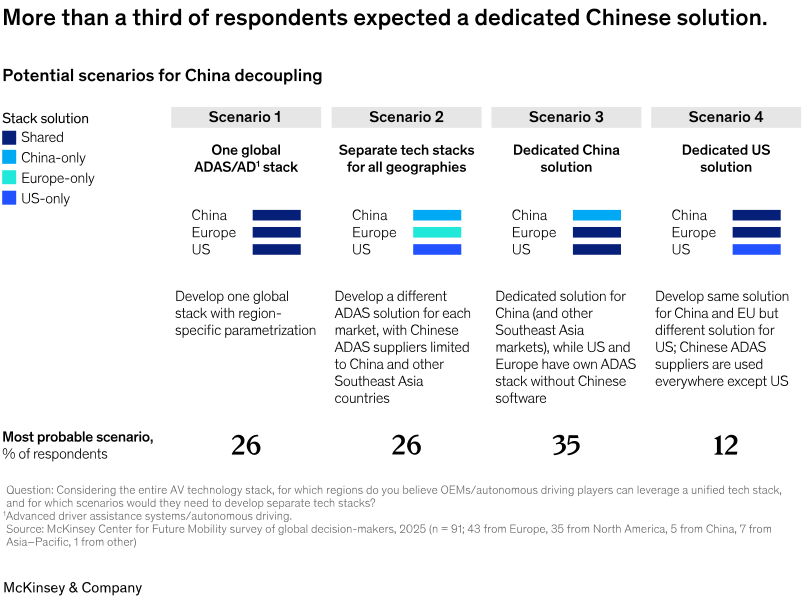
When presented with scenarios for how global ADAS technology stacks might develop around the world, surveyed experts were divided. Most (74 percent) predict a dedicated China tech stack, but they vary in how they predict regional tech stacks might manifest: 26 percent predict that Europe, the United States, and China will each have their own tech stacks; 35 percent predict that China will have its own tech stack and the United States and Europe will share another; and 12 percent predict that the United States will have its own tech stack, with another tech stack developed in China and shared with Europe. Experts might expect a dedicated China stack because of heightened interest in ADAS capabilities among Chinese consumers4 and the region’s independent supply chains, as well as overall geopolitical uncertainty leading to regionalization across sectors.
Autonomous-driving software stacks are most likely to incorporate end-to-end AI systems in hybrid models
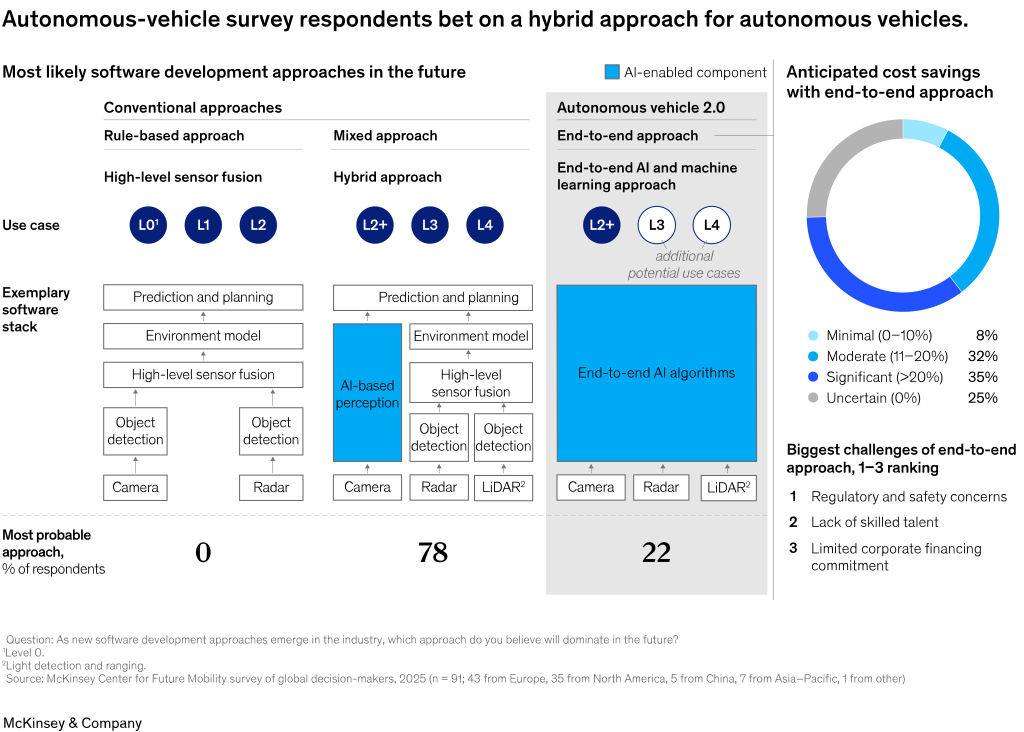
This year’s survey dived into expert predictions about “end to end” learning, a more recent development in the autonomous space offered by a few leading players. End-to-end learning platforms are built on one large foundational AI model and trained using machine learning. This differs from traditional software development for vehicles, in which programmers individually define the vehicle’s rules for perception, sensor data fusion, and path planning, whether through manual coding or with separate AI algorithms.
End-to-end learning has the potential to offer performance benefits, including simulating human-like driving behavior. Vehicles using end-to-end tech stacks can more easily be driven in areas that are less used (or even not yet tested) by autonomous driving. Experts also expect that creating end-to-end learning systems could reduce development costs: 32 percent of surveyed experts assume a moderate cost reduction of between 10 to 20 percent, while 35 percent assume a higher reduction of more than 20 percent. However, there are also some drawbacks to end-to-end learning. Experts cite regulatory and safety concerns (such as AI hallucinations and the model behaving as a “black box”) as the number-one challenge to implementing end-to-end learning systems. This is followed by difficulty finding skilled talent (that is, talent well-versed in AI) to build these systems and high investment costs to, for example, build data centers or collect required data.
Due to these challenges, only 22 percent of the experts assume that “end-to-end only” models will be the dominant approach in the future. The vast majority of experts expect hybrid models, which combine traditional algorithms with end-to-end AI models. Such a hybrid vehicle might, for example, calculate a trajectory with its end-to-end model, then check that trajectory with traditional algorithms. Among different use cases, experts think that end-to-end only ADAS might still be used up until L2+, in which the driver is supervising and can take action if the system fails. For use cases above L3, less than 10 percent of experts estimate an end-to-end only model as the dominant approach.
Experts are increasingly divided in how hardware and software will be sourced
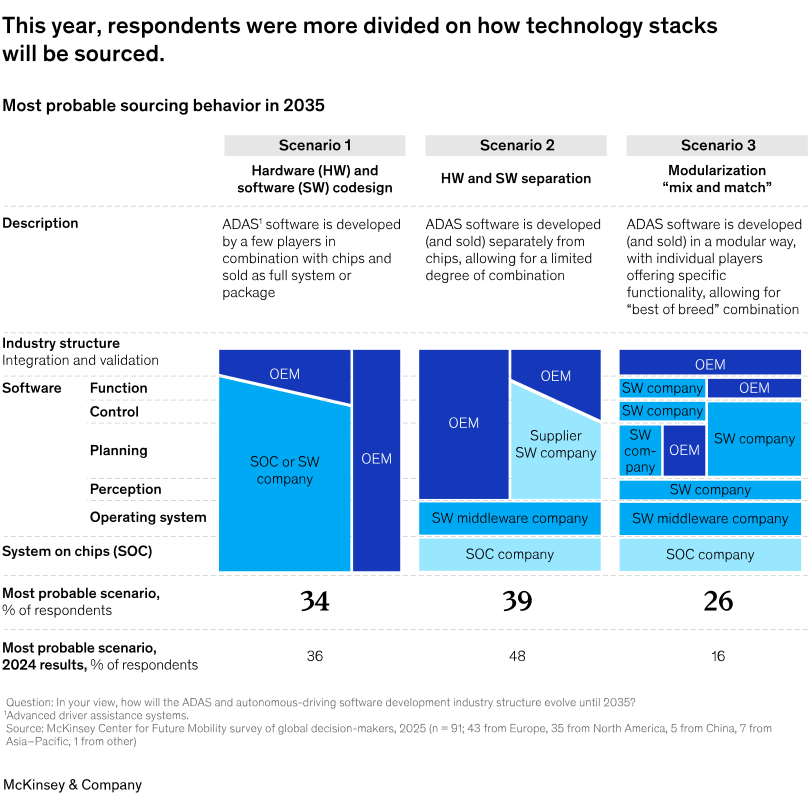
This year saw a greater split in expert opinions about how OEMs will source hardware and software components in 2035. Today, the majority of the market of L2+ is dominated by system players (which develop chips and software together), but the experts we surveyed predict that the dominant sourcing strategy in 2035 will be hardware–software separation (that is, OEMs sourcing chips independently from the software). Some OEMs might also develop the software themselves in this scenario. About a third of surveyed experts (34 percent) expect a scenario in which chips and software are either jointly developed by a tech player and chip company or in which everything is done in-house by an OEM.
The most notable change in this year’s survey is the greater share of experts who assumed a mix-and-match approach—26 percent, up from 16 percent in 2023. In this scenario, elements of the technology stack are sourced from different suppliers and integrated by an OEM or a tier-one supplier in the final product. Expert predictions for a mix-and-match approach are likely driven by the rise of end-to-end and hybrid architectures, which could incorporate end-to-end systems from one supplier (or from an OEM’s own development) and traditional systems from another supplier.
A few insights can help autonomous players succeed
The results of this year’s survey have multiple implications for autonomous driving companies. A few key insights stand out:
- Being agile and flexible will help companies stay up to date. Given uncertainty about technology, regulations, and public perception, players will need to constantly track the latest developments in autonomous driving and adapt quickly to changes. This is especially important in areas above where experts have flagged a “split view" (for example, on how hardware and software is sourced, tech stack strategy by region, and so on).
- Successful market strategies will likely be both targeted and collaborative. As autonomous markets shift and consolidate, companies can focus on parts of the value chain where they have the right to play and win. Partnerships for elements outside of the core business can also help broaden market share.
- Maintaining focus on customer value will be key. In today’s rapidly shifting markets, companies can track what customers want to pay for and build offerings that will meet those expectations.
- Safety guidelines will be critical for scaling. As with all new technological developments, safety and regulation will be crucial. Industry groups can collaborate to set standards and ensure there are no speed bumps to scaling safely.
- Organizational excellence can help overcome roadblocks. Tech, commercial, and operational teams need to work hand in hand to keep development costs in check and make progress at pace.
The industry is getting closer to at-scale realization, however gradually. Even though challenges remain, new innovations and offerings in the industry show encouraging progress. By creating and adjusting plans based on today’s evolving factors, autonomous-vehicle companies stand to find their niche in the coming autonomous landscape.