Until recently, the shift from internal combustion engine (ICE) vehicles to battery electric vehicles (BEVs) was steadily gaining momentum, driven primarily by international targets for reducing CO2 emissions. New vehicles sold have bold targets—49.5 grams of CO₂ per kilometer (km) by 2030 in the European Union,1 for example—with related penalties for exceeding fleet targets playing a major role in increased electrification.
Despite some slowdown caused by geopolitical trends and constantly changing climate targets, our forecasts show global BEV sales to increase by 18 percent per year by 2030 to meet current regulatory targets. To achieve the projected global ramp-up of zero-emission vehicles, EVs will need to penetrate mass markets before 2030. Although the total cost of ownership (TCO) for many EVs (including purchase price, maintenance, electricity, taxes, and insurance) is better when compared with ICE vehicles in important markets, higher costs and customer prices for BEVs remain significant barriers to faster adoption.
The largest cost driver for BEVs is the battery pack, which typically accounts for 30 to 40 percent of a vehicle’s total cost. Even though costs have fallen significantly in the past few years, large battery packs can cost as much as €15,000 for incumbent OEMs. Still, some Chinese companies have found additional cost advantages of 25 to 40 percent compared with their peers, setting the industry benchmark for cost efficiency.
This article illustrates how Western OEMs can follow the cost curve of Chinese competitors, and it describes how even though costs for Chinese companies will likely remain lower, the combination of an acceptable cost position and a focus on customer value could help protect market shares in Europe and North America.
EV battery packs: An overview
When comparing vehicles with similar battery capacities, Chinese OEMs consistently achieve cost advantages—even as high as 40 percent. They do so by focusing on lowering the number of parts and making more cost-effective technology choices, selecting lower-cost cell chemistries such as lithium iron phosphate (LFP), and optimizing components costs (Exhibit 1).
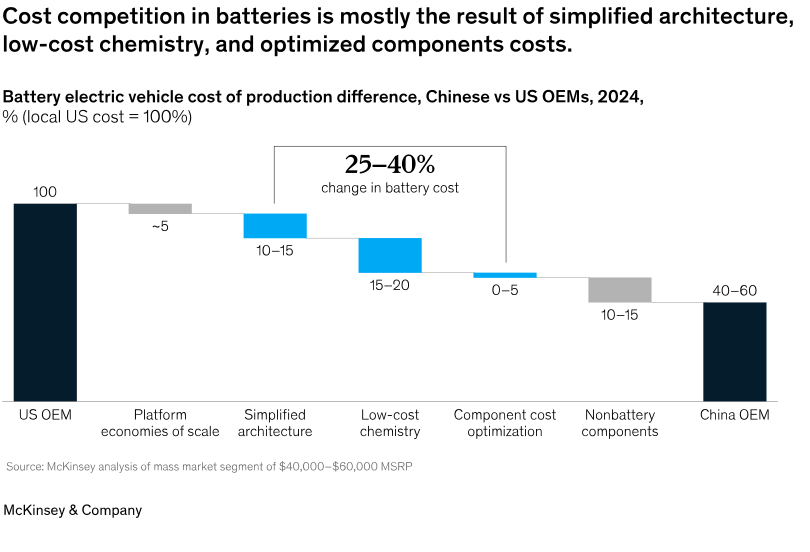
These points in mind, some Chinese manufacturers have reached battery pack costs of approximately €64 per kilowatt-hour (kWh) for LFP solutions and about €82 per kWh for lithium nickel manganese cobalt (NMC) solutions, resulting in cost advantages of €2,000 to €4,000 for midsize vehicles made in China2—a key reason why incumbent OEMs have lost market shares of up to 50 percent since 2023.
Overcoming challenges and achieving cost excellence
The following critical challenges can be addressed to help companies succeed in the competitive BEV market: battery platform and architecture, battery component design choices, supply chain and lower-cost chemistries, time to market and innovation cycles, and customer life cycle value.
Battery platform and architecture
A number of OEMs have lowered costs by simplifying pack design, increasing the functional integration level, and reducing the number of variants across their vehicle portfolios. In a joint announcement in 2019, two Chinese companies unveiled cell-to-pack (C2P) battery architecture concepts, which avoid battery modules by integrating large cells directly into the battery pack. The following year, a disruptor designed the first pack that could be charged with unstable power sources. In mid-2025, the first European C2P architecture was being launched while Chinese players unveiled third-generation C2P designs.
This in mind, incumbent OEMs can take the following actions to follow the success of market leaders:
Design vehicles around the battery pack. Many Chinese OEMs prioritize simplicity and cost competitiveness, while a number of legacy OEMs have adapted their BEV portfolios based on existing ICE vehicle architectures. The latter decision was made to maximize the number of components that could be used across architectures as well as to maintain a multipowertrain platform of ICE, hybrid, and fully electric powertrains. However, this ultimately results in less-than-efficient designs. Although multipowertrain platforms will no doubt continue to exist in low-volume niche vehicles, many OEMs are not consequent enough to design their BEVs around the battery pack, even when doing so has a clearly positive business case. A typical example is compromising space for battery cells in the footwell or placing onboard chargers in separate housing located in the vehicle’s crash zone.
Weight differences between OEM’s body-plus-pack platforms of comparable performance (in terms of stiffness and crash safety) can reach 5 to 10 percent. C2P architectures can reduce total weight by 2 to 4 percent and more than €500 per vehicle by mitigating housing costs of battery modules, wiring, and vehicle underbody parts. Integrating high-voltage components into the same housing can also save an additional €50 or more per vehicle.
A compounding factor for these inefficiencies is legacy OEMs’ wider range of electric powertrain options, compared with disruptors. Some incumbent OEMs offer models with as many as five different powertrains, whereas new entrants sometimes limit offerings to two or three. To minimize investment costs, legacy OEMs are reverting to mixed ICE or BEV platforms for their next-generation vehicles. However, this approach could mean sacrificing efficient materials costs and optimized design, further widening the gap with more streamlined competitors.
Enable cost-efficient cell chemistries. Although most customers don’t select their BEV by battery chemistry, chemistry choice does drive customer attributes, including up-front cost, TCO, and range (Exhibit 2).
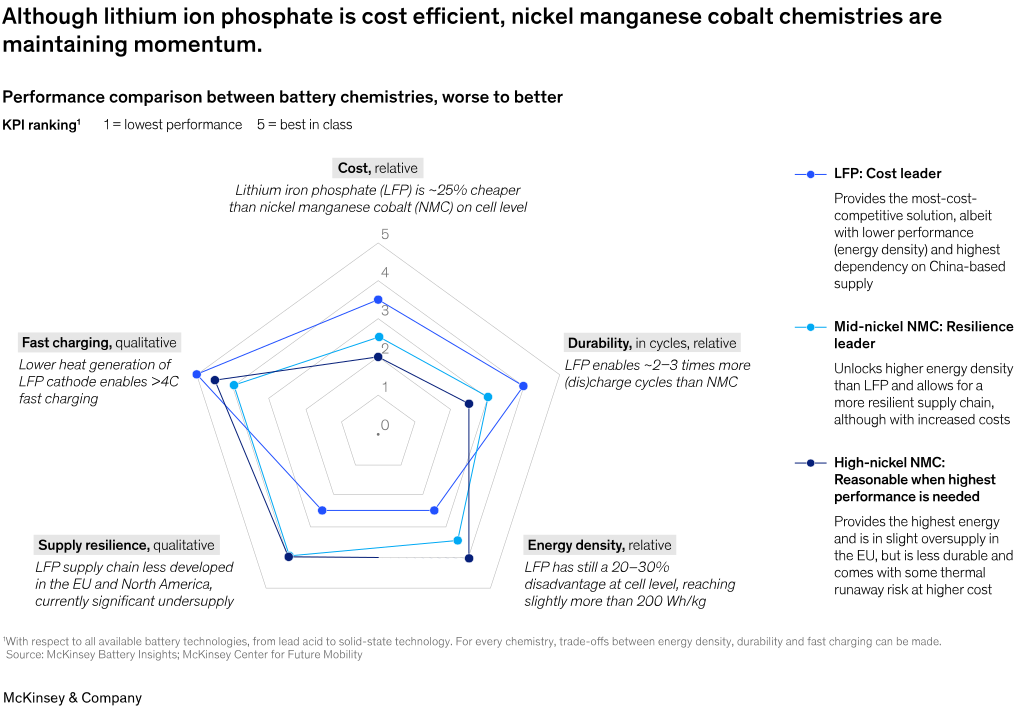
Adopting LFP battery chemistry is another effective way to lower costs, with the added bonus of safety advantages over other lithium-ion chemistries. However, LFP sacrifices energy density, which can result in lower ranges if the vehicle is not designed to take full benefit of the advantages of LFP. Chinese OEMs have embraced LFP across entry-level and midrange vehicles, often compensating with innovative fast-charging technologies (about ten to 15 minutes for a charge of 10 to 80 percent). Although LFP adoption is increasing among incumbent OEMs, the pace outside China remains slow. Decision makers still typically prioritize range over cost, perpetuating the “pay an additional €3,000 to €5,000 for 20 percent more range” mindset for customer segments that need full-range capability, even if it’s only a few times per year.
In the years to come, multiple LFP vehicle variants are going to be launched by non-Chinese OEMs to address price-sensitive segments. The slower adoption of such cost-effective chemistries in the West is partly based on the less-developed value chain in Europe. Alternative, upcoming mid-nickel chemistries such as lithium manganese-rich or lithium manganese nickel oxide cells are one approach to balance cost and energy density and increase supply resilience.
Beyond cell chemistry, the form factor of battery cells has also evolved, with shapes shifting from pouch and cylindrical to prismatic. Pouch’s popularity has declined as thermal management, production, and safety requirements have become more complex. When it comes to improving packing efficiency, less-rigid cell structures necessitate packs that are more structurally stable, which can complicate C2P integration. However, a European EV producer recently announced pouched-based C2P architecture. Most OEMs have adopted or are planning to use prismatic cells because of the high packing density as well as the fact that cylindrical cells allow for easier thermal propagation control and better manufacturability. Hence, all battery cell form factors have nuanced advantages, and a clear winner has yet to be determined.
Battery component design choices
Legacy OEMs often take a customer-first approach, adding requirements and complexity to BEV architectures without a strict focus on perceived value. In this way, the traditional approach of cascading requirements and defining strict subsystem interfaces can limit the ability to simplify and increase costs. Although first-principles design helps address these complexities, corner-case requirements (such as 15-year durability in tropical climate conditions) should be balanced with costs or explicitly advertised for willing buyers.
We have observed some common differences between Chinese and incumbent OEMs:
- Simplified design. OEMs that successfully lowered costs have developed innovative and simplified design approaches, as seen with blade battery or prismatic C2P designs, which can reduce costs by more than €500 per vehicle, or single-stage charging, which can save up to €150 per vehicle.
- Product specifications. Legacy OEMs sometimes spend hundreds of euros to offer superior corrosion protection, stiffness, shock resistance, and lifetime sealing. However, such features are not always advertised to buyers.
- Production capital expenditures. Capital investment in battery pack plants is mostly driven by equipment (approximately 60 percent), building, and infrastructure (the remaining 40 percent). Production capital expenditures account for around 3 to 5 percent of unit costs, yet significant capital investment is required and contributes to the overall business case. The following design and construction levers can help minimize up-front investment:
- Product design drives manufacturing complexity (for example, cell-based designs help reduce the number of assembly steps and can simplify manufacturing).
- Manufacturing technology and testing standards are highly dependent on process technology capabilities and subsequently drive equipment requirements and costs. Some Asian equipment suppliers have demonstrated high process technology capabilities while reducing overall capital expenditures. As a result, they are rapidly expanding into other regions.
- Production requirements (such as cleanliness and curing times) and the number of required production steps, both of which are often the largest drivers of plant capital expenditures, can be optimized during the product design phase.
Best-in-class players can achieve capital expenditure costs of approximately €4 million per gigawatt hour (GWh), or €200 million for a 50 GWh battery pack factory (roughly 2 to 3 percent of unit costs), which is significantly better than the industry standard.
- Design for serviceability. Disruptors typically limit the serviceability of their batteries (similar to battery makers for laptops) while incumbent OEMs accept lower battery energies, more weight, and additional costs to allow for serviceability for more components. Unfortunately, despite being planned, servicing a battery in several cases can be complicated and (in the case of failure) is rarely worth it, economically speaking.
Supply chain and lower-cost chemistries
Rapidly evolving geopolitics are creating uncertainties about the sourcing of critical components, such as battery cells and power electronics.3 Although Chinese-manufactured components are often more cost-competitive, many incumbent OEMs continue to source components, especially battery cells, at higher costs from Asia–Pacific, the European Union, and the United States (Exhibit 3).
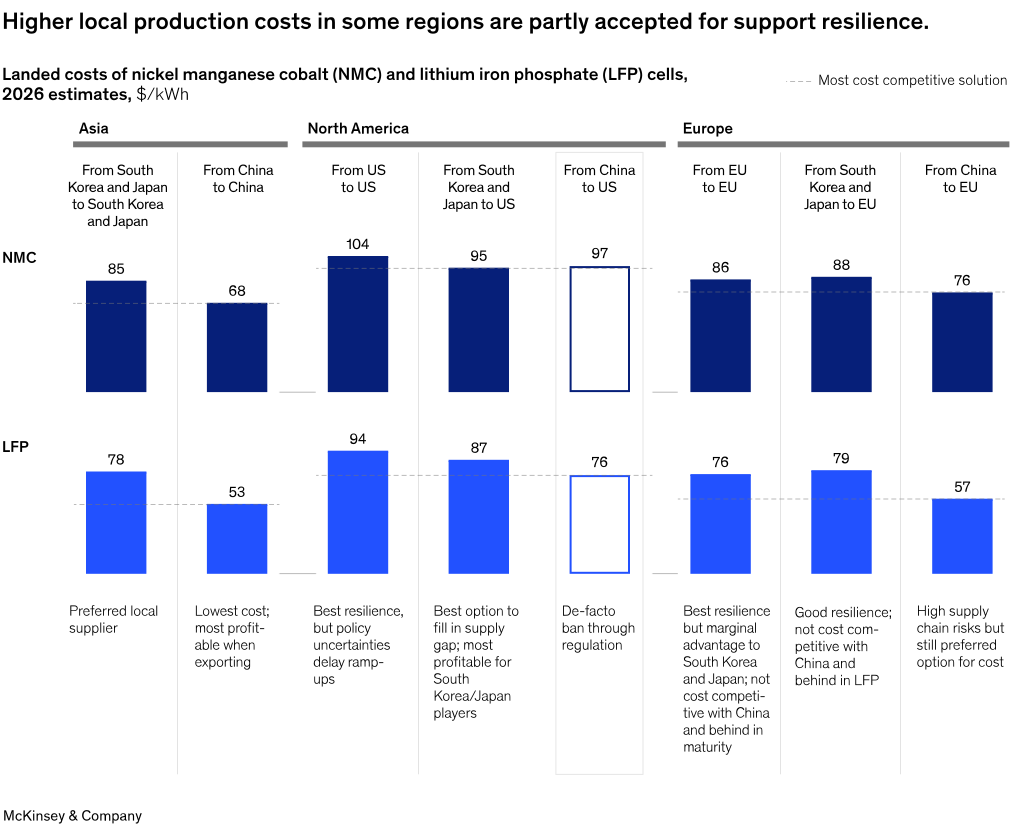
Supply chain security can significantly influence sourcing decisions for battery cells, potentially leading to price compromises with OEMs outside China. Although sourcing from Europe or factories located in Japan or South Korean can offer more resilience, it can also come with 15 to 30 percent higher costs because of the higher cost of energy and labor, lower economies of scale, and pricier materials.
Still, resilience for producers outside China is limited—especially for LFP supply—because China largely controls the supply chain and therefore maintains the best access to raw materials. This advantage sometimes allows Chinese cell players to dictate contract terms with Western customers while keeping prices attractive, given overcapacities and fierce competition among Chinese cell producers.
With oversupply in the market, flexibility in meeting customer demand—for instance, balancing NMC and LFP models—has become a priority. Many OEMs are therefore adopting a mixed “make and buy” approach, selectively outsourcing certain battery variants while setting up in-house production and partnering with specialized engineering service providers for others.
Time to market and innovation cycles
Development cycles for incumbent OEMs are often twice as long as those of Chinese competitors, sometimes stretching to nearly a decade. For incumbents, the aim to maximize factory and equipment utilization periods is a relevant barrier to quickly adopting new technologies. Investing in new production equipment for new pack architecture is less of a burden for disruptors celebrated for their growth and not steered by capital expenditure efficiency. In fact, capital expenditure efficiency of equipment accounts for less than 3 percent of product cost in a best-in-class Gigafactory, with materials costs driving more than 90 percent.
To catch up with innovation cycles in China, legacy OEMs can consider launching flagship vehicles earlier and using them as testing grounds for new battery packs before scaling across the fleet. Chinese vertical integration can also be countered with deep partnerships and late-stage second-sourcing strategies. However, legacy OEMs will need to relearn how to innovate quickly, as much of this capability has been outsourced to tier-one suppliers.
Customer life cycle value
Although up-front vehicle prices remain a key factor for customer adoption, the following aspects typically hold back BEV adoption:
- Technology uncertainty. How battery technologies will evolve as well as battery pack lifetimes, such as the strategies for LFP and NMC chemistries, are still uncertain. Depending on the driver profile, EV packs can last from approximately ten to 20 years (Exhibit 4). Given the high cost for battery replacement, customers need to be more confident that buying a well-engineered EV does not expose them to relevant risks.
- Resale value. Most BEVs today have lower resale values compared with ICE vehicles of similar age and usage, with some BEV models depreciating by as much as 50 percent within three years. This nonlinear devaluation is not in line with the technical condition and practical value of BEVs.
- Operating costs. Varying electricity prices across geographies, particularly higher costs for public and fast charging, can erode the maintenance cost advantage of BEVs over ICE vehicles in certain use cases. Beyond competitive electricity costs, vehicle efficiency—electrical consumption per km—is critical to making EVs attractive. Recently, more and more OEMs have focused on optimizing vehicle efficiency without compromising simplicity or cost.
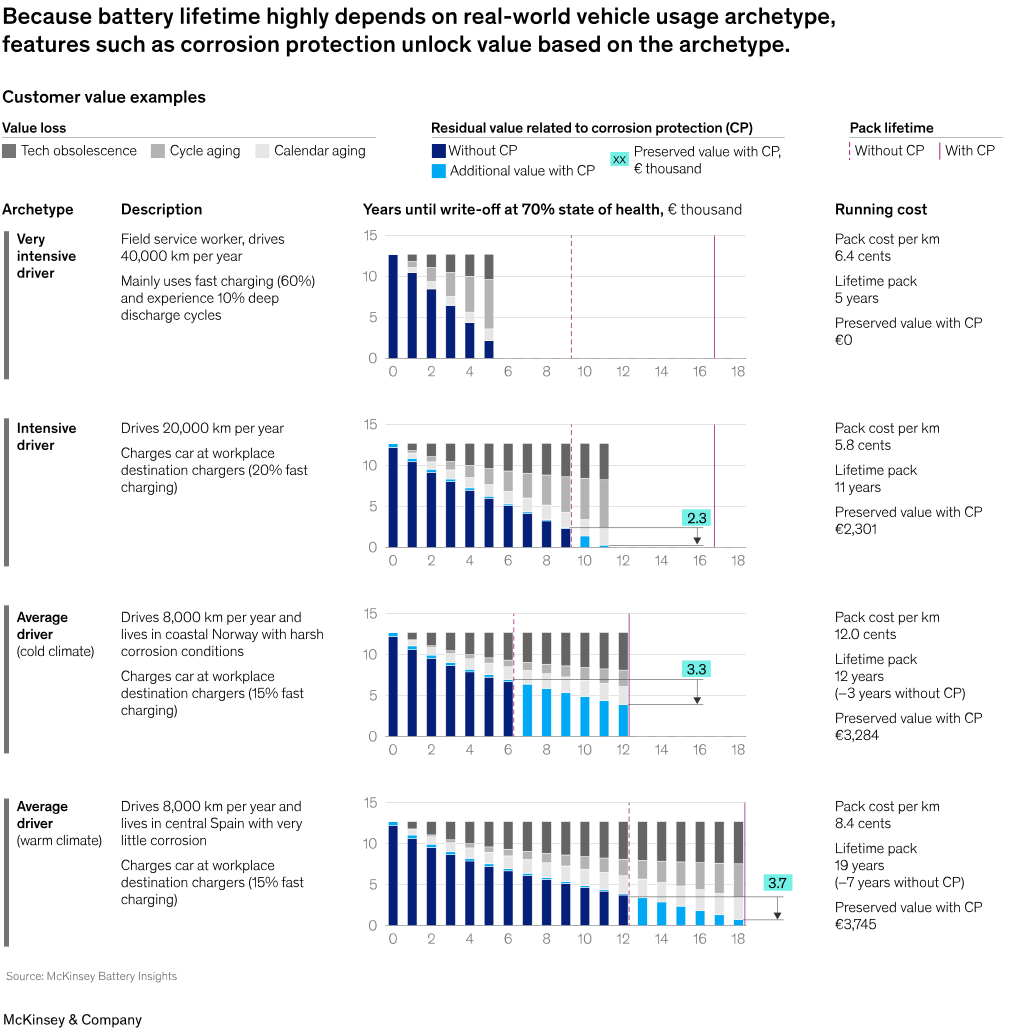
EV companies have an opportunity to provide increased customer value and reduce operating costs while improving resale value—and ultimately optimizing TCO. Building customer trust through robust aftermarket services, such as affordable beyond-warranty service, can play a pivotal role in boosting resale values. In addition, effectively marketing the durability and quality of battery packs as well as highlighting features such as advanced corrosion resistance and adherence to high-performance standards can help justify premium prices over Chinese competitors. While disruptors are increasing their engineering standards step by step, in teardowns of some their battery packs, we have seen shortcomings in design details, quality, and durability that would not have been accepted by an incumbent OEM.
Launching the next generation of EVs in Europe and North America
The latest technology developments by leading companies are a call to action for Western OEMs to launch new competitive generations of EVs. Doing so requires readjusting product requirements, investing in new production lines, and looking for compromises in the supply chain and opportunities to save supply costs. When it comes to learning from Chinese OEMs on cost structure and sourcing advantages, incumbent OEMS can take the following actions to remain competitive:
Close the cost–performance gap
Despite the challenges inherent to matching the cost advantages of Chinese OEMs, incumbents can take targeted actions to narrow the gap.
- Develop cost-effective battery pack designs (C2P and cell-to-chassis) with realistic customer expectations in mind by applying lower-cost battery chemistries at scale while reducing overly stringent requirement levels.
- Standardize battery pack platforms by taking the simplest approaches to reducing the number of variants as well as the complexity of the portfolio (for example, by leveraging supplier’s economies of scale for low-volume vehicles).
- Implement measures to reduce costs and footprint during the product design phase to minimize capital and operational expenditures. In some instances, capital expenditures can be reduced by more than 30 percent and footprint by more than 40 percent.
Reclaim customer value leadership and differentiate through unique selling propositions
There is much discussion about how to take the lead in innovation and differentiate through unique selling propositions. Next-generation battery chemistries such as solid state, lithium sulfur, and sodium ion have the potential to leapfrog existing solutions. Realistically, the success of the next generation of BEVs depends on whether OEMs can convince customers that their battery offerings are the best, despite costing slightly more than those of Chinese OEMs. On this point, creating a compelling offering requires confidence in the battery’s lifetime, low service costs, and high resale value. Furthermore, range extender models can allow OEMs to play out their leading ICE technologies, especially for vehicles that need high-energy battery packs, and cater to cost- and range-conscious customers.
Build strategic partnerships and leverage incentives
OEMs cannot win alone. They will likely need to establish innovative partnerships with cell and pack component suppliers to rapidly scale local production of cost-efficient technologies and shorten development cycles. This means working closely with policymakers to support incentives and create a favorable environment for competitive production, particularly in regions such as Europe, where cell manufacturing lags behind global benchmarks.
China may have a head start when it comes to lowering battery costs, but that doesn’t mean Western OEMs are idling at a red light. Achieving cost excellence is a matter of balancing cost position and customer value, and actions taken today could determine who pulls ahead and who gets left behind.