AI is now the top technology spending priority for many organizations, as leaders put powerful tools into employees’ hands, automate parts of existing workflows, and urge people to experiment. Yet results are still falling short of leaders’ ambitions.
The reason is becoming clearer: AI does not create enterprise value simply because more people use it. Individual productivity gains matter, but they rarely translate into lasting advantage when the organization around them stays the same.
Companies moving furthest ahead do two crucial things differently. First, they focus on areas where AI can create the most value, redesigning and rewiring workflows around what the technology makes possible, rather than spreading pilots across the organization or simply automating existing processes. Second, they treat AI transformation as an organizational change effort, not just a technology deployment, by investing in the workflows, behaviors, skills, leadership practices, and change management needed to make new ways of working stick.
To better understand employee and organizational readiness for AI-enabled transformation, we conducted a global survey of 750 employees and leaders across industries. The results show that most organizations are still early in their AI transformation journey—and that employees are more ready to use AI than their organizations are to change around it. Closing that gap may be the difference between AI activity and AI value.
We grouped organizations into three “horizons” based on how deeply AI is embedded in daily work.1 In the first, enablement, organizations offer individual employees access to general-purpose AI tools that assist with parts of their existing jobs. In the second, automation, companies automate and improve existing cross-functional workflows using AI at scale. In the third, reinvention, they creatively reimagine how work gets done by redesigning roles, workflows, and operating models to leverage AI’s full potential (see sidebar, “About the research”).
Of the leaders we surveyed, only 11 percent say that their organizations are in the reinvention horizon, and the majority across all three horizons say that AI has yet to deliver meaningful enterprise value in terms of business performance, cost savings, employee experience, or customer outcomes.2
The survey results provide a current snapshot of organizations at different horizons of AI transformation maturity. Given how rapidly AI capabilities are evolving, it is not surprising that organizations are still learning how to translate individual productivity gains into enterprise-level impact.
In this article, we examine how organizations are capturing value across the three horizons of AI transformation: enablement, automation, and reinvention. We also identify the people and culture factors that matter most in each horizon, and what leaders can do now to turn experimentation into sustained enterprise performance.
Most employees are ready for AI. Most organizations aren’t.
Employee and organizational readiness are crucial to capturing value from AI. We asked all 750 survey respondents to rate their personal readiness and a subset of 608 leaders (executives, senior leaders, and middle managers3) to rate their organizational readiness. We defined these categories as follows:
- Personal readiness reflects not just adoption, but whether individual employees report feeling supported, capable, and willing to work differently with AI. It includes whether each employee has access to the right tools, understands how to use them, and trusts the organization to provide support through continual change.
- Organizational readiness reflects whether leaders report that their organization is ready to make the people and culture shifts to become an agentic enterprise. It goes beyond deploying tools to redesigning workflows around AI and building foundational AI fluency among leaders for the most significant upskilling effort in decades. It requires allocating resources to new ways of working (including strategic workforce planning) and reshaping the cultural and behavioral norms needed to sustain change over time (Exhibit 1).
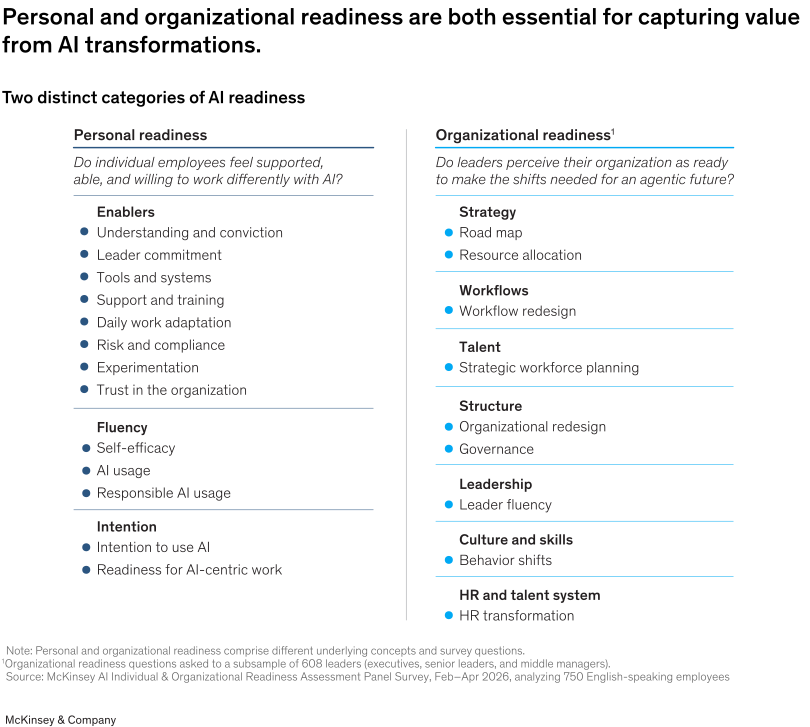
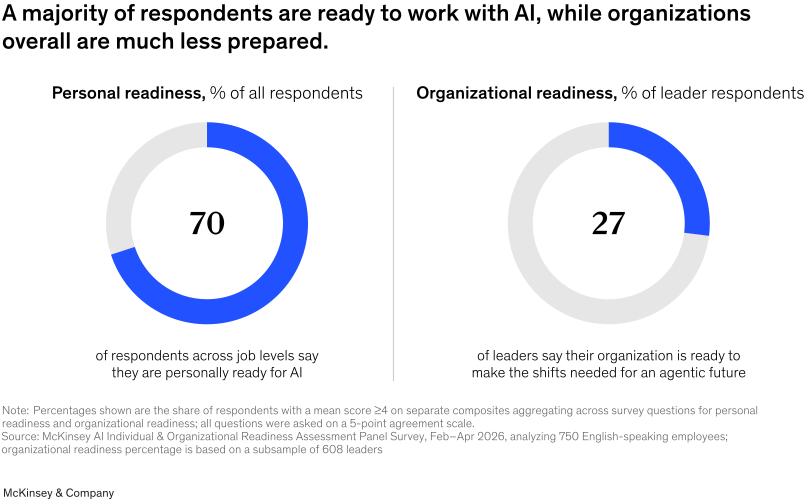
The survey reveals a striking readiness gap: While 70 percent of respondents say they feel personally prepared to adopt and use AI, only 27 percent of leaders believe their organizations are ready to make the shifts needed for an agentic future (Exhibit 2). Organizations are living in two different AI realities: Employees are adapting to AI faster than the institutions they work in, a finding consistent with McKinsey research. 4 The challenge is not AI adoption by employees, but how leaders can drive organizational changes to capture value.
Why organizational readiness matters more
The research also shows that organizational AI readiness, not personal readiness, is most strongly associated with creating enterprise value. Organizational readiness accounts for 48 percent of the difference between leaders who report capturing value from AI and those who don’t, while personal readiness accounts for 25 percent of that difference.
This suggests that an organization’s ability to evolve its workflows, operating model, leadership behaviors, and culture is nearly twice as important as personal readiness to adopt AI in determining whether the technology delivers meaningful business value.
Even though organizational readiness is more important for value capture, leaders should not downplay personal readiness. Both types of readiness are precursors to the change journey that organizations and their people need to undertake.
In fact, these findings highlight a critical distinction between individual AI adoption at scale, which most companies are pursuing, and AI-enabled transformation, which is still rare. Individual AI adoption at scale means employees are using AI tools for a broad range of activities—from drafting emails and summarizing meeting notes to analyzing data, creating presentations, and preparing for leadership or client interactions. Yet while individuals may work faster, the broader organization often continues to operate as it did before.
AI-enabled transformation requires the organization as a system to fundamentally change how work gets done, how decisions are made, how teams are organized, and how value is created. Organizational readiness remains both the biggest blind spot and the greatest opportunity to achieve AI-enabled transformation.
Leaders create the conditions for AI transformation success
For many leaders, the challenge is recognizing the extent to which the operating model itself must evolve. This is why the leadership mantra to “bring employees along” must mean more than just encouraging people to use AI tools. The real work is leading behavior change at an institutional level.
Organizations creating the most value from AI are reshaping norms, workflows, decision rights, roles and structures, resource allocation, and performance expectations. Trust is also critical—not only in AI as a technology, but also in the organization and its leaders to guide people through meaningful change and support them through disruption.
For leaders embarking on AI transformation, core questions include the following:
- Where will AI create value?
- How will work need to change to capture that value?
- What skills do I need to develop?
- How do I manage a human-and-agents system?
Those choices do not emerge organically from bottom-up experimentation alone. Senior leaders must be fluent enough in AI’s implications to articulate a bold vision for how the organization evolves.
Reinvention is a distant goal for most organizations
Given the magnitude of change required, few organizations are reinventing how work gets done with AI. Based on leader responses, nearly 90 percent of organizations remain in the first two horizons of AI maturity (Exhibit 3).
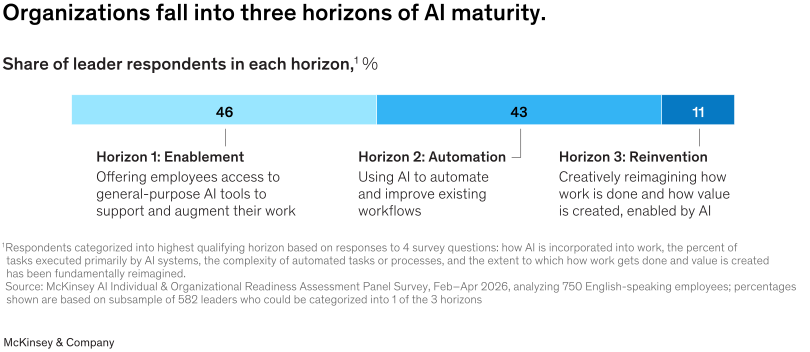
While only 11 percent of leaders report that their organizations are in the reinvention horizon, this group is most likely to capture meaningful enterprise value from reimagining how work is done with AI. Forty-eight percent of leaders in this group report realizing enterprise value, compared with 24 percent in the automation horizon and 13 percent in the enablement horizon.
Of the leaders we surveyed, 84 percent in the enablement horizon and 68 percent in the automation horizon say their organizations aren’t ready to make the people and culture shifts needed for an agentic future. Even among the leaders in the reinvention horizon, 44 percent say their organizations aren’t ready to make these shifts.
Most organizations are still building the capabilities and experiences needed to capture enterprise value from AI. The survey results provide a road map for how leaders can make progress along the way.

The state of AI in 2026: On the road to ROI
Organizations are deploying agentic coding tools and coming to grips with the costs of AI while still seeking to capture more of the benefits that their workers are deriving from their individual use of AI.
AI creates potential. People create value.
Not every company can reach reinvention quickly; many in the first two horizons must first establish a clear business case. Our research identifies the personal and organizational readiness factors that most strongly predict enterprise value capture in each horizon, based on leaders’ responses.5

The technology shifts every business leader should be watching
October 15, 2026, 9:30 a.m. ET / 3:30 p.m. CET
Join McKinsey experts Michael Chui and Roger Roberts for a discussion on tech trends, including where momentum is building, how the major trends are converging, and what these shifts mean for business leaders, workers, and society.
Build trust no matter your starting point
The survey results show that trust in the organization is the critical readiness factor across all three horizons. Employees need to trust that the organization will support them through AI-related change, not simply expect them to absorb it.6 AI transformation can fundamentally alter how people work, what they are responsible for, and how they perceive their value in the organization. Employees need leaders to be honest about what is changing, clear about expectations, and fair in how they support people through the transition. When that trust is established, employees at all levels are more willing to go on the journey and be part of the change.
Respondents across all job levels and horizons report anxiety about AI-related changes at work, which underscores the importance of leadership in this moment. Middle managers report particularly high levels of anxiety, with one in four expressing concern compared with one in five individual contributors. Respondents who report low trust in their organizations’ support during AI transformation are 1.5 times more likely than those reporting high levels of trust to feel anxious about workplace changes related to AI.7
One important distinction emerging in the AI conversation is the difference between reducing anxiety and building trust. The two are related, but they are not the same. Leaders often respond to employee concerns by trying to reassure them that AI won’t disrupt their jobs or dramatically change the organization. That may temporarily reduce anxiety, but it doesn’t necessarily build trust, particularly if employees suspect those assurances can’t realistically hold over time. In a period of disruption as significant as this, some anxiety is both understandable and appropriate. The goal is not to eliminate anxiety altogether, but to build trust through uncertainty and change.
Leaders create trust by communicating what they know—and what they don’t know. Employees are more likely to trust leaders who acknowledge uncertainty honestly and explain how decisions will be made. Trust is also built on what leaders do, and whether they follow through on commitments, invest in employee capabilities, and redeploy talent as roles and work change. In our survey, organizations with higher levels of trust report capturing greater value from their AI initiatives.
Horizon 1: Enablement
While organizations in the first horizon are focused on deploying AI tools to draft presentations, summarize meetings, and prepare for client interactions, those seeing business value are also changing behaviors and redesigning workflows to integrate AI across the business.
At the organizational level, leaders are 5.3 times more likely to report enterprise value capture when workflows are redesigned than when they remain unchanged (32 percent versus 6 percent, respectively). Realizing those benefits requires change at the workflow level but also at the individual employee level. This is reflected in the fact that daily work adaptation emerged as the most important concept in personal readiness for enterprise value capture, according to respondents (Exhibit 4).
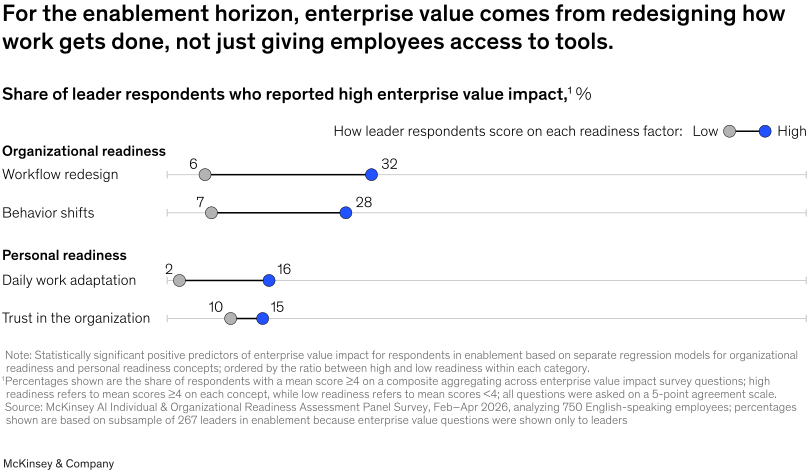
Organizations in this horizon face two distinct challenges: first, moving employees beyond experimentation to sustained AI use; and second, rewiring aspects of work that can be performed differently while accelerating shifts in behavior to capture value from these changes.
Unfortunately, many organizations are experimenting with AI in ways that don’t meaningfully improve productivity. Employees gain personal efficiency, but their freed-up capacity doesn’t necessarily translate into business impact. They may spend more time on personally interesting pursuits, but those projects aren’t always tied to enterprise priorities.
Even in this earliest horizon, achieving enterprise-level value from AI requires employees to adjust their daily work routines while organizations make formal adjustments to workflows, clarify expectations about how people should work differently, and channel freed-up capacity toward higher-value business priorities.
The focus is less on developing advanced capabilities and more on establishing baseline fluency in using and managing AI tools and integrating AI into daily workflows. Getting this workflow redesign right also involves building shared understanding and alignment so employees are brought into the transformation and inspired to embrace AI rather than feeling sidelined by it.
Horizon 2: Automation
Organizations in the second horizon are using AI to automate end-to-end cross-functional processes. For leaders reporting that their organizations are pursuing this horizon of change, operating model changes emerge as a critical predictor of value capture.
These organizations have already deployed general-purpose AI tools to help employees with individual tasks. They are now using AI at scale to transform end-to-end workflows that cut across functional and structural silos. For instance, AI systems can route customer requests, generate responses, and escalate complex cases to humans.
But they aren’t just automating workflows; they are also optimizing and improving them. What keeps these organizations from advancing to the reinvention horizon is that they are still starting with the current state and optimizing it, rather than reimagining with a blank slate.
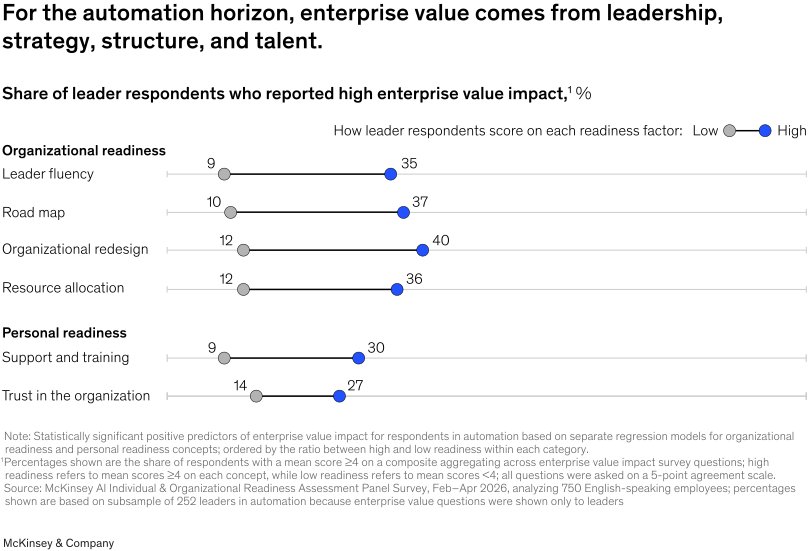
Top drivers of value capture in this horizon include establishing a systems-level vision for redesigning the organization, creating a road map anchored in business value, actively reallocating resources, and changing the organization’s structure and formal roles to take advantage of the process changes. These structural and resource changes can create perceived winners and losers in the organization, fueling resistance to change among some leaders.
At the organizational level, leaders are 3.9 times more likely to report enterprise value capture when their leadership teams demonstrate high AI fluency compared with when teams demonstrate low AI fluency (35 percent versus 9 percent, respectively), reflecting how critical it is for leaders to have the technological knowledge and understanding of AI, in addition to business domain expertise.
At the personal level, leaders who receive the support and training needed to build new skills as AI changes their work are 3.3 times more likely than those who don’t to report enterprise value capture (30 percent versus 9 percent). Together, these findings suggest that organizations need both AI-fluent leadership and strong support for capability building as AI reshapes work (Exhibit 5).
Horizon 3: Reinvention
Organizations in the third horizon have progressed from automating processes to reimagining how work gets done with AI at the core. Each horizon builds on the previous one, meaning all the challenges involved in enablement and automation apply. But organizations in this horizon are no longer starting with the current state and automating it. Instead, they are redesigning work, roles, workflows, and operating models from scratch.
Reinvention is both the most difficult level of change and where the greatest potential value lies. The opportunity extends far beyond technology deployment. Increasingly, the constraint is leaders’ ability to creatively reimagine how work gets done with AI.
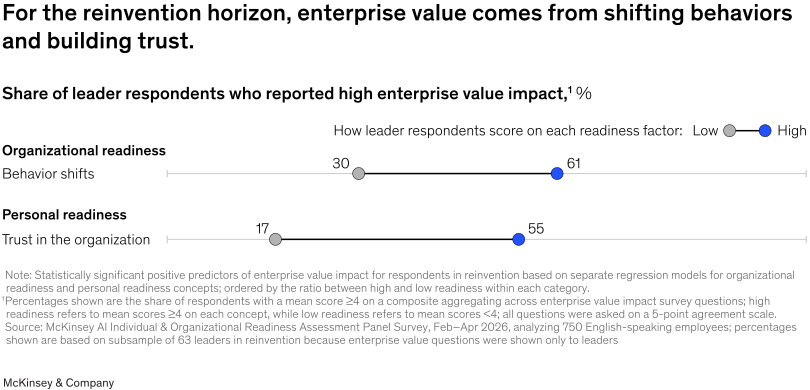
In this horizon, organizations are not just evolving employee behaviors (as we see in the enablement horizon); they are shifting collective, organizational behaviors. These cultural changes define how leaders “run the place” and how the organization operates at its core. Leader responses suggest that, in this horizon, behavior shifts at the organizational level are the most important factor associated with value capture—in addition to trust at the personal level (Exhibit 6), which emerged as critical across all three horizons.
Although behavior shifts predict enterprise value capture in both the enablement and reinvention horizons, we wanted to dive deeper into the most impactful behaviors in the latter category, since organizations in this horizon can offer meaningful insights for companies earlier in the AI journey.
We turned to McKinsey’s Organizational Health Index, which reflects decades of research into the management practices that drive sustained organizational performance, to identify the AI-agnostic behaviors8 that differentiate those in reinvention from those in enablement, as leaders rethink how work gets done from the ground up. Four themes stood out.
First, tech investments are made and deployed as business-led decisions with a clear link to value. Though tech enablement may seem obvious, companies often assume that making work easier for individual employees will automatically translate into stronger organizational performance. But McKinsey research does not support that assumption.9 In fact, individual productivity with technology is not predictive of organizational health and sustained performance. What matters is whether tech enablement is explicitly tied to enhancing the organization’s business performance. Companies in reinvention emphasize tech-enablement holistically.
Second, innovation is championed from the top, but employees at all levels help unleash it horizontally across the organization. Because organizations are in an innovation race with competitors that have access to the same technology and tools, getting ahead means harnessing ideas from across the enterprise.
Third, leaders focus on rigorous performance transparency and regular process documentation. This discipline turns ambition into impact and has been linked to a higher likelihood of achieving aspirational transformation targets.10
Fourth, organizations cultivate cross-functional collaboration across the business and with technology teams, while encouraging continuous learning. The latter requires building the necessary AI competencies that emphasize human skills that machines cannot replicate, including creative and analytical thinking, resilience, and flexibility.
A culture that infuses these elements into the day-to-day behaviors of leaders and employees at all levels will be positioned to deliver more enterprise-level value.
Don’t wait. Iterate.
AI transformation is ultimately a story of human change and reinvention. The companies pulling ahead are not just deploying technology; they are also rethinking decision-making, accelerating how teams learn, and building cultures that can adapt continuously as AI evolves. The winners are learning and innovating faster than their competitors.
This is not the first time that organizations have faced a gap between technological possibility and organizational readiness. In the early days of electrification, for example, manufacturers replaced steam engines with electric motors but kept factories, workflows, and management systems largely unchanged. Electricity was clearly a superior technology, yet productivity gains remained limited. Real value emerged only after companies redesigned factories around electricity by rethinking assembly lines, workflows, equipment placement, and the organization of work itself.
AI represents a similar inflection point today. Many organizations are layering AI onto existing workflows, operating models, and management structures while expecting transformational results. But AI will not create enterprise value simply because employees use new tools. The larger opportunity—and challenge—is to redesign and rewire how work gets done.
For leaders, this moment can feel daunting as AI capabilities continue to evolve and the skills required to work effectively with AI evolve as well. The three horizons of AI transformation—enablement, automation, and reinvention—provide a useful framework for understanding this journey. The goal should be to build the capabilities, operating models, and cultural foundations needed to reimagine how work gets done with AI. Organizations creating an advantage today are learning in real time by iterating, redesigning, and evolving faster than competitors. In a subsequent article, we will explore examples of how leaders are driving organizational change as their companies progress through these horizons.
Related Articles