AI is shattering many decades-old assumptions about how growth happens. The fundamentals of growth still matter, but the way companies create, capture, and scale growth with AI has fundamentally changed the game. It’s like what happened in basketball when the three-point shot was introduced: The foundations of the game didn’t change, but the strategies for how to win championships were transformed.
The race for growth has entered a new era. The companies pulling ahead recognize how deeply AI is changing the way they create demand, convert customers, and generate value. While every CEO wants to achieve above-market growth, early AI leaders are going bigger. They are achieving EBITDA uplifts of 20 percent or more by rewiring their commercial engines around AI, not simply deploying new technology.1
That value is not some theoretical aspiration. For example, Reckitt, a global leader in home and consumer health care, unlocked more than $500 million in new revenue with its ambitious growth transformation. The company used AI-powered simulations and scenario planning to improve commercial pricing, promotions, and assortment decisions as well as to guide field sales teams on which in-store merchandising activities to prioritize to create tangible value. In another case, DBS, the Singapore-based bank, has generated hundreds of millions of dollars in value by rewiring its business around AI.
Yet these companies remain the exceptions. Nearly 90 percent of companies regularly use AI in at least one business function, according to a global McKinsey survey, but just 37 percent of respondents attribute any level of EBIT impact to AI.2 Furthermore, the gap between leaders and laggards is growing. Our latest research shows that 60 percent of market leaders report double-digit revenue growth, compared with just 21 percent of laggards.3
To narrow the gap and turn AI into a force multiplier for growth, CEOs need to fundamentally rewire how they operate to move faster, more iteratively, and with clearer direction. That starts with rejecting the myths that can sink their growth aspirations.
Myths and realities about AI and growth
In our experience, we see seven common myths that can hamper business leaders’ ability to turn AI into value.
Myths that limit ambition
-
Myth: Above-market growth goals are enough.
Reality: AI raises the ceiling on how much growth is possible. While nearly 75 percent of companies set above-market growth targets, that’s not bold enough.4 Our research finds that leaders who set bold growth ambitions—underpinned by AI—can unlock nearly three times more value than they imagine.5
-
Myth: AI is primarily a productivity tool.
Reality: Some 80 percent of companies use AI to improve efficiency, but AI can do much more. The companies creating the greatest value are using AI to improve both efficiency and effectiveness.6 Greater effectiveness creates new demand, increases conversion, and accelerates growth and innovation.
Myths that preserve old ways of working
-
Myth: Layering AI onto existing processes drives growth.
Reality: Bolting AI onto existing processes—often resulting in a proliferation of isolated use cases—doesn’t lead to growth. Rather, it is activity without architecture. AI high performers are three times as likely to say their organizations have fundamentally redesigned individual workflows.7
-
Myth: The chief technology officer (CTO) should lead the AI transformation.
Reality: The approach associated with growth is to undertake a business transformation enabled by technology, with people at the center. That’s why leaders at half of top-performing companies co-create strategy across technology and business to redesign new pathways to growth.8
Myths that slow down value capture
-
Myth: Scaling AI is mostly a tech rollout.
Reality: Creating enterprise-wide growth involves more than new technology; it involves new ways of working, capabilities and skills, and governance models. Achieving this degree of change requires resources dedicated to change management. The rule of thumb is that for every $1 a company spends on an AI initiative, it needs another $3—and sometimes more—for change management.9
-
Myth: AI initiatives take a long time to create P&L value.
Reality: In our experience, AI leaders often see impact on leading indicators within weeks and create substantial economic value within three to six months. That happens when companies focus on high-value commercial workflows in priority domains and iterate rapidly.
-
Myth: Companies need perfect data in order to introduce AI.
Reality: Good data matters, but in our experience, 80 percent of companies do not need to build a data lake or rebuild their entire data architecture to get value. “Good enough” data is sufficient to start capturing value quickly.

McKinsey at Dreamforce 2026
Discover the shortest path from AI to ROI with us in San Francisco, September 15-17
Building an AI-driven commercial growth engine
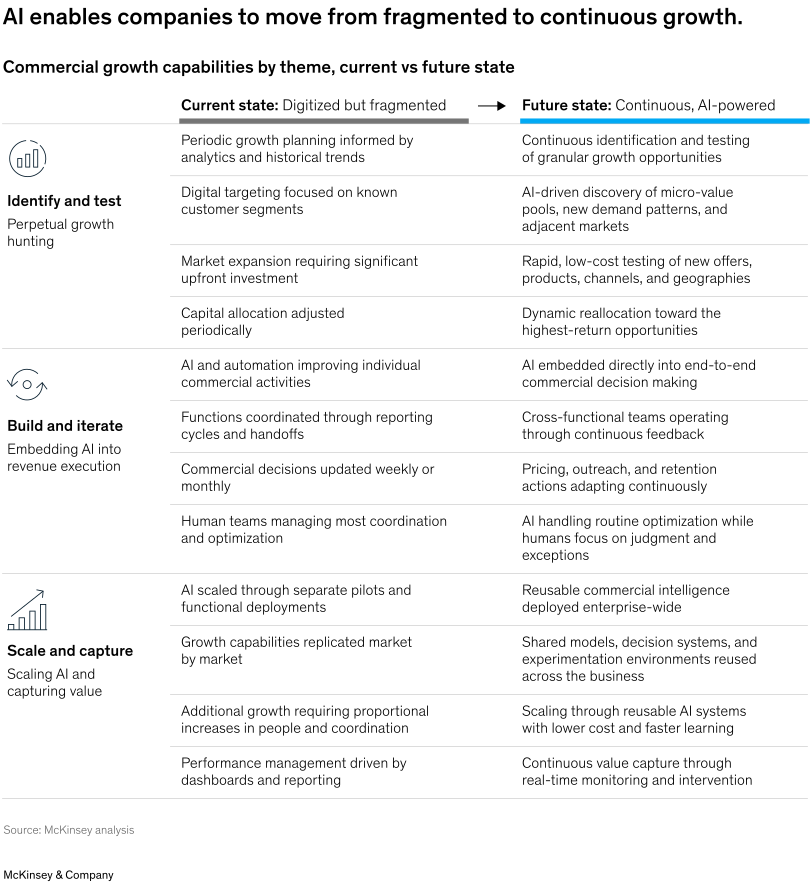
Business leaders who want to shake off the growth myths and build a different kind of commercial growth engine can do this by taking concerted steps (Exhibit 1). These actions are laid out sequentially, but to win the growth game, the best companies imagine them as a system that is continually running and optimizing in fast learning cycles.
Bold ambitions: Continuously hunt for growth
Companies have long searched for growth through periodic strategy reviews built on aggregated market data. AI changes the economics of growth by making growth discovery continuous instead of episodic. Companies can now spot emerging pockets of demand by analyzing specific customer behaviors, local market dynamics, or price sensitivities.
At the same time, AI dramatically lowers the cost of experimentation to pursue those opportunities. Companies can personalize engagement at scale, rapidly test offers, and enter niche segments or geographies that were previously too costly or complex to profitably pursue. They can leverage AI to set overall strategy.
An industrial distributor used AI to transform how it finds and wins business, moving from transactional selling to predictive selling. Historically, sales teams relied heavily on relationship-based selling, local knowledge, and manual lead generation to identify projects that might require their products. Tight sales windows created even more variability.
The distributor built an AI-driven engine that continuously scans signals such as building permits, project activity, customer history, and product data to identify where demand is likely to emerge. By scraping publicly available building permit approvals and surfacing opportunities precisely when customers are most likely to buy, the system recommends the next best sales action and generates personalized customer outreach with product recommendation and discount coupons.
The system was integrated into Salesforce CRM so the distributor’s sales reps could quickly review, edit, and send the emails directly to the customers. The result: an estimated $300 million to $400 million in incremental gross margin.
The broader lesson for CEOs is that AI turns growth from a periodic planning exercise into an always-on commercial capability.
Rewiring ways of working: Embed AI into all commercial operations
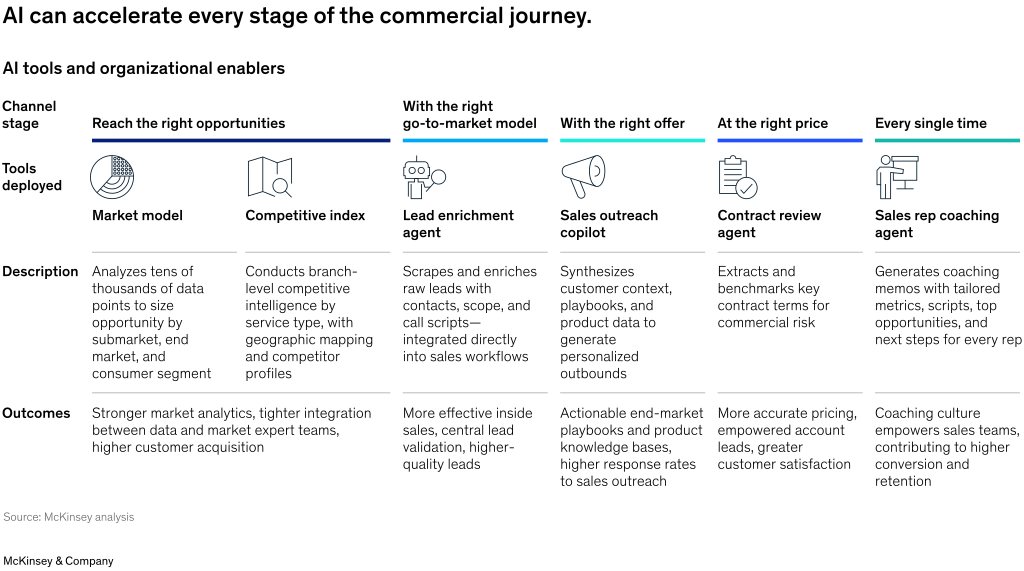
The companies pulling ahead are compressing the distance between customer signal, decision, and action. AI enables commercial decisions to happen within the flow of work—continuously analyzing signals, recommending the next best action, and increasingly executing routine decisions with human oversight. As a result, a handful of people working alongside AI systems can deliver levels of personalization, experimentation, and optimization that once required entire departments.
To make this shift, CEOs and chief commercial officers (CCOs) must focus less on deploying AI tools and more on redesigning how commercial decisions are made (Exhibit 2). AI high performers are nearly three times as likely as other companies to say their organizations fundamentally redesign individual workflows rather than simply automating existing processes.10 That redesign includes explicitly determining how commercial decision logic is integrated into ways of working.
The advantage is cumulative, as in the case of Reckitt’s RGM and smart execution transformation. Rather than relying on analysts to generate insights, pricing leaders use self-service platforms to test promotion calendars and dynamic price elasticity curves in real time. Planners simulate complex scenarios such as competitor moves, inflation shifts, and other market dynamics to find the optimal paths to maximize top-line revenue. Product teams prototype new packaging in seconds by using AI-generated consumer personas to gather simulated feedback. Similarly, in smart execution, sales leaders use AI-driven recommendations to prescribe to their teams what to execute at each point of sale. This combination helped increase average project sizes (measured in expected incremental net revenue) by 25 percent year on year.11
Critically, Reckitt designed its AI capabilities backward from the tasks that commercial teams typically perform. The company realized that implementing a next-generation RGM system would require training commercial teams at the moment of action, such as when they are developing sales plans or shaping brand strategies. Practical, hands-on sessions using live market data helped prove the value of insights in real time, which accelerated buy-in and changing behavior at scale.
This example shows the necessity of encoding AI into workflows, not just making individual tasks faster. The CEO and CCO roles increasingly focus on setting the operating rules, KPIs, funding thresholds, escalation paths, risk tolerances, and resource priorities that allow the system to move quickly without losing control.
Accelerate the timeline: Scale value
Growth comes from scaling what works across products, channels, geographies, and customer segments. Historically, that required large amounts of people, local coordination, and manual effort. AI changes those economics.
The companies moving—and growing—fastest are those that standardize the underlying models that drive growth decisions. They create reusable components (for example, customer propensity models, pricing logic, offer generation systems, sales agents, experimentation environments, and performance signals) that can be redeployed across the business without increasing head count or organizational complexity.
The key decision for CEOs and CCOs is how to strike a balance between standardization and localization. Leaders increasingly centralize core data, models, governance, and decision systems while decentralizing experimentation, customer engagement, and market adaptation. This allows successful strategies to spread quickly across the organization while still being adapted to local market conditions.
Reckitt’s approach to rolling out its RGM solution reflects this understanding. For more mature, data-rich regions, Reckitt provides an advanced version of the solution, while other countries have access to a simpler version that helps them develop better data hygiene and transition teams to fact-based models before giving them access to more advanced features.12
Salesforce demonstrates the importance of building AI as an integrated system. When the company launched Agentforce, a platform for building, deploying, and governing AI agents, it made sure the agents were tied into its data cloud, Data 360. This allows agents to reason based on trusted business context rather than disconnected data sources. Salesforce recently reported that Data 360 ingested 112 trillion records in fiscal year 2026, up 114 percent year over year, reflecting how strong data structures can enable agentic performance.13
Rather than deploying AI as a stand-alone capability, Salesforce embedded agents into the core sales, service, marketing, and commerce workflows that customers already used. This means agents operate in the same systems as the people they work alongside, governed by the same trusted processes, permissions, and controls. This focus, along with flexible pricing that lowered the barrier to entry and helped customers manage their AI spend, increased adoption among existing customers. To help customers track and manage performance, Salesforce also introduced Agentic Work Units, a standardized measure of the work that agents perform across the platform. For the first quarter of fiscal year 2027, Salesforce reported that Agentforce’s annual recurring revenue (ARR) reached $1.2 billion, up 205 percent year over year, with more than 50 percent of bookings coming from existing customers.14
The value of an integrated AI approach becomes clear in business workflows like sales coaching, where AI can shift frontline managers’ focus from monitoring activity to improving outcomes. Historically, frontline managers have spent much of their time interpreting dashboards, checking CRM activity, and preparing for one-on-ones with limited context. AI can now equip sellers with superpowers, coaching them in the moment to improve performance.
AI does this by synthesizing CRM data, account history, pipeline movement, seller activity, customer interactions, and peer benchmarks to identify the highest-impact opportunities for improvement. Instead of simply flagging that a rep is behind plan, AI could, for example, identify that the rep is selling too narrow of a product set, discounting too early, or failing to tailor offers.
That feedback loop can now happen almost immediately. AI-enabled tools can analyze recorded sales calls, meeting transcripts, and customer notes after an interaction, then give the seller direct feedback. Managers can see patterns across reps and teams and intervene where coaching will matter most to drive growth. Such a focus on performance drives results. For example, a program of AI-enabled coaching as part of a broader commercial effort enabled one company in the built-environment space to increase conversion by more than 20 percent in just nine weeks.
What CEOs can do now
Developing an AI-driven growth engine is an investment of time and resources. But our experience has shown that companies can make progress quickly, especially if they tackle three actions first:
- See the full set of AI-enabled growth opportunities in days, not months. Don’t start with the one or two use cases already on the table. Using advanced AI tools, first- and third-party data, and industry benchmarks, companies should develop a strong self-assessment that helps them identify where AI can drive profitable growth (new demand pools, underserved segments, pricing, sales). The CEO’s job is to demand that full view quickly. The goal is to concentrate efforts on the one to three domain-level opportunities with the most value.
- Align on specific outcomes and commit to bold goals. Turn the opportunity into a short set of specific, measurable outcomes (for example, market share growth, improved margin) on a clearly stated timeline. Those outcomes should be bold enough to force leadership to reimagine and redesign how growth happens. It is important to have strong benchmarks from across industries and geographies to help teams pressure-test their ambition, define what “good” really looks like, and translate it into concrete targets the organization can rally behind. The CEO’s job is to push their team to develop truly aspirational goals and commit the organization to achieving them.
- Mobilize cross-functional teams and commit the resources to fuel them. Instead of expecting a central AI or technology function to deliver the outcomes, organizations should make use of small, cross-functional teams that combine commercial, technical, data, and operational talent. The CEO works with growth leaders to stand these teams up, point them at the highest-value workflows, and reallocate capital, talent, and attention to support them. Given the speed of change, the CEO needs to put a premium on fast adaptation and learning from mistakes.
The companies that turn AI into growth aren’t those with the flashiest models. They are the ones building repeatable systems that help their sellers create sustained commercial advantage.