At a glance
- The US economy could create more jobs in the next decade than will be replaced through automation, but the change may require the largest and most sustained workforce transformation in US history. We estimate that roughly 11 million workers in declining occupations may need to transition to new jobs, ranging from six million to 16 million depending on the pace of automation adoption and its impact on labor demand.
- Jobs of the future, particularly growing jobs, could pay more on average but require more skills. Roughly 60 percent of growing employment could be in the top two wage quintiles, with much of the increase concentrated in healthcare, construction, and management occupations. Conversely, more than 70 percent of declining employment could be in the bottom two quintiles, primarily in office and administrative support, retail and sales, and transportation and logistics occupations.
- One in seven workers could have a direct pathway into growing jobs, but almost half may face an unpaved pathway. While every transitioning worker has a route into growing work, only about one in seven can make the move with no or very limited retraining. Barriers, particularly credentials or certifications, which roughly 85 percent of growing jobs require, can twist or block otherwise viable pathways.
- Overall, more than 70 percent of workers could require some level of reinvention because new tasks may require more than 15 percent of their time. Whether or not workers change jobs, most of them will need to continually build new skills as most occupations reinvent regardless of whether employment grows, declines, or remains stable.
- Three types of skills help workers move, move up, and keep adapting. “Essential” skills widen career options, while “enabling” skills unlock higher-paying jobs. “Empowering” skills prepare workers for continuous change, and demand for them has already started to surge. The demand for AI fluency has increased 11 times since 2022, as demand for adaptability has increased fivefold and demand for resilience, curiosity, and willingness to learn has tripled.
Every generation confronted by a new technology asks whether machines will replace workers. Steam mechanized production, electricity restructured factories, computers digitized information. Artificial intelligence has revived the question with new urgency because it affects all workers and all jobs, including cognitive work that once seemed resistant to automation.
Labor markets adjust to technology innovation and adoption not simply by shedding jobs but also by creating new jobs and by reorganizing and reallocating work. Some activities are automated, others become more valuable, new tasks emerge, demand expands in some sectors and contracts in others, and workers move—or fail to move—between occupations, employers, and geographies.
Electronic spreadsheets do in seconds what took an accounting clerk a day before they came on the market in the late 1970s, but while clerical roles built on manual calculation disappeared, accountants did not. In fact, the US Bureau of Labor Statistics estimates that the profession will grow more rapidly than the average over the next decade. Even as calculating a forecast became cheap, judgment and expertise became more valuable.
While social media abounds with dire predictions about the impact of AI on labor, the United States is likely to have more jobs available in 2035 than today, but with fewer workers because the population is aging. While estimates of the full impact of AI on the workforce differ widely, our base estimate indicates that automation could reduce labor demand by the equivalent of roughly 36 million jobs, while growth in the AI value chain and the broader economy could generate demand for more than 40 million jobs over the next decade.
Our estimates reflect four factors. First, automation enabled by AI and other technologies could reduce labor demand, but not on a one-for-one basis, because automation of work does not translate directly into job losses. Second, the demographic backdrop and rising living standards could drive sustained labor demand growth in the “human economy”—jobs that are often harder to automate and already face or could face labor shortages. Third, the AI boom, combined with the need to modernize infrastructure, could increase demand for workers in both the “physical economy” and the “tech economy.” Finally, we expect AI itself to create new jobs that we cannot yet imagine, just as previous general-purpose technologies did. Much of this shift would occur within occupations, but roughly 11 million US workers, or about 7 percent of current employees, might need to shift between occupations to secure new jobs.1
Counting jobs is an insufficient measure of the impact of new technology. Job opportunities can be abundant and yet leave millions of workers without work if those positions require different skills, credentials, locations, or pay structures than current jobs. Many growing jobs in the next decades will require new and more skills, so having viable pathways from shrinking to growing jobs will be critical to successful transitions in a labor market shaped by automation.
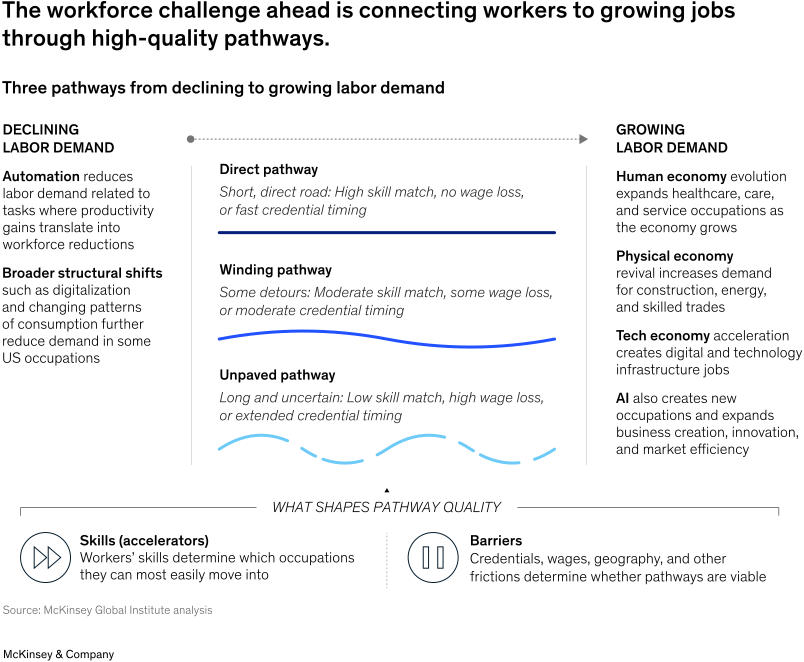
A pathway provides a practical route between occupations and is shaped by four conditions—destination demand, skill adjacency, wage preservation, and time needed to acquire credentials. A direct pathway will take a worker to a growing occupation with limited retraining and no loss of income, while a winding pathway requires developing more new skills or accepting pay cuts. An unpaved pathway is strewn with large skills gaps, lower wages, or additional required credentials. Any of these pathways can be blocked by barriers too large to overcome in practice.
The quality of the pathway into a new or changing occupation matters (Exhibit 1). While almost every worker in the US economy has at least one pathway to a new job, only one in seven workers has a direct pathway to new work. The skills workers carry from one occupation to another are the keys to navigating pathways to new jobs successfully. Some skills are required in a wide range of occupations, and some are concentrated in higher-paying work. Skills like adaptability, curiosity, resilience, and a willingness to learn may increase in value because they help workers acquire new capabilities as work changes.
But while skills facilitate mobility, a variety of bumps along pathways can become barriers. A worker may have the skills needed for a job in a growing occupation, but other factors—requirements for a license or specific academic degree, or a move to a region with a different language—may make it unattainable. In this report, we examine skills and barriers that shape pathways to growing occupations in the era of AI.
Why jobs change
While the precise number of jobs that AI may create or displace is uncertain, the technology together with broader economic trends could give rise to 41 million jobs in the United States over the next decade. In our base estimate, automation adoption could reduce labor demand by 21 percent of current work hours, equivalent to about 36 million jobs. For roughly 25 million of these workers, growth in their current occupations could offset the impact of automation, allowing them to stay in the same occupation, although their jobs could change. The remaining 11 million may need to switch occupations entirely. The next decade’s challenge is mobility, not scarcity.
Demand for workers shifts because technology changes the number of workers needed to perform existing work. On its own, artificial intelligence can have a direct impact on demand for some occupations by automating or augmenting activities, which has raised fear and concern, and it can increase work related to implementation, governance, supervision, and workflow redesign. But AI can also indirectly create jobs by expanding demand for certain work, including in the infrastructure and technology value chain, and can give rise to new products and industries, as well as contributing to economic growth more generally.
Moreover, AI is taking hold as society is aging. People are living longer around the world, and fewer babies are being born, particularly in developed countries. Previous MGI research estimates that at the current rate of demographic decline, advanced economies would need to raise productivity growth by two to four times current rates simply to hold per capita GDP growth steady through 2050. More older people and fewer people of working age are already increasing demand for home healthcare workers, medical technicians, and food service workers, while demand for primary and secondary education, toy manufacturing, and camp counselors is dropping. If the working population is supported in making job transitions, artificial intelligence could greatly accelerate economic growth. But if these transitions are handled poorly, only a few will benefit while the employment outlook for many workers grows dim.
Automation adoption will be faster in office and admin, computer and math, and sales occupations, and slower in healthcare
Early discussions about AI and the workforce focused on its potential impact on white-collar jobs, but in fact automation adoption is likely to be highly uneven in all types of jobs. Historically, automation has taken hold in fits and starts as organizations decide how and where to deploy new technologies, where to wait, and where human work should remain central. Similarly, what AI can do as well as where it can create value with acceptable levels of risk will determine its deployment and use.
Our analysis finds that occupations in office and administrative support will have the highest expected average adoption, roughly 80 percent of current work hours by 2035. Automation could take on 70 percent of the hours currently worked in technology and analytics occupations and 68 percent in retail and sales occupations (Exhibit 2). By contrast, the technology will likely roll out more gradually into 26 percent of work hours in healthcare professionals, and 28 percent of public safety and security occupations (see sidebar “Our methodology”).2
Automation adoption varies substantially within occupational groups, not just between them.
1Automation adoption is defined as the share of current work hours potentially automated or meaningfully augmented.

Variation of automation adoption within occupational groups is almost as important as variation between them. For example, the expected adoption for office and administrative support roles ranges from roughly 48 percent to 96 percent of current work hours. Similar dispersion appears across most occupational groups, illustrating how the pace of automation adoption is ultimately determined by the activities workers perform.
To capture this variation, we evaluate the potential for automation adoption at the occupational and detailed-work activity level rather than assigning a single score to an entire occupation. Each activity is assessed on eight dimensions that influence the pace of adoption. Four dimensions—codifiability, repetitiveness of task, ease of verification, and degree of reconfiguration required to enable automation—cover the feasibility of automating an occupation with AI.3 The other four—regulatory constraints, social acceptability, business criticality, and reputational risk—encompass challenges to overcome. Activity-level scores are then rolled up into an adoption estimate for each occupation, weighted by the time spent on each activity, which surfaces variation across occupations.
This variation explains why organizations do not necessarily adopt automation even when it is technically feasible. Instead, companies adopt it first where it creates value with acceptable levels of complexity and risk. Activities that are codifiable, are routine, are easy to verify, and require limited workflow redesign are often first to use AI. By contrast, activities involving tacit judgment, physical interaction, regulation, trust, or high business criticality are likely to adopt automation more gradually because the cost of errors is substantially higher.
Our adoption estimates are therefore directional rather than deterministic. They identify the occupations where automation is likely to become economically attractive first, not the speed at which every organization will deploy it. Actual adoption will continue to depend on workflow maturity, data quality, operating discipline, leadership priorities, and business context, so two organizations with similar workforces may experience very different adoption trajectories. Technology determines what is possible, but managerial choices determine how quickly those possibilities become reality.
Higher levels of automation adoption don’t necessarily mean fewer jobs
Across the US economy, we estimate that automation technologies could absorb about 54 percent of current work hours by 2035—but that won’t translate one-for-one into reduced demand for workers. We estimate that organizational and market mechanisms could offset about 60 percent of the labor impact of automation adoption, reducing labor demand by the equivalent of about 21 percent of current work hours (Exhibit 3). This doesn’t take into account the offsetting impact of other forces, such as economic and income growth, demographic shifts, and new jobs created by AI.
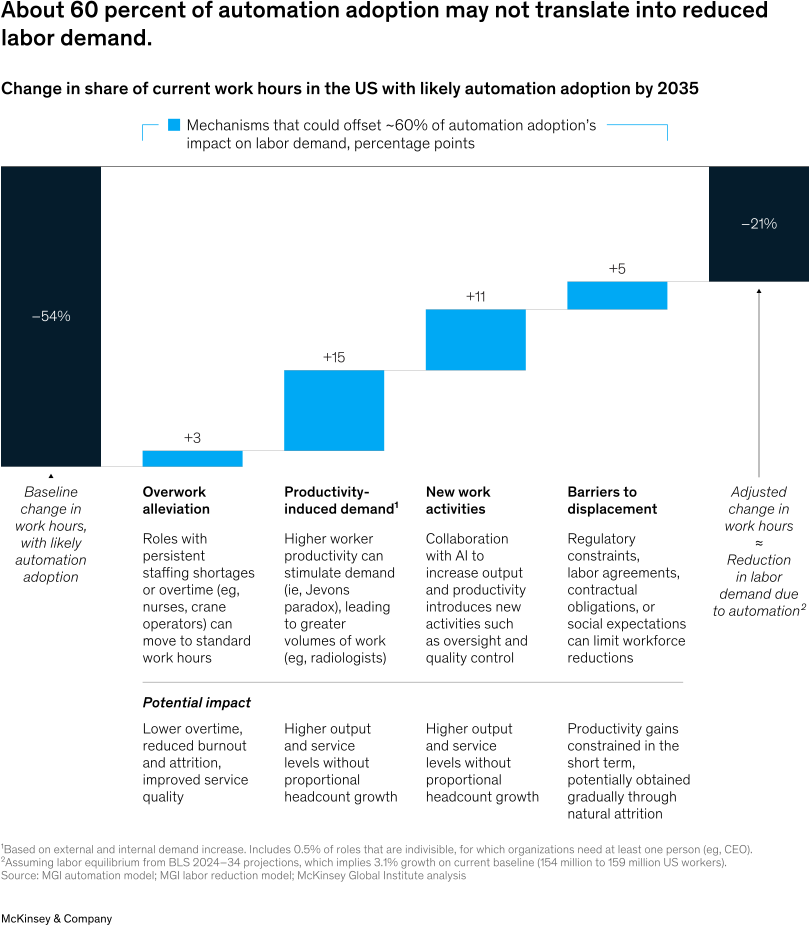
Moving from activities to jobs is not straightforward, because occupations are bundles of interdependent activities, not just collections of independent tasks.4 When an automated activity requires judgment, coordination, accountability, or other work only a human can do, automation may change the mix of work without eliminating the job.5 While automation may reduce the labor required to perform existing activities, four mechanisms can offset its impact on labor demand.
The first mechanism is overwork alleviation. In occupations facing chronic labor shortages, excessive workloads, or sustained overtime, productivity gains may allow workers to return to more sustainable working patterns rather than reducing employment.6 Employees working overtime are about 60 percent more likely to be injured, and those working more than 55 hours a week have a 35 percent higher risk of a stroke, than colleagues working fewer hours.7 Staffing gaps and long hours are often primary constraints in nursing, crane operation, and other occupations8 with labor shortages. In these settings, automation may reduce overtime, burnout, and attrition while improving service quality, leaving head count unchanged.9 Of course, overtime pay is a key source of household income for some workers, so less overtime may need to be offset with better jobs or higher wages.
The second mechanism is productivity-induced demand (Jevons effect).10 Higher productivity often lowers the cost or increases the quality of services, encouraging organizations to deliver more of the same work rather than reduce employment. Auditing is one example. A recent study found that employment of auditors increased 4.3 percent after the adoption of AI. Audit quality also improved, suggesting that productivity gains were used to expand audit capacity and quality rather than reduce labor demand.11 Similar dynamics can emerge wherever substantial unmet demand already exists. Productivity expands capacity, increasing output rather than reducing labor.
The third mechanism is new work activities.12 AI rarely reduces human work without also creating new responsibilities. As routine activities become automated, workers spend more time reviewing AI-generated outputs, handling exceptions, assuring quality, coordinating AI-enabled workflows, documenting decisions, and supervising intelligent systems.13 A professional who spends less time drafting documents may spend more time advising clients. A customer service agent who answers fewer routine questions may spend more time resolving complex cases. Rather than creating entirely new occupations, these activities often reshape existing ones as work hours done by AI are absorbed by new employee tasks.
The fourth mechanism is barriers to displacement. Even when organizations automate work, regulatory constraints, labor agreements, contractual obligations, or social expectations may require or encourage workers to remain in their roles. Some organizations may adopt automation while retaining workers whose activities have changed, with potential adjustments to workforce levels occurring gradually over time including through natural attrition.
Automation affects labor demand differently across occupations
Some occupations may be highly disrupted, with high adoption translating into substantial labor reduction when work is routine, high volume, and relatively easy to separate. An example is call-center jobs (Exhibit 4). Others may mostly be augmented, with AI changing how work is performed but the need for human judgment, expertise, or accountability continues to limit displacement; examples include insurance sales agents and underwriters. A third group of occupations may experience lower disruption because work in them depends heavily on physical presence, regulation, or human interaction; for example, teachers. Finally, some occupations, like tractor-trailer truck drivers and janitors, may experience latent disruption, when long-term automation potential exists but physical variability, implementation complexity, or weak economic incentives may slow adoption.14
The impact of automation on labor demand varies widely between occupational groups.
Thus, automation adoption and reduced labor demand are fundamentally different concepts.15 This distinction materially changes the employment picture and varies considerably across occupations.
Similar levels of automation adoption can have different impacts on labor demand depending on how productivity gains are absorbed. AI and other automation technologies may convert a relatively large share of activities in routine, high-volume occupations such as office and administrative support, retail and sales work, and transportation and logistics into fewer jobs because the activities it can automate are more easily separated from the rest of a role. By contrast, occupations in the legal, management, and engineering and architecture professions may have meaningful automation adoption but substantially lower reduction in labor demand because productivity gains are more often absorbed through augmentation, new AI-enabled work, and human oversight rather than through workforce reduction.
Organizational context further shapes outcomes. Companies with persistent labor shortages may use AI primarily to expand capacity, improve quality, or reduce burnout. Businesses with greater cost pressure and less growth opportunity may convert a larger share of productivity gains into lower labor demand. Company size also matters. Smaller organizations often cannot divide roles even when many tasks are automated, while larger organizations have greater flexibility to reinvent work and adjust head count. Industry characteristics, workflow maturity, operating models, regulation, and leadership choices all influence how much of AI’s technical potential ultimately translates into changes in the labor market.
AI expands the frontier of what organizations can accomplish with a given amount of labor. Whether those productivity gains lead to fewer workers, higher output, better quality, shorter turnaround times, less overtime, reduced attrition, or entirely new forms of work depends on how organizations and labor markets absorb the technology. AI has productivity potential, and labor demand reflects how that potential is deployed.
Our base case estimate depends on two uncertain factors, how quickly organizations adopt automation and how much automation reduces labor demand. If automation adoption moves materially faster or reduces demand for labor more, the number of workers needing to change occupations could increase from our base estimate of 11 million to more than 16 million. Conversely, slower automation adoption or less reduction in labor demand could mean only about six million workers need to transition (for more, see the technical appendix).
AI will spur new work in different parts of the US economy
History suggests that periods of major technological change create new work rather than simply replacing existing work. Since the Industrial Revolution, every major general-purpose technology including steam power, electricity, the internal combustion engine, telecommunications, computers, and the internet has enabled entirely new occupations that could not have existed before the technology emerged (Exhibit 5). Steam power created railroad conductors, boilermakers, and locomotive engineers. Electrification required electricians, elevator installers and repairers, and radiology technicians. The internal combustion engine created demand for aircraft pilots, and automotive mechanics. Telecommunications needed telephone operators, broadcast announcers, and equipment installers, while computers and the internet gave rise to occupations such as software developers, computer systems analysts, and information security analysts. Over time, each technology created not only new occupations but also entirely new industries, business models, and supporting services.
Every major general-purpose technology has created new occupations, as have rising living standards.
12025 figures are estimates from US Bureau of Labor Statistics (BLS) Occupational Employment and Wage Statistics (OEWS) May 2025. IPUMS microdata for 2025 were not available at the time of analysis.
2Occupations that scaled after 1950 through demographic growth and rising incomes. They represent the professionalization of services that support modern life.
Technology is not the only source of new occupations. Aging populations, rising incomes, and changing patterns of consumption have also created entirely new categories of work. As households became wealthier, activities once performed informally in the home became professionalized and commercialized, creating occupations such as personal care aides, childcare workers, yoga instructors, and many other service occupations that support modern lifestyles.16 These occupations illustrate how structural economic change, not technology alone, has been a powerful engine of job creation.
Occupations resulting from the deployment of successive general-purpose technologies account for about a third of US employment today, while occupations that emerged as incomes rose account for more than one-fifth.17 The cumulative effect of these transitions is a workforce that looks nothing like the workforce of a century ago.18 In 1920, roughly one in four US workers was employed in agriculture; today, farming accounts for less than 2 percent of employment.19 Some of the jobs that replaced farm work demanded more cognitive and technical skills and paid more, while many others were oriented toward services rather than the production of raw goods. We expect AI to extend this trend rather than break it, leading to an economy whose occupational structure looks substantially different a generation from now.
Drawing on the historical rate of annual occupation creation linked to adoption of previous general-purpose technologies in the US economy, we estimate that AI could create roughly 500,000 to two million new jobs in occupations that do not yet exist or are too small to measure today.20 Some of these roles may span the AI value chain, from model development, AI infrastructure, and agent engineering to workflow design, AI governance, human oversight, and evaluation. Other roles could emerge as AI matures and accelerate new business creation and innovation to a much greater extent than previous general-purpose technologies.21
Macroeconomic forces will shape labor demand as much as or more than AI
We rely on employment projections from the US Bureau of Labor Statistics for 2035 employment levels in this research, modeling various drivers of labor demand to understand how the mix of jobs might change. The largest sources of labor demand may come from broader structural forces such as demographic change, rising living standards, investment in physical infrastructure, and the expanding digital economy (Exhibit 6). Together with the automation-driven reduction in labor demand and our estimate of 500,000 to two million jobs in new AI-era occupations, these forces account for the overall employment change captured in our analysis.
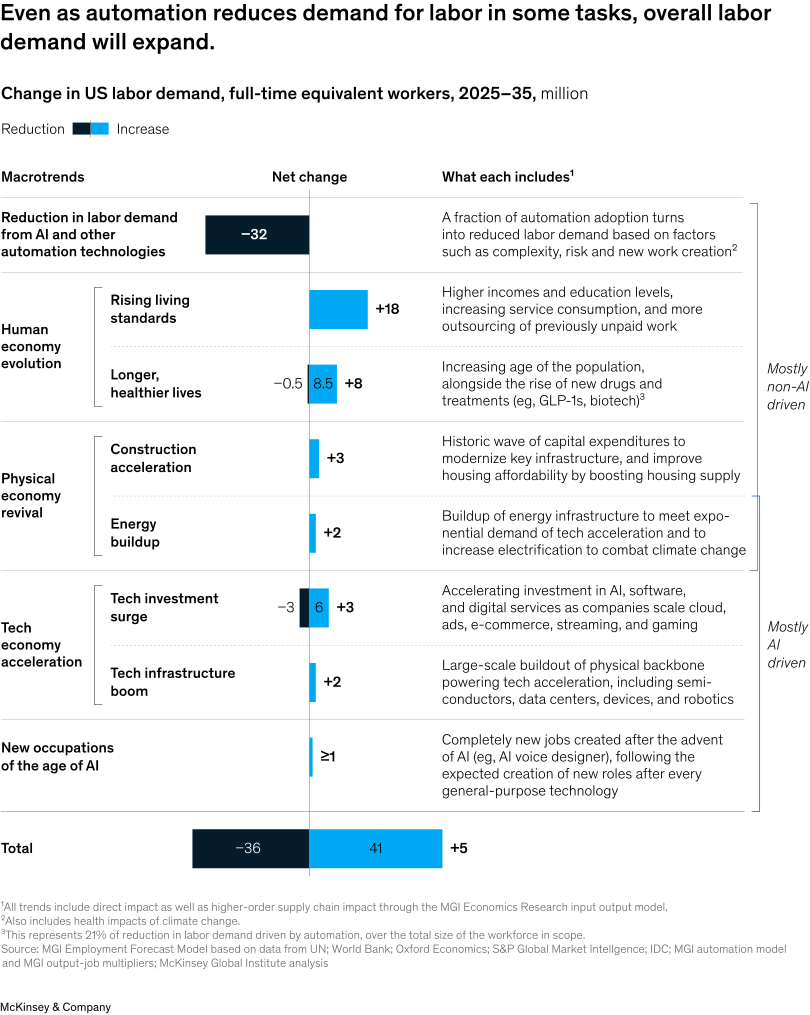
The human economy is one of the largest growth engines in the United States. Rising living standards may account for approximately eighteen million jobs as households and firms purchase more services, professionalize work that was once informal, and increase demand for management, business operations, hospitality, personal services, workforce training, and other coordination-intensive work. Aging is likely to increase demand for long-term care, chronic and specialty care, home-based support, pharmacy, nutrition, care coordination, household support, and related services. We estimate that demographic shifts will create an additional eight million net additional jobs.
The physical economy is another engine of job growth. Housing shortages, infrastructure renewal, grid modernization, electrification, industrial capacity, and reshoring require workers in construction, installation, maintenance, repair, transportation, warehousing, and skilled trades. These jobs are often place based and physical, which can make them less vulnerable to AI substitution but more exposed to geographic mismatches. We estimate that construction needs will add roughly three million full-time equivalents (FTEs), and the energy build-out fueled by AI and other factors will contribute an additional two million.
The technology economy is equally important to job creation. Growth in software, cloud computing, e-commerce, advertising, streaming, gaming, data services, and digital operations is expanding labor demand for engineers and data specialists as well as for product managers, customer-support teams, implementation specialists, trust and safety roles, sales operations, content operations, and business functions that keep digital businesses running. We estimate a net increase of roughly three million FTEs from the surge in the digital economy over the next decade before taking account of AI-driven reductions in labor demand in these occupations.
The technology economy also has a physical backbone. Data centers, semiconductors, networking equipment, devices, robotics, cooling systems, grid connections, and backup power all require workers to build, maintain, repair, and operate them. The analysis estimates that the technology infrastructure boom will account for roughly two million additional FTEs. This labor demand may rise and fall with investment cycles, but the need to support the physical infrastructure will likely remain a meaningful source of work.
To be sure, not every job growth engine is equally certain, equally permanent, or equally accessible. Some physical build-out will be project based. Some technology infrastructure demand will depend on investment cycles. Some healthcare demand will be shaped by productivity, care models, pharmaceuticals, public funding, and regulation. The more certain conclusion is that labor demand is already shifting to different occupations, skill sets, wage bands, credentials, and geographies, which will offset falling labor demand in other occupations.
These estimates describe the long-run balance between declining and growing labor demand, not the path the labor market takes to reach it. Over the next decade, businesses may reduce demand for 36 million jobs while simultaneously creating demand for 41 million others as automation, AI, and structural growth reshape work (Exhibit 7). These shifts relate to additional labor-demand adjustments associated with AI and broader structural trends and are incremental to the normal dynamics of the labor market, which includes quitting, retirements, business-as-usual hiring, and cyclical layoffs.
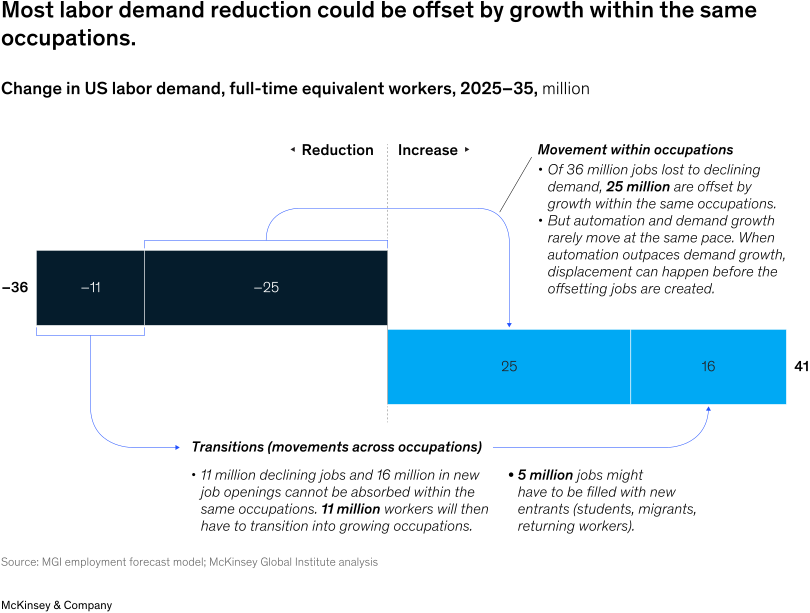
Within occupations, a total of roughly 25 million jobs are likely to “net out” as automation decreases demand for a job while macroeconomic trends increase demand for it. Whether this happens without displacement depends on timing. If automation-driven reductions and macroeconomic-driven job creation move at a similar pace, workers can migrate directly into new roles, but if automation outpaces demand growth, displacement may occur before any offsetting jobs materialize.
For example, demand for software developers fell sharply from its peak in 2022 as companies corrected pandemic-era overhiring but also increasingly due to AI’s automation of software development tasks. Since early 2025, however, job postings seeking software developers have increased by about 15 percent. Today’s gaps are in senior and AI-oriented roles, suggesting that AI is creating demand for new technical capabilities even as it automates others.22
The remaining 11 million jobs subject to reduced demand and 16 million in new job openings exceed what any single occupation can absorb on its own and may require workers to move into different occupations altogether.
AI is likely to shift labor demand within and between occupations, but to different degrees. Understanding which occupations will experience dwindling demand and which ones will see growth can inform efforts to mitigate the impact of AI on the workforce and reshape labor markets with less disruption.
The great workforce reallocation
Roughly 11 million US workers may need to transition into new occupations by 2035. Meeting that need will require about 770,000 workers to switch occupational groups each year, roughly 3.6 times the historical average. While 16 million new jobs could open up, filling them will depend on whether workers have the skills those jobs require. Jobs may be plentiful, while direct pathways to them may not.
What makes the workforce shifts coming over the next decade different is not how many workers move but where they need to move; in other words, a story of reallocation. Historically, transitions have occurred either within broad occupational groups requiring similar skills or within a single occupation, lowering barriers to mobility. We expect most of the workers in the 36 million jobs disrupted by automation to follow the latter pattern and transition into a job in the same occupation.
However, roughly 11 million US workers may need to transition out of occupations with declining demand into wholly new occupations by 2035. That figure represents about five million fewer workers than will be needed to fill the new jobs opening in growing occupations. These occupational transitions are a smaller but more visible outcome of the much larger labor-market shift, and they could require substantially more movement across occupational groups over a longer period than the US economy has typically sustained (Exhibit 8). Yet workers today move less from one employer to another than they did in the late 1990s and early 2000s, notwithstanding a temporary surge in mobility around the pandemic.23
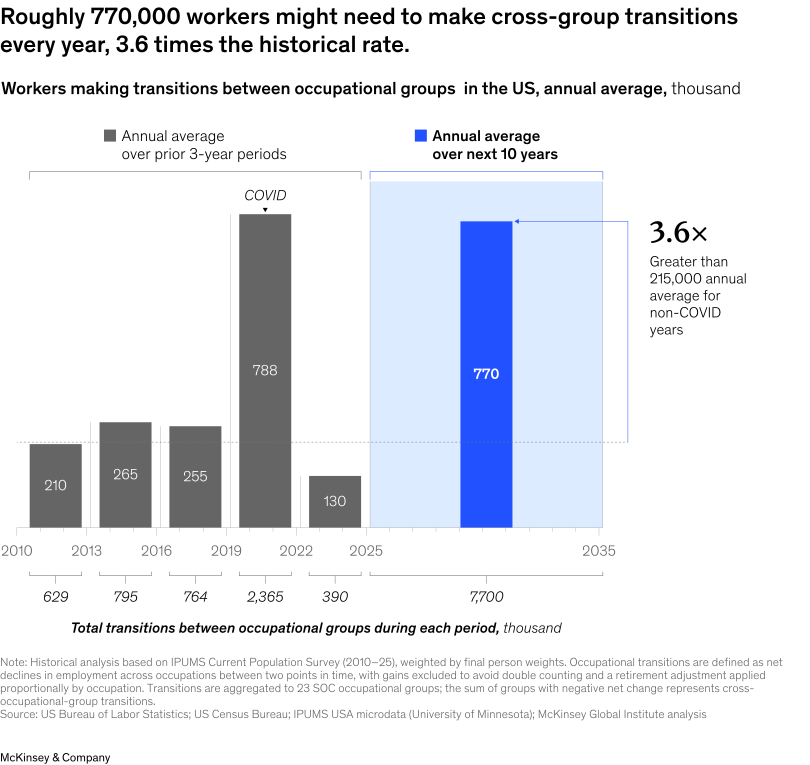
Some 215,000 workers have needed to make transitions across occupational groups on average each year, but the next decade may require roughly 3.6 times as many to make that leap annually. To be sure, the labor market grappled with a comparable number of transitions across occupations during and immediately after the COVID-19 pandemic, when about 788,000 workers made such changes annually from 2019 to 2022 without the prolonged dislocation many feared.
What is different this time is the duration of the shift. A two- to three-year shock is one thing; a decade-long one is another. This sustained demand for transition makes pathway quality the central constraint on the current reallocation. Changing occupational groups typically requires workers to acquire more new skills, adapt to different work contexts, and overcome bigger credential, wage, and geographic barriers than transitions within the same occupational group.
Although we project job openings may exceed the number of workers needing to change jobs, that doesn’t mean there is a ready match for everyone. Workers don’t move around the labor market as interchangeable units. They carry specific skills, wages, credentials, location preferences, experience, and other constraints. The economy can generate more jobs than it loses, and many workers will nonetheless have difficult transitions.
Decline is concentrated in office, retail and sales, and transportation occupations
The decline side of the great reallocation may be highly concentrated (Exhibit 9). More than 75 percent of FTEs who may need to transition into new occupations work in just three of 22 occupational groups: office and administrative support, retail and sales, and transportation and logistics. Within those groups, a small number of occupations account for a disproportionate share of declining jobs due to adoption of automation technologies and other factors. About a third of FTEs transitioning between occupations are in five occupations: customer service representatives, retail sales associates, office assistants, cashiers, and warehouse workers.
About five million jobs could be added in health and construction occupations through 2035.
Note: Bars show gross jobs gained and gross jobs lost within each occupation group. Groups are ranked by net change in jobs. Net values to the right of each bar are jobs gained minus jobs lost within the group. The change column gives the net change as a percentage of the group’s 2025 employment. Figures may not sum to 100%, because of rounding.
1Includes an additional 1 million jobs in new US occupations created by AI, not in the chart.
This concentration suggests that practical pathways can be built for workers in a small set of occupations where demand could fall, allowing employers, educators, and policymakers to target their efforts (see sidebar “Automation could have a bigger impact on food service jobs”).
Concentration also means the impact of automation falls unevenly. Lower-wage workers are 7.6 times more likely to need to transition to a wholly new occupation than higher-wage workers (Exhibit 10). Workers without a college degree are about 1.8 times as likely as those with at least a bachelor’s degree to need to change occupations, while younger workers are about 1.6 times as likely as prime-age workers, women are about 1.6 times as likely as men, and Hispanic and Black workers about 1.2 times as likely as White workers, a reflection of these groups’ representation in occupations in which automation is more likely to reduce labor demand. These estimates illustrate the potential scale and distribution of labor transitions, and actual outcome could vary as technology adoption, labor demand, and broad economic conditions evolve. For example, demographic forces may shift these patterns. As growing numbers of baby boomers retire, replacing them could open doors for younger workers in growing occupations.
Lower-income workers are more likely to need to transition into new jobs in the next decade.
1Value for middle wage quintile is 9%.
2Value for Asians is 6%, 8% for Native American, 9% for Native Hawaiian, and 7% for 2+ races.
Many occupations could grow
A broader set of occupational groups may increase. More than a third of positions likely to open in growing occupations are concentrated in four of 22 occupational groups—healthcare support, healthcare professionals, construction, and management occupations.
Employment growth from 2025 to 2035 may be concentrated in healthcare, professional and technical services, and construction sectors. Jobs may also increase in manufacturing, education, and information sectors. The largest declines are expected in retail trade and in accommodation and food services, which together could account for most sector-level job losses (Exhibit 11).
Across sectors, employment could increase most in healthcare and construction and could decline most in retail.
The workers most likely to need to transition are often not in the same occupational groups as these growing jobs, creating a matching problem. A cashier may have customer interaction, basic digital, and reliability skills, but jobs are likely to grow in caregiving, construction support, healthcare support, and business operations. An administrative assistant may have coordination, scheduling, documentation, customer interaction, and workflow knowledge, but the most attractive increasing jobs may require management, business operations, technology, or specialized process skills. The challenge is to match skills to the jobs coming online.
Many occupations will be reinvented altogether, not just grow or shrink
Not every worker falls into either a declining occupation or a growing occupation. For many, the central experience of the next decade could be reinvention on the job. Their occupation may remain but be reconceived as its task mix, tools, workflows, skill requirements, and sources of value change. These workers could account for much of the change in the labor market, although potential job loss or creation gets more attention. About 25 percent of the workforce could have more than 30 percent of the time needed to do their tasks reallocated, either reshuffled into existing activities or shifted to new ones. Between 15 and 30 percent of the task time in 47 percent of the workforce could be reallocated (Exhibit 12). Some automated hours may reduce the need for labor, while others go into new or expanded activities, changing the mix of work performed by the workers who remain.
Most of the workforce will go through reinvention, not just grow or shrink.
1Low reinvention is measured as less than 15% of a worker’s task time that is reallocated, either reshuffled within existing activities or shifted to new ones. In moderate reinvention, 15–30% of tasks are reallocated, while more than 30% are reallocated in high reinvention.
Reinvented occupations matter because they shape future mobility. A worker who learns to collaborate with AI systems, redesign workflows, or interpret machine-generated outputs could increase their mobility as technology improves.
Nor is reinvention limited to occupations where AI augments work without reducing head count. It can occur whether employment in an occupation grows, declines, or remains broadly stable. It occurs across two dimensions that define an occupation’s trajectory: the pace of automation adoption and the direction of labor demand (Exhibit 13).
Greater automation drives the greatest need for reinvention, which extends well beyond the most disrupted occupations.
In the most highly disrupted occupations, reinvention happens in tandem with significant reduction in head count, not instead of it. Cashiers are one example. Self-checkout, mobile payment, and increasingly capable point-of-sale systems have already replaced much of the work that once defined the role (Exhibit 14). However, the remaining cashiers aren’t doing a smaller version of their old job. Their work has shifted toward tasks machines still do poorly, such as resolving payment and transaction exceptions, handling customer interactions, influencing purchases, and overseeing AI-enabled systems, tasks that require judgment, interaction, or physical presence. A big drop in labor demand and high reinvention could occur simultaneously in this occupation, which may shrink and change at the same time.
When AI mostly augments work in an occupation, reinvention doesn’t reduce labor demand as much. AI may do a large share of routine or data-intense parts of an occupation without necessarily reducing demand for it. What fills the time that opens up varies. Some workers may have tasks that didn’t exist before; some could spend more time on existing tasks that machines can’t do well; and some do their existing tasks differently, reviewing and directing AI output rather than producing work themselves. Insurance underwriters illustrate one version of this. As AI agents increasingly ingest, validate, and synthesize applicant data into decision-ready summaries, underwriters could spend meaningfully less time gathering and verifying information. At the same time, they may spend more time assessing risk and judging AI-generated recommendations and explaining decisions to brokers and customers. For other occupations with high automation adoption and relatively stable labor demand, the shift may be toward relationship management, exception handling, oversight of multiple AI systems, or creative and strategic work.
In occupations with low automation adoption and lower disruption to labor demand, some reinvention can still occur. Teachers are an example. The additional capacity automation may free up by assisting with curriculum planning and administrative work could allow teachers to spend more time on individualized coaching, student support, and classroom engagement, tasks that depend on direct human relationships. Even with low automation adoption, the mix of work can still shift meaningfully.
Some occupations that involve physical, in-person work may have moderate levels of automation adoption and labor-demand reduction. Some of them have latent potential for further disruption as AI takes over routine, back-office aspects of the work, although that could place more emphasis on activities requiring a human. For example, the number of tractor-trailer truck drivers is expected to increase over the next decade, even as AI takes on order handling, routine communications, and aspects of navigation and scheduling. Driving and physically handling cargo may account for a greater share of drivers’ work in the future, as such tasks depend on human presence, safety judgment, and on-road execution. Autonomous driving may play a role in labor demand reduction, but over the next decade, that effect might not be large enough to outweigh broader macroeconomic factors supporting industry growth.1 Lower automation adoption does not necessarily mean low reinvention.
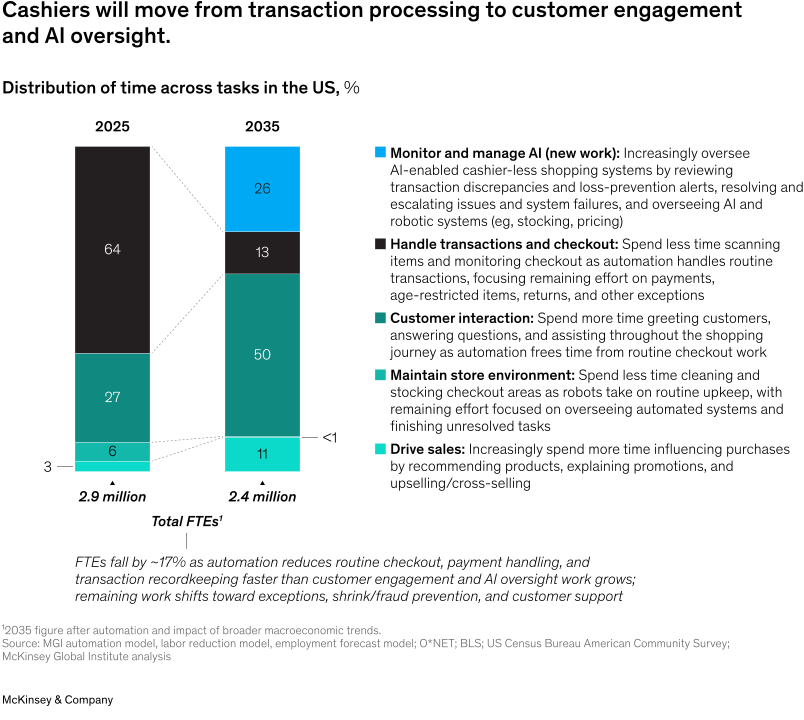
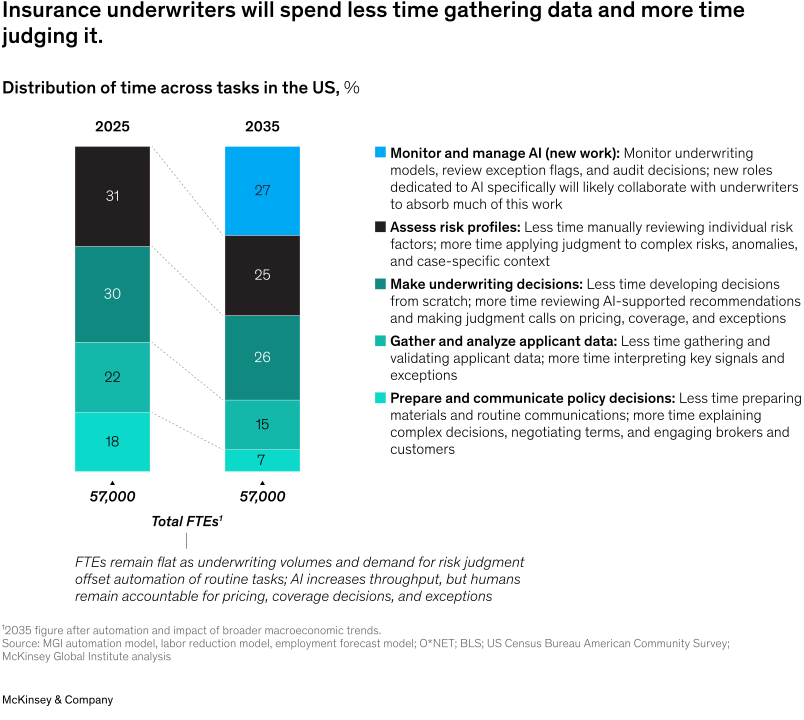
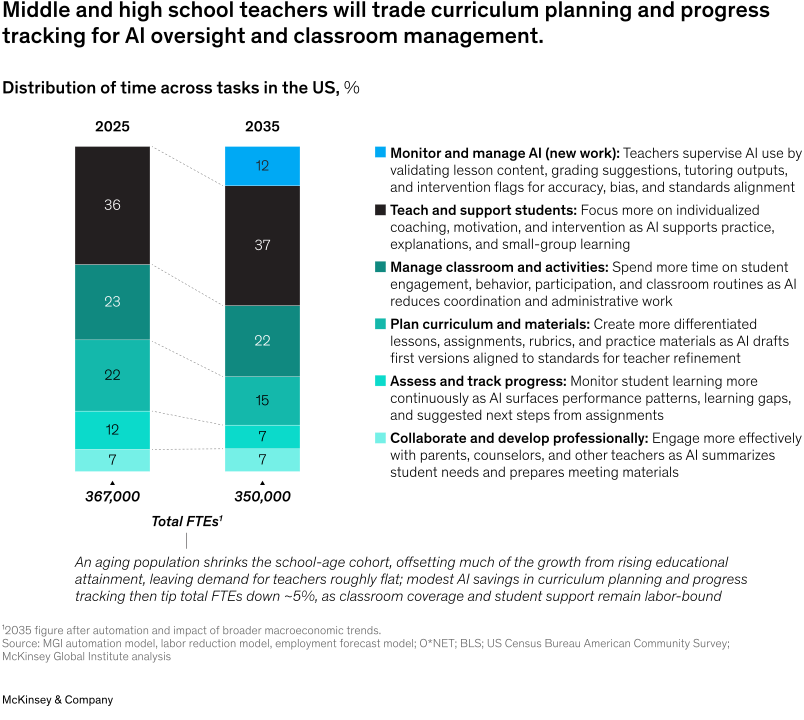
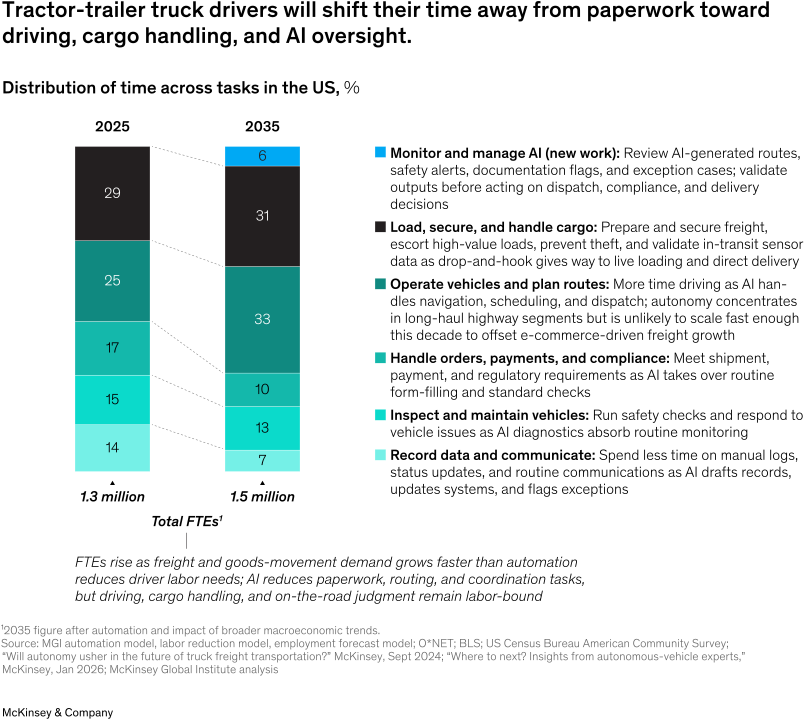
Across these cases, the lesson is the same. Reinvention is not distinct from decline and growth; it is present in both. Companies and workers need to understand which tasks are changing and what new skills those changes will require, whether an occupation’s head count is falling, flat, or rising.
The occupations most at risk are not necessarily those most exposed to AI
Exposure and transition risk are not the same. A worker in an occupation with high automation adoption may face limited transition if productivity gains are offset by the need for new tasks, if demand grows, or if a worker can move easily into adjacent roles. Conversely, a worker in a moderately exposed occupation may face significant transition risk if demand declines and few pathways lead directly to a new occupation.
Workers face the greatest risk when demand for the work they do is declining and pathways to growing jobs are weak due to limited skill adjacency, credential barriers, geographic mismatch, employer screening, low wages that make training difficult, or limited time or ability to retrain. Nor does pay determine pathway quality at an individual level. A lower-wage worker may have a more direct pathway to a growing job than a higher-income worker whose specialized skills transfer to fewer destination jobs.
The next chapter introduces a method for assessing pathway quality. Rather than asking whether pathways exist in theory, it examines whether they are direct enough to be practical for workers and scalable for the economy.
Three types of pathways lead to growing jobs
Nearly every worker needing to change occupations may have a pathway to growing work, but the quality of those pathways varies substantially (Exhibit 15). Only about one in seven workers has a direct pathway requiring minimal retraining and no wage loss. Four in ten face a winding pathway requiring meaningful retraining to navigate, while nearly half will travel an unpaved pathway strewn with larger skill gaps, extensive credentialing requirements, and other barriers. Pathway quality determines whether job growth becomes workforce opportunity.
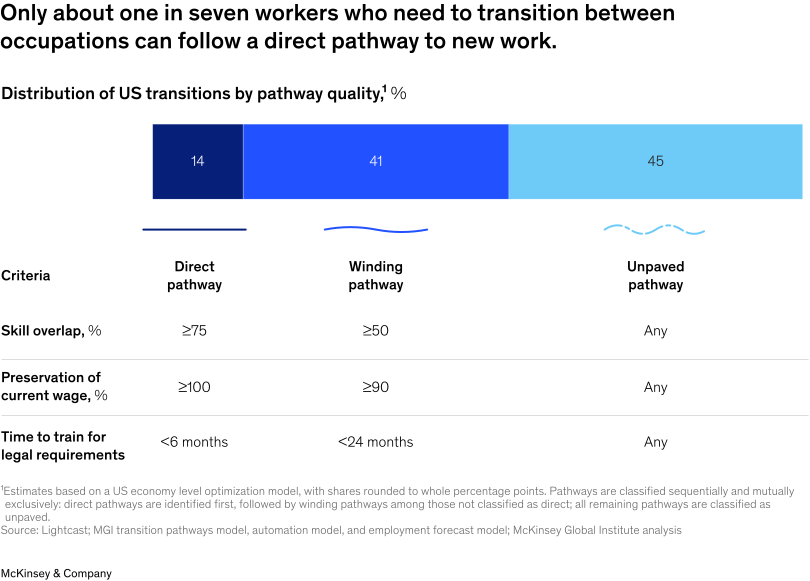
A direct pathway is set by four conditions. The occupation into which a worker is headed must be growing. The worker’s current occupation must require a large share of the skills needed for the destination occupation. The wage in the destination occupation must preserve or improve the worker’s current compensation. Finally, obtaining legally required credentials must require minimal time.
On a winding pathway, those conditions are less certain. This pathway may require meaningful reskilling, a modest wage trade-off, or a longer credential timeline. An unpaved pathway is one where the skill gap is even larger, with a potential wage trade-off and unbounded credential timeline. Some pathways may be blocked altogether by insufficient demand, material wage loss, a long credentialing process, geography barriers, language barriers, or employer screening.
Of course, a worker may not follow a pathway determined by their apparent skills at all, because humans have skills beyond those they use at work.
Pathway quality varies for workers needing to transition to new jobs
About 45 percent of the workers displaced by automation could travel more challenging pathways that require larger skill investments, longer credentialing processes, or lower pay, as well as likely substantial changes in work context. The transition challenge is highly concentrated among occupations. Office and administrative support occupations account for the largest share of workers who may need to change jobs, followed by retail and sales, and transportation & logistics. Pathway quality differs sharply across these groups. Almost half of office and administrative support workers may follow winding pathways, and more than 60 percent of retail and sales workers could walk unpaved pathways. Transportation and logistics workers are more likely to have winding or straight pathways. The challenge is driven not only by the number of workers needing to transition but also by the quality of pathways available to them (Exhibit 16).
Pathway quality varies widely for workers moving from declining to growing occupations.
1Does not include net new occupations including those created by AI.
2Theoretical new entrants to the workforce who would fill demand for growing occupations and likely would not go into declining occupations.
Additionally, workers don’t move into a single destination occupation. Office and administrative, retail and sales, transportation and logistics, and food service workers are likely to disperse into a wide range of growing occupations including healthcare support, construction, and management roles, and pathway quality to those destinations varies substantially. Straight pathways exist but are not evenly distributed across the largest declining occupations.
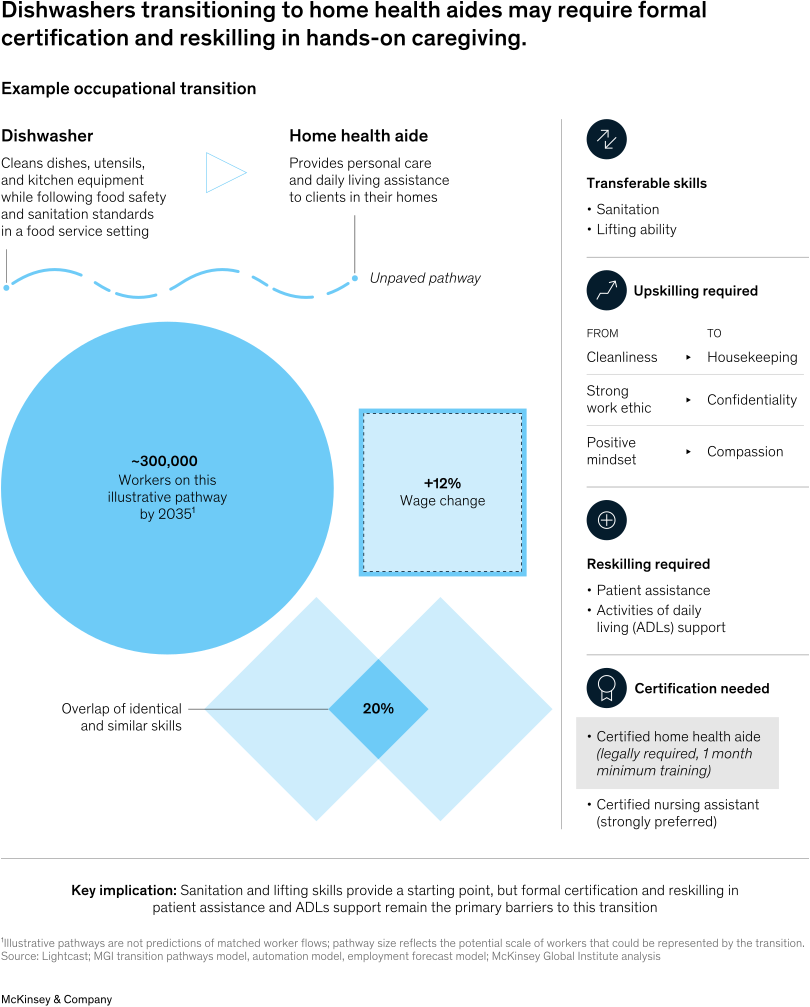
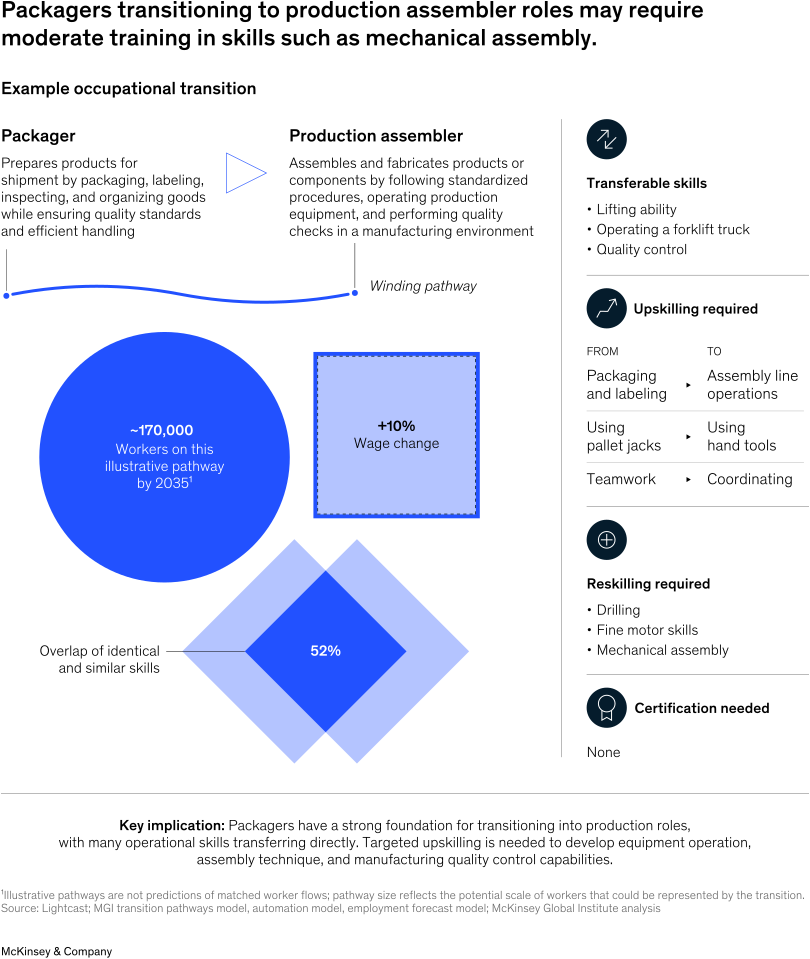
Some potential occupation-to-occupation transitions illustrate the challenge. Dishwashers could become home health aides, for example.24 Other potential pathways include packagers moving into production fabricator and assembler jobs, and office and administrative assistants moving into project manager roles (Exhibit 17).
The pathways differ substantially in how much reskilling they require. The pathway from dishwashing to home health aide work is unpaved, with a skill overlap of 20 percent. A packager seeking to become a fabricator and an office assistant aiming for project manager will follow a winding pathway with a skill overlap of 52 and 58 percent, respectively.
These three transitions are difficult for different reasons. Dishwashers have sanitation and lifting skills that home health aides use, but they would need to acquire caregiving capabilities such as patient assistance and vital-sign assessment. Additionally, the transition calls for formal instruction to become a certified home health aide, which requires about one month of training. What’s more, certified nursing assistant credentials requiring more training are preferred.
A transition from packager to production fabricator presents a different type of challenge. Packagers have a strong operational foundation, including lifting ability, quality control, and experience operating equipment like forklifts. However, the fabricator role requires a greater focus on creation and assembly, which requires mechanical assembly, drilling, and fine motor skills. While the pathway from packager to production fabricator leads to a meaningful wage increase and builds on a reasonable skill overlap, it also requires targeted skill upgrading to capabilities needed for specific manufacturing equipment, assembly techniques, and advanced quality control procedures.
Transitioning from office and administrative assistant to project manager illustrates a barrier of a different kind. Office assistants have a strong foundation in planning, scheduling, and coordinating operations. These skills transfer well to the project manager’s role, which also requires workers to lead projects, manage stakeholders, and deliver business outcomes. So in addition to building capabilities in project scheduling, process improvement, business development, forecasting, and quality management, many office assistants may need to obtain a bachelor’s degree and professional project management certification. Although this pathway offers one of the largest wage gains among these examples, it also entails one of the greatest investments in education and credentialing.
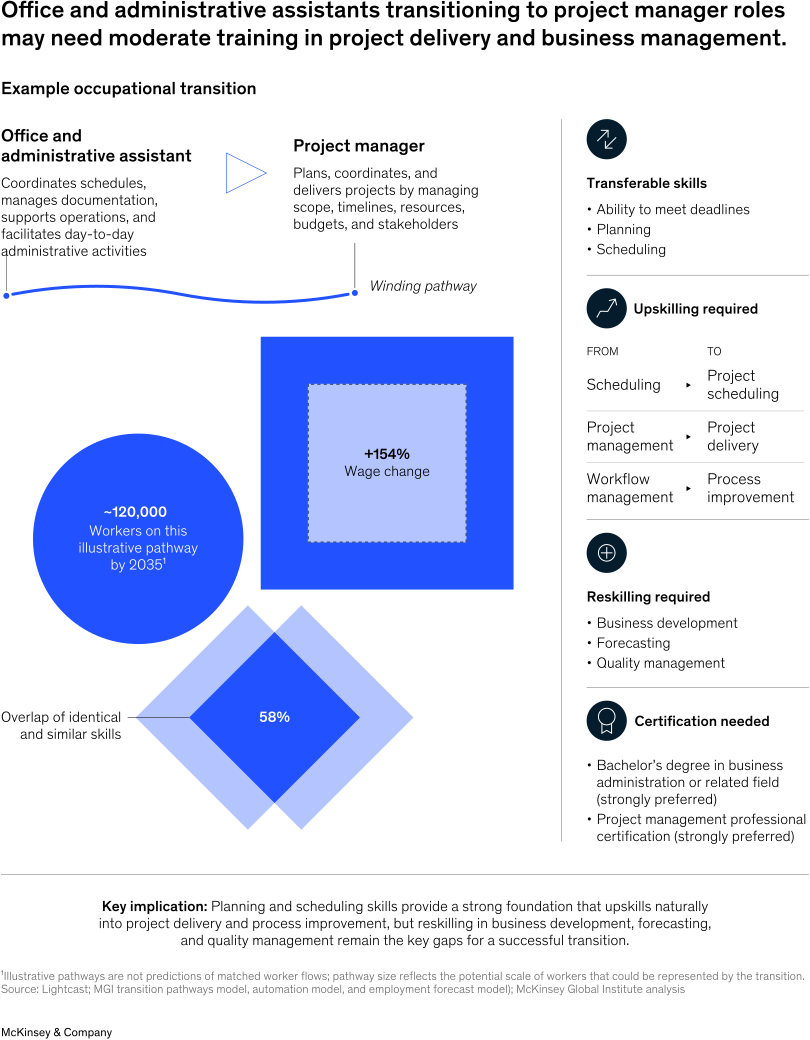
None of these transitions is impossible. All are feasible and build on meaningful existing capabilities. But feasibility is not the same as ease. These examples illustrate why pathway quality is the relevant measure of transition risk.
Even if workers successfully navigate these transitions, they are unlikely to meet labor demand on their own. Meeting demand will also require expanding the pool of workers entering the labor market. This includes younger workers entering the workforce for the first time, migrants who help address labor shortages, people returning after career breaks, and older workers who remain economically active. These sources of labor are complementary and not substitutes for effective pathways that help existing workers transition into growing occupations. Worker transitions and new labor-force entrants will both be needed to address the scale of projected workforce demand.
Wages may increase as the workforce is reallocated
A transition into growing work is not necessarily a step up. Some accessible jobs may offer flat or lower pay, while some higher-paying jobs may require substantial new skills, credentials, or experience. Understanding the workforce impact of AI requires looking not only at whether workers can move but also at whether those moves preserve or improve their economic prospects.
At the economy level, employment shifts could support higher average wages. Fifty-seven percent of employment in growing occupations will fall in the top two wage quintiles, while more than 70 percent of declining jobs are concentrated in the bottom two quintiles (Exhibit 18). On net, the economy may shed lower-wage work and add higher-wage work. As workers move into growing roles, many may gain higher earnings, with potential benefits for their livelihoods, families, and communities.25
At the economy level, the reallocation of employment could support higher average wages.
1Separate distributions of 11 million declining jobs and 16 million growing jobs.
Wage improvement in the aggregate, however, doesn’t automatically translate to an individual worker’s pocketbook. Workers can only move into occupations for which they have the requisite skills. The good news is that matching transitioning workers to feasible destination occupations suggests that only 3 percent of workers—roughly 305,000 of the 11 million expected to transition—will follow a pathway that requires a pay cut. The pathways of most workers will preserve or improve current earnings, suggesting that the workforce reallocation AI is bringing may be favorable not only in aggregate but also for most workers able to transition. (This analysis holds current wage levels within each occupation constant, which captures changes in earnings as workers move across occupations, but not potential changes in occupational wage levels as labor supply and demand rebalance.)
The occupation examples illustrate why the trajectory of wages cannot be evaluated in isolation. The transition from dishwasher to home health aide broadly preserves earnings but offers limited income progression, despite requiring meaningful reskilling and a substantial change in work context. By contrast, the transition from office and administrative assistant to project manager offers a clearer wage premium but requires a larger shift in technical capabilities and work environment. The quality of a pathway therefore depends on the combination of skill requirements, wages, credentials, and work context.
Growing jobs require more skills, not just better pay
A greater demand for skills accompanies higher wages. Across occupations, employers seek an average of 64 distinct skills in their job postings.26 In growing occupations, 68 skills are sought, one and a half times as many as the 47 skills needed in declining occupations. Formal education requirements follow the same pattern: 84 percent of growing occupations require postsecondary education, compared with 45 percent of declining occupations.27 Reallocation thus moves workers toward better-paid work and also toward occupations for which employers seek a broader range of skills and educational attainment.
Nor is the difference only in the number of skills required. Many growing jobs demand greater judgment, interpretation, and decision-making, potentially increasing cognitive load even when formal credential requirements are unchanged. The McKinsey Health Institute’s work on brain capital suggests that managing this load is increasingly a question for employers, not simply an individual responsibility. Workers cannot build and deploy the capabilities increasingly needed in an AI-enabled workplace on a foundation of burnout or cognitive overload.28
For workers navigating these pathways, training cannot stop at task-specific instruction. They will also need to build the capacity to handle work broader in scope and more variable than in the jobs being left behind, and companies must create conditions that respect growing demands on cognitive capacity.
Pathway quality differs across US demographic groups
Pathway quality is not evenly distributed across the workforce. While nearly all workers likely to transition will have a pathway to a growing occupation, the likelihood of landing on a direct pathway varies substantially across demographic groups. Only 14 percent have a direct pathway, but this share differs markedly by education, earnings, and gender.
Current earnings account for the largest disparities. High earners in the top quintile are four times as likely as a worker in the bottom quintile to have access to a direct pathway. Only 10 percent of workers in the lowest wage quintile, who earn less than $38,000 a year, are likely to have a direct pathway, compared to almost 40 percent of workers in the fifth quintile.
Educational attainment and gender are also associated with meaningful differences in pathway quality. Workers with more than a bachelor’s degree are about 50 percent more likely to have a direct pathway than those with a bachelor’s degree or less, and men are about 30 percent more likely than women to have one.
Overall, these findings suggest that workforce transitions will not be uniform. Workers with lower earnings have substantially fewer high-quality pathways into growing occupations and so will require more targeted support including training, career navigation, and other transition assistance to successfully move into expanding roles in the labor market.
Pathway quality determines the kind of support a worker will need. The workers most at risk are not those in occupations with the highest automation adoption, but those with very winding or even blocked pathways to take them from declining demand to growing demand. That is why skills matter, but also why skills alone are not enough. The next chapter examines the skills that expand mobility and, in some cases, help workers move up the employment ladder.
Essential, enabling, and empowering skills can expand access to more and better pathways
Three categories of skills can enhance the number and the quality of pathways available to workers. Essential skills are required for many occupations and expand workers’ career options, while enabling skills have broad applicability but are harder to master and can support upward mobility because they are concentrated in higher-paying work. Empowering skills provide career resilience and help workers continuously adapt to evolving technologies, activities, and skill requirements (Exhibit 19).
Skills create value in different ways.
Image description: A text table highlights attributes of three categories of skills: essential, enabling, and empowering skills. End of image description.
1All figures relevant for the US.
2Average top-quintile wage.
Together, these three skill types determine not only whether workers can move but also where they can move and whether they can continue adapting as the labor market changes.
Essential skills open the largest number of opportunities
Some skills are valuable because they are required in occupations that make up a large share of the labor market. These essential skills form the base of workforce mobility because they make it easier for workers to move between occupations without starting from scratch. Prior MGI research identified skills such as problem solving, leadership, interpersonal communications, people and process management, and detail orientation among the most broadly required skills across occupations.29
These skills matter because most work transitions are not leaps into entirely unrelated work but rather adjacent moves that build on existing capabilities. A worker with customer relations, problem-solving, and detail orientation skills may be able to move from retail into care, administrative coordination, or operational roles. Similarly, workers with leadership and operations skills may transition between functions, industries, and work settings because those capabilities are valuable in many different contexts.
Essential skills create optionality because they are required in much of the labor market, so workers who lack them may find many occupations out of reach.
Enabling skills open doors to better opportunities
Not all skills create value in the same way. Some highly specialized skills, particularly in healthcare and other credential-intensive fields, provide access to exceptionally high-paying occupations but are needed in relatively few jobs.
Enabling skills combine broad applicability with access to higher-paying occupations, allowing workers to earn more. Skills such as decision-making, innovation, and critical thinking are associated with occupations that offer higher wages and have broad applicability across industries and business functions. They support transitions from execution-heavy roles into coordination, business operations, project leadership, and other higher-value work (Exhibit 20).
Essential skills are demanded in a broad range of occupations, and enabling skills are concentrated in higher-wage jobs.
Note: The exhibit is intended to show the breadth of occupations in which a skill is required and whether less ubiquitous skills are concentrated in higher-paying occupations, not to estimate the wage premium associated with an individual skill.
1Average wage of the US occupations that require the skill, weighted by full-time equivalent count. Because the wage measure reflects the average wage of occupations requiring each skill, weighted by employment, skills required in most occupations will mechanically converge toward the economy-wide average wage.
A pathway that preserves employment but locks workers into lower-value work is fundamentally different from one that expands career opportunities and earnings. Enabling skills represent a particularly valuable form of mobility capital because they improve long-term economic opportunity.
Empowering skills are fast becoming economic assets
As technology changes the nature of work itself, a third type of skills has gained importance. Unlike essential skills or enabling skills, which determine where workers can move today, empowering skills influence how well workers continue adapting as occupations evolve. These skills are relevant for workers transitioning between occupations as well as for the much larger share of workers who will remain in their current occupations as those occupations are reshaped by AI and other technologies.
Job postings already point to their importance. Between 2022 and 2026, demand for AI fluency30—the ability to work effectively with AI tools and intelligent systems—increased approximately 11-fold, while demand for willingness to learn, resilience, and curiosity roughly tripled, and demand for adaptability increased about fivefold (Exhibit 21). These trends suggest that employers increasingly value not only what workers know today but also how quickly they can acquire new capabilities.
Demand for empowering skills has increased exponentially since 2022.
The gap between these five empowering skills is widening rather than closing. The growth in demand for AI fluency isn’t just fastest in relative terms; it is present in far more occupations in absolute terms than willingness to learn, resilience, adaptability, or curiosity. Yet those skills aren’t secondary to AI fluency. They allow a worker to keep pace with whatever follows the current wave of AI tools. If demand for these empowering skills doesn’t match the pace of demand for AI fluency itself, employers risk building a workforce that can use today’s AI tools but is no better equipped to adapt to the next set of changes those tools may bring. In this sense, AI fluency is not a destination but a capability supported by other skills that must be continuously renewed as AI technologies evolve (see sidebar “The proven teachability of empowering skills”).
Workforce reallocation driven by AI will not be a one-time event. Occupations will continue to evolve as technologies advance, business models change, and new ways of working emerge. For many workers, the primary challenge will not be moving into a different occupation but continuously reinventing how they perform their existing one. These skills become a form of long-term mobility capital, helping workers to continuously build new capabilities as the labor market evolves.
Many of the essential, enabling, and empowering skills are also least exposed to automation. MGI’s Skill Change Index, which measures how susceptible skills are to automation, suggests that skills such as people and process management, leadership, and the ability to influence others are relatively resilient.31 As AI takes on more structured and repetitive work, these distinctly human capabilities complement technical skills, enabling workers to create value in ways that technology is less well suited to replicate.
Skills deployable across occupations ensure greater mobility across jobs
Skill adjacency is highest where occupations share a common skill base (Exhibit 22). Many practical transitions are likely to be adjacent moves within occupational groups or into nearby occupation families rather than large leaps across the labor market.
Skills overlap most within occupational groups, but strong adjacencies also exist across groups.
But mobility is not equally strong in all occupational groups. Healthcare is the clearest exception. Healthcare professionals have relatively little internal skills overlap because their roles are highly specialized and require credentials. Even within the same broad healthcare group, different occupations require distinct clinical knowledge, licenses, and work settings. Healthcare shortages are unlikely to be solved with simple redeployment unless pathways are deliberately designed around stepping-stone credentials and training capacity. Redesigning roles, workflows, and staffing models to increase the productivity of scarce clinical talent with technology can also address these shortages.32
Workers in occupations with higher wages often have more adjacent skill profiles because their work combines analytical, organizational, commercial, managerial, and communication capabilities applicable across business contexts. Roles in management, business and finance, and some professional services may have multiple mobility options. But high wages do not guarantee mobility. Some specialized technical and healthcare roles pay well but require a narrow set of skills and specific credentials and so have limited adjacency across sectors (Exhibit 23).
Higher-wage occupational groups often have greater skill adjacency across the labor market.Higher-wage occupational groups often have greater
skill adjacency across the labor market.
Profiles with high-skill adjacency are also not solely the possession of high-wage workers, as workers in office and administrative support occupations demonstrate. Even when demand declines, many workers in these roles have coordination, scheduling, customer interaction, problem-solving, and other skills that can transfer to other administrative, operational, customer-facing, or coordination-heavy roles.
The most constrained workers are those in lower-wage, execution-heavy, highly specialized, or context-specific roles in which skills are valuable in a current job but less transferable to growing or higher-wage destinations. Lower-wage occupational groups often have less skill overlap with higher-wage groups, a structural barrier to upward mobility. Moving into better-paid work may require not only job matching but substantial reskilling, credential acquisition, or a shift in work context.
Skills need to be visible and recognized
Workers who have a skill needed for a role may appear less qualified in interviews or on applications. Skills may be discounted or unrecognized, making it harder for employers to identify workers whose skills could transfer to other roles and for qualified people to get hired.33
Employers can reduce this barrier by relying less on subjective signals and instead focusing on structured, skills-based hiring. Consistent interview criteria, practical assessments, and clearer definitions of required skills can help organizations identify talent more accurately.
Skills expand the set of jobs a worker can attain and their access to higher-wage work. But the impact of skills can be narrowed or blocked. The next chapter examines the barriers that determine whether skill-enabled pathways materialize.
Reducing barriers could make pathways more direct for workers
Skills enable transitions, but barriers determine whether those transitions are straightforward. In many cases, workers targeting new positions already have the adjacent skills and can move without sacrificing pay, but the job posting requires a qualification they lack. Geography, language, training costs, and employer hiring practices also matter, but credentials are one of the largest barriers to workforce mobility (see sidebar “How barriers look different within and beyond the United States”).
These barriers are widespread. Some 85 percent of growing employment in the United States calls for a credential or certification of some kind, whether legally mandated or required by an employer. Seventy-six percent of those jobs cannot be performed remotely, tying a job to a specific location, and 25 percent are in the bottom two wage quintiles (Exhibit 24).
Credentials, geography, wages, and language barriers can block pathways even when workers have the required skills.
Context matters. The same pathway may be viable in one state or country and blocked in another because of licenses, wages, worker protections, language, or mobility constraints.
1Legally required, preferred by employer, or both.
2Compared to 72% of Hispanic and Asian workers with average English proficiency, and 99% of white and Black workers.
Such barriers can turn a pathway feasible on paper into one difficult or blocked in practice. Thus, labor-market mobility is not only a training issue. Training can close skill gaps, but training alone cannot remove licensing rules, change employer hiring practices, relocate jobs, compensate workers during training, or make low-wage destination roles attractive. Across the pathways, barriers are often the binding constraint. A worker with adjacent skills is often blocked by a location, a wage, or the need for a credential rather than by inability to do the work a role requires. In this chapter, we examine those gates and illustrate why they must be diagnosed together.
Legal requirements for credentials can hinder some pathways
Credentials required by law or regulation are among the biggest barriers to mobility. About 38 percent of growing employment has a credential required by law. These requirements are concentrated in areas where safety, liability, professional standards, or public trust are central to the work, such as healthcare professionals, legal, transportation and logistics, education, engineering and architecture, and public safety and security.
Healthcare is a good example. Healthcare professionals are a meaningful source of growing demand, but many of those occupations require specific clinical skills and formal credentials. Ninety-six percent of growing occupations in this group require mandated licenses or certifications. A transitioning worker may have strong communication, service, coordination, or problem-solving skills and be unable to obtain a credentialed healthcare role without completing training and licensing. In some cases, these requirements make direct transitions impossible without formal intervention such as modular or sequential training with financial support.
Employer preferences for credentials can also limit mobility
In many cases, employer preferences for degrees, certifications, and prior job titles also can create barriers to job movement. Among jobs that are growing, 47 percent have no legal credential requirement but employers prefer a credential nonetheless, according to job postings (Exhibit 25). Companies can lower these barriers by resetting degree requirements, using skills assessments, recognizing prior experience, and creating apprenticeships. Currently, only 15 percent of growing jobs have no credential requirement whatsoever.
Growing occupations differ sharply in the credentials workers need to enter them.
1Training time for workers with an associate’s degree, the weighted average years of schooling in the US civilian labor force. For each occupation, the maximum training duration between legally required and employer-preferred credentials was used. For each occupational group, the employment-weighted average training duration was then calculated.
Training time determines whether credentials are realistic
The impact of a credential barrier also depends on how long the credential takes to obtain. In occupations requiring a credential by law, the average training time for someone graduating from high school is roughly 32 months, and for someone graduating with a bachelor’s degree, 17 months. Those figures mask wide variation. Some legally required credentials can be earned with short training times, while others require years of education, supervised experience, or other advanced credentials.
For example, training requirements take less than six months on average for growing occupations in healthcare support. By contrast, growing occupations with credential requirements in education, engineering and architecture, and healthcare professionals require more than two years of training on average. The length of training, not just the presence of a requirement, is what separates a direct pathway from a winding or unpaved one.
Credentials requiring less training time can support faster mobility. Medication aides and technicians, for example, require credentials such as certified nursing assistant or certified medication technician that can be obtained in months rather than years. Tractor-trailer truck drivers generally require a driver’s license and a commercial driver’s license, which can be obtained relatively quickly. Occupations in engineering and architecture, legal, and social and community service roles require time-consuming credentialing, but mobility can be enhanced with early-career pipelines, longer-term training investments, or stepping-stone pathways.
Healthcare again illustrates why averages can mislead. While medication aide and technician roles may be accessible through short-cycle credentials, many practitioners require long education and licensing. A workforce strategy that treats healthcare as a single destination may fail unless it accounts for short-cycle care pathways, mid-cycle technician roles, and long-cycle professional roles.
Wage friction can make accessible jobs unattractive
A theoretically viable pathway can still fail to deliver a worker to a growing job in practice. As noted in Chapter 3, wage loss on the way to a job in a growing occupation is rare. But avoiding a pay cut is not the same as finding a wage high enough to justify a transition. Many destination roles pay no less than the job a worker is leaving, yet that isn’t enough in absolute terms to compensate for the disruption, risk, and cost of making a change.
Two financial issues make or break a transition. The first is the wage in the destination job. About 25 percent of growing employment is in the bottom two wage quintiles. For example, 97 percent of jobs in food service occupations and 92 percent of growing employment in healthcare support are in the bottom two wage quintiles (Exhibit 26). These roles might preserve pay relative to many declining occupations, but workers may be less attracted to them once differences in physical or emotional demands and the costs of transitioning are taken into account. Redeployment can fail even when demand is strong because an offered wage is a constraint, not compared to a worker’s existing job but relative to other options.
Most growing employment is higher wage, with lower-wage growth concentrated in a few occupational groups.Most growing employment is higher wage, with lower-wage growth concentrated in a few occupational groups.
The second issue is the income gap created by training. Even a destination job with an attractive wage can be out of reach if the pathway to it first winds through weeks or months of reduced income or unpaid training. Workers with limited savings, caregiving responsibilities, or no access to paid training may rationally decline a pathway that looks favorable on paper because they cannot absorb the interruption in income it requires. This barrier is largely invisible in a pathway’s steady-state wage comparison but can be decisive to whether a worker starts a transition at all.
Geography can separate workers from opportunity
Pathways are also shaped by where workers and jobs are located. A transition that seems feasible at the national level may disappear in the labor markets where workers live. Many occupations in installation and repair, healthcare, and manufacturing and production are inherently place based and cannot be done remotely. Even when workers have adjacent skills and destination wages are attractive, geographic mismatch can prevent a transition. Relocation may be costly or undesirable; family responsibilities, housing constraints, transportation, and local labor-market conditions can further limit mobility.
We find that geography could reduce transition opportunities. When matched only to growing occupations in the state where they live, the number of workers with access to direct pathways falls by 5 percent because fewer destination occupations are available there.
Some geographic barriers can be reduced by changing how work is delivered rather than by moving workers. Seventy-six percent of growing jobs require physical presence (Exhibit 24).34 At the same time, from 2019 to 2024, the average distance between workers and their employer’s worksite increased by more than 70 percent, illustrating employers’ ability to recruit from a wider geographic area without requiring relocation.35 However, these gains have been concentrated in higher-paying, office-based roles such as business and finance, and technology and analytics, while geographic constraints remain largely unchanged for occupations that require physical presence.
Where remote work is possible, employers could fill demand without requiring relocation. More than 90 percent of workers in technology and analytics, business and finance, and office and administrative support occupations can do remote work, while healthcare support, education, installation and repair, and food service occupations offer essentially no opportunity to work remotely (Exhibit 27).
Remote work can expand access to some fast-growing occupations, while others remain inherently place-based.Remote work can expand access to some fast-growing occupations, while others remain inherently place-based.
1Remote mode applies to occupations with a nontrivial share of employees spending a large majority of work hours on telework.
2Growing remote occupations include designers, translators, and writers.
Redesigned production models can reduce other barriers. For example, many construction jobs remain inherently place based, but modular construction can shift part of the work from dispersed building sites to centralized manufacturing facilities located closer to available labor pools. Similar opportunities may exist for remote monitoring, centralized diagnostics, virtual customer support, distributed back-office operations, and other models in which work is done in a location separate from the location where services are delivered. Such approaches may not eliminate geographic mismatch but can increase the number of workers able to do a job without relocating.
Language proficiency can limit access to some growing occupations
Language can be a meaningful barrier to occupational mobility even when workers possess the skills required in a growing occupation. English proficiency is rarely mandated by regulation. Employers may explicitly require English proficiency in job postings, but more often, language expectations are implicit in the need to communicate with customers, collaborate with colleagues, and understand instructions, among other requirements. The composition of the US workforce today suggests English proficiency could be particularly important to obtain some occupations expected to grow.
While roughly one-third of growing jobs explicitly mention English proficiency in job postings, on average, 91 percent of current workers in growing jobs are proficient in English, rising to between 96 and 98 percent in groups such as healthcare professionals, business and finance, and management (Exhibit 28).36 By contrast, jobs in areas such as construction, manufacturing and production, and food service have substantially lower rates of English proficiency among current workers. This gap between explicit requirements in job postings and the characteristics of workers currently employed in these occupations suggests that language may be an implicit barrier to entry in some growing roles.
Language could be a barrier in several growing occupations that require high levels of English proficiency.Language could be a barrier in
several growing occupations that
require high levels of English
proficiency.
1English proficiency is defined as speaking only English at home or speaking English “very well.”
Exposure to the language barrier is not evenly distributed across the workforce. Nationally, 91 percent of workers are proficient in English, although that varies across demographic groups. While proficiency is nearly universal among White and Black workers, it is roughly 72 percent among Latino and Asian workers.37 These differences matter for occupational mobility because workers with lower English proficiency may have a narrower set of accessible pathways to growing occupations, particularly if communication is central to the work. Language may compound other skill, credential, wage, and geographic barriers for some workers.
Language barriers are also addressable. Occupation-specific English instruction, bilingual onboarding, workplace language support, and integrated language-and-skills training could expand access to growing occupations without changing underlying technical requirements. When language is a barrier, these approaches could broaden the set of viable transition pathways.
All these barriers overlap, compounding their impact in several ways. For example, jobs in healthcare support and in food service occupations are largely low-wage and also have almost no potential for remote work. Transportation and logistics occupations, which account for a meaningful share of low-wage work, may require extensive legal credentialing and have almost no potential for remote work, suggesting that multiple constraints together can affect pathways, including credential requirements, compensation, and geographic access. These cases illustrate why understanding barriers together is important. A moderately winding pathway on any single dimension can be blocked by compounding barriers.
Barriers present challenges to worker reallocation that the United States will need to overcome in the era of AI. The next chapter examines the core tasks for companies, policymakers, educators, and workers who need to build workforce resilience and enhance the ability to move talent toward opportunity before the labor market forces abrupt adjustment.
Enabling workforce transitions
Supporting workforce reallocation requires multiple actors, including companies, governments, educators, and workers. Retraining and reallocating workers isn’t new, but the scale and duration of the challenge is much bigger in the AI era and comes from both ends of the labor market. Workers in declining occupations might need support to access new opportunities, while employers need the skills required in growing jobs.
No single actor can build these pathways alone. Companies, governments, educators, and workers each have a role in improving workforce transitions. Working together, they can support more direct pathways, reduce unnecessary barriers, and help workers adapt as occupations continue to evolve (Exhibit 29).
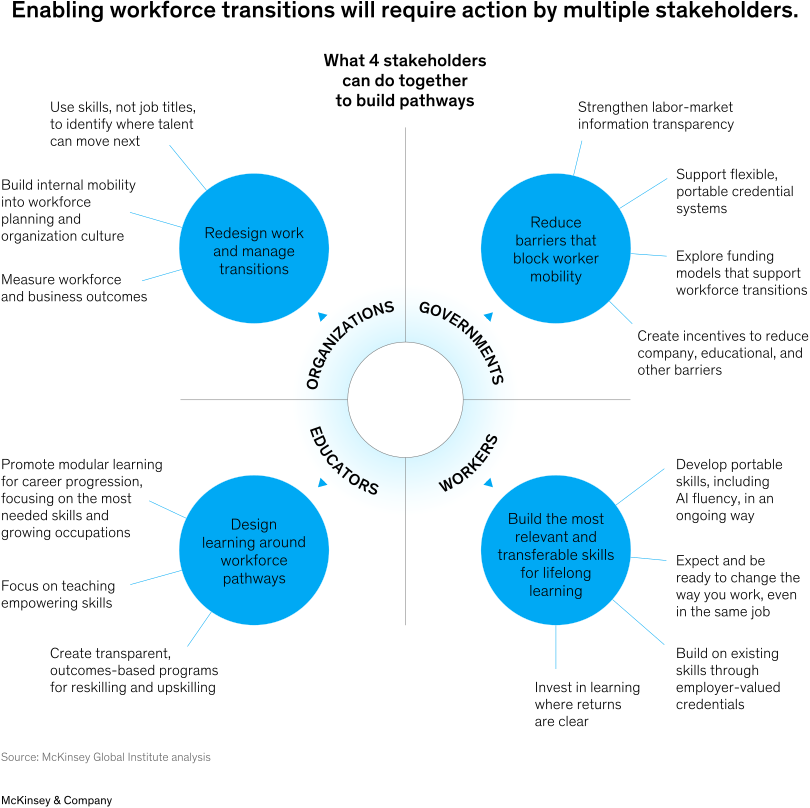
Implications for companies
As AI reshapes workflows, it also changes the demand for work and skills. Understanding how work is changing and identifying existing skills in their workforce38 helps organizations determine which occupations will grow or decline, which employees are equipped to move into growing roles, and when additional hiring or retraining is needed.
This increasingly shifts the focus of workforce management from job titles toward skills. Companies can distinguish between employees able to migrate quickly into growing roles, those who need targeted upskilling, those requiring longer transition pathways, and roles that cannot be filled internally.39 Companies’ culture and workforce incentives will be key determinants of the skills employees develop and how prepared they are to adapt.40 Helping workers navigate those changes also requires transparent communication, structured learning, and involving employees in reinventing how work evolves in tandem with AI.41
The mechanisms for supporting these transitions will vary by company size and organizational context. For example, large enterprises may be better positioned to build internal mobility mechanisms, such as talent marketplaces, and invest in skill development, while smaller companies with less scale may rely more on skills-based hiring and external partnerships.42
Finally, workforce transitions can become a core business metric alongside productivity. Measuring redeployment, internal fill rates, and employee outcomes and not just cost savings can ensure that AI strengthens business performance and workforce resilience.43 Companies that use agile talent management programs will have an edge as skill requirements shift.
Implications for governments
Governments can’t specify the occupations that will grow, but they have a range of levers to create conditions in which workers, employers, and educators can respond more effectively to job changes. Governments can also help create incentives and support for reskilling at scale. They also often track data and have early signals of what is working or not working and of the pace of change in occupations, industries, and geographies.
Better labor-market information is one lever. Timely, granular information on growing occupations, transferable skills, training requirements, and wages can help workers identify viable pathways into growing roles, help employers make more informed workforce planning and talent management decisions, and help educators design programs that reflect current demand.44
In addition, credential systems can support more flexible workforce pathways. Modular and stackable credentials, which allow smaller qualifications to accumulate toward broader credentials, and formal recognition of prior learning can help make pathways more direct and help maintain professional standards.45 Governments can strengthen collaboration between employers and educators in designing these systems, helping ensure that credentials remain aligned with labor-market needs.
The way workforce transition programs are funded also matters. Policy approaches in different markets include public funding that can help workers pay for training, replace lost income, and combine learning with employment.46 Some governments also direct funding toward programs with demonstrated employment outcomes, including sustained employment and placement in growing occupations. The effectiveness of these approaches depends on program design, implementation, and local labor market conditions.
Finally, governments can reduce practical barriers to make otherwise viable transitions possible. Housing, transportation, childcare, relocation support, and regional development policies shape whether workers have access to opportunities in new geographies.
Implications for educators
Educational institutions cannot simply expand existing programs to address the workforce impact of AI. Training can instead be designed backward by identifying the skills needed in a growing occupation, the capabilities workers already possess, and any gaps that must be closed.47 The goal is to build more direct pathways from today’s jobs to tomorrow’s opportunities by helping workers develop and signal the skills employers increasingly value.
This requires more flexible, demand-driven learning models and close collaboration with employers to ensure that training reflects evolving labor-market needs. Short-cycle programs can support transitions where skill gaps are narrow, while longer pathways are essential for professions requiring extensive preparation. Modular and stackable credentials help workers build capabilities progressively throughout their careers rather than treating education as a one-off event.48 Equally important, educators can publish outcomes including employment rates, wages, and career progression so workers can make informed decisions about investing their time and effort.49
Implications for workers
Workers will increasingly need to build new skills as occupations evolve and demand shifts from old jobs to new ones. Even workers who remain in the same occupation will need to continually update their skills as AI reshapes work, making ongoing upskilling, not just reskilling, increasingly important. This demands time, money, confidence, and a belief that effort will lead to better opportunities. The time, financial, and practical demands of building new skills can be more burdensome for lower-wage workers, older workers, caregivers, and others with fewer resources, contributing to lower participation in retraining and learning new, more valuable skills.50
Successful mobility requires more than just access to courses. Workers need clear destination roles, credible future wages, and confidence that employers will recognize the skills they acquire. Learning opportunities are ideally modular, flexible, and compatible with work and caregiving responsibilities, and help workers develop empowering skills such as resilience that support repeated adaptation as work evolves. Governments, employers, and educators can reduce financial and practical barriers to participation.51 Ultimately, building a more resilient workforce will require workers to continuously develop new capabilities, but also easier ways to make investing in those capabilities worthwhile.
The future of work is not predetermined. AI has the potential to create more and better jobs, but realizing that opportunity will depend on how effectively workers can move into them. Helping millions of workers make that transition will be one of the defining workforce challenges, and one of the great opportunities, of the AI era.
Final thoughts
History suggests that major technological revolutions have ultimately created more jobs than they destroyed. Artificial intelligence has the potential to do the same, but only if people have what’s needed to perform the work it creates. The economies and organizations that realize AI’s full potential will be those that move talent as effectively as they deploy technology. Creating high-quality pathways that help workers move into new opportunities quickly will turn AI’s productivity into sustained growth and expanded prosperity.
The economic stakes are rising. Aging populations will slow labor-force growth, and rising dependency ratios mean future prosperity will increasingly depend on making better use of available talent. AI could increase productivity, but capturing those gains will depend on how effectively workers can secure jobs and master in-demand activities. In the age of AI, people and institutions matter as much as the technology itself.
That is why the quality of pathways to jobs is critical. Nearly every transitioning worker has at least one pathway into growing work. For about one in seven workers, that pathway is already direct. Other workers will likely need additional support along pathways that are more winding. Skills remain the bridge between declining and growing work but are only part of the equation. Credentials, training time, wages, geography, language, hiring practices, and access to learning determine whether a pathway that looks possible on paper is walkable in practice.
Realizing that future will require more than better technology. It will require leaders who invest in people as boldly as they invest in AI, educators who prepare learners not just for their first job but for a lifetime of adaptation, governments that help make transitions faster and fairer, and workers who continue to cultivate curiosity, adaptability, resilience, and the willingness to learn. The great workforce reallocation is already underway. Our challenge is to ensure that it becomes the next great expansion of human opportunity.
Related Articles

Agents, robots, and us: Skill partnerships in the age of AI