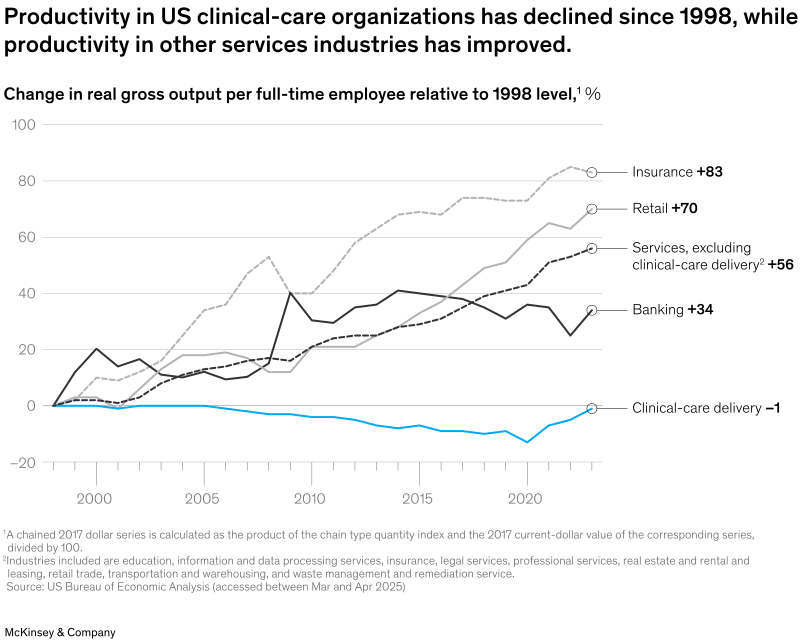
US healthcare faces a paradox. Over the past two decades, labor productivity in clinical-care organizations has declined roughly 1 percent, while productivity across the broader US services economy has increased more than 55 percent (Exhibit 1).1 In other industries, technology advances over the years have driven meaningful productivity gains by transforming entire operating models and workflows, not just digitizing isolated tasks. By contrast, healthcare organizations have long pursued incremental improvements without achieving comparable productivity gains from technology and automation.
One of the clearest examples of this transformation can be seen in warehouses, where robots deliver products directly to workers rather than workers being forced to walk miles each shift, and each task is automated in real time. The improvement is dramatic: twofold to fourfold productivity gains,2 with some warehouse operators reporting 20-fold-plus increases in output per worker over the past decade.3
Healthcare tells a different tale. The industry is automating inefficiency faster than it is eliminating it: more technology, more people, yet less output per unit of labor. US clinical-care organizations now invest more than $150 billion annually in IT,4 yet face compounding costs and margin compression. These outcomes reflect not only execution challenges but also the realities of delivering high-stakes care within a fragmented, highly regulated system. Healthcare has also long accepted that productivity improvements are fundamentally limited by the labor-intensive nature of care delivery.5 For the first time, however, AI creates an opportunity to redesign how care is delivered and how shared services function, overcoming the historical barrier linking labor inputs and output.
The future of work in healthcare, therefore, should not be a technology story alone. It must be a story of operating-model transformation enabled by technology. Improving margins, as well as enhancing patient access, experience, and outcomes, will require substantial labor productivity gains across clinical-care organizations, far beyond what incremental improvements from point solutions or isolated pilots can deliver. Instead, interventions that provide 40 to 50 percent end-to-end improvements in processes and functions are needed, based on our experience.
What does it take to rewire an operating model?
To achieve meaningful productivity gains, clinical-care organizations need to rethink both care delivery functions and shared services.
Commit to a bold redesign of care delivery
Over the past two decades, US clinical-care organizations have expanded their workforce steadily at approximately 2 to 3 percent annually, adding more than five million clinical roles.6 Yet increased hiring has not translated into commensurate improvements in access.7 The system’s primary constraint is not workforce capacity; rather, it is the absence of a model for how care delivery work should be done.
Organizations need to take a different approach to lead in process redesign and AI enablement. For example, in a medical surgical unit, a substantial share of routine tasks (such as documentation, care coordination, and nonessential administrative steps) can be eliminated, automated, or reassigned. In the traditional care delivery model, a 25-bed medical surgical unit would have roughly one registered nurse (RN) for every five patients, along with one patient care technician (PCT) for every ten to 15 patients.
A redesigned model could allow for fewer RNs needed per patient and more lower-licensed clinical staff like PCTs. And instead of relying solely on in-person roles, the future state could incorporate virtual RNs shared across units and tools like ambient documentation. This would allow teams to redistribute work, operate more efficiently, expand care, ensure care quality, and adapt to hourly patient volume fluctuations. Caregiver satisfaction and sense of purpose also deepens, with some systems seeing first-year RN turnover fall by more than 60 percent.8
Organizations that transform their care models can see labor cost improvements that exceed 20 percent, in our experience. These gains, however, only emerge from the coordinated redesign of workflows, technology, and staffing. Implementing isolated changes, such as adding point solutions without redesigning care processes or adjusting staffing models, can instead reduce productivity, increase caregiver burden, and create new workforce challenges, limiting or even reversing the intended benefits.
Make shared services work for you, not the other way round
Redesigning clinical-care delivery is only part of the equation. You cannot run a top-of-license clinical model on a bottom-of-license shared-services system. For example, many human resources business partners spend substantial time on administrative tasks such as resolving payroll errors and processing transactions, rather than focusing on higher-value work such as workforce strategy and talent planning. So what does it mean for shared services to operate at the top of their license?
Historically, organizations improved shared services productivity by offshoring or outsourcing back-office functions to lower-cost labor markets. Today, organizations are instead standardizing processes, centralizing fragmented work, and embedding AI and automation directly into operations. The result, our experience shows, is improved productivity that can lower costs and enhance control of processes, accelerate decision-making, and keep strategic capabilities and value creation closer to the enterprise.
The stakes are high. Administrative functions account for 15 to 25 percent of spending,9 and US health systems employ roughly twice as many administrative staff as physicians and nurses combined.10 While up to 50 percent of administrative work can now be automated, one reason most organizations fail to realize the benefits of automation is because they layer AI onto broken, antiquated workflows.
The solution takes three forms. First, organizations must solve for the work of tomorrow, not today. For example, rather than relying on fragmented workflows and human-led processing, leading organizations are redesigning the HR function around autonomous, AI-enabled workflows supported by humans. Routine activities such as candidate screening, initial interviews, onboarding tasks, and employee inquiries are increasingly executed by AI agents, allowing HR teams to focus on accelerating skills development, building an adaptive talent ecosystem, and strengthening culture.
Second, systems must eliminate unnecessary work before automating a process or domain. In revenue cycle management (RCM), routine activities such as payment posting and appeals management are increasingly being targeted for automation so that human teams can focus on exceptions and complex payer interactions. Organizations typically begin by deploying agentic workflows in lower-risk back-office functions before expanding across the broader revenue cycle to move toward a more touchless, end-to-end operating model. In our experience, the payoff is transformational: up to 40 percent productivity gains, faster cycle times, and a materially leaner, faster, and more resilient RCM operation.11
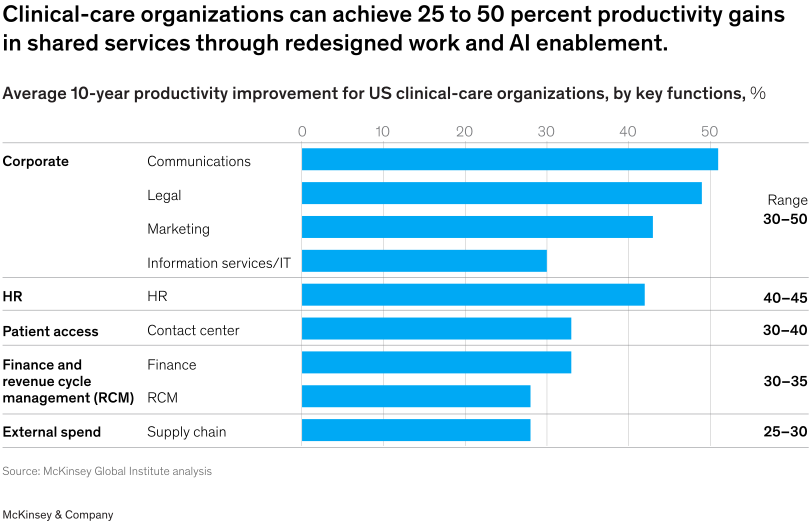
Finally, shared services must support the patient journey in a more integrated way. Patients often navigate fragmented systems across scheduling, billing, referrals, and care delivery. In the future model, these functions become managed through continuous, concierge-like navigation layers. Intelligent agents proactively guide patients across administrative, clinical, and financial workflows, while financial specialists step in for more complex or high-touch interactions. According to McKinsey Global Institute analysis, the result is a more seamless patient experience alongside materially lower administrative burden and operating costs, as well as improved productivity (Exhibit 2).
How can roles and skills be redefined for the workforce of the future?
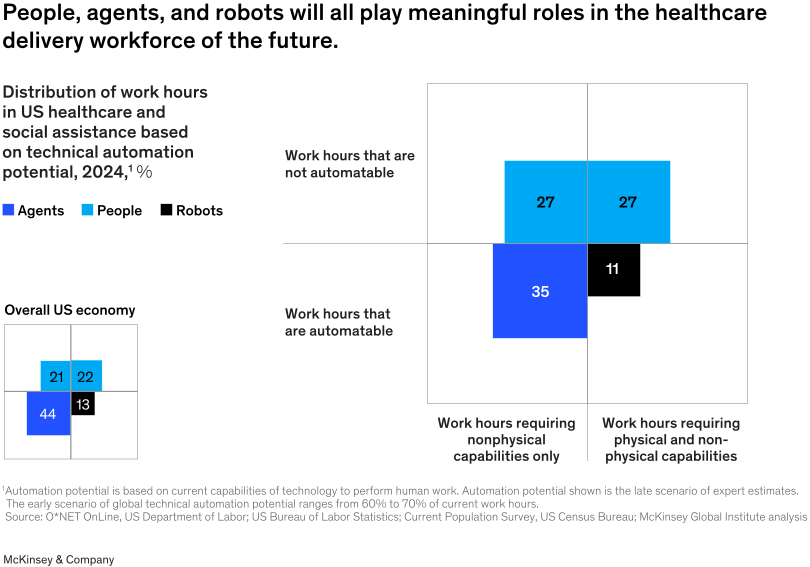
Automation, agentification, and corresponding workflow change alone will not alter healthcare’s economics. Removing 20 percent of tasks from a role rarely removes 20 percent of the costs. In most cases, the employee is redeployed to focus on top-of-license work, and the organization also incurs an added technology expense. That’s because very few roles are automatable end to end (Exhibit 3). Most jobs sit in the middle: Some tasks can shift to agents or other forms of automation, while others require clinical judgment, human coordination, and contextual decision-making. That distinction matters. Partial automation creates capacity, but it does not immediately change the cost structure.
While some workforce displacement is likely, healthcare continues to face shortages in many critical roles. Organizations that redesign work effectively can use AI-enabled productivity gains to reduce administrative burden, improve workforce sustainability, and reallocate capacity to higher-value patient care and coordination. Done well, this can expand access, improve patient outcomes and experience, and increase clinician satisfaction by enabling more time for direct patient care.
Capturing value requires a more fundamental redefinition of roles. As automation removes routine tasks, the remaining work must be reallocated into broader, higher-value roles. In ambulatory care, the future operating model cannot continue to rely on fragmented handoffs among patient service representatives, medical assistants, financial navigators, and social workers. As intelligent agents increasingly absorb routine scheduling, billing, referral, and coordination activities, organizations can instead consolidate these responsibilities into an integrated role, such as a care continuity partner (CCP), who serves as the primary coordinator across the patient journey and is empowered by technology to deliver more personalized, predictive, and human-centered outcomes.
Enabled by AI, CCPs could coordinate across clinical and operational teams, resolve escalated barriers to care, and serve as the trusted human relationship throughout the patient experience. In effect, CCPs could become the human control layer for an AI-enabled ambulatory operating model. Consolidating care coordination, financial navigation, and social support into a single redesigned role has the potential to increase productivity, lower no-show rates, improve prior authorization accuracy, and extend clinician capacity—without adding licensed full-time equivalents.
But reshaping roles is only part of the equation. Capturing value requires new capabilities in human judgment, cross-functional collaboration, and human–AI orchestration. It also raises expectations for managers, who must direct and evaluate both AI agents and human teams.
Productivity gains must translate into structural changes in staffing, organizational layers, and spans of control. Without those changes, organizations simply add technology on top of existing costs.
What turns urgency into enterprise action?
Where leaders start matters as much as what technologies they deploy. Most organizations move too quickly to automation, piloting tools across fragmented workflows and expecting material improvement. That rarely works.
Success requires three leadership choices: defining the ambition by deciding where to act, how bold to be, and what level of performance improvement justifies investment; aligning capabilities to that ambition by rewiring care delivery and shared-services workflows and redesigning roles around human–AI collaboration; and establishing accountability for outcomes, workforce redesign, and cost reduction. Without translating productivity gains into new roles, skills, staffing models, and ways of working, organizations will struggle to realize sustainable value. Without those choices, AI will not fix a broken system; it will scale existing inefficiencies.
The gap between leaders and laggards in AI enablement will not close over time—it will widen quickly and perhaps irreversibly. In healthcare, those that succeed will not be the organizations experimenting with the most AI tools. They will be the ones making bold strategic choices about where AI can reshape the operating model12 and moving with the speed, discipline, and accountability to realize the value at scale.