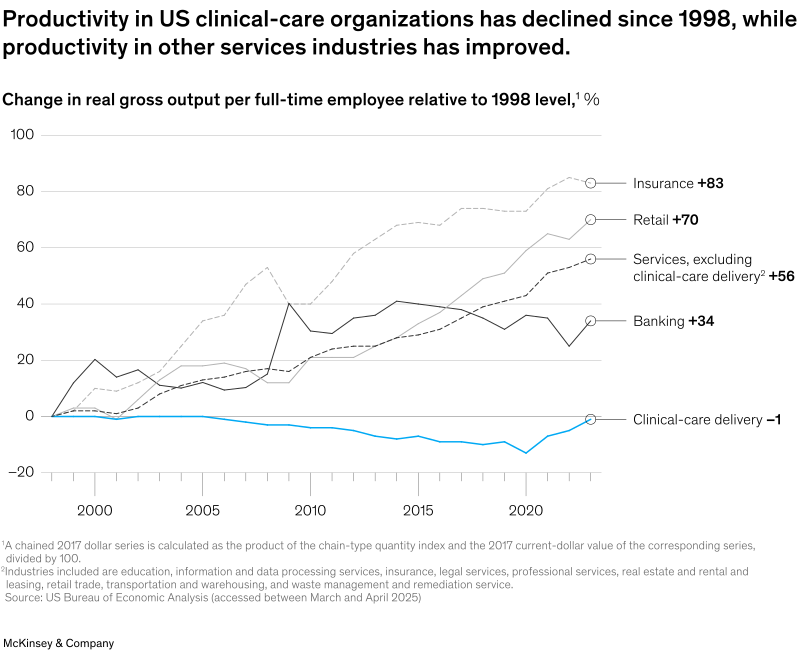
Over the past two decades, most service industries have grown more productive. Health systems have not (Exhibit 1).1 Labor shortages, administrative complexity, an aging population, and evolving regulatory dynamics have created structural challenges that traditional efficiency improvements can no longer offset. The result is an untenable dynamic: health systems working harder but achieving less financial breathing room.
AI offers health systems an opportunity to change their productivity trajectory. But health systems have not yet seen transformational value creation from AI, and the impact has been limited to select use cases, such as coding, appeals, and ambient listening. In the Q4 2025 McKinsey US Gen AI Healthcare Survey, 50 percent of healthcare leaders report that their organizations have already implemented gen AI, but only 45 percent of them have quantified the return on investment.2
That’s because, to date, many organizations have looked at AI with a bolt-on mindset rather than a transformation mindset. The consequence is a proliferation of point solutions and pilots without the integration or scale required to create enterprise value. Health systems aren’t struggling to adopt AI—they’re struggling to get value from it. The issue isn’t access to technology; it’s how that technology is being applied.
What’s becoming clear is that realizing AI’s full value requires a fundamental rethinking of how work gets done with AI. It demands an overhaul of an organization’s operating model, led from the top, and a reimagining of entire workflows or domains with AI at the core. CEOs must motivate their organizations to confront chronically challenging issues head-on and move beyond incremental fixes. This requires assembling and empowering cross-functional teams composed of frontline workers, technologists, subject matter experts, designers, and product owners to redesign workflows end to end around outcomes that matter to patients, caregivers, and the enterprise, rather than around legacy structures.
The question is no longer about where to deploy AI, but where to fundamentally change the operating model—and how to mobilize the organization to do it. Health systems that make this shift are beginning to convert AI from a fragmented of experiments into a compounding source of enterprise value. Those that don’t risk mistaking activity for progress.
For health system CEOs, the agenda is practical and knowable. When CEOs set a bold ambition, focus on priority domains, and apply McKinsey’s rewired approach to transforming workflows in collaboration with frontline leaders, value will begin to compound for patients, caregivers, and the enterprise.
The health system CEO’s guide for AI impact
While health systems are at different stages of AI maturity, our experience suggests there is a recipe for realizing value, based on the success we have seen in other industries.
Establish CEO conviction and shape the ambition
AI success starts at the top. CEOs must prioritize AI and broadly communicate its role as a tool to enable enterprise ambition, versus treating AI as a stand-alone initiative. That tone from the top should align capital allocation, governance, and talent around a unified ambition. Without a bold vision and sustained sponsorship, AI efforts remain fragmented and incremental, limiting their impact. And while every organization is unique, health systems face a rather consistent set of headwinds and imperatives for differentiation. CEOs can focus their organizations on simple and bold outcomes that are enabled—but not solely defined—by AI.
Prioritize the right domains and rewire them end to end
To date, most health systems have focused on AI point solutions that address specific pain points, rather than rewiring entire workflows. For example, using gen AI to handle drafting appeal letters is useful, but it falls short of the value from building coordinated AI agents to address all sequential tasks across back-end revenue cycle management (RCM), from claim submission through to cash posting and reconciliation.
Rather than fragmenting investment across a smattering of use cases, health system CEOs should start by picking one or two high-value domains based on the value they create for the organization (including and beyond potential financial impact) (Exhibit 2).
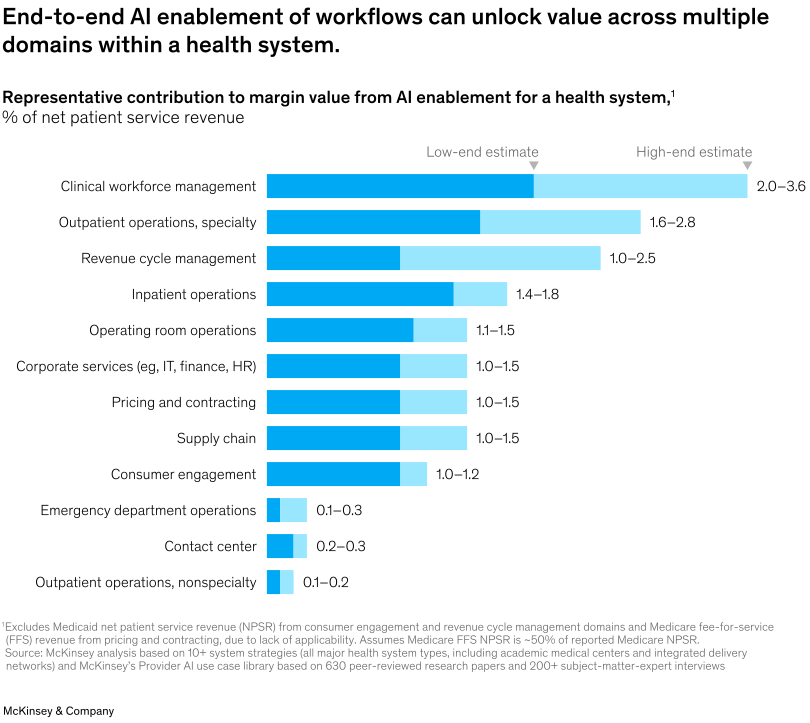
However, capturing this level of impact requires end-to-end transformation of all referenced domains; as such, most health systems can start by prioritizing a subset of domains. The back-end of RCM and the supply chain could be potential smart entry points (see sidebar, “Reimagined workflows”), as each comprises a series of tasks with many handoffs and limited clinical risk. Transforming domains end to end around AI from the outset—rather than trying to retrofit AI into preexisting, legacy processes—entails fully redefining what work is required and rebuilding roles, processes, and technology to do just that. Over time, health systems can extend this approach to more complex workflows, such as care access and workforce management.
Set guardrails up front, but build foundations iteratively
Speed to impact depends on a more pragmatic approach to both technical foundations and governance. If health systems wait for the perfect data foundation, infrastructure, tooling, et cetera, they risk delaying progress indefinitely. Reusable data and infrastructure are important, but they can be built as needed for the prioritized domains. This approach not only delivers results sooner but also strengthens foundations by grounding them in real-life business needs as opposed to building them in a vacuum.
Overall governance and risk management are different. Health systems should set up a simple set of guardrails and processes up front, so that everyone involved understands what the health system stands for and what will and will not be done with AI. Rather than prescribing rigid rules, governance should articulate a cogent philosophy, with guardrails and processes for evaluating applications. AI is changing so quickly that this more nimble approach will be more efficient and ensure consistent application of a health system’s principles.
Break the siloes and enable cross-functional teams
Technology alone cannot transform healthcare. Rather, success hinges on how health systems mobilize their people to work differently and work together. It’s not simply about changing who does the work or what tools they use. Instead, workflows need to be fundamentally redesigned, and core processes must be modernized.
This can be achieved by standing up cross-functional product development “pods” for each domain. These pods bring together a mix of designers, end users, subject matter experts, and technologists from across the organization to deliver reimagined processes. Each pod is empowered to pivot and redeploy talent as learning emerges. Business leaders make the best pod leaders, or product owners, because they are focused on the required business outcomes and understand the underlying issues and process nuances; with the right mindset, they can learn the technology. Product owners are accountable for prioritization, resource allocation, shaping process design, and measuring value.
Measure constantly and reallocate dynamically
Each pod should have performance metrics for both the near and long term. These metrics should be reported quarterly to the executive team, including the CEO. Each domain’s metrics should focus on those that correlate with value creation for that domain. For example, in RCM, these value drivers could include improved accuracy of clinical documentation, reduced cost to collect, yield improvement, and cash acceleration. Long-term KPIs should measure outcomes tied directly to the value drivers (for example, 10 percent reduction in cost to collect), while short-term KPIs should track progress on actions required to achieve those long-term outcomes (for example, 20 minutes saved per appeal letter). As another example, consider the care and case management domain, which includes key value drivers such as reduced hospital readmissions and fewer unnecessary emergency room visits. Relevant near-term KPIs could include the share of admissions with a completed care transition assessment, the proportion of patients with medication reconciliation completed within 48 hours of discharge, the percentage of patients with a follow-up visit scheduled within seven days of discharge, and the share of acute exacerbations predicted at least two weeks in advance.
Not every initiative will work perfectly from the outset, and underperformance should be addressed promptly. A key part of the CEO’s role in driving this transformation is setting expectations for pace and progress. With these expectations established, pod owners are empowered to act decisively when KPIs aren’t being met, whether by removing barriers, stopping work, or pivoting quickly. This approach builds momentum, enables rapid experimentation, and allows teams to fail fast, learn, and redeploy top talent to the highest-yield opportunities.
Build AI fluency across the organization
In parallel to the above steps, health systems can build AI fluency across leadership levels, starting with the CEO and cascading through executive teams, middle management, and frontline workers. The CEO sets the vision and signals ambition while offering tangible training and creating space for experimentation. This enables the organization to create sufficient AI fluency so that every employee has the potential to spot opportunities and collaborate effectively with technologists.
Finally, AI adoption requires strong, organization-wide change management, grounded in a rationale for change that inspires a shared understanding of the importance of the transformation. It also demands consistent role modeling from leaders and the ability to build AI fluency. Financial and nonfinancial incentives can further reinforce desired behaviors and accelerate adoption. This is especially important in the early phases of implementation, when the potential to revert to legacy processes and the status quo at the first sign of obstacles is high. It’s in these times that cross-functional product teams can inject momentum and help sustain the transformation.
A moment for CEO leadership
Capturing AI’s full value in healthcare is a leadership challenge, not a technical challenge. The tools are ready, but realizing their value demands vision, resolve, and sustained focus from the top.
Health system executives who move now to anchor AI in business transformation rather than experimentation have the potential to reverse the sector’s productivity decline, sustain quality as healthcare demand rises, and redefine what efficiency means in healthcare. Those who wait risk finding themselves outpaced by health systems with meaningfully lower administrative and operational costs, a competitive gap that will be difficult to close.
The imperative is clear: Treat AI not as an initiative but as a new way of operating. Health systems that do so will not only survive the industry’s financial pressures, but they’ll also shape the future of care delivery itself.