People are living longer than ever before, but those extra years are increasingly spent in poor health. Over the past six decades, every additional year of life expectancy gained has come with roughly six more months lived with illness or disability. Despite decades of progress in medicine, health systems have struggled to convert longer lives into healthier ones. At the same time, demographic change is accelerating the urgency of the issue. By 2040, nearly 15 percent of the global population will be aged 65 or older, up from about 10 percent today.
This has led to increasing attention on health span: the years of life spent in good or great health, free from serious disease or disability.
What are the drivers of health span?
Get to know and directly engage with McKinsey’s senior expert on health span
Lars Hartenstein is a partner at the McKinsey Health Institute based in McKinsey’s Paris office.
Many drivers of health span are already well understood. Factors such as nutrition, physical activity, sleep, stress, and social connection play a central role in shaping long-term health outcomes, alongside broader environmental, behavioral, and socioeconomic conditions. Together, these drivers explain much of the gap between longer lives and healthier lives, highlighting that health span is shaped not only by medical care, but by the conditions in which people live, work, and age. Over time, the cumulative effects of these conditions manifest as chronic, age-related diseases, linking everyday behaviors and environments directly to long-term health outcomes and societal burden.
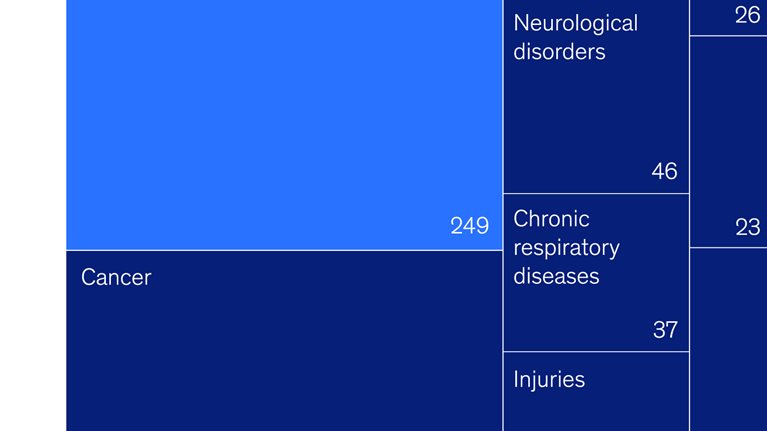
Noncommunicable diseases are responsible annually for approximately 46 million deaths and 768 million years lived in poor health. Age-related diseases, including cancers, neurodegenerative conditions such as Alzheimer’s disease, and musculoskeletal disorders such as arthritis, account for roughly one-third of the total global burden of disease.
McKinsey Health Institute (MHI) estimates that addressing even half of this burden could unlock approximately $2 trillion in annual global GDP, largely through a healthier, more productive adult population that is able to remain active in the workforce and society for longer.
For leaders, this shifts the conversation from understanding the problem to deciding how to act. While many drivers of health span are already well understood, translating that knowledge into meaningful gains requires broader action.
What are paths to improving health span?
In practice, there are two complementary paths to improving health span: one focused on applying what is already known to deliver population-level impact today, and another focused on expanding what may be possible over time through advances in science and research.
Metabolic health: One of the most powerful near-term levers for improving health span lies in metabolic and cardiometabolic health. Rather than focusing narrowly on obesity treatment alone, approaches that prioritize prevention and the management of cardiometabolic risk over a lifetime can deliver substantially greater impact. MHI estimates that improving metabolic health at scale could yield health benefits three to four times greater than a treatment-only focus on obesity and generate up to $5.65 trillion in annual GDP uplift by 2050, equivalent to roughly 3 percent of total global GDP.
Health span science: In parallel, scientific understanding of aging is advancing rapidly. Over the past decade, researchers have identified a set of core biological processes that contribute to aging, often referred to as the “hallmarks of aging,” opening new possibilities to target age-related decline at its roots. Investment in health span science has quadrupled over the past decade, and clinical trial initiation has grown by 27 percent over five years, resulting in a pipeline of several hundred drug candidates.
While these advances are promising, most remain in the early stages of development. Their long-term impact will depend on continued progress in biomarkers, clinical translation, and regulatory pathways. Health span science therefore represents a complement to population-level prevention, expanding what may be possible over time, rather than replacing what can be done today.
Why is health span important for society?
Improving health span is no longer solely a healthcare challenge, but a strategic, economic, and societal priority with direct implications for workforce participation and fiscal sustainability. As populations age, responsibility for health outcomes broadens beyond just healthcare providers, encompassing employers, educators, urban planners, policymakers, health systems, and communities, too.
For leaders, the opportunity lies in combining what can be done today at scale with what is emerging through science and innovation. Population-level prevention, particularly through improved metabolic and cardiometabolic health, offers the most immediate gains, while advances in health span science expand what may be possible over time.
Across both approaches, data and technology play an enabling role. Advanced analytics and AI can help accelerate research and development, improve the efficiency of clinical trials, and support more personalized approaches to prevention and care. Digital tools, wearables, and virtual companions also offer new ways to help individuals sustain healthier behaviors over time. These capabilities are most effective not as stand-alone solutions, but when embedded into broader prevention strategies, health systems, and everyday environments.
Leaders who take this comprehensive view, integrating prevention at scale, advances in science, and enabling technologies, will be better positioned to extend healthy years of life and strengthen societal resilience. Closing the gap between longer lives and healthier lives will require coordinated action across sectors, making health span a shared responsibility and a defining leadership challenge of the coming decades.
Articles referenced:
“The health of nations,” February 18, 2026, Alex Beauvais, Brad Herbig, Matt Wilson, and Pooja Kumar
“Health span science may enable healthier lives for all,” August 29, 2025, Chris Anagnostopoulos, Hemant Ahlawat, Lars Hartenstein, and Rachel Moss
“Dependency and depopulation? Confronting the consequences of a new demographic reality,” January 15, 2025, Anu Madgavkar, Marc Canal Noguer, Chris Bradley, Olivia White, Sven Smit, and TJ Radigan
“From crisis to catalyst: Investing in addressing noncommunicable diseases,” September 17, 2025, Alex Beauvais, Brad Herbig, Matt Wilson, and Pooja Kumar
“Generative AI in healthcare: Adoption trends and what’s next,” July 25, 2024, Jessica Lamb, with Greg Israelstam, Rahul Agarwal, and Shashank Bhasker
“Adding years to life and life to years,” March 29, 2022, Erica Coe, Martin Dewhurst, Lars Hartenstein, Anna Hextall, and Tom Latkovic
“The secret to great health? Escaping the healthcare matrix,” McKinsey Health Institute, December 20, 2022, Lars Hartenstein and Tom Latkovic
Related Articles
Stayin’ alive and well

Healthy Longevity