Over the past two years, progress in the realm of AI has been nothing short of stunning. As recently as 2024, gen AI was just beginning to enter the enterprise, but today, AI agents bloom like wildflowers. Multiagent systems, at that time untested at scale, have since evolved to transform complex workflows. Significant investments in AI continue to fund advancements across all organizational layers.
Though AI’s promise may be closer than ever to fruition, businesses face a growing paradox. Despite rapidly accelerating adoption, enterprise-wide impact has not kept pace. This gap is particularly significant for banking: McKinsey’s Global Banking Annual Review 2026: Precision with speed found that banks end up spending more on technology than the next four sectors combined. Yet banking continues to face challenges in translating that investment into productive growth.1
For bank leaders, the results demand an attack plan that is both more vigorous and nuanced. In short, we see the chief executive’s task as reshaping the bank and fostering an operating model that regularly translates AI investment into enterprise value that can be enhanced and compounded with each new application. In this article, we examine why AI adoption is outpacing enterprise value in banking. We identify four critical gaps holding institutions back. We then set out the steps leaders can take to transform legacy banks into the “AI-first” banks of the future: setting clear strategic direction, establishing value discipline, building reusable enterprise AI “capital,” and redesigning how employees and AI work together.
Four gaps are trapping AI value inside banks
Banks have moved well beyond AI experimentation, but impact often fails to scale. Why? One clear pattern we see is that as deployments multiply, gains stay trapped inside individual functions and don’t bridge to enterprise performance. Four structural gaps are the primary culprits.
A value gap
Many banks we observe cannot trace their AI investment to enterprise outcomes, directing investment away from the highest-impact opportunities. This is typically due to three factors:
Redesigns come up short. McKinsey’s 2026 State of AI Survey found that nearly nine in ten organizations now use AI regularly in at least one business function, and 44 percent are scaling AI across the enterprise, up from 38 percent a year earlier.2 Yet only 37 percent report any positive enterprise-level earnings impact from AI, essentially unchanged from 2025. Just 6 percent qualify as AI high performers3 generating significant value. Many deployments fail to redesign business processes end to end. AI benefits fragment across functions and fail to deliver enterprise-level financial impact.
Banks spread their bets too thin. Our analysis found that a relatively small number of high-leverage opportunities can account for 70 to 80 percent of the AI value at stake in a typical bank.4 Yet many institutions continue to spread investment across dozens of initiatives. Capturing disproportionate value requires concentrating investment, leadership attention, and scarce talent behind a limited number of enterprise transformation bets. Without this concentration, banks risk accumulating a broad portfolio of incremental improvements without generating enough impact in any one area to materially change enterprise performance.
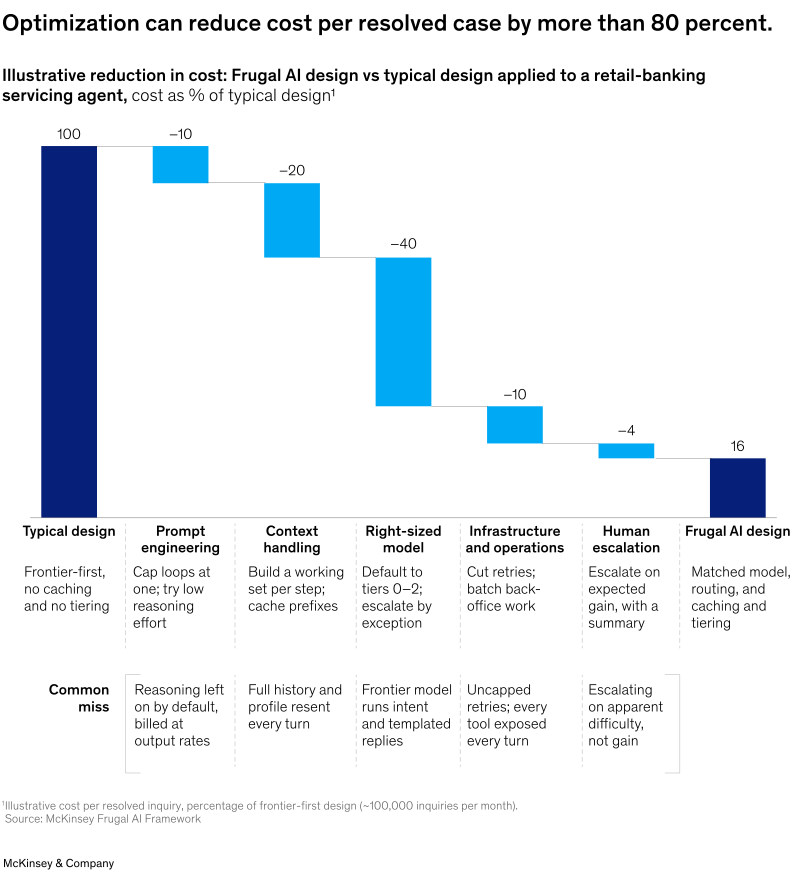
AI economics lack an enterprise perspective. AI introduces a different economic equation for banks. Costs extend beyond model usage to include orchestration, infrastructure, monitoring, retries, human review, and the growing number of model calls embedded within agentic workflows. The 2026 State of AI Survey found that one in five organizations is constraining AI use because of operating costs. At the same time, 60 percent expect AI investment to increase over the coming year, with banking and other financial institutions among the sectors most likely to anticipate higher spending.5 As deployment scales, banks face critical design choices that are easy to overlook but can materially alter returns. For example, our analysis of a retail-banking servicing agent suggests that optimizing choices on models, context, infrastructure, and other elements could reduce costs by more than 80 percent (Exhibit 1).
An intelligence gap
At most banks, a significant leap is needed to upgrade improvements at the task level to enterprise-level intelligence. Capability grows inside individual teams, but little of it becomes an institutional asset that makes the next deployment better than the last.
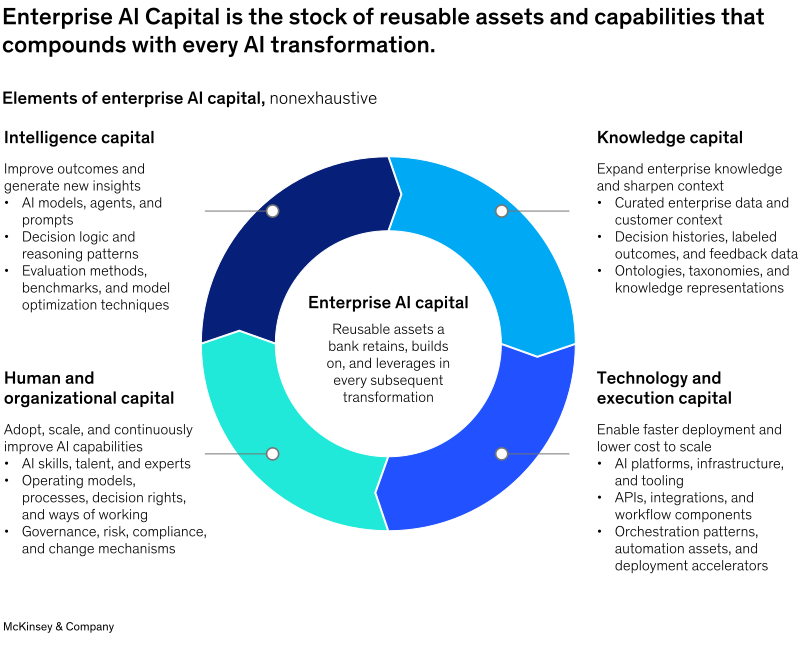
Enterprise AI capital is in short supply. What we call enterprise AI capital—a validated, reusable stock of AI assets and capabilities that make each deployment faster, more effective, and cheaper than the last—runs low across AI transformations. Many AI use cases are developed as stand-alone solutions: models, prompts, data products, and governance artifacts developed for the use case in front of the team, with no requirement to make them usable elsewhere. Each new initiative starts from scratch, resolving problems the institution has already solved, at full price and at full risk. The bank ends up owning hundreds of AI implementations and almost no enterprise AI capital. We consider AI’s unique ability to exploit this learning curve a critical tool for extracting value from cross-cutting enterprise processes (Exhibit 2).
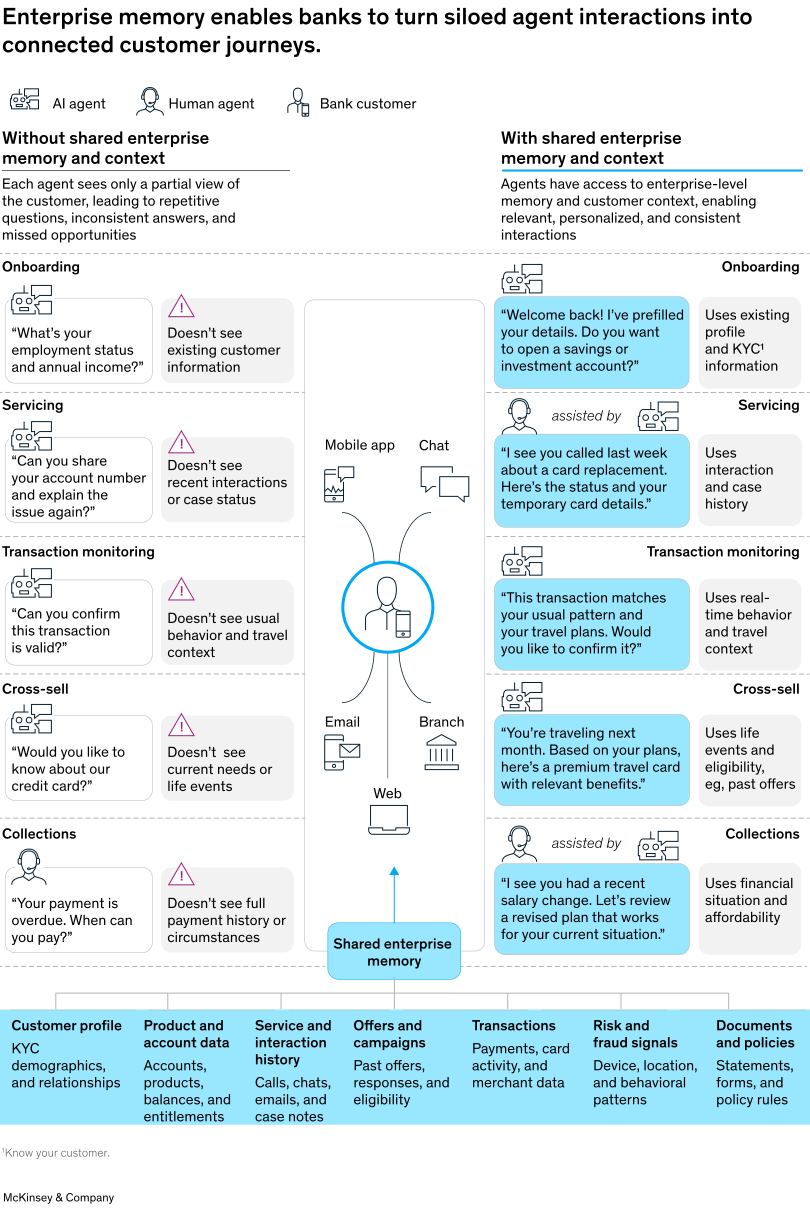
Shared context and semantics are missing. Banks hold decades of accumulated institutional knowledge across customer relationships, credit decisions, policy expertise, and operational judgment, yet much of it is fragmented across data silos or captured only in employee experience. The meaning of data is similarly fragmented across products, functions, and systems, with terms such as customer, income, exposure, delinquency, or profitability defined differently. People have traditionally reconciled these differences through institutional knowledge and judgment, but AI systems cannot reliably do so at scale. Without a governed semantic layer linking definitions, entities, relationships, metrics, metadata, and authoritative data, each AI initiative rebuilds its own context and business rules, creating inconsistent interpretations, siloed solutions, and limited reuse. Fragmented context leads to poorer customer experience and higher costs. In our experience, however, when that accumulated knowledge is orchestrated into shared language and what we consider “enterprise memory,” it creates powerful, connected customer journeys (Exhibit 3).
Learning loops are missing. AI’s real promise is capturing what it learns from every interaction. The feedback loops that carry this knowledge suffer when banks rush solutions into production without adequately emphasizing evaluation. Many deployed AI systems we’ve observed perform the same on day 300 as they did on day one. We see banks rarely capturing the signals that would make systems better—for example, which recommendations were adopted, which agent outputs required correcting, or the point at which customers abandoned a conversation. When evaluation and feedback aren’t wired into production, learning is trapped in anecdotes instead of flowing back into models, prompts, and workflows.
An execution gap
The ability to build AI solutions rapidly has come a long way. Today, the limiting factors are often a bank’s ability to redesign work, mobilize key talent, and define an operating model to absorb change.
Operating models predate agentic ways of working. Generative and agentic AI cut across functions, evolve in production, and shift parts of execution from people to systems. This creates tension for banks when cross-domain workflows lack a natural owner, funding mechanisms favor projects over products, and roles and incentives reward human throughput even as value shifts toward judgment and orchestration.
AI talent remains concentrated. Centralized AI teams help banks concentrate scarce expertise and establish common standards, but they can become a constraint when every business depends on the same limited capacity. As AI scales, capabilities must be free to move across institutional boundaries. Business teams should develop sufficient expertise to build, tune, and operate AI within enterprise guardrails while a central team provides shared platforms, standards, expertise, and reusable assets.
Banks underestimate the effort needed to redesign workflows. AI rarely delivers its full value by being inserted into existing workflows. Making the most of the opportunity often requires redesigning the processes, roles, controls, and decision rights around it. For example, an underwriting AI agent can require changes to credit policy, procedures, quality assurance, controls, interfaces, job design, audit trails, and more. Value moves at the speed of the slowest dependent change. Programs that fund AI but not the surrounding redesign should expect adoption and economics to disappoint.
A risk and governance gap
Scaling AI safely is increasingly a race between two runners: the pace at which AI capabilities advance and the pace at which banks can adapt their controls and regulatory posture. Typically, the latter has a hard time keeping up.
Governance lags behind evolving AI capabilities. AI systems are probabilistic and increasingly dynamic: Models, prompts, tools, and context can change in production, while emerging systems can adapt, learn, and potentially improve their own capabilities over time. Governance must therefore do more than keep pace with today’s AI. It must anticipate increasingly autonomous and recursively improving systems. Faster, more continuous governance and embedded risk controls are essential.
Agentic AI materially expands risk areas. As AI moves from supporting employees to acting on their behalf, the consequences of errors grow. For example, there is an important difference between AI recommending whether a loan should be approved versus autonomously making that decision itself.
Regulatory debt grows as accountability evolves. Expectations that autonomous AI decisions can be explained and accounted for and that risks can be modeled are evolving rapidly and unevenly. Today’s decisions spawn future obligations. Banks need to build capabilities to explain and justify AI-enabled decisions, even as those capabilities evolve daily.
Unlocking and expanding AI bank value
The interconnections between these gaps, combined with AI’s ability to operate across functions and controls, require bank CEOs to take a comprehensive approach to rewire their enterprises.6 We believe that six decisions will be particularly consequential in determining whether AI investments will compound into enterprise value or remain a collection of individual initiatives. The list begins with the chief executive deciding what overall mindset to adopt. Then comes translating that vision into a practical enterprise-value road map, building a compounding mechanism to ensure that each transformation strengthens the next, establishing a way to monitor and verify value gains, establishing a common enterprise AI stack, and revamping governance systems. These choices cut across the mandates of the CEO, CFO, technology organization, and business leaders. As the integrator-in-chief, the CEO’s role is central to driving this AI agenda, rather than treating it as a technology program.
Embrace a founder’s mindset
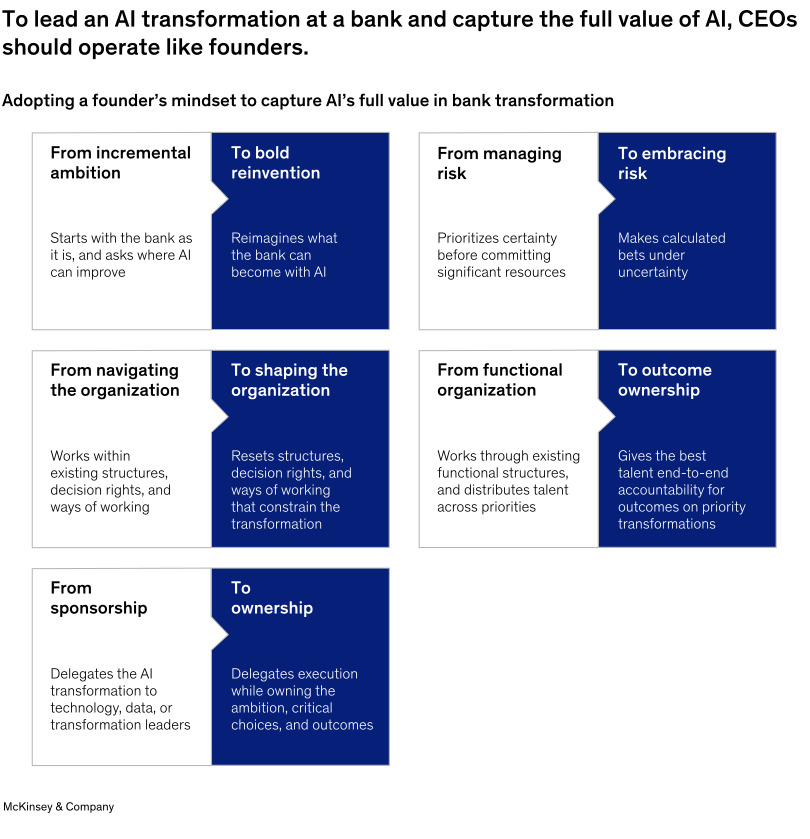
In our experience, the CEO needs to act less like the manager of today’s institution and more like an entrepreneurial founder, with a clear vision of tomorrow’s bank.
To exploit that opportunity in the service of creating value, the CEO must think and act like the head of a bank that could exist if it were built again from scratch. A CEO with a manager mindset will optimize what already exists—better budgets, faster versions of existing processes, and tighter risk controls. By contrast, a founder starts with a blank sheet and asks which capabilities would matter most if nothing were fixed in place. This mindset shift is critical: Much of a bank’s inherited characteristics, including processes and technology that cut across organizational boundaries, were drawn up years (if not decades) before anyone had AI in mind (Exhibit 4).
Consider the story of Singapore-based DBS Bank. When the bank embarked on a digital transformation in 2014 that experimented with AI to reach a new generation of tech-savvy customers, its approach was unconventional: make DBS run less like a bank and more like a technology start-up—fast, nimble, and built around the customer.7 DBS rebuilt its operating model around platforms jointly led by a business executive and a technologist, together responsible for delivering the platform’s goals. Its data-driven operating system cut AI deployment times dramatically. A fundamental rethinking of culture, measurement, and technical expertise delivered higher revenue, lower cost to serve, and higher ROE from serving digital customers over traditional customers.
Set a clear organizational purpose to orient focus, direction, and meaning
With the CEO’s vision understood across the enterprise, savvy leaders can next define a clear North Star direction for the bank, as well as AI’s role in achieving it. Without this vision, different functions—business, technology, operations, and risk—will pursue their own priorities. Efforts to materially change the institution will stall. In our experience, banks do best when they view the AI transformation through two lenses: one devoted to customers and the other devoted to employees. For example, leaders could aspire to achieve a customer experience that is more of the following:
Conversational. Conversation can become central to discovering, comparing, and executing financial services. Through a single interaction, specialized AI agents might interpret intent, retrieve customer context, assess products, and coordinate bank actions. For example, a customer who sees an unfamiliar credit card transaction could simply ask, “What is this charge? I don’t recognize it.” Within a single interaction, conversational banking could immediately explain the transaction context, answer follow-up questions on how it was authorized or whether payment is required during investigation, and clarify the dispute process and timelines, as well as initiate the appropriate action. The experience combines in one intuitive conversation transparency, real-time query resolution, and action, rather than requiring customers to navigate menus, forms, and separate service channels.
Proactive. Events, rather than requests, could build customer engagement. While this has long been an ambition for banks, AI makes it more achievable by interpreting a broader range of signals and customer context continuously, rather than relying primarily on predefined triggers and rules. AI can continuously monitor signals such as changes in income, spending, liquidity, markets, or life events; match them to customer context; and determine when engagement is constructive. Does a customer face a cash flow shortfall? Spending insights or restructuring options could be offered before stress becomes acute.
Invisible. Banking can increasingly operate in the background, with the bank authorized to take routine actions on the customer’s behalf, rather than waiting for each interaction to be initiated. For example, during an international trip, the bank could automatically enable appropriate card settings, optimize how payments are routed, adjust fraud controls to the customer’s location, and activate preauthorized protections as circumstances change.
Within the bank, guiding principles for redesigning work and decision-making should focus on three dimensions: how work gets done, how decisions are made, and how institutional intelligence accumulates. Three shifts stand out:
A hybrid workforce arises. Agentic work factories become a new unit of productivity. Work increasingly moves from employees executing discrete tasks to human–AI teams orchestrating end-to-end workflows. AI handles more routine execution, while people focus on judgment, relationships, exceptions, and orchestration.
For example, Uber is extending its agentic AI efforts beyond software engineering by embedding AI-proficient engineers with experts across business functions. Its agentic pods pair roughly 30 engineers with domain experts for a two-week sprint: The team observes the work, identifies high-impact opportunities, builds an agent alongside the employee, validates it with other users, and ships it. Uber reports that, in two months, it ran 16 pods across 16 business functions, reducing capital allocation work across 150 cities from 15 hours to 30 minutes, financial pacing reports from two days to ten minutes, and marketing web quality assurance from two weeks to 50 minutes.8
To be sure, a bank is not a rideshare app. But the broader lesson is less about productivity numbers than operating model choice. Uber makes work flow, rather than the individual task, the unit of redesign, bringing engineering and domain expertise together to rethink handoffs, decisions, tools, and human intervention. That provides an early example of how organizations can begin moving from employees using AI tools toward human–AI teams redesigning how work gets done.
Decision making becomes continuous. AI can continuously evaluate new signals, learn from outcomes, and trigger actions as conditions change. For example, credit offers can be reassessed as income or repayment behavior changes, while fraud defenses can respond as attack patterns evolve. Humans remain accountable for setting policy, exercising judgment, and overseeing material exceptions.
Enterprise intelligence becomes democratized. AI can put the bank’s collective intelligence, context, and expertise in the hands of employees across the enterprise. This enables better, more consistent decisions at every level and turns institutional knowledge into a source of competitive advantage.
Build a compounding engine
Banks typically measure an AI transformation by the value it creates in the business where it is deployed. However, that misses a second source of value: what the transformation produces that can be of use for the rest of the bank.
Consider an AI-enabled underwriting transformation. The effort may improve conversion, turnaround time, credit outcomes, or cost to serve. But those outcomes can also spawn document intelligence, verified data products, decision logic, agents, workflow components, evaluation methods, controls, and implementation know-how. Some of these capabilities can be applied well beyond the original transformation. This accumulated stock of reusable assets constitutes valuable enterprise AI capital.
Value lies in using that capital to improve subsequent transformations. Typically, each transformation creates its own unique value. In a compounding model, the bank retains what has been built and learned, makes it available elsewhere, and improves it through further use. This reusable, evolving library of capabilities can help each subsequent transformation start from a stronger base than the one that preceded it (Exhibit 5).
A compounding engine is the mechanism that makes this transfer work. It is a team of specialists that can sit within an existing enterprise AI team or transformation structure, but that requires a distinct mandate, accountable leadership, and a different scorecard. Its role is not to take delivery accountability away from business teams but to ensure that what one transformation creates and learns becomes available to the next.
For example, a bank’s personal-loan business might build an AI assistant for underwriting. The AI agent could develop capabilities to extract information from pay slips and bank statements, verify income and obligations, identify document fraud, apply credit policy, route exceptions, and maintain evidence for each decision. However, the enterprise AI capital thus gained could also be reused in mortgages, small-business lending, onboarding, and know-your-customer processes. The capability to check fraud could be applied to other customer journeys. Evaluation methods, exception patterns, and audit controls could become common assets. With each deployment, operating experience could extend and sharpen those capabilities further.
UBS illustrates one approach to turning fragmented institutional knowledge into shared intelligence. Its in-house AI assistant, Red, brings together curated internal sources, including investment research, process and product information, and fact sheets. This allows employees to retrieve and apply trusted knowledge without searching across fragmented sources. UBS says that Red has been rolled out to around 100,000 employees, supported more than 25 million queries, and saved users an average of 80 minutes per week.9
A compounding engine’s work spans the transformation life cycle. Before a build starts, the engine identifies existing enterprise AI “capital” that the team can use and determines which new capabilities could have wider application. During design and development, it works with business, technology, data, and risk teams to make those capabilities portable, with common interfaces, data definitions, evaluation methods, and control patterns where appropriate. At deployment, reusable assets are documented, assigned ownership, and made accessible to other teams. Production experience then travels back with those assets, including failures, exceptions, overrides, performance data, and realized outcomes. When the next new transformation begins, the initial query won’t be “What do we need to build?” but rather “What has the bank already built and learned?” (Exhibit 6)
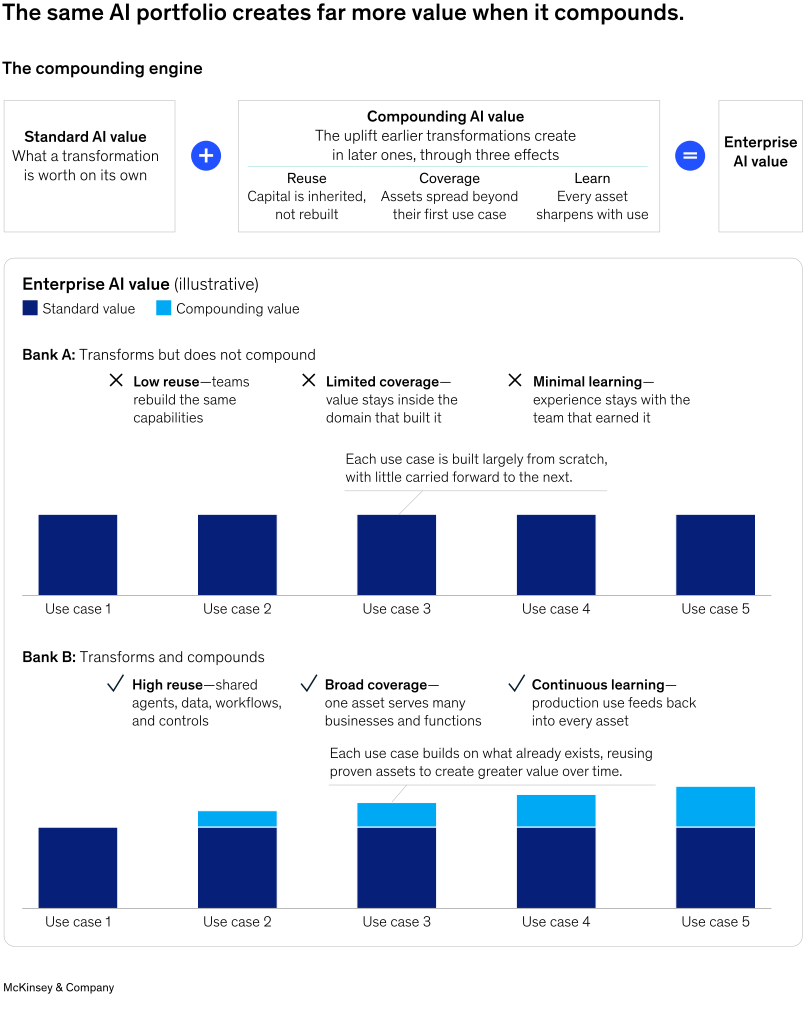
An effective engine can deliver three key insights: It can pinpoint how much a new transformation reuses assets the bank has already created, rather than rebuilding them; it can measure the reach of value-creating assets as they travel across the businesses and workflows; and it can gauge how much the production experience learns and improves the assets themselves. Customer responses, human overrides, exceptions, failures, risk outcomes, and operating performance can all inform the next version of an agent, workflow, evaluation set, or control.
The result is a different value equation. A transformation still needs to produce the revenue, cost, productivity, risk profile, or customer outcomes that justify the investment. But it can also create value by improving the economics of transformations that follow. A compounding engine’s effect on AI value creation depends on how effectively the bank reuses its enterprise AI capital, extends its reach, and improves it through learning.
Leaders will also have to change how they judge progress. Tallying the number of agents launched or reusable components cataloged won’t suffice. They’ll want to focus on measures like the share of new transformations that draw on existing enterprise AI capital, improvement in shared capabilities from production learning, and changes in the time, cost, quality, and risk profile of subsequent transformations. Leaders may pose a simple test: Is the tenth AI transformation materially better or more economical because of what the first nine built and learned? If the answer is no, the bank may be scaling AI, but it is not yet compounding value.
Establish a dedicated value-realization office
To verify that AI investments are delivering value, it makes sense to set up an office to check the bank’s AI ambitions against an explicit value plan. Where, for example, do we expect to see value? How will it be measured?10 What will the delivery cost be? The CEO and CFO will be the logical owners of goal setting and outcomes. Some best practices can help:
Make measurement and attribution part of the design. Estimating AI’s value and attributing it to initiatives is hard. Banks should define the measurement approach before deployment, establishing baselines and, where possible, comparable adopter and control groups. An AI-enabled relationship-management project can illustrate. At launch, the bank sets a baseline and defines the relevant cohorts. After three months, it tracks adoption and leading indicators such as preparation time, client interactions, and qualified opportunities. After six months, it compares conversion, products per customer, and revenue per relationship manager across groups. After 12 months, Finance converts improvements into revenue and productivity impact, deducts full costs, and measures ROI to decide whether to scale, redesign, or stop.
Track the full costs of transformations. The CFO also needs to see the full cost of an AI-enabled outcome, not merely the cost of the model. Architecture choices increasingly become economic choices, as well. McKinsey research suggests that solution architecture can have a ten to 100 times effect on reducing costs.11 Banks can reserve cutting-edge frontier models for tasks requiring complex reasoning while routing other work to smaller or specialized models. While the CFO might not be making the choice, finance leadership should ensure that economic implications are visible and periodically reassessed. The CFO can also track an enterprise-wide view of cost and value, use that evidence to scale what is and isn’t working, and take capital away from underperforming efforts. Few banks currently allocate AI investment this way.
Establish a common enterprise AI stack
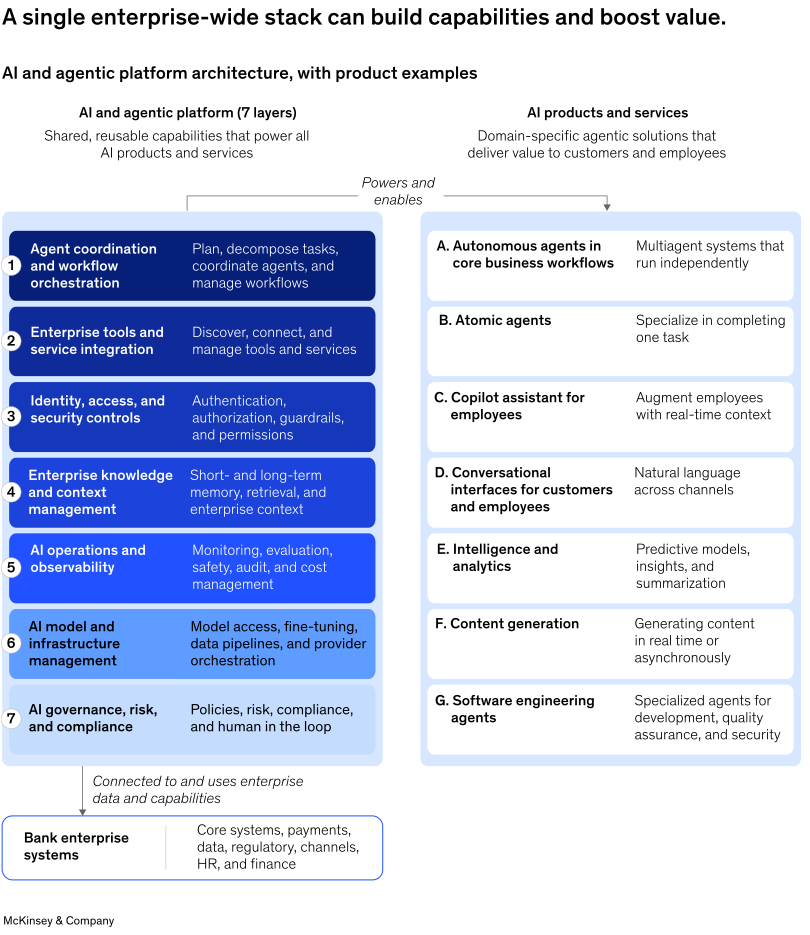
Banks need a common AI foundation to build, govern, reuse, and scale capabilities across the enterprise, rather than assembling the underlying technology for each transformation. One useful stack model might span seven capabilities, from workflow orchestration and enterprise tools to context management, observability, model infrastructure, and governance, connected to the bank’s core systems, data, payment rails, and customer channels. Controls should also be embedded into the foundation. User and agent identity, security, observability, traceability, and governance should operate consistently across applications rather than being recreated for each deployment. This becomes increasingly important as AI moves from generating recommendations to orchestrating agents and taking actions within banking workflows. The stack should also remain adaptable as technology evolves. It should support different models, providers, tools, and deployment choices as the ecosystem evolves. Clear principles on building, buying, and partnering, combined with portability and interoperability, can allow banks to access new capabilities without creating unnecessary concentration or costly lock-in (Exhibit 7).
Reimagine governance frameworks to manage risks
Finally, these shifts cannot be achieved without accompanying changes to a bank’s operating model. Decision rights, organizational structures, talent, incentives, governance, and ways of working need to support an institution that is continuously building, deploying, and learning from AI. A couple of approaches can help:
Redesign the operating model for a combined human and AI-agent workforce. This means mapping work at an activity level to determine what humans should own, what should be delegated to AI agents, and what should be performed jointly. With that allocation in hand, leaders can then redesign roles, team structures, spans of control, decision rights, handoffs, incentives, and performance measures.
Define accountability clearly as AI adoption scales. Executives need to specify where accountability resides with people, where human intervention is mandatory, what authority can be delegated to AI, and how exceptions and overrides are handled. These choices should be explicit in the design of the workflow. Governance must evolve with the operating model. Banks will need more continuous monitoring of model and agent performance, controls, and emerging risks.
Closing banking’s AI value gap calls for a different kind of leadership agenda. CEOs must pair the ambition of a founder with a clear vision for customers and employees, concentrate resources on measurable outcomes, and ensure that knowledge and capabilities developed in one transformation strengthen the next. The banks that get these choices right will not only be better positioned to close the gap between AI’s enormous potential and its economic value but also be able to redefine how banking services are delivered, how decisions are made, and where competitive advantage is created.