The past decade in the banking industry has been dominated by digital transformation. Banks are spending about $600 billion globally on technology each year, replacing old systems and introducing mobile apps and other digital tools to keep pace with evolving customer expectations and competition. But the results have been mixed.
Although banks have significantly improved their digital capabilities—for example, European banks now average 45 percent digital sales1—they increasingly struggle to maintain their primacy amid profound shifts in customer behavior and loyalty. In fact, competition among European banks for customers’ attention and share of wallet reached its highest level in 2025: Our analysis of six countries shows that customers maintained accounts at 2.6 banks on average, compared with two banks in 2021.2 Many European banks are experiencing flat or declining customer share of wallet3 (Exhibit 1).
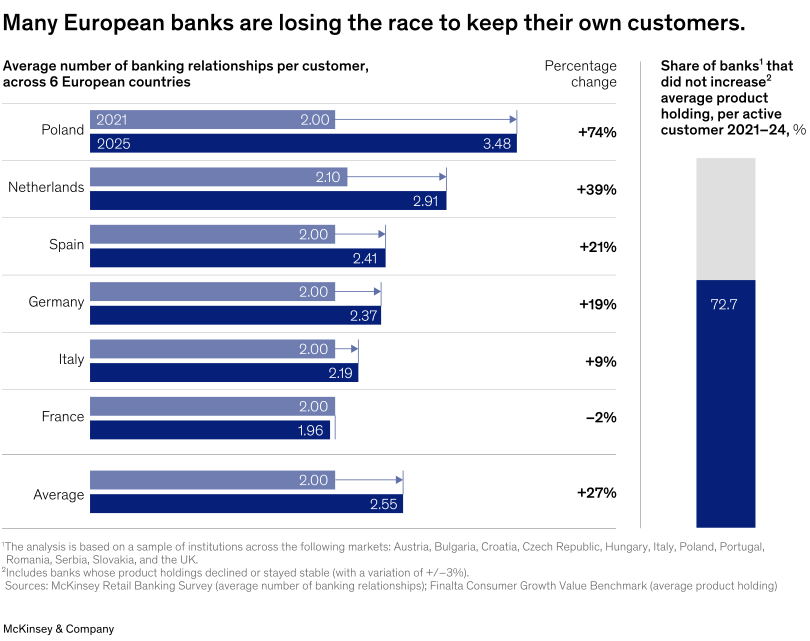
This trend is largely driven by the success of digital-first neobanks, which now attract one-quarter to one-third of customer banking relationships in some markets due to their digital capabilities, low or free pricing, strong user experience, and branding that appeals to younger customers. For example, UK-based Revolut, a leading fintech, has surpassed 70 million customers and is starting to compete for primacy with subscription offerings and a broader product set.
The greater emphasis on digitization has also increased transparency, price comparability, and commoditization in the banking industry, further intensifying the pressure on incumbent institutions. The challenge for banks over the next decade is clear: How can they win the race to keep their own customers?
Banks must move to answer this question before losing their remaining competitive advantages, such as brand recognition and rich customer data from historically primary relationships. Our work with European banks, which can be broadly applied across regions, has shown that banks should quickly adopt a stronger customer-first approach that focuses on understanding individual needs, personalizing interactions, and using AI to scale these efforts. In this article, we explore the four key components of how banks can build an AI-enabled, hyperpersonalized customer value management (CVM) model to enhance their customer relationships and retain primacy. We then outline how they can get started with this approach.
Unlocking the potential of existing customers
Banks are realizing they need to do a better job of leveraging the potential of their current customer relationships amid rising competition from traditional peers and neobanks, as well as the radical shift to digital banking. Ninety-nine percent of customer service interactions now take place digitally.4 Recent Finalta by McKinsey research shows that 69 percent of surveyed European banks prioritize “organic growth through better development of existing customers.”
Banks have significant untapped opportunities to further develop their customer base. In our analysis of 112 million relationships between customers and their banks across six European markets, 48 percent of customers held only one product with the bank, and 81 percent held two or fewer.5
Yet some high-achieving traditional banks continue to unlock greater value and capture a higher share of wallet from their customers. Banks in the upper quartile of product penetration achieve 13 percent higher balances, 5 percent higher revenues, and 22 percent higher product ownership per customer compared with their least effective peers.6
Our experience shows that leading banks are embracing AI-driven CVM models that prioritize more frequent and proactive communication. Instead of sending a few generic communications to a subset of customers every month, they now engage most of their customers regularly—sometimes daily—with personalized messages, taking a similar approach to many online retailers. AI tools can help banks understand their customers’ preferences and behaviors so they know how to tailor messages to each individual and decide what to offer, when to reach out, and which channels to use.
Banks can support this strategy by offering stronger digital experiences, especially through AI-enabled mobile apps that allow customers to manage most of their banking in one place and receive seamless support and services. This also provides banks with greater insights into consumer behavior, enabling them to better compete with fintech players.
Finally, leading banks taking this approach are changing how they run and improve their customer outreach campaigns in two key ways. First, instead of launching static, product-centric initiatives, they continuously test, learn, and refine their strategies so they can run more effective customer-centric campaigns at scale. Second, they are evolving beyond “push” campaigns (such as emails and texts) by embedding personalized content within the customer’s core product experience across the full range of “pull” channels (such as mobile apps and websites).
In our work with banks, we have found that executing these efforts well can improve customer engagement by 20 to 30 percent, customer value by 10 to 25 percent, and customer experience by 15 to 25 percent. While this approach is not completely new in the banking industry, many companies have struggled to crack the code to realize these types of gains.
Four key components of AI-powered customer value management
Based on our work, we have identified four key components of a top-performing, hyperpersonalized CVM model powered by AI: customer data and decision-making, personalized campaigns and journeys, measurement and marketing technology (martech) capabilities, and operating model and talent.
Customer data and decisioning
This component focuses on pulling together customer data, understanding each customer’s needs, and deciding the most relevant action to take, such as making an offer, sending a reminder, or providing guidance.
Many banks fail to integrate all relevant customer data—such as digital activity, previous campaign reactions, transactions, or interactions with staff—when deciding what to offer, partly because it’s costly and complex to do at scale. Leading banks instead focus on specific use cases and pull in only the types of data they need for those instances, rather than building all-encompassing data pipelines. This allows them to deliver results faster while gradually building a more complete data setup. A key caveat is to ensure that data collection and any subsequent personalization it enables should comply with applicable privacy regulations and customer consent frameworks.
Most banks already have analytical models that suggest which offer or message to send to a customer, but they are often too static and don’t generate enough volume or breadth of offers. A stronger approach is to complement the analytical models with near-real-time triggers that are based on transactions or other customer activity. Examples could include communications about lending or savings triggered by market-specific thresholds for changes in a customer’s current account balance, or messages about travel insurance triggered by flight purchases. Leading banks use hundreds of these triggers across their products and continuously test what works best, which has been shown to improve click-through rates by two to three times in our experience (table).
Banks can utilize hundreds of triggers for customer communications to improve response rates.
| Communication type | Commercial trigger | Transactional trigger |
| Websites and programmatic ads |
|
|
| Offer-based engagement |
|
|
| Product promotion and incentives |
|
|
| Loyalty program |
|
|
| Customer life cycle and retention |
|
|
While behavior-based triggers have proved to deliver value, there are other ways to generate customer interactions. These include messages related to legal or regulatory updates, offers targeted at segmented audiences, or larger campaigns tied to events or certain times of year. These help ensure that most customers receive relevant offers, even without a specific trigger.
As banks use these techniques to radically scale the volume and types of communications to their customers, they need to move away from product-led campaigning and toward customer-level “decisioning” to ensure they prioritize the most relevant “next best action” to an individual at the right moment through the right channel.
Finally, the increasing adoption of AI is making it faster and easier to deliver hyperpersonalized customer experiences. Standardized data sets and performance reports can automatically provide insights on campaign performance. Analytical AI models can generate highly targeted customer segments by combining data and insights from banks, their partners, and external sources. Agents can be set up to scan customer behavior across purchases, transactions, and other interactions with banks to identify opportunities for personalized communications.
Personalized campaigns and journeys
This component involves designing and delivering hyperpersonalized campaigns at scale and optimizing customers’ digital journeys to enable “always on” customer engagement.
We have found that a digital-first campaign and sales approach can significantly boost sales in most retail banking products, with mortgages as the only notable exception. Indeed, European banks in the upper quartile now drive 69 percent of all retail banking sales through digital channels, helping them grow market share.7
Banks are more conservative than fintechs or ecommerce firms in how often they send sales messages to customers, typically communicating three to five times less frequently, according to our benchmarking research. By using more behavior-based triggers, banks can increase their campaign volumes and loosen their limits on how often they contact customers. Based on observed implementations, banks can send up to one message every one to two days before customers start opting out at a significant rate.
In addition, using gen AI can help banks automate the production of a wide range of marketing content more quickly and inexpensively, enabling them to scale personalized communications for individual customers. In our work with banks that have used AI to create marketing content, we have seen 15 to 20 percent increases in production speed and up to 25 percent improvement in click-to-lead conversion rates. AI agents can also help automate campaign delivery by driving content workflow across gen AI engines, storage, and publishing.
When personalizing messages, banks need to create a hierarchy of elements to customize (Exhibit 2). In our work with banks, we have found that a typical email can include up to 15 personalized elements—such as the offer, images, wording, or call to action—and tailoring most of these makes the message more effective. One approach is to start by personalizing the product and its presentation, adjust the channel and timing, and then refine pricing. This can deliver incremental results while helping to build out a more sophisticated approach. AI-led insights on campaign performance can also be used by agents to dynamically optimize the placement and content of different campaign elements.
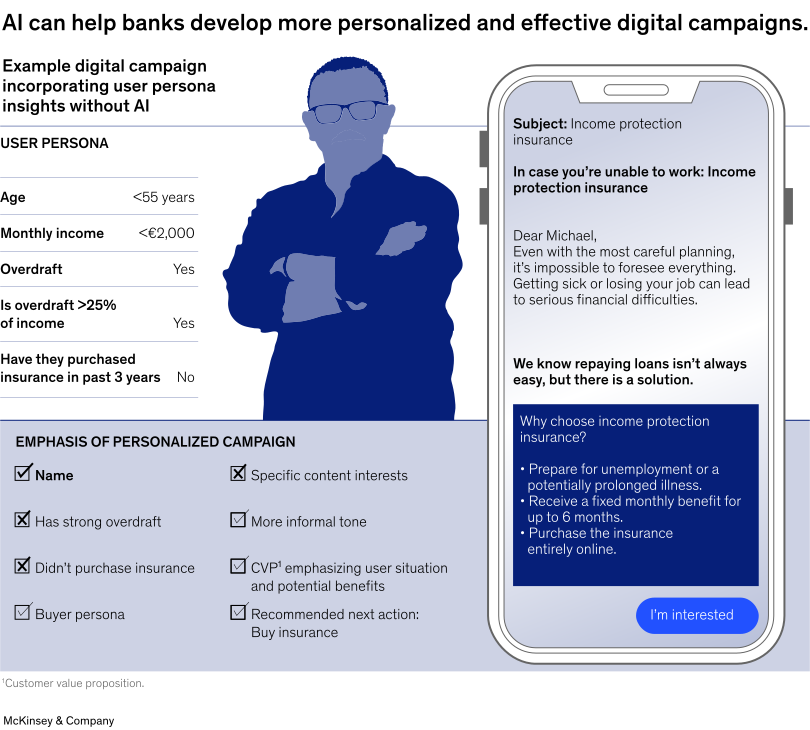
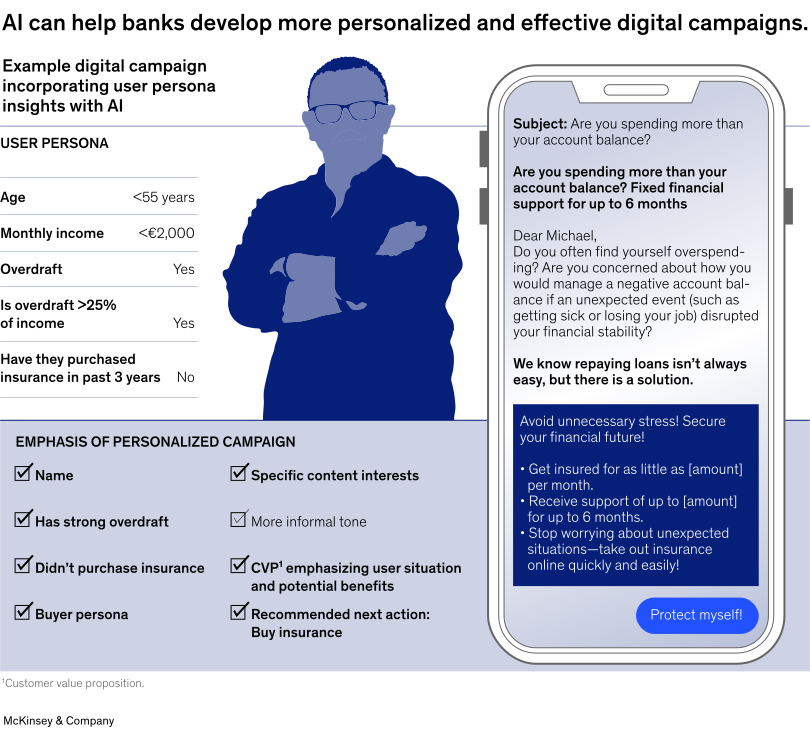
Based on observed implementation, leading banks that are rigorous and disciplined about when and how to send initial and follow-up communications have improved their lead generation by up to 70 percent. These banks use a sequenced mix of push and pull channels in parallel to communicate with customers.
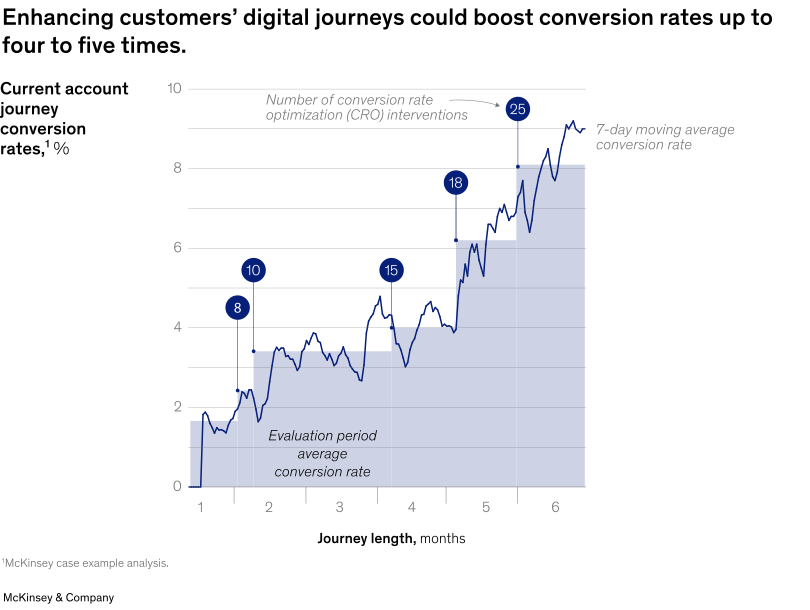
Once a customer has engaged with a campaign and starts the process of responding to an offer, it’s critical to make their digital journey as seamless and smooth as possible. One European bank boosted the conversion rate of its mobile current account opening journey by five times, from below 2 percent to close to 10 percent (Exhibit 3). The result came from removing obstacles from the digital onboarding process, including making it easier for customers to verify their identity, explaining why personal data was being collected and how it would be used, adapting the experience for different mobile devices, minimizing data entry, and making instructions clearer.
Our research also shows that customers who receive a high volume of service-related alerts generate 30 percent more sales. Expanding digital servicing and transaction features—such as suspicious log-in alerts, new payee warnings, lost card reporting, loan payment reminders, and disputed payment resolutions—can help banks enhance customer experience and boost sales.
Measurement and martech capabilities
This component focuses on the analytics and martech tools needed to run always-on, hyperpersonalized customer communications.
It is imperative for banks to track how their campaigns perform and use that data to continuously improve performance. This can range from changing subject lines when email open rates drop to targeting specific audiences in the evenings, as conversion rates decrease during the day. Banks should have an end-to-end marketing performance dashboard that tracks the full customer journey across all channels, including online and offline channels and customer relationship management systems. The dashboard will allow them to see which campaigns led to sales and where adjustments are needed.
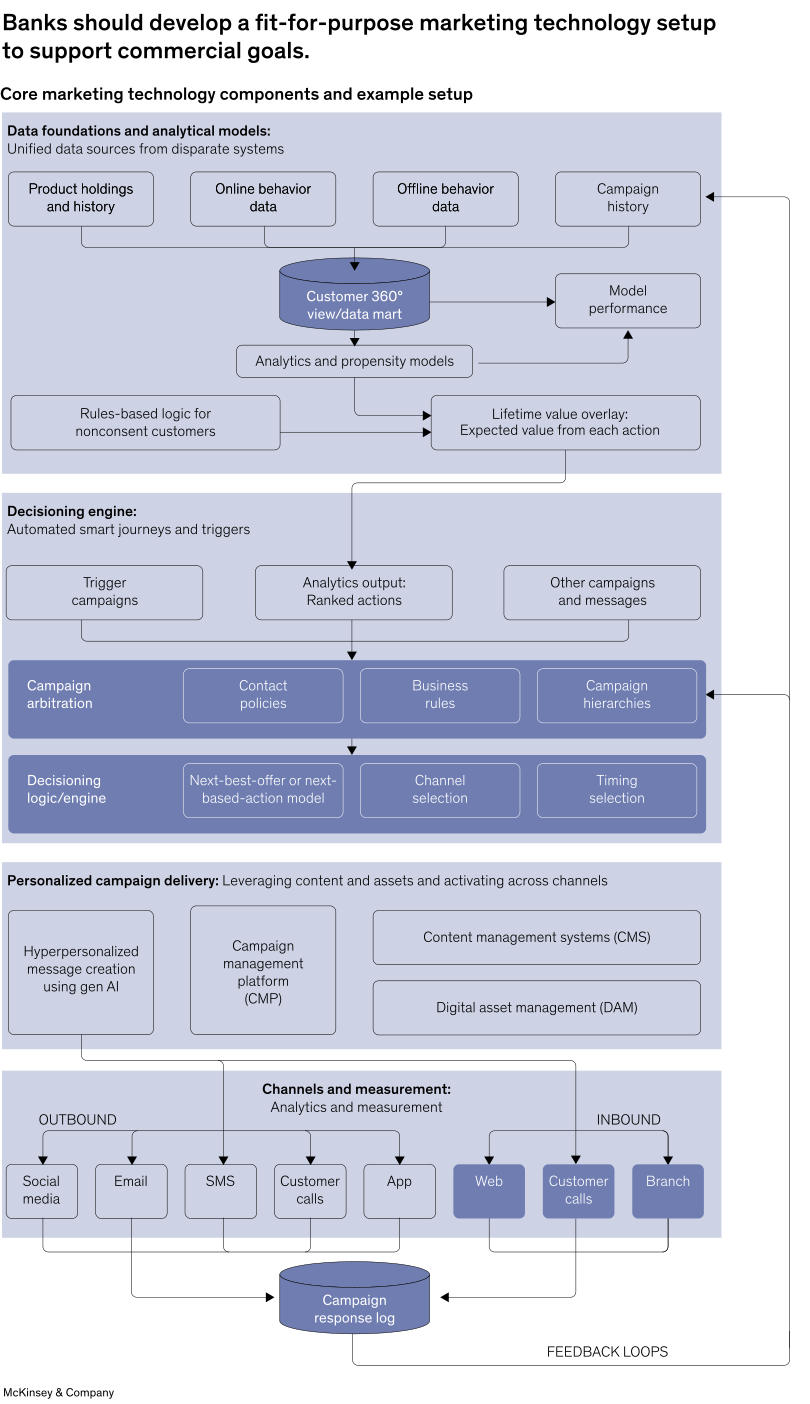
To improve performance, banks should develop a fit-for-purpose martech setup (Exhibit 4). They can first define their commercial objectives and use cases, then identify the martech tools needed to support them. Some core tools—such as A/B testing, app personalization, and content management systems—are essential for personalizing and optimizing customer journeys to drive digital sales at scale. Cross-channel sales journeys, for instance, might require a comprehensive identity management solution embedded in a customer data platform that fully unifies internally and externally collected data.
Operating model and talent
This component is about setting up the right operating model, governance, and talent to effectively support continuous, tailored customer communications.
Best-in-class banks define the key activities—such as data collection, analytics and technology development, decisioning, and campaign execution—needed to deliver CVM-driven sales. Then they assign clear ownership and accountability. An increasing number of banks realize they need to reflect the shift from product-led to customer-led campaigning in their operating models by establishing a cross-product and cross-channel organizational mandate to coordinate CVM activities.
Once the structure is in place, banks need to establish seamless, coordinated ways of working. They will need workflow management and AI-led automation tools to help teams execute their tasks smoothly; clearly defined priorities, KPIs, and incentives for all teams; and a structured governance process.
Finally, banks need to ensure their teams have the right roles and skills. These can range from traditional roles such as campaign managers and operators, data engineers and scientists, and creative designers to emerging roles such as AI platform architects. Several of these capabilities can be developed through continuous-learning programs, with a mix of formal training and hands-on experience, while a few will likely require new talent hiring.
How to get started
Banks will have different starting points for this journey. Some may have already invested in building foundational data and martech tools but lack a proven execution machine. Others may have successfully run a set of pilot programs but don’t have the data backbone or operating model to scale those early efforts. Our analysis suggests that banks that take the following three-step approach can achieve the most impact:
- Identify your biggest need. Top-performing banks ruthlessly diagnose their existing capabilities across the four key components defined above and prioritize their most critical areas of development.
- Pilot top commercial use cases. After identifying their key capability gaps, leading banks take one of two approaches. They either run a full transformation effort to build top-tier capabilities or they pilot one or two commercial use cases and use those learnings to incrementally build the capabilities they need. They select pilots with the greatest potential impact, such as selling new products to existing customers or trying to increase existing product usage and engagement. Based on observed implementation, starting with a few focused use cases tends to deliver more sustainable results.
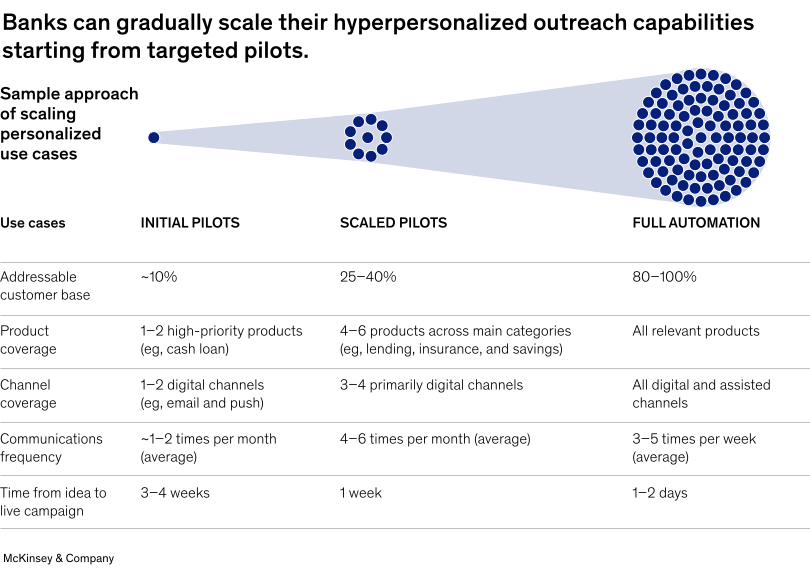
- Scale across all key areas. After testing and proving a few use cases, top banks scale what works across more customers, products, channels, and campaigns (Exhibit 5). The lessons from these pilots—and the resulting improvements in data, technology, processes, and skills—help them deliver more personalized and consistent customer experiences at a much larger scale.
As competition with neobanks and fintechs intensifies, banks can leverage the latest advances in digital technology to fight back. Developing AI-powered, hyperpersonalized communication strategies can strengthen customer relationships and stem the flow of business to their digital-first rivals. But they must move fast, as the window to maintain their primacy with customers is closing rapidly. It’s critical for banks to understand and adopt the key components of a modern customer value management system to remain competitive in the decade ahead.
.jpg?cq=50&mw=767&car=16:9&cpy=Center)