Imagine an essential industry booking the best earnings in a decade, generating the largest net income of all publicly traded companies. This industry’s ROE has accelerated in the past four years to today exceed prepandemic levels, with global revenue topping $3.0 trillion annually, growing at an average of 6.2 percent per year from 2020 to 2024.1
Does that sound like a sector that should be the lowest valued among industries?
The strong financial performance of global banks in recent years is not reflected in their valuations: The price-to-book multiple of retail banks trails the average of all other industries by almost 70 percent globally. For example, in 2022, the price-to-book ratio of other industries was 2.9 times the banking industry globally, and in 2024, it was 3.3 times.
Why? Markets doubt banks’ recent highs are sustainable, seeing them as tailwind-driven.
Complicating the picture are macroeconomic forces, including declining interest rates, and a host of challenges that appear to contribute to this disconnect between financial and market performance, such as fragmented customer relationships, shifting channel preferences, rising cost pressures, and emerging tech competition.
Yet some retail banks do outperform the market in terms of valuation.2 To understand why and how, we leveraged our Strategic Distance Framework for universal banks—banks whose operations span a full spectrum of services, including retail banking—to examine four pillars encompassing 20 dimensions and more than 500 variables. This article details the four institution archetypes that came out of that research; two have outperformed peers in growth and profitability. Because these are banks that are either digital natives or legacy institutions that have truly digitally transformed, we provide a process for rewiring banks to capture immediate value and drive long-term performance.
Key challenges affecting universal banks
The disconnect between the financial and market performance of universal banks is based on several major challenges, including fragmentation of primacy, shifting channel preferences, increasing cost pressures, and competition from tech-native players.
Fragmentation of primacy
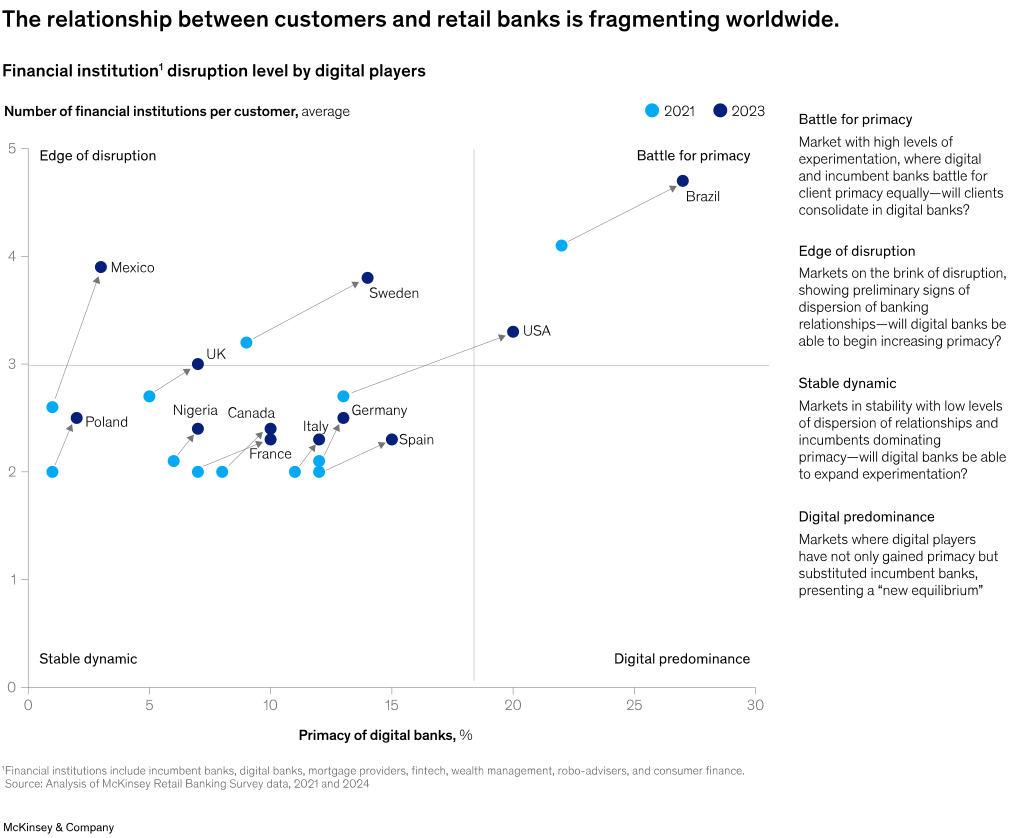
As digital banking players have emerged to disrupt the industry, the average number of financial institutions per customer has increased almost uniformly around the world, growing from about 2.5 per customer in 2021 to 3.0 by 2023 in the analyzed countries (Exhibit 1).3 The degree of incumbent disruption varies: Banks in many countries remain predominant as digital banks seek to aggressively expand. Nonetheless, the net impact has been to unbundle offerings and provide customers with greater price transparency and options. Customers everywhere can now pick and choose services based on what they value and are willing to pay.
Shifting channel preferences
Just as the range of banking options has increased, so have the channels through which services are available. The biggest disruptor has been mobile banking; compared with physical branches, mobile banking today boasts three times the number of active users and 50 times the number of touchpoints (an increase of more than 90 percent since 2020).4 Digital dominates everyday transactions and is revolutionizing the provision of banking services in many developing nations. However, person-to-person interaction remains relevant for the acquisition and cross-selling of retail banking products that are more complex.
In a second wave of disruption, retail banks are leveraging evolving customer preferences (for example, about 50 percent of customers in Mexico are seeking to consolidate all their needs with a single institution) and shifts in technology and regulation (such as the more than 65 million accounts connected to open banking in Brazil) to accelerate the use of technology and drive greater personalization. Methods include orchestrating customers’ entire finances, using gen AI assistants for advisory services, embedding finances into retail journeys, and introducing super applications expanding to nonfinance services. All banks are seeking to enhance efficiency and the customer experience with agentic AI and other emerging technologies.
Rising cost pressures
Like many industries, banks face rising cost pressures, from wage growth to rising technology costs. In Brazil, for example, the growth of banks’ average operating costs is expected to outstrip the rate of inflation, rising by about 6 percent annually from 2024 to 2030.5 However, the banking sector also has unique factors that are increasing the cost to serve, such as the higher cost of funding amid a structural shift to fixed-term deposits, accelerating delinquency and fraud, and heightened credit risk. The industry can potentially save money from the reduced need for physical infrastructure as customers increasingly adopt digital banking, but that also increases demand for IT services while leaving many companies with decisions to make about the future of existing brick-and-mortar facilities.
A major emerging source of efficiency gains is using AI to revolutionize the way banks operate and serve customers, increasing satisfaction, time to market, and efficiency. For instance, according to McKinsey analysis, some banks that have deployed AI agent squads in credit model development have reduced development times by up to 95 percent compared with humans. Leaders are already capturing the economic benefits: A leading Asian bank established cross-functional teams to harness the potential of AI and data, cutting end-to-end AI deployment time by a year, adding more than $500 million in economic value in 2024 from AI and data initiatives, and reducing the cost-to-income ratio of serving digital customers relative to traditional ones by 50 percent.
Emerging tech-native competition
The emergence of tech-native banks and ecosystems promises a deeper understanding of new client needs, the ability to come to market faster and with more innovative approaches, and a more efficient cost structure, lowering the cost of acquiring and serving customers. It is not that incumbent banks are unable to offer similar products and services but that many are having to do so while supporting traditional banking infrastructure. This often leads to gaps between emerging disruptors and incumbent banks as the latter grapple with legacy technologies with limited integration, a relatively low ability to attract and retain top tech talent, difficulty with product personalization and flexibility, and operating models and culture that are often siloed, reducing collaboration and time to market.
In Brazil, for example, Nubank leveraged this model to reach more than 107 million clients by the second quarter of 2025—an increase of more than 100 percent compared with 2021—while more than doubling revenue per active customer in the same period for an ROE of 28 percent.6 A similar trend is evident in other regions. In Germany, 45 percent of new accounts are being opened with neobanks or digital banks.7 In Spain, Revolut expanded from about 2.5 million customers in 2023 to about 4.0 million a year later.8 Nubank reached 12 million customers in Mexico in the second half of 2025, a 130 percent increase compared with 2023.9
The Strategic Distance Framework
Some banking institutions have been able to buck the broader trend and significantly outcompete the market. Banks in Latin America provide representative examples: Santander in Chile, Brazil’s Nubank, and Banco de Crédito del Perú achieve price-to-book valuations multiples higher than those of their competitors.10
To understand what makes these and other universal banks globally outperform the market, we adapted our proprietary Strategic Distance approach for comparing organization performance for use with universal banks, facilitating an integrated way to understand and compare individual bank performance and determine strategic options to generate value (see sidebar, “About the research”).
We took a comprehensive view of a bank’s competitive position based on the four key challenges discussed above: fragmentation of privacy, shifts in channel preferences, increased cost pressures, and emerging tech competitors. We then evaluated the ability of institutions to outcompete the market by addressing those challenges, finding that banks need the following pillars to thrive:
- A distinctive value proposition serves to combat the increasing fragmentation of primacy by engaging and enchanting customers, ensuring ownership and monetization. This can include a strong brand connection that attracts customers alongside high customer satisfaction that brings in new customers as well as allowing current clients the ability to fulfill their daily banking needs. The net effect is that the bank satisfies a high share of its needs, improving profitability.
- Mobile-orchestrated distribution is an answer to shifts in channel preferences and the rise of mobile. It requires an ability to orchestrate across both digital and human channels to offer and distribute what clients want and where they want it, irrespective of channel. A starting point is an outstanding mobile user experience that allows clients to undertake daily banking simply and effectively, enabling banks to easily sell products through digital channels and provide specialized services. For example, leading banks in Latin America leverage AI as a concierge or adviser, and they see up to ten percentage points of higher satisfaction from clients integrated into their new apps.11
-
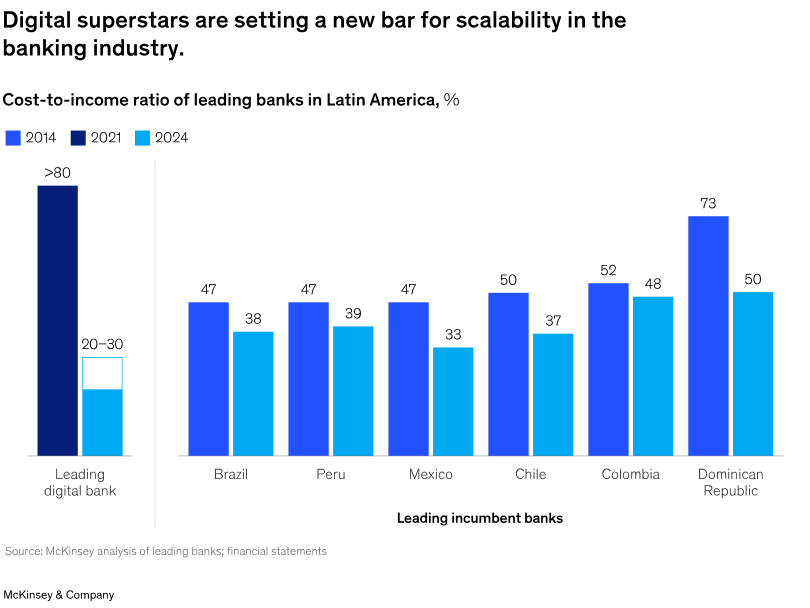
Operational scalability is the ability to maintain efficiency and balance revenue and costs across operations, addressing cost pressures and enabling profitable growth. Low marginal costs will allow banks to attract and acquire new customers and grow in a cost-effective way. Operational scalability also entails best-in-class credit and fraud management capabilities to maintain low delinquency rates while producing a significant revenue for each additional resource invested.
Banks have been leveraging agentic AI to accelerate this transformation. For example, some banks have built hybrid human–AI agent squads to improve credit analysis processing times and quality.
- Tech company DNA is a response to emerging tech-native competition. This is the ability to develop operational strengths that enable banks to operate and compete like a tech-driven company. It requires a cloud-based ecosystem powered by cutting-edge AI to capture data and leverage it for personalized and real-time decision-making. A strong tech base will also help attract talent and foster a test-and-learn culture of innovation that will ultimately permeate throughout the bank’s entire operating model.
The four core banking archetypes
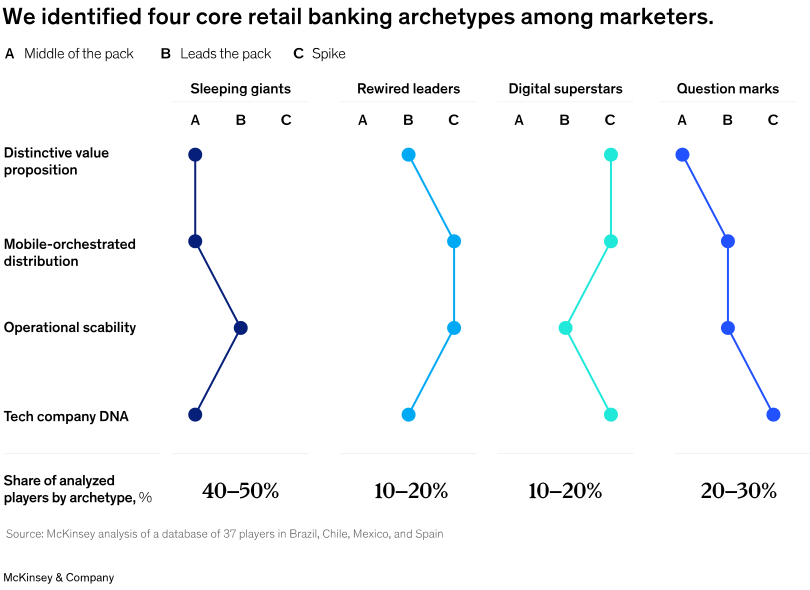
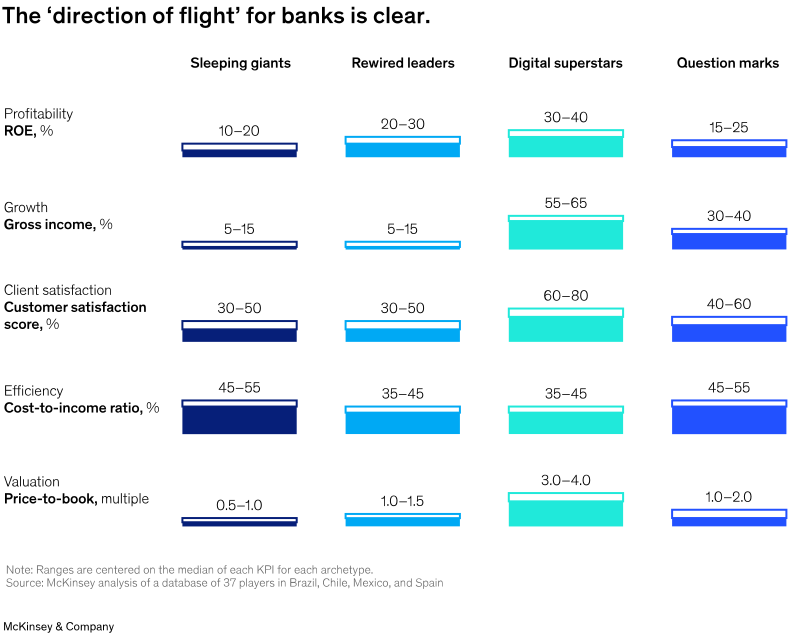
Our Strategic Distance Framework research found four universal banking archetypes across markets (Exhibit 2), providing a clear view of their performance across critical metrics. We found that the two most digitally driven—“digital superstars” and “rewired leaders”—outperformed their peers in growth and profitability, emerging as market leaders compared with incumbent banks and other institutions. These findings provide insight into what makes banks thrive and the challenges institutions face behind the digital curve, although all archetypes have strategic imperatives. A critical competitive differentiator is wisely choosing where and how to play, and the framework seeks to help organizations better understand their strengths and weaknesses so they can prioritize initiatives.
- Digital superstars. Digital superstars are digital-first banks that are reshaping the industry by redefining the customer experience and value proposition. They’re particularly distinctive within the pillars described above and have tech company DNA. Their strategy has been to target key pain points for customers using traditional retail banks, quickly growing their customer base. In Spain, for example, digital superstars grew their base by about 60 percent in 2024.12 Opportunities remain for digital superstars to focus on building customer primacy and a product portfolio to monetize their distinctive value proposition while continuing to scale without compromising customer experience and unit costs. These banks may benefit from boosting partnerships in embedded finance to accelerate their portfolio penetration, for example, as well as deploying AI at scale in core and support functions to enable hyperpersonalization of customer engagement.
- Rewired leaders. Rewired leaders are established banks that are successfully reinventing themselves to thrive in the digital era, having started their tech and talent transformation a few years ahead of the curve. For example, in Brazil and Mexico, these banks have about 20 percent of their workforce (excluding sales) from tech and digital roles on average, while that number is below 15 percent for other incumbents, according to McKinsey analysis. They are leaders when it comes to having a distinctive value proposition and tech company DNA, with spikes in mobile-orchestrated distribution and operational scalability. Their challenge now is to consider doubling down on orchestration and accelerating digital transformation to build a hard-to-copy distribution advantage. That can include leveraging AI capabilities to build engagement through hyperpersonalization, both of products and in customer communication. For scalability, widely adopting AI can boost worker productivity and increase self-service and digital sales.
-
Sleeping giants. Sleeping giants are large banks that once dominated the market but are now at risk of falling behind in the new digital landscape. In Spain, for instance, the market share of primary customers from the largest banks in this archetype decreases by almost 50 percent when considering clients that have switched primary banks in the previous year, compared with their share across all clients.13
While they perform well in terms of operational scalability, sleeping giants are losing ground across other pillars and may need to define a clear and compelling value proposition that enables differentiation and market traction. For example, they may need to build greater product flexibility and self-customization capabilities. For their mobile journey, that may mean improving daily banking and digital sales, as well as mobile-human integration. In tech, they may be too reliant on legacy systems and need to upgrade to a modular cloud-native architecture.
- Question marks. Question marks are digital banks still seeking a strategic edge and unique value proposition beyond being digital, ensuring their value proposition is unique and compelling. They have deep tech company DNA and are leaders in terms of mobile experience and cost to serve. But these banks could focus on reprioritizing a value proposition strategy around a few anchor advantages that resonate with a target audience, as well as building a strong brand identity. Maturing their prediction and engagement capabilities across the credit cycle may play a key role in improving monetization and efficiency while keeping delinquency rates low.
How banking markets are evolving
The different contexts of universal banking markets provide tangible and broadly applicable examples of how countries are developing and the performance of each archetype. As noted above, digital superstars have been able to quickly and relatively quietly acquire significant market share in many markets, driven by a focus on customer satisfaction and rapid development of brand strength. Despite often initially reacting slowly, rewired leaders have begun to fight back, accelerating their digital transformations to start catching up with digital natives on metrics such as customer experience and pricing. However, they often have much ground to recover given the territory claimed by digital superstars (Exhibit 3).
In many countries, sleeping giants maintain dominant positions with regard to primacy with customers and share of wallet, often averaging more than 40 percent primacy share compared with digital superstars’ less than 20 percent.14 Yet sleeping giants are struggling to compete with transforming institutions and digital superstars on metrics such as brand positioning and the ability to meet customer expectations. And as customers increasingly prefer mobile banking services, leaders continue to build strategic distance on critical future battlefields, from providing advisory services at scale by leveraging AI to providing comprehensive financial platforms and services beyond banking. In Spain, for example, sleeping giants retain a high share of primacy, with more than 50 percent of their base composed of primary customers, compared with fewer than 20 percent among digital superstars.15 Yet digital superstars already have a clear lead in customer satisfaction.16 As for question marks—those digital players still to find their unique edge—they are often caught in no-man’s-land between incumbents and faster-growing institutions, and they struggle to grow their base and primacy as fast as digital superstars.
So, how could the complex dynamics between digital superstars, rewired leaders, sleeping giants, and question marks continue to play out in the future? As digital superstars and rewired leaders build distance in primacy and productivity compared with question marks and sleeping giants, the gap in growth (revenue), efficiency (cost-to-income), and profitability (ROE) should continue to widen. In this scenario, we expect an increase in the share of players in the digital superstars and rewired leaders archetypes, because the others will be forced to rewire themselves to remain competitive and profitable. Exhibit 4 provides a snapshot of how all four archetypes compare in providing a distinctive value proposition.
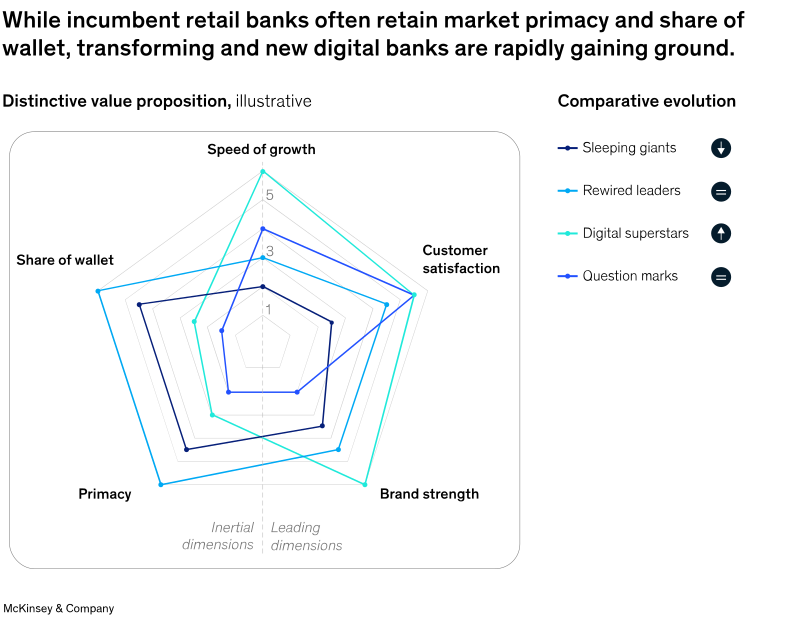
Leveraging the strategic distance lens and building a granular understanding of the dimensions and metrics allows banks to track their performance against themselves and peers, aligning the whole organization around the elements that have the highest potential to generate competitive advantage and to impact strategy execution.
Bank transformation: Three steps
Implementing an assessment such as the Strategic Distance Framework can be the first step in a broader journey to transform a universal bank. Understanding how and why an institution’s performance is lagging is a prerequisite to effectively addressing any shortcomings, and we recommend a three-step process:
- Value creation plan. Undertake a sprint to identify strengths, gaps, and opportunities across business areas, leveraging strategic distance lenses. The net result is a comprehensive view illuminating a clear North Star for the institution’s future as well as defined workstreams and solutions to make it happen.
- Frontrunner execution and transformation backbone. Chart the path to market leadership by capturing rapid value from low-effort opportunities while laying the foundation for long-term transformation. Accelerate execution with front-runner initiatives, drive quick wins, evolve capabilities, continue planning subsequent waves, and implement enabling foundations to sustain growth and impact.
- Full value capture and scale-up. Ignite sustained growth by driving value creation through structured waves, leveraging a robust performance infrastructure, and tracking to deliver measurable results. Scale and align initiatives to maximize impact across the organization.
We also note that this is not a one-and-done exercise—institutions should continuously monitor performance, analyze metrics, and adjust as necessary. In addition, we recognize changing a company’s operating approach is among the more difficult transformations it can undertake. But this structured approach to identifying where a bank stands, gaining a deep understanding of its challenges and opportunities, and methodically implementing a growth strategy empowers banks with the talent, technology, data, and agile operating model needed to sustain momentum for lasting impact.
The world’s banking industry stands at an inflection point. Allaying market skepticism about its ability to generate and sustain long-term value requires the industry to embrace strategic transformation by truly understanding why, where, and how it can elevate its strengths and overcome its weaknesses. By doing so, banks have an opportunity to navigate the sector’s current challenges and position themselves for sustained success in an increasingly competitive landscape.