The future of marketing will be defined by how well organizations operate in an AI-mediated world. Consumers are discovering, evaluating, and purchasing through increasingly intelligent systems; attention is fragmented across proliferating platforms; and expectations for relevance, personalization, and immediacy are rising at once. Marketing is no longer confined to campaigns and channels—it is becoming a real-time growth engine that integrates insights, content, commerce, and performance in a continuous loop. In this environment, advantage will accrue to those that can learn faster, personalize at scale, optimize across the full funnel, and design experiences not only for people but also for the AI systems that guide them. The role of the CMO is expanding accordingly—from steward of brand and demand to orchestrator of data, technology, and AI-enabled execution.
That kind of execution is no simple task—and marketing organizations understand this better than most. Marketers, after all, have been among the earliest adopters of gen AI, piloting use cases from copy generation to image creation. Many tools have gained traction, yet because they typically solve isolated tasks, the result has been a patchwork of disconnected pilots and systems that increase activity (for example, more early-concept images produced) while delivering few meaningful enterprise-wide benefits. Much of this fragmentation reflects legacy marketing technology architectures—multiple CMS, digital asset management , CRM, and analytics systems that were never designed for real-time agentic workflows or shared data models. It’s the “gen AI paradox”: The technology can increasingly be found everywhere—except on the bottom line.
Agentic AI—systems built on foundation models capable of acting and executing multistep processes—has the potential to address this problem because it offers the opportunity for organizations to fundamentally transform the way work gets done. Rather than relying on practitioners using isolated tools to boost individual productivity and effectiveness, organizations can create hybrid human–agentic workforces—in which people design and oversee networks of AI agents that handle most of the execution. In this model, one marketing professional can supervise a team of agents, potentially driving growth, boosting productivity, and freeing human colleagues to focus on higher-level tasks like creativity and strategy. Realizing this shift requires a modernized technology foundation: unified identity and data layers, flexible model-serving infrastructure, and content and activation systems that expose reliable APIs for agents to act on.
Realizing this potential value is only possible through the reimagining and rebuilding of workflows around agentic AI. This is no simple task, which helps explain why companies so far have struggled to extract significant value from AI agents. Organizations that fail to do the hard work needed to reinvent workflows risk creating suboptimal human–agent collaborations and systems that fall far short of delivering on the technology’s promise.
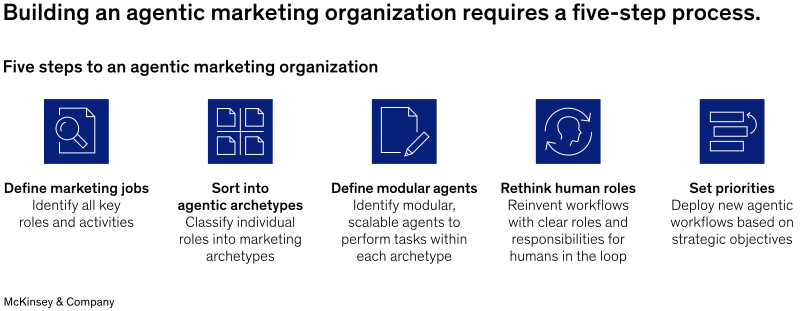
While we are still in the early days of agentic AI, a recipe for how to reimagine and rebuild marketing workflows is emerging. This article will examine the five-step process for creating an agentic marketing workflow.
The value of agentic AI in marketing
We estimate that agentic AI will come to power as much as two-thirds of current marketing activities, enabling tasks such as automated content generation, synthetic audience testing, and audience-based media planning (Exhibit 1).
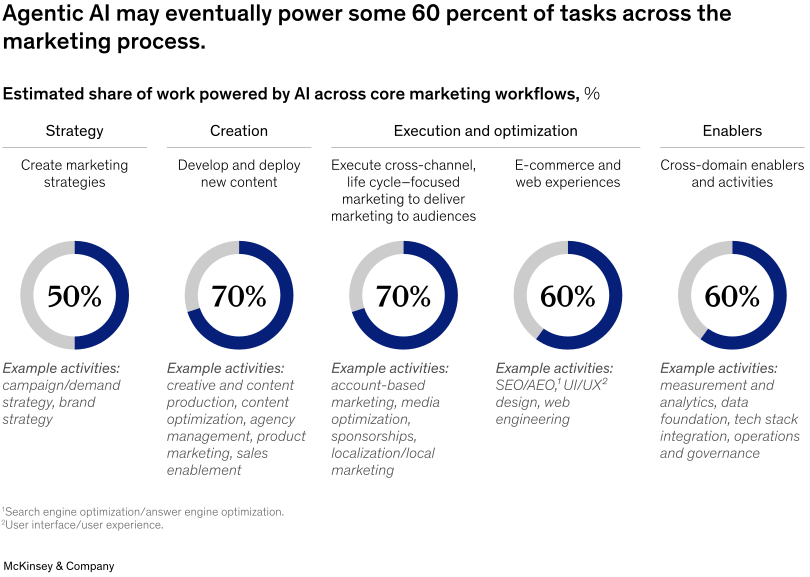
Ultimately, an agentic workforce has the potential to transform marketing operations in three key ways:
Powering topline growth. Organizations that are implementing agentic workflows in marketing can expect to see 10 to 30 percent revenue growth from hyperpersonalized marketing, according to McKinsey research. Much of this new marketing activity will be self-serve due to always-on, AI-enabled campaigns with improved cross-functional collaboration across teams and channels.
Enabling speed. We estimate that agentic systems will accelerate the creation and execution of marketing campaigns by ten to 15 times, by speeding up both the brainstorming and vetting of ideas, leading to faster testing and sharper optimization.
Fueling working spend and growth. Powering more work with AI agents will allow resources previously spent on processes and operations to be reallocated toward directly reaching consumers. The result: humans focusing on the more important tasks and higher ROI from data-driven marketing, media, and creative performance.
These gains, of course, are by no means certain. They will only be realized by reimagining the way marketing work is accomplished. Below, we explain how leading organizations are doing just that.
Creating an agentic marketing workflow
Designing an agentic AI solution generally requires a five-step process—from identifying the tasks that can be accomplished with agents to rethinking human roles for proper oversight (Exhibit 2). As they navigate this process, leaders must be aware of several factors that add to execution complexity. Some agentic solutions, for example, can be applied to similar tasks across multiple functions and should be built for reuse, with the ability to upgrade as the technology evolves and new models emerge. Agentic systems will also need to be designed to scale. And in all cases, companies will need to reimagine workflows based on business goals.
Step 1: Create a detailed taxonomy of key marketing activities
Creating tomorrow’s agent-driven workflow, of course, cannot be done without first developing a granular understanding of the way work gets done today. An important first step in that process is to break down priority workflows into the full chain of key activities involved. This mapping must include the underlying systems—customer relationship management, content management systems, digital asset management, analytics, and data pipelines—that support each activity, since system constraints often shape how agentic workflows can be designed. This will serve as the foundational current state that eventually will be translated into the future-state “clean sheet” agentic workflow.
This is how many companies across industries have begun. Take, for example, one leading consumer brand that sought to redesign the process of creative ideation and production. Historically, this was an often complex undertaking that could take months of effort, with numerous stakeholders, both internal staffers and outside agencies, engaged in iterative cycles of feedback and rework. To determine how AI agents might help, the organization first created a comprehensive list of activities involved in the process, encompassing ideation, concept creation and testing, content production, content versioning, content optimization, and agency management. Those activities were then further broken down into hundreds of individual microtasks. Within concept creation and testing, for example, the team identified subtasks like concept image generation, pretesting with focus groups, assessing risk, and more. This detailed taxonomy provided executives with a more comprehensive understanding of its workflows—an understanding that later informed the build-ready specifications for agents.
This taxonomy should also include the insights function within marketing—activities such as synthesizing data, generating hypotheses, interpreting consumer signals, and translating findings into action. These activities form a critical part of the marketing process, and many can be augmented or accelerated through agentic workflows without replacing the human judgment required to make meaning from them.
Step 2: Define agent archetypes
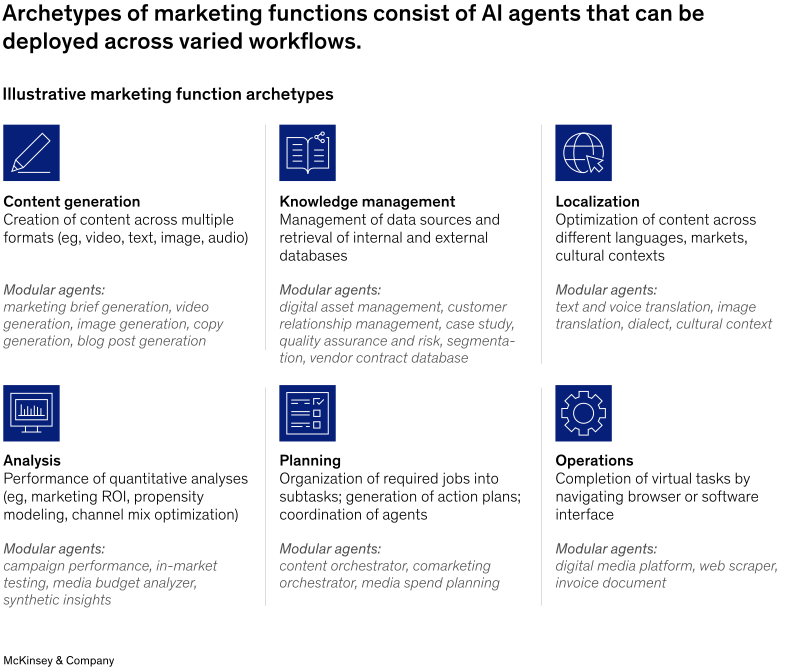
After establishing a baseline understanding of organization-wide tasks, the next step is to classify these tasks into agentic archetypes, which will serve as reusable blueprints to guide where and how agents are deployed within workflows. In marketing organizations, some of those archetypes might include “extracting knowledge to build context and reasoning,” “analyzing data to define outputs,” and “generating materials across mediums with variations.”
Leaders at the consumer brand above, for example, classified scores of marketing tasks into six agentic archetypes—content generator, knowledge, localization, analyzer, planner, and operator—which were subsequently used to define the modular, scalable individual agents to be deployed and reused across the marketing process (Exhibit 3).
Step 3: Determine the full set of agents needed across workflows
After identifying key tasks and classifying them into distinct archetypes, tech and business leaders must determine the specific agents needed within those archetypes to transform a workflow. Teams must also confirm that agents can technically integrate with required systems—data platforms, content repositories, and activation platforms—since system interoperability, not model design, is often the limiting factor.
One key agentic archetype identified by the consumer brand, for example, was content generation. Within that archetype, executives identified almost 100 individual modular agents—that is, individual agents that can be inserted into the creative process across multiple workflows. A short-form text-generation agent, for example, could be used in different ways across tasks like creative-content development, sales-collateral development, e-commerce/web optimization, and comarketing with business partners. Some marketing technology platforms, including Adobe and HubSpot, now offer AI agents that can be embedded directly into creative workflows. These agents can generate and refine copy and design variations, tailor assets to audience segments, and update content across channels based on real-time behavioral signals. Marketers remain responsible for brand integrity and strategic guidance, but the agents orchestrate much of the ongoing production work. Early pilots show shorter production cycles and an increased ability to respond quickly to changing market conditions.
Step 4. Define future-state workflows with clear roles for humans in the loop
Of course, as AI agents are increasingly inserted into workflows, human roles will need to change. In marketing, that will mean focusing more time on tasks like developing marketing strategies based on qualitative factors like “taste” that are not prone to automation; developing a deeper understanding of what will resonate with audiences; sustaining and building relationships with stakeholders; and engaging on tasks best handled in person, such as marketing activations.
Marketers will also need to oversee the technology infrastructure powering these workflows: data quality and schemas, content metadata, orchestration rules, and API governance that ensures agents operate safely and consistently. This will require brands to invest in talent capable of fine-tuning off-the-shelf foundation models to brand context and upskilling human employees to redefine ways of working. Among the new skills humans will need to master:
- prompt engineering: knowing how to structure instructions so agents can produce desired outputs
- collaborating with agents: understanding handoffs between agents and marketers, and steering agents to formulate new strategies
- quality monitoring: ability to monitor agent activity, spot anomalies in quality, compliance, and so on, and track agent tasks
- refining ideas with human expertise: assessing and enhancing AI outputs with human instinct and experience
- data and AI fluency: ability to prep and clean datasets and validate AI-generated insights against real-world performance
- machine learning modeling: knowledge of applied machine learning, data engineering, experimentation, and workflow orchestration
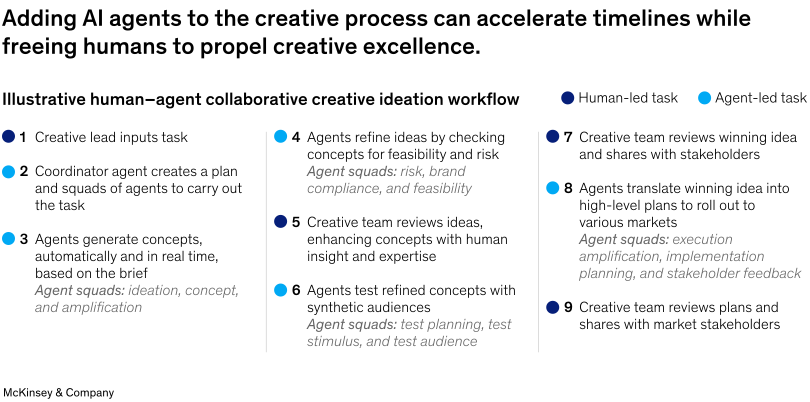
Consider the concept generation and testing workflow at the consumer brand cited above. The future-state agentic process the team created includes squads of agents that collaborate with human colleagues. Agents focus on generating concepts and content, cross-checking with risk guidelines, pretesting content, and writing first-draft plans. The human workers focus on what they do best: prompting and managing agents, reviewing output, enhancing ideas with instincts and insights drawn from years of industry and market experience, and then sharing outcomes with key stakeholders (Exhibit 4). This new workflow allows the consumer company to generate and test a greater number of creative concepts in parallel, accelerating learning cycles and freeing marketers to spend more time refining the ideas that resonate with consumers.
Step 5: Prioritize in waves, focusing on high-value workflows to drive adoption
After identifying and mapping future-state workflows, organizations will need to prioritize their development and rollout; they also must determine whether to build custom tools or deploy off-the-shelf solutions. The first priorities should include areas with the highest efficiency potential, to get quick wins, or workflows based on organization-wide goals related to effectiveness and business growth. Prioritization should reflect technical readiness, as some workflows cannot be automated until data pipelines, metadata structures, and key execution systems are prepared for agentic orchestration.
The consumer brand introduced its agentic marketing system in three waves. The first wave focused on building an ideation engine, with agents continuously generating and refining campaign ideas and assets, providing the team with a steady stream of new content to test. The second wave added further intelligence and safeguards, with agents running rapid pretests of creative concepts and automatically checking content brand, legal, and risk compliance. The final wave extended the system globally, enabling agents to adapt messages for local markets and coordinate scalable testing and rollout.
Together, these waves transformed a slow and manual process into a fast and data-drive system that, in some content creation pilots, increased the speed of the end-to-end process by four times versus traditional workflows.
Agentic systems are also beginning to emerge in media execution. One advanced advertising platform is now building AI agents to autonomously optimize campaigns across major digital channels, continuously evaluating performance, adjusting bids and budgets, pairing creative with audiences, and generating new message variants. These agents operate in real time, managing thousands of microadjustments that previously required constant manual oversight. Early adopters report faster optimization cycles and measurable improvements in return on ad spend, highlighting how agentic execution is reshaping modern media operations.
Fueling growth and adoption, while limiting risk
End-to-end agentic workflows will help marketing organizations capture value by producing more consumer experiences far more quickly, while powering top-line growth and fueling working spend. But facilitating this change is no simple task, requiring leaders to execute in key ways across the organization. Brands will need to set a top-down vision (led by the board and CEO), with strong governance to ensure adoption and scaling, while limiting brand and legal issues. Leaders also must understand that agents are only one tool in the AI playbook; other tools, including scripting, robotic process automation, and machine learning, also need to be considered. Focusing too narrowly on agents alone can leave significant efficiency gains on the table when scaling.
Nor is this process without risk—especially in marketing, which directly affects consumer-facing content and brand perception. Marketers will need to pay close attention to potential brand and legal vulnerabilities, above and beyond the technology and data risks posed by agentic AI across all functions. Marketers seem to understand the novel risks AI presents. A McKinsey survey of 35 CMOs of Fortune 250 consumer and technology companies found that executives were primarily concerned about brand and legal governance, human capability challenges, technology under investment, and data bottlenecks. Insights teams will also need new governance mechanisms to validate AI-generated insights, establish confidence thresholds, and ensure accuracy before findings inform major brand or investment decisions.
Nearly 90 percent of CMOs are experimenting with AI use cases across various points of the marketing process, but less than 10 percent have captured value across end-to-end workflows, McKinsey research has found. Agents can help move the needle. But as they begin to deploy agentic AI, marketers also must grapple with a fundamental question: Will the future of marketing be defined by the ability to orchestrate complex networks of AI agents, or will human intuition and creativity continue to sit at the helm of the systems that drive success?
The answer lies not in replacing human marketers but in augmenting their capabilities to create unprecedented levels of personalization, efficiency, and innovation. Human-led insights—grounded in cultural understanding, qualitative sense-making, and strategic judgment—will remain essential complements to the precision and scalability that agentic AI enables. The real challenge will be in navigating the uncharted territory where human judgment and creativity intersect with AI-driven precision and execution, and in doing so, redefining the very fabric of marketing itself.