

For most banks, the core banking system has long been the quiet workhorse of the enterprise: reliable, rigid, and largely invisible. Today, that is no longer enough. As generative AI, real-time data, and cloud-native architectures redefine what “digital” means, legacy cores are becoming a structural constraint.
A new era of core banking is emerging, one where the core shifts from a monolithic system of record to an intelligent financial engine with modular features that are integrated with AI and analytics. This shift is more than a technology refresh. It is an architectural, operating-model, and economic transformation that may determine which banks actually capture the value of AI at scale. Successful core banking transformations have already been able to generate value within 12 to 24 months.
As digital volumes surge, regulatory expectations tighten, and AI adoption moves from experimentation to scaled deployment, we make a case for why modernizing the core matters now and offer a playbook on how to do it right.
Why the core matters again
A core banking system is a bank’s central hub of software and technology. It hosts centralized databases and records, processes real-time transactions, and allows for management of customer accounts and loans.
In our experience, institutions often underestimate the extent to which legacy core architecture constrains AI adoption. While many banks have made substantial investments in analytics, cloud, and AI capabilities, the limiting factor increasingly lies in a bank’s ability to operationalize intelligence within transaction flows and business processes. The highest-performing institutions are not necessarily those with the most advanced AI models but those that have successfully embedded decision intelligence directly into core banking operations.
Over the past decade, many banks looking to modernize their IT backbones have focused on customer journeys and digital channel layers while leaving the core largely untouched. That bought time, but it also created technical debt.
More fundamentally, banks are increasingly shifting from systems optimized to record transactions to systems expected to support millions of real-time decisions. Historically, core banking platforms were designed to answer the question “What happened?” In an AI-enabled banking environment, institutions need systems capable of answering a different question: “What should happen next?”—for anything from approving a loan application to adjusting a credit limit or detecting potentially fraudulent activity. This shift is bringing renewed strategic attention to the core.
Today, CIOs and CTOs typically report several issues with their legacy core systems:
- Slow product innovation. Launching a new deposit product or fee variant can still take months because product logic is entangled deep in the core.
- Batch-driven processing. Nightly batch runs make it difficult to deliver real-time balances, instant credit decisions, or real-time risk views.
- Data locked in silos. Customer, transaction, and risk data sit in different segments across the core and satellite systems, making AI use cases hard to scale.
- High run costs. Many cores still run on mainframes or tightly coupled proprietary stacks, with limited elasticity and high costs per million instructions per second.
In today’s rapidly changing external environment, this technical debt holds banks back. Legacy cores are hard-pressed to support AI. Because legacy cores are complex and difficult to modify, they also struggle to meet rising regulatory expectations about real-time visibility. In addition, fintechs and neobanks have reset customer expectations through rapid product innovation, dynamic pricing, and highly personalized digital experiences. In this environment, banks constrained by rigid legacy cores risk losing ground.
Suddenly, the “invisible” core is very visible: It is either the enabler or the bottleneck of becoming an AI-first bank. Those that delay modernization may find that every new AI initiative hits the same wall: legacy cores that cannot provide the data or flexibility required.
Increasingly, the limiting factor in scaling AI is the ability of core systems to operationalize intelligence in real time rather than model sophistication. Many institutions have already invested heavily in analytics and AI capabilities but struggle to embed them effectively into customer journeys, decision workflows, and operational processes because of legacy architecture constraints.
On the other hand, banks that act decisively to modernize the core could gain several capabilities, including the following:
- Launching and iterating products at fintech speed
- Embedding AI into every core decision flow, from credit to collections to fraud
- Running more-resilient and efficient platforms with lower structural costs
- Offering customers proactive and personalized financial services
For example, one large universal bank found that its legacy core required overnight batch reconciliation before updated customer balances and risk metrics were available. This delayed credit-line adjustments and fraud interventions by up to 24 hours. Through an event-driven modernization layer and embedded machine-learning-based decisioning, the bank reduced credit decision turnaround times from hours to seconds, increased approved lending volume by 12 percent in targeted segments, and reduced fraud losses by 18 percent within the first year.
In our experience, 60 to 80 percent of technology spending at many large banks continues to be directed toward maintaining and operating existing systems, limiting the resources available for innovation and AI-enabled transformation.
From monolithic cores to intelligent financial engines
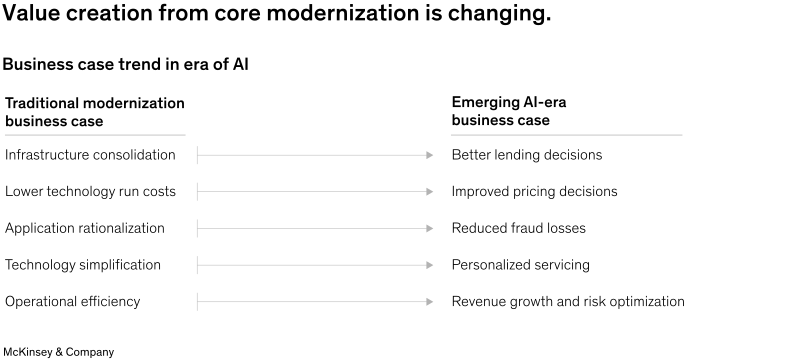
Our work with global and regional banks suggests that core modernization business cases are undergoing a significant shift. Our analysis of more than 200 core modernization business transformation engagements shows that the majority of value was derived from infrastructure consolidation, technology simplification, and run-cost reduction. More and more, however, leading institutions are finding that the largest value pools stem from improvements in decision quality across lending, pricing, servicing, fraud management, and risk operations. In many cases, decision-driven value creation can exceed technology savings by a factor of two or more.
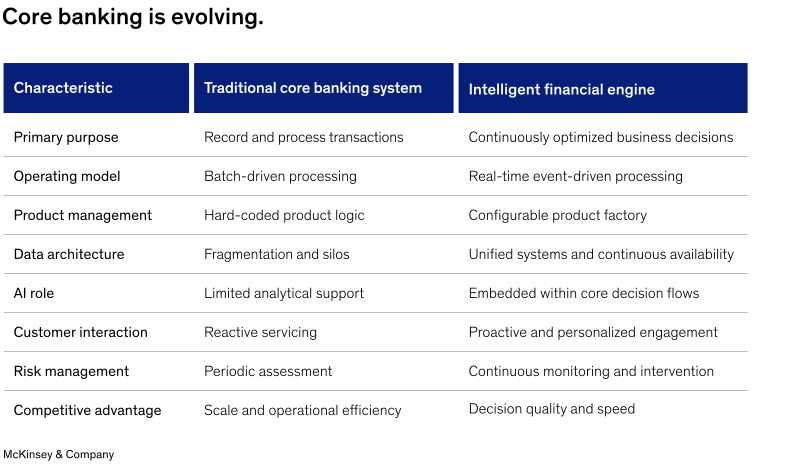
Modernization is not just about replacing one core package with another. Banks are moving toward intelligent financial engines that can fully leverage AI, meet growing regulatory expectations, and keep up with the pace of change set by fintechs. The distinction is important. Traditional cores were designed primarily to process transactions efficiently and reliably. Intelligent financial engines are designed to continuously optimize decisions across credit, pricing, servicing, fraud, and risk management. As AI adoption accelerates, decision quality may become as important to competitiveness as transaction processing accuracy and scale (Table 1).
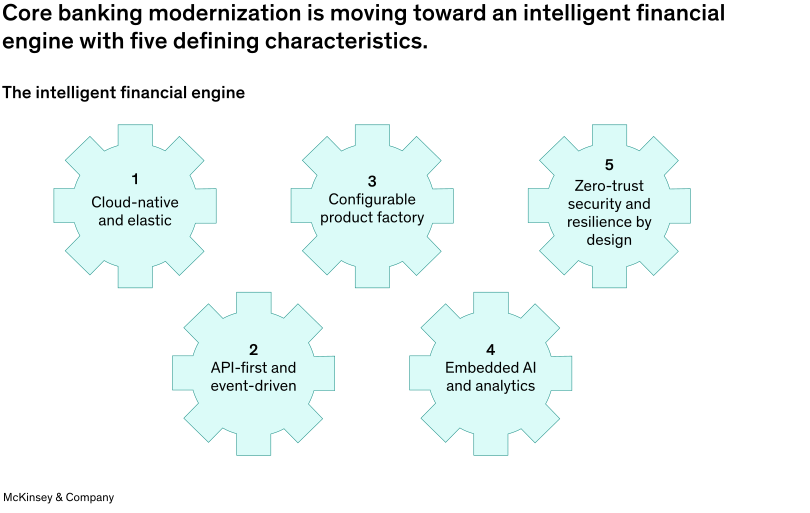
Intelligent financial engines have five defining characteristics (Exhibit 1):
- Cloud-native and elastic. Intelligent financial engines deploy components (for example, accounts, pricing, limits, ledger, and collections) in containers or with serverless runtimes to improve speed and agility. They are horizontally scalable to handle peak loads without permanent overprovisioning.
- API-first and event-driven. Core capabilities can be shared as secure APIs to digital channels and external partners (for example, fintechs) to extend core banking functionality. Critical business events such as loan disbursement and credit card authorization are published in real time—serving as fuel for AI, fraud detection, and analytics.
- Configurable product factory. Product parameters are modeled in configuration rather than code, enabling business teams to design and deploy products faster. Variant management and simulation engines allow developers to test pricing and feature changes before rollout.
- Embedded AI and analytics. Machine learning models are embedded directly in key decision points to incorporate more sources of data and yield more-accurate results. Gen AI models are integrated into developer workflows, customer service, and operations to accelerate change and reduce manual work.
- Zero-trust security and resilience by design. Intelligent financial engines integrate security measures such as fine-grained identity and access management, continuous monitoring, and automated compliance checks. They use active–active or active–standby architectures, automated recovery, and chaos testing to meet rising resilience expectations.
Our analysis suggests that banks are progressing through three distinct stages of AI readiness (Exhibit 2). The first stage, the AI-assisted core, applies AI primarily to analytics and productivity use cases outside core workflows. The second stage, the AI-enabled core, embeds AI into selected decision processes such as underwriting and fraud management. The third stage, the AI-native financial engine, integrates AI continuously across products, operations, servicing, risk management, and technology delivery. While many institutions have begun the journey toward AI-enabled cores, relatively few have yet achieved AI-native operations at scale.
In intelligent models, the core is a programmable platform, not just a ledger. For instance, a regional retail bank operating across multiple countries struggled with launching new deposit products due to hard-coded product logic in its legacy core. Introducing a configurable product factory that separated product parameters from code enabled business teams to launch new pricing variants in under three weeks, down from four to six months. Within 18 months, the bank introduced more than 40 microvariants tailored to specific customer cohorts, increasing cross-sell penetration by 9 percent and improving customer retention in priority segments.
The AI opportunities within intelligent financial engines
With a modernized core, banks can roll out key AI use cases, not only within the core itself but to all stakeholders—developers, customers, and regulators.
Within the core, operations can be made more autonomous and self-healing (that is, able to identify and recover from failures without human intervention) with gen AI copilots, reinforcement learning, and other tools. For example, anomaly detection on telemetry and logs can predict incidents before they hit customers.
For developers, new AI tools can transform how core banking software is built. For example, developer copilots can accelerate feature delivery by generating boilerplate code. Architecture guards can help preserve the integrity of the target architecture by flagging antipatterns (ineffective or counterproductive code), and platform blueprints can generate reference templates consistent with security and compliance standards. And as banks begin to reshape their core architecture, AI can derisk and accelerate the transformation process by powering tools for developers, including tools for code understanding and refactoring, automated test generation, and data mapping and reconciliation.
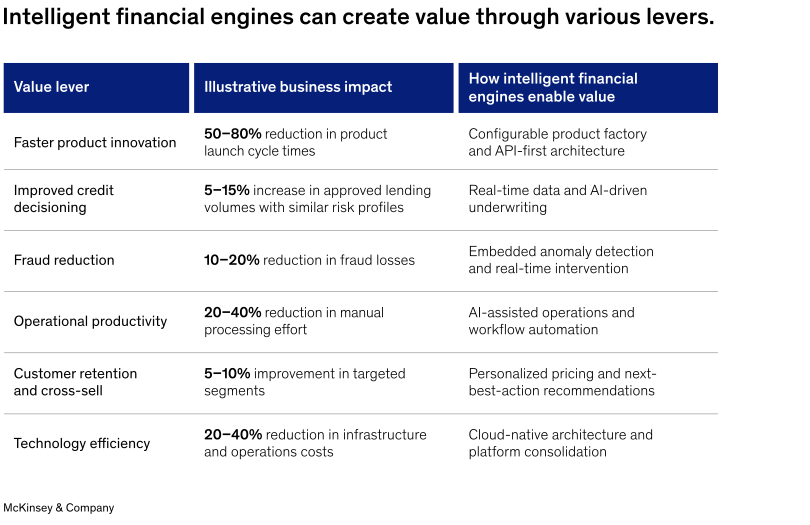
On the customer side, AI-native product and pricing engines can personalize offerings with fine-grained, real-time data. The strategic significance extends beyond automation. As AI becomes embedded into underwriting, pricing, fraud management, collections, and servicing, banks may increasingly compete on decision quality rather than process efficiency alone. Small improvements in decision accuracy, applied across millions of customer interactions and transactions, can create substantial economic value through higher revenue, lower losses, and improved customer experience (Table 2).
For example, AI-powered pricing engines can propose overdraft limits or fee waivers based on lifetime value and risk indicators such as transaction histories and behavioral signals. At the same time, as AI increasingly influences credit, pricing, and collections decisions, institutions must ensure explainability and strong model governance. This includes adversarial testing and monitoring to guard against AI-related risks.
AI can also help meet rising regulatory expectations for near real-time visibility into core metrics. AI models can facilitate risk mitigation and reporting, allowing banks to offer intraday liquidity monitoring at granular levels, real-time credit and fraud analytics, and faster, more accurate regulatory reporting, with explainable lineage from the report back to the source transactions.
While infrastructure savings often provide the rationale for modernization, leading institutions are increasingly capturing value through better decisions, faster innovation, improved risk outcomes, and enhanced customer engagement.
The modernization playbook
Our experience across recent large-scale programs finds that modernization, when executed in progressive waves, can reduce product launch cycles from several months to a few weeks, lower infrastructure and operations costs by 20 to 40 percent through platform consolidation and cloud elasticity, and improve service availability and recovery performance.
Several principles guide the most successful core modernization efforts: an AI-and-people-first approach, progressive transformations, and measures to increase resilience.
Use an AI-and-people-first approach
Banks that treat data and AI as a “do later” part of modernization often struggle to achieve results. In practice, data and AI architecture must be co-designed with the core from day one. Leading banks make their cores AI-ready with three efforts woven into their modernization programs:
- Adopting canonical data models for core entities (customer, account, contract, transaction, and so on) aligned across the bank
- Streaming events into governed data lakehouses or platforms with clear lineage, quality checks, and privacy controls
- Defining up front which AI and analytics use cases will sit in-flow (for example, real-time decisions) versus off-flow (for example, batch risk models and planning)
Core modernization in the AI era is also as much an organizational shift as a technical one. Banks that treat modernization as a purely IT program—without rewiring team operating models and governance—will struggle to capture full value.
Modernize with progressive renewal
Most institutions—especially large global banks—cannot risk a “big bang” replacement of the core. Leading players are instead using progressive renewal strategies built around three typical modernization patterns:
- Strangler Fig architecture. Surround the legacy core with modern APIs, progressively move products and segments to a new core, and gradually decommission legacy components.
- Segmented greenfield core. Stand up a new cloud-native core for specific businesses while retaining the existing core for traditional segments. Migrate profitable or strategic books of business to the new platform.
- Core renovation with heavy decoupling. Retain the existing vendor or core, but decouple product engines, pricing, and channels through a modern integration layer and event backbone. Introduce AI-driven decisioning outside the core while gradually simplifying the legacy codebase.
The right pattern is context-specific to the regulatory environment, scale, vendor landscape, and risk appetite.
Build for resilience
Banks should consider designing architecture that will support innovation, resilience, and scale over the next decade. For instance, instead of relying on one core vendor, banks could design a broader ecosystem of vendors optimized for resilience across multiple domains. In addition, banks can embed resilience in their journeys from the outset. Zero-trust security models, continuous identity verification across users and services, and fine-grained network segmentation are becoming standard.
Leading banks are exploring other resilience-focused practices. For example, a systemically important bank redesigned its core architecture with active–active multiregion deployment and automated failover. This allowed critical services to continue even during regional outages while meeting data residency requirements. By combining chaos testing, AI-driven anomaly detection, and zero-trust controls, the bank reduced mean time to recovery by more than 60 percent and met enhanced supervisory expectations for operational resilience without materially increasing run costs.
A practical road map for leaders
For CEOs, CTOs, and heads of technology and operations, the challenge is balancing ambition with pragmatism. A practical road map typically includes a number of key steps:
- Diagnose the constraint. Ask what exactly the core is preventing the company from doing—is it faster product launches, AI in underwriting, real-time risk assessments, or improved cost efficiency? Quantify the value at stake and define a clear “why modernize now” rationale.
- Define the target architecture and AI vision together. Co-design the target core architecture, data platform, and priority AI use cases. Make deliberate choices on the cloud strategy, event backbone, and boundaries between core and peripheral systems.
- Pick the first beachhead. Identify a business line or product family where a new core or modernized slice can unlock visible value within 12 to 24 months (for example, small- and medium-size enterprise lending or the digital-only retail segment). Use AI tools from day one in migration, testing, and operations.
- Build the platform and operating model in parallel. Stand up platform engineering, site reliability engineering, and data and MLOps capabilities as part of the first wave, not as an add-on. Move to domain-aligned product teams with shared incentives across tech and business.
- Industrialize and scale. Treat each migration wave as a product release, with clear metrics (such as time to market, customer satisfaction scores, cost to serve, and resilience). Reinvest savings and learnings into accelerated decommissioning of legacy systems.
The new era of core banking will be defined by the architectural and operating choices leaders make now, not by a single vendor or technology. Banks that reimagine their cores as intelligent financial engines designed for AI, built on modern platforms, and operated by product-centric teams could be best positioned to define the next decade of banking. Competitive advantage may depend not only on how effectively banks process transactions but also on how intelligently they turn those transactions into decisions, actions, and outcomes.
Chandrasekhar Panda is a partner in McKinsey’s Riyadh office, and Henning Soller is a partner in the Frankfurt office.