The biggest technology breakthroughs rarely deliver on their full potential. Value flows only when organizations redesign their operating models to capture the new technology’s promise.
AI, and agentic AI in particular, demands a fundamentally different operating model. It reshapes how decisions are made, how work is done across functions, how capabilities are developed, and where value is created. As organizations move from experimenting to reinventing work with AI, two questions are critical: Which operating model choices distinguish organizations that successfully create value from AI? And where should leaders focus their efforts to maximize the impact of those choices?
McKinsey recently conducted a global survey of AI maturity and readiness for AI transformation. We built on that analysis by surveying more than 700 executives and senior leaders1 at organizations across industries and geographies to understand how their operating models drive AI transformation and performance.
Our new research found that “reinventors”—organizations that are fundamentally reimagining how work gets done—are more likely to report stronger operating model performance than organizations in earlier stages of AI adoption (see sidebar “About the research”).
In this article, we discuss the operating model choices reinventors make and how well they execute those choices to capture tangible gains from AI. We also offer five lessons from this group that can help leaders maximize returns from their AI investments.
How AI maturity influences operating model performance
In both the prior AI readiness survey and in our new research, organizations fall into three “horizons” based on how deeply they embed AI in daily work. In the first horizon, enablement, organizations offer individual employees access to general-purpose AI tools that assist with aspects of their existing jobs. In the second, automation, companies automate and improve existing cross-functional workflows using AI at scale. In the third, reinvention, they reimagine how work gets done by redesigning roles, workflows, and the operating model to leverage AI’s full potential (Exhibit 1).
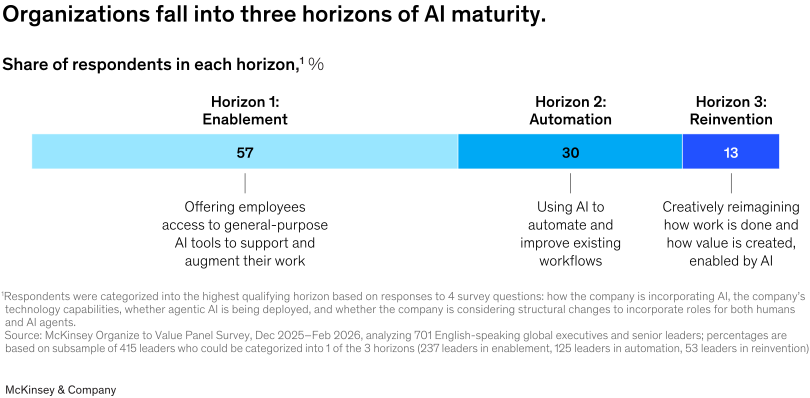
Reinventors represent just 13 percent of this sample. However, the previous AI readiness research found that reinventors are significantly more likely to realize meaningful enterprise value than organizations in earlier horizons. Nearly half (48 percent) of leaders in the reinvention horizon reported capturing meaningful enterprise value from AI, compared with just 13 percent of leaders in the enablement horizon and 24 percent in the automation horizon.2
The reinventor advantage in operating model performance does not stem from adopting a single “best” operating model. Rather, it reflects a combination of different operating model choices and stronger, focused execution.
High-performing operating models are best understood as dynamic systems of interconnected design choices. McKinsey’s Organize to Value research3 shows that organizations choose among 12 operating model elements, including structure, governance, processes, technology, leadership, talent, and rewards (table). The combination of these decisions—whether by refining several of the elements or shifting all 12—forms an organization’s unique operating model “fingerprint.”
The 12 elements of the ‘Organize to Value’ system
| Element | Definition | Link to performance | |||
| Value agenda | How the organization creates value | Clarity on the value agenda enables optimal resource allocation | |||
| Structure | How accountable units and mission teams are designed | Internal organization in the service of strategy enhances prioritization and accountability | |||
| Ecosystem | How the organization works with partners to create value | External partnerships create and share value beyond the organization’s boundaries and capabilities | |||
| Governance | How to set priorities, allocate resources, and manage business performance | Ensures enterprise resources are managed in a consistent, integrated way in alignment with the strategy | |||
| Processes | How workflows are designed | Approach to value-creating activities is clear and consistent across the enterprise | |||
| Technology | How digital, data, and AI enable value creation | Data and AI are deployed to increase productivity and drive new sources of value creation | |||
| Leadership | How leaders make decisions and catalyze action | Roles and dominant approach to decision-making are clear and consistently implemented | |||
| Talent | How the organization attracts and develops talent | The right capabilities are available to meet value creation goals | |||
| Footprint | How the organization locates and deploys talent | The right skills are available in the right locations in alignment with business needs and priorities | |||
| Purpose | How the organization defines its core reason for being | Clear purpose helps employees and stakeholders navigate uncertainty | |||
| Behaviors | How culture is nurtured across the organization | A unique “secret sauce” creates value for employees and customers | |||
| Rewards | How people are rewarded for performance | Rewards support the desired behaviors and practices that increase value | |||
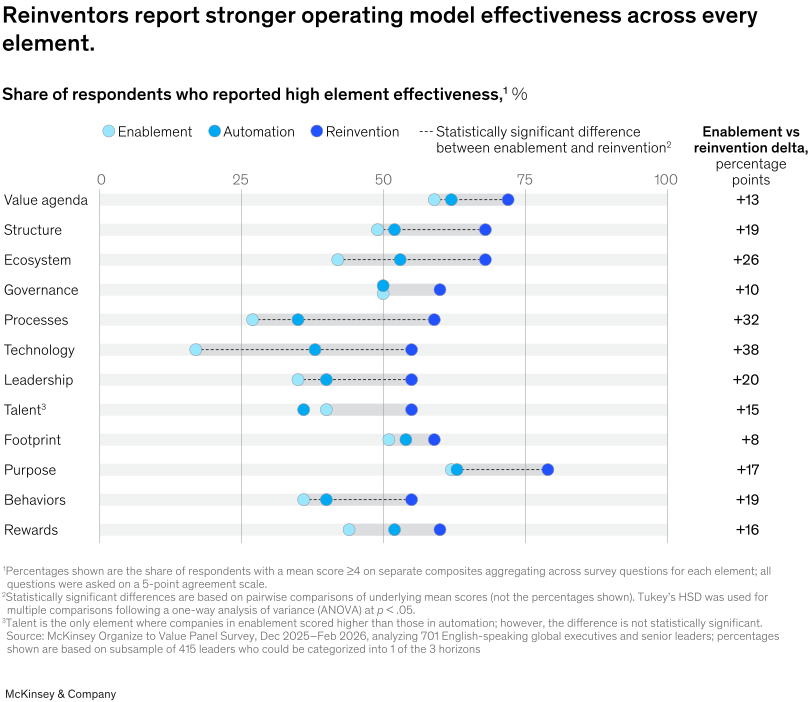
Regardless of the combination of choices they make, organizations in the reinvention horizon report higher effectiveness across all elements than those in the automation and enablement horizons (Exhibit 2).
The clarity and speed advantage
The design choices leaders make and how well they implement them drive four crucial outcomes: clarity, where resources and accountability are aligned to strategy; speed, reflecting fast and frictionless tech-enabled workflows; skills, reflecting a future-ready workforce equipped to deliver the highest possible value; and commitment, which stems from a performance-oriented culture. Our new analysis shows that reinventors report better results in all four outcomes, and that using AI to automate existing workflows without pushing for reinvention delivers lower clarity and skills than those enjoyed by companies in the enablement horizon (Exhibit 3).
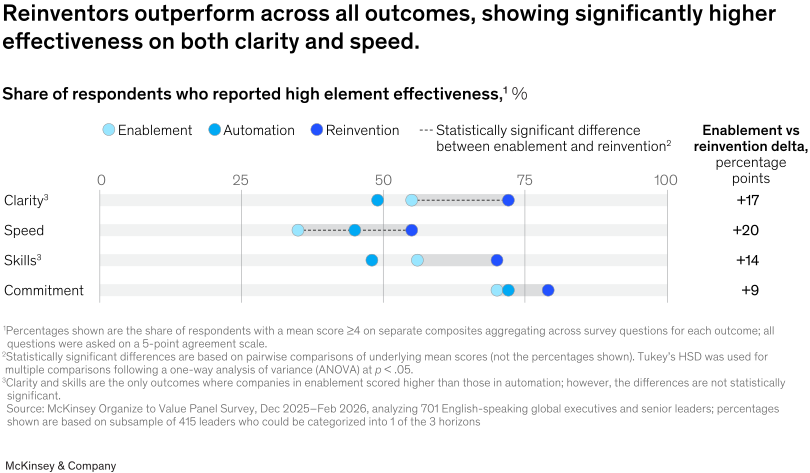
The difference in outcomes is particularly notable in speed and clarity: The share of reinventors reporting greater speed is 20 percentage points higher than those in the enablement horizon and ten points higher than those in automation.
McKinsey’s Rewired research makes clear that speed is the defining organizational advantage. Businesses are in an innovation race with companies that have access to the same technologies. Today, advantage no longer comes from the technology itself, but from how fast that technology can be applied to solve business problems at scale. Companies win that race when their operating model redeploys resources more rapidly to important opportunities, empowers teams to act without excessive dependencies, and reduces the time from insight to decision to action.
Clarity is also critical. Leaders of reinventors report greater clarity on strategic direction and how work connects to enterprise priorities. That helps them align teams and resources with strategic priorities and adapt quickly as technologies, markets, and customer expectations evolve.
How and where to focus
The reinventor advantage can’t be explained by improvements in any single operating model element. Reinventors don’t simply invest more heavily in technology, flatten their hierarchies, or centralize decision-making. Instead, they create a reinforcing system by configuring multiple elements of their operating model. Like a healthy biological system, performance emerges from how these components interact. To understand the sources of this advantage, we examined organizations through two distinct lenses: the design choices they make and the elements in which they are especially effective.
Lens 1: Reinventors make distinctive design choices
Reinventors by design
Organizations can make multiple design choices within each of the 12 elements of our Organize to Value system. Reinventors are more likely to favor certain choices in several of these elements—for instance, they often choose decisive leadership, skills-based talent, and hybrid-based rewards. But multiple variations exist among reinventors (exhibit), and the specific combination that works best depends on organizational context.
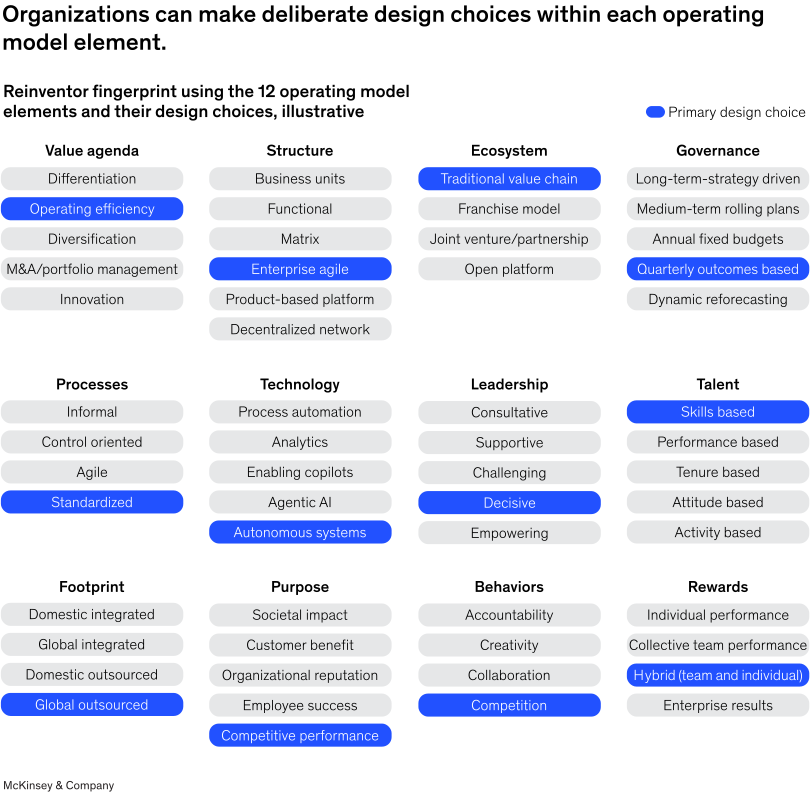
In every operating model, leaders decide how work is organized, decisions are made, technology is embedded, talent is developed, performance is rewarded, and where the organization partners externally. Together, these choices create an organization’s operating model fingerprint (see sidebar “Reinventors by design”).
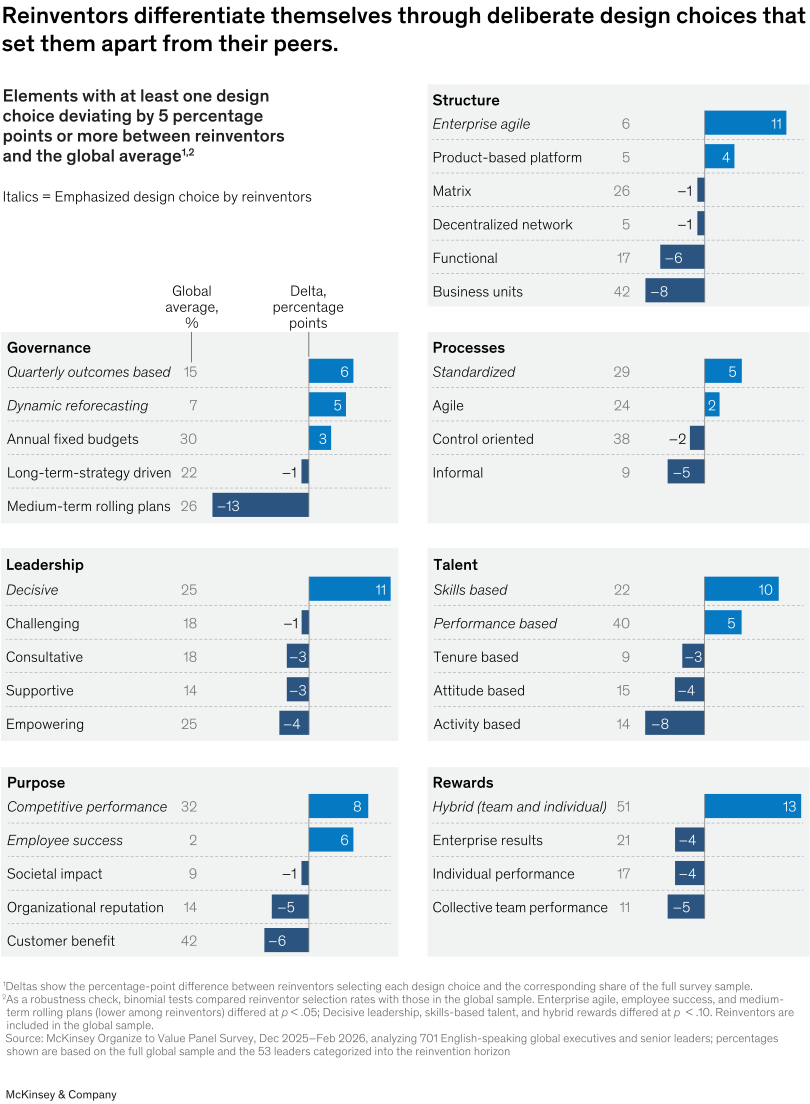
When it comes to structure, reinventors are more likely to adopt an enterprise-agile model, which organizes work around small, cross-functional teams that have greater autonomy and accountability for outcomes, enabling faster and more iterative delivery. While the research reveals a pattern, it doesn’t mean that enterprise agile is always the most effective choice for every organization; some may pursue a matrix model or decentralized network. Different designs can be effective in different contexts.
The research shows that across some operating model elements, such as value agenda, reinventors can look remarkably similar to organizations in earlier stages of AI adoption. They differ by making deliberate choices that reshape how value is created and scaled.
To understand that impact in more detail, we examined the choices reinventors make in seven of the 12 elements: structure, governance, processes, leadership, talent, purpose, and rewards (Exhibit 4).4
Structure: Organizing around value, not hierarchy
Agentic capabilities are accelerating the shift toward organizing around end-to-end value creation. Rather than structuring work primarily around business units or functions, reinventors are more likely to organize cross-functional teams around products, customer journeys, and business processes, giving those teams end-to-end accountability for delivering value quickly.
In practice, this means decisions, capabilities, and accountability sit closer to where value is created, whether that’s with teams serving customers, on the production floor, or at critical handoffs between functions. This approach reduces unnecessary transfers and enables teams to continuously improve products and processes rather than optimize individual functions.
Governance: Managing rapid learning with adaptive planning
Reinventors are less likely to rely on medium-term rolling plans (typically over a three-to-five-year period) and more likely to adopt quarterly outcomes-based governance or dynamic reforecasting. While these both represent distinct governance models, they reflect a shift away from governance centered on longer planning horizons toward more frequent adaptation as conditions change.
In the context of AI reinvention, where technological capabilities and market dynamics are evolving faster than ever, governance must combine strategic direction with the ability to redirect resources quickly. Organizations that emphasize quarterly outcomes can rapidly scale successful AI initiatives or discontinue those that fail to deliver value. Those anchored in dynamic reforecasting can adjust budgets and plans as new information emerges. In both cases, governance supports continuous resource reallocation without losing strategic focus.
Processes: Standardizing how work gets done
Reinventors are more likely to favor standardized processes, with consistent workflows, clear protocols, and defined metrics that enable rapid decision-making, and less likely to rely on informal processes driven by relationships and consensus. This discipline becomes more important as AI takes on a greater share of work. Clear processes make it easier to define where decisions sit, what outcomes are expected, and where human judgment or oversight is required.
This finding is consistent with evidence from McKinsey’s Organizational Health Index. Our AI readiness research found that reinventors emphasize management practices around systematic process documentation and rigorous performance transparency. Together, these practices reinforce an approach that combines process consistency with rapid, metric-driven decision-making.
Leadership: Optimizing for decision velocity
As AI accelerates the pace of work, organizations can’t afford to have important decisions stalled by prolonged debate. Leaders can reduce decision latency by acting promptly, resolving enterprise trade-offs, and providing the clarity needed for disciplined execution.
While a broad leadership tool kit remains important, reinventors are more likely to describe decisive leadership as the dominant model, which includes establishing clear direction, resolving trade-offs quickly, and creating conditions for disciplined execution. They reinforce this model by selecting and promoting leaders who are willing to act decisively rather than default to consensus, and by pushing decision rights down so more choices can be made without escalation.
Talent: Cultivating dynamic skills over static roles
Reinventors are more likely to adopt a skills-based talent model where people are hired for specific skills, developed through structured training, and advanced based on demonstrated skill mastery. Or they follow a performance-based talent model where people are hired for proven results, developed through performance coaching, and advanced based on measurable business impact and data-driven evaluations.
As AI automates tasks and workflows evolve, work becomes less defined by static job descriptions and more by combinations of skills that can be rapidly assembled and redeployed. Skills become the primary currency for staffing work, allowing organizations to move expertise to emerging priorities rather than reorganizing the enterprise each time strategy shifts.
Purpose: Existing for competitive performance or employee success
Reinventors are more likely to anchor organizational purpose in one of two distinct design choices: competitive performance or employee success. The former fosters a competitive mindset and performance-driven environment that prioritizes bold ambition, tangible results, and celebrated wins; the latter prioritizes investing deeply in people, empowering high performance, and supporting professional growth.
AI can play a critical role in advancing either orientation. For organizations oriented toward competitive performance, this may mean that AI helps them win faster through greater speed, productivity, and execution. For those oriented toward employee success, AI can help unleash human potential by enabling people to learn, adapt, and contribute in new ways. While the orientations differ, each provides a coherent North Star for redesigning work and embedding AI across the enterprise.
Rewards: Incentivizing collective outcomes
Finally, reinventors rethink how success is recognized. Leaders place greater emphasis on hybrid reward systems that recognize team outcomes as well as individual contributions, compared with companies that prize individual performance or collective performance alone. This reflects the reality that value is increasingly created through cross-functional teams rather than individual activities. Hybrid incentives encourage collaboration without diluting accountability, ensuring that people are recognized both for their own performance and for the success of the outcomes they deliver collectively.
Lens 2: Reinventors are effective at the elements they choose
Designing the operating model for an agentic enterprise is only half the challenge. A system of mutually reinforcing choices creates the conditions for performance but does not guarantee it. While every element must be effective enough for the system to work, not every element needs to be a source of advantage.
We asked leaders: Regardless of your chosen design, how effectively does each operating model element perform its role? For any given structure, effectiveness means supporting value creation, establishing accountability at the right levels, and helping the organization adapt. A matrix organization and an enterprise-agile organization could therefore both have an effective structure, depending on the context and the combination of other design choices.
Consider an AI customer-service agent. One design choice is the underlying large language model (LLM): A company might select a frontier model, a smaller specialized model, or an open-source model. Different choices can be effective if they deliver the accuracy, reliability, speed, and cost that the use case requires. But even an effective LLM may not be where exceptional performance creates the most value. The greater differentiator may lie in how effectively other parts of the system work—for example, how well the agent is integrated into workflows, connected to company data, or adopted by employees. The model choice matters, but it does not determine performance on its own. Leaders must also decide which parts of the system need to be exceptionally effective.
To understand where leaders can focus, we examined which operating model elements stood out as relative strengths within each AI horizon. As organizations mature in their implementation of AI, the source of their operating model advantage shifts. Companies in the early enablement phase (where employees have access to general AI tools) typically focus on traditional management strengths, such as governance and talent. While reinventors report higher effectiveness across every element, they place particular emphasis on technology, processes, and ecosystem orchestration (Exhibit 5).
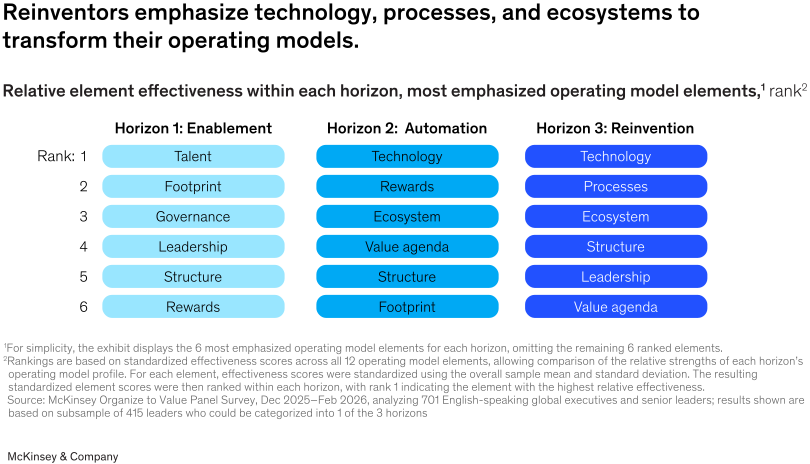
Notably, technology and ecosystem strengths are shared with organizations in the automation horizon, suggesting these are foundational capabilities built earlier in the journey.
Technology: Creating business value from AI
For reinventors, it is perhaps not surprising that technology emerges as the strongest relative operating model strength. Leaders of reinventors are more likely to report having the digital tools needed to deliver on strategy, flexible and modular technology architectures, disciplined technology investment decisions, and a clear path to realizing value from AI.
Taken together, these findings suggest that technology functions as much more than an enabling capability. It becomes part of the operating model itself, embedding new ways of working into the organization’s day-to-day execution and making those changes easier to sustain over time.
The experience of an electronics retailer illustrates how strategic technology investments can accelerate transformation. Rather than starting with dozens of AI use cases, the company first invested in modern technology foundations, including stronger data governance, engineering standards, and an internal tech and AI factory. It then deployed technology and AI across e-commerce, pricing, fulfillment, and digital lending. The transformation contributed to an approximately 35 percent increase in EBITDA in the first year.
Processes: Redesigning workflows
Process effectiveness is a defining strength of reinventors. They emphasize outcome-oriented teams, continuously optimized processes, and cross-functional workflows while minimizing unnecessary handoffs. Rather than simply executing existing processes more efficiently, reinventors redesign workflows across the enterprise, focusing on transforming end-to-end domains rather than disconnected use cases. This finding is consistent with The state of AI in 2026: On the road to ROI, a new McKinsey report showing that nearly three-quarters of AI high performers report fundamentally redesigning their workflows because of AI use, compared with just one-quarter of other respondents.
The experience of a global financial services company shows how critical effective processes are to capturing value for reinventors. Rather than deploying AI as a collection of disconnected use cases, the company redesigned enterprise workflows from the ground up. Teams tested digital copilots inside redesigned processes, which generated rapid productivity gains and identified the potential to automate a substantial share of work over the next several years. This redesign is expected to reduce cycle times for priority processes by more than half, allowing employees to shift from repetitive data work to higher-value analysis and strategic decision-making.
Ecosystems: Creating value beyond organizational boundaries
Reinventors are good at creating value by orchestrating external partnerships as an integral part of their operating model. They are intentional about which capabilities to build internally and which to source externally. Once again, this finding is reinforced by The state of AI in 2026, which indicates that nearly half of AI high performers have chosen to build rather than buy at least one software product or feature, compared with 31 percent of other organizations.
This disciplined build-versus-buy approach allows organizations to concentrate internal investment on capabilities that generate competitive advantage while leveraging external technologies and partners. By doing so, reinventors accelerate innovation and enhance scalability to realize value more quickly.
Lessons from reinventors
Organizations are at different stages of AI maturity. Where do they look to capture more value from AI, even if they aren’t yet fully reinventing work? The operating model profiles of reinventors point to five lessons for leaders seeking to redesign their operating models around AI and capture more value from it:
- Organize around end-to-end value creation. While this lesson confirms McKinsey research, it remains foundational. Move beyond functional hierarchies by organizing cross-functional teams around customer and business outcomes, with clear accountability from end to end. Support these teams with modular technology platforms and workflows that make it easier to collaborate across boundaries and reduce unnecessary handoffs. And rather than applying AI to isolated tasks, redesign entire processes so that people, technology, and workflows operate together to improve how value is created and delivered.
- Extend the operating model beyond the enterprise. Be deliberate about which capabilities to build and own—and where external partners can provide greater speed, scale, or expertise. Reinventors treat these partnerships as an extension of how the organization creates value, not simply as a source of outsourced capabilities. As priorities and technologies evolve, they continually manage the boundary of where internal ownership creates a competitive advantage and where tapping into the broader ecosystem can accelerate progress.
- Hold ambition steady and move resources faster. Reinventors are less likely to rely on medium-term rolling plans and more likely to govern through either quarterly outcomes or dynamic reforecasting. The common thread is not a particular planning cycle but the ability to preserve a bold strategic direction without locking resources to yesterday’s assumptions. Set an ambitious North Star, then reallocate resources as evidence changes—scaling AI investments that deliver, stopping those that don’t, and making bold investments that serve the long-term goal. Decisive leaders reinforce this model by resolving trade-offs quickly and giving teams the clarity to act. Together, these practices keep the destination clear while allowing the route to evolve.
- Reward people for reinventing the enterprise, not optimizing their silos. Reinventors pair a strong orientation toward competitive performance with rewards that emphasize team outcomes alongside individual contributions. This combination is important: Competition can accelerate reinvention, but only when people are competing to create value for the organization rather than maximize their own performance. Hybrid rewards help channel that drive toward shared outcomes by recognizing individual contributions while making cross-functional success part of how performance is rewarded. The aim is not to temper competition with collaboration, but to direct both toward reinventing the enterprise.
- Build skills around the work that creates value. Reinventors are more likely to organize talent around skills rather than static roles. As AI reshapes jobs, identify the workflows that matter most, break them into the tasks and capabilities required, and build the skills needed to deliver them. This creates a more dynamic way to match people to work—and helps determine which tasks AI agents can perform, where people are essential, and where the two should work together. As workflows evolve, organizations will need to continually reassess the skills they require and develop and deploy talent accordingly, rather than periodically reskilling against a static view of jobs.
These lessons from reinventors build on what has long been true about operating models: Structure is only one part of the equation, and no single blueprint fits every organization. AI doesn’t alter those fundamentals, but it does change which elements matter most and how leaders configure them. Reinventors are not simply making their organizations more agile or more technology enabled. Their advantage comes from configuring the operating model to build greater adaptability where it creates value, greater discipline where it’s needed, and distinctive strengths in how technology, processes, and ecosystems work in practice. The imperative is to make these elements work together as a coherent system—one that delivers the clarity, speed, skills, and commitment needed to turn strategy into performance. That means reinventing the operating model, not simply rearranging the one already in place.
The operating model has become a primary source of competitive advantage in the age of AI. Organizations that redesign how decisions are made, work is performed, and capabilities are deployed are better equipped to create stronger outcomes and capture more value. They will also be more adaptable as AI continues to reshape both the organization and the work within it.
Related Articles

From adoption to impact: Three horizons of AI transformation