Growth is harder than ever to find, which is precisely why corporate venture building is gaining steam internationally: In recent McKinsey surveys, about 40 percent of global CEOs continue to cite new-business building as one of their top three strategic priorities despite cost pressures (Exhibit 1).
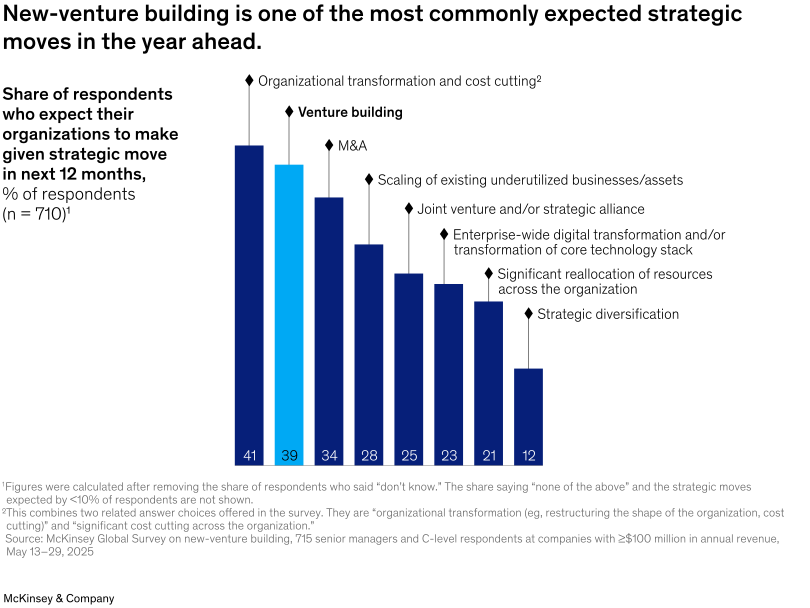
This prioritization is largely driven by leaders’ desire for growth and innovation as they attempt to keep up with gen AI and other technologies and external forces.1 Amazon Web Services (AWS) provides a good example of the promise of such an approach: Originally designed as an internal resource for Amazon’s technological infrastructure, AWS has evolved into a platform generating more than $70 billion in annual revenue.
Even in the current volatile business environment, pursuing new ventures remains a sound strategy: According to McKinsey’s most recent survey on new venture building, even in uncertain times, roughly half of reported new businesses meet or exceed expectations, and those that succeed are reaching $10 million in revenue faster than ever—on average, in just 31 months.2
Still, many new corporate ventures struggle to scale—not because ideas are weak but because there is typically no system to support those ideas. The incentives, governance, and cultural norms established for the core business often are at odds with the speed, risk, and autonomy that new ventures require.
Leaders across the organization, including the chief marketing officer, CFO, and chief human resources officer, should collaborate and coordinate efforts and activities associated with launching and scale new ventures; such large transformation initiatives must be symbiotic. However, it’s the CEO who plays the most central role in resolving the timelines and tensions between new growth and the existing business, although resource allocation decisions cannot be their only focus. Strategy, culture, and governance are just as critical for the CEO to own. Indeed, our research shows that those companies in which CEOs personally prioritize venture building consistently outperform their peers, with new businesses contributing nearly 20 percent of enterprise-wide revenue within five years.3
Our own experience in the field shows that venture-building works best when the CEO behaves less like an operator of the business and more like an architect of a portfolio of future businesses, where the CEO typically must make (and continually revisit) a series of hard choices: For instance, how much capital and talent should the CEO divert from core businesses? How aggressively should the new venture be allowed to cannibalize existing revenue? And how can the CEO help the organization address the common collective action problems that often keep new ventures from achieving their full potential?
Trade-offs aside, there are four areas where the CEO’s attention matters most: setting venture building as a top strategic priority; deciding where to play and what to build; committing capital with patience; and creating the culture, capabilities, and partnerships required for new ventures to thrive.
In this article we explore those four focus areas as well as some of the trade-offs CEOs may need to make to move fast on new ventures without compromising the parent company’s brand or operations.
Setting venture building as a top strategic priority
There’s been perennial debate about whether to keep transformation efforts in an organization separate from the core business or integrate them. McKinsey’s research points to the importance of linking transformation efforts with day-to-day operations; it’s the only way to ensure that change sticks.
Similarly, new venture building can only scale when it’s explicitly treated as part of the overarching corporate strategy rather than just a side effort. The entire organization must see the value of continuous innovation and entrepreneurship and commit to the actions required to seize new business opportunities when they arise.
As the “keeper of strategy,” the CEO is best positioned to send the message that building new corporate ventures, and not just pursuing geographic or product line expansions, is central for growth and that some trade-offs may be required vis-à-vis the core business. In some cases, the core business itself can become the biggest obstacle to building the next one.
The CEO’s framing and conversations with the board, members of the senior leadership team, and employees must echo the organization’s first principles of strategy. Specifically, the CEO should be able to codify the scope and strategic intent of new business building and tell a compelling story about it:
-
Scope and intent. The CEO will need to set parameters for new ventures being proposed: For instance, is the goal here to generate incremental revenue, defend market share, adopt technologies that can help future-proof the organization, or seize another strategic advantage? Should new ventures be designed to complement the core business, replace parts of it, or disrupt it altogether?
When Procter & Gamble’s A.G. Lafley became CEO, innovation at the company was stalled, and growth was inconsistent. Rather than simply tell employees to innovate more, he established strategic guardrails for how and where P&G would build new businesses. Among other rules, he defined specific customer segments and unmet needs to target, prioritizing categories such as home care and beauty. He set new metrics and expectations for where growth would come from: About half of all innovation should come from external partnerships, and growth potential needed to be large scale rather than incremental. Over time, Lafley’s “strategy as choices” model helped P&G significantly improve productivity and growth.4
- Storyline. Just as important, and in collaboration with the CMO and other communications professionals, the CEO must tell a story that convinces investors, employees, and partners that business building is a core growth pillar. For instance, in CEO Andy Jassy’s quest to turn Amazon into a portfolio of AI businesses (a platform, a series of custom chips, infrastructure build-outs, and strategic partnerships), he has explicitly and repeatedly framed AI as a once-in-a-lifetime growth opportunity in conversations with critical stakeholders.5 Jassy is consistent with the narrative, regardless of channel or audience. For instance, he structured his annual shareholder letter to convey the six simple truths about AI. In town halls and other public forums, he built credibility with investors and employees by openly acknowledging the tensions between high capital expenditures associated with AI growth and near-term margin pressures.
Deciding where to play, what to build
Organizations that pursue new ventures must decide which customer segments, geographies, and business models will yield the greatest opportunities for growth. In many cases, they must look beyond their core identity and devise new ambitions for where to play and what to build.
In both instances, the CEO holds significant sway—after all, the chief executive is the only one who can sanction bold moves to step away from business as usual. And given the CEO’s oversight across teams, functions, and geographies, they are best positioned to resolve questions about permissions and boundaries:
-
Where to play and what to build. The CEO’s most important initial act is deciding where to play and what to build. In our experience, the leaders who are best at building new corporate ventures tend to approach these questions with a venture-capital-style mindset and encourage their executive teams to do the same. That is, they manage a portfolio of bets and launch multiple ventures at once rather than looking for a single winner. McKinsey’s latest research on corporate venture building shows that such an approach can enable faster learning and more effective reallocation of resources and can enable companies to outperform: Organizations launching three or more ventures at once can achieve up to 30 percent higher revenue growth over time than organizations that only launch a single initiative.6
Rather than pursuing isolated bets, the CEO and leadership team at Saudi Telecom Company implemented a multiyear, multipronged strategy for launching new businesses that combined a dedicated venture capital (VC) arm, a robust internal incubation pipeline, partnerships, and spin-offs.7 The CEO didn’t just launch ventures; he built a system for continuous new-business building that is paying off: The subsidiaries are growing between 10 and 15 times faster than the core, contributing double-digit revenue growth and supporting margin expansion.8
-
Setting boundaries. The CEOs who are best at new-business building also work in short review cycles (stage gates designed to test a small set of measurable hypotheses) and they aren’t afraid to kill weak ideas and shift resources to higher-potential opportunities. Indeed, given the speed of change, as well as the speed of opportunity, it’s incumbent on today’s CEOs to embed agile practices and mindsets across teams and functions. As ideas for new businesses emerge and develop, outcomes may dictate the need for course corrections. The best venture-building CEOs treat failure as a normal part of the process. They make commitment-rich choices to launch, then “tack” the underlying thesis as circumstances shift and new opportunities surface. They never confuse adaptation with a lack of resolve, however. Only the CEO can hold both halves of that tension at once.
Underneath that tension is an interesting question for the CEO—not “Should we pivot?” but “How should we pivot without destroying trust in the organization’s next big commitment?” That was the situation facing Microsoft’s CEO Satya Nadella in 2014. Microsoft had invested $7.2 billion to acquire Nokia’s handset business, betting it could build a competitive mobile platform from scratch. When it became clear the venture had no viable path to scale against iOS and Android, Nadella chose to write down the entire investment and exit mobile hardware completely, rather than continue adjusting course. The reason? To simply keep patching a failing venture would erode trust in the cloud-first strategy he was asking the entire organization to commit to.9
The most successful venture-building CEOs know the organization’s limits—identifying, for instance, the number of new businesses the organization can realistically sponsor all at once, the maximum number of losses the parent company can absorb, and the minimum evidence required before another tranche of capital is allocated to new ventures. They understand that most bets placed will fail, but what’s most important is reallocating capital, talent, and other resources quickly.
Under CEO Jeff Bezos, for instance, Amazon launched a range of businesses that closed quickly when customer demand and strategic fit proved to be weak—think of the Fire Phone and Amazon Destinations. But given Bezos’s “fail fast and move on” philosophy, where he treats new ventures as options rather than commitments, Amazon has been able to maximize its learning while concentrating investment on eventual success stories like AWS and Prime.
Committing capital with patience
Related to decisions about where to play and what to build, CEOs must be realistic about their capital commitments, especially in the face of economic uncertainty and cyclical pressures on P&L.
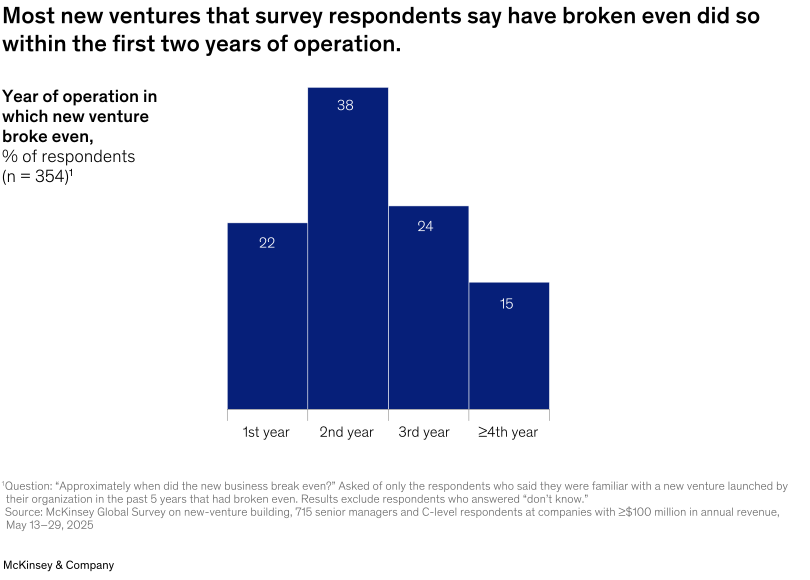
In our experience, the CEOs who are best at achieving growth through new business building are more likely than others to accept some level of short-term risk (again, understanding that not all bets will pay out). They tend to be champions for the long game, understanding that while many ventures nowadays tend to break even within two years, those programs still need sustained backing to scale (Exhibit 2).
Additionally, these VC-minded CEOs tend to be more willing than others to explore different funding dynamics. They are deliberate about how and where venture economics show up. They denote, for example, when costs sit with the parent, when they sit with the venture, and what should be treated as capitalized investments versus near-term operating expenses.
Most of these CEOs eschew fixed budgets and, as mentioned previously, allocate capital dynamically. They rely on stage-gated funding for projects and allocate more capital only when certain thresholds are met. Others have explored partnerships and sponsorships to co-fund and derisk new ventures. The venture-building arm of a global technology company has done a combination of both: Rather than making large up-front investments, the CEO and team has created and tested a series of small ventures internally, and increased funding at various milestones. They also partnered with external investors to mitigate risk and build up organizational tolerance for failure, recognizing that not every experiment would pan out. In this way, the technology company has been able to evaluate a large pipeline of ideas, launch numerous ventures across different sectors, and build a meaningful portfolio or growth business over time.
Setting the right culture, talent, infrastructure, and partnerships
Success with new-venture building requires sustained commitment. Running episodic pilots or focusing only on short-term experiments will not be sufficient. Because the CEO is the main touchpoint and convenor for all key stakeholders, only the CEO can achieve this level of commitment among members of the top team, board directors, employees, and investors.
Culture: Taking risks, sometimes over and over again, is a central tenet of new business building, and yet a lot of organizations still pay only lip service to the idea of psychological safety; employees are often penalized rather than rewarded for experiments and attempts to innovate.
As MIT Principal Research Scientist Andrew McAfee notes in his book The Geek Way (Little Brown, 2023), the CEO’s role here is to legitimize risk-taking as a corporate value, not a career liability. This may mean diverging from corporate rules around incentives, compensation, and operating norms. For instance, in some companies, venture leaders get equity shares or rewards tied to the new venture’s valuation or revenue beyond their base salary or bonus. In other companies, venture builders are given longer-term incentives—as one technology leader did, linking executives’ rewards to the long-term growth of its cloud business. Still other companies have created new “founder track” career paths for employees.
Talent: In many cases, the skills required to launch new ventures may not exist in the organization. Despite any desire to upskill and create internal mobility, CEOs shouldn’t hesitate to look outside for the right skills, even leadership skills. The search for top external talent should be considered a normal if crucial input into the venture-building process. Some CEOs pursued secondments with partner organizations to help transplant important production or engineering practices into their new ventures. Still others have created equity-like upside, earn-outs, or milestone-based compensation to attract external builders.
In all cases, it’s incumbent upon the CEO to find and appoint leaders who can combine start-up agility with corporate strength, regardless of background or function.
Banco de Crédito del Perú (BCP) did just this when launching Yape, a start-up-like organization within its walls. Yape, a mobile wallet provider, was staffed with product development, engineering, and design talent rather than traditional bankers. The company targeted candidates with an entrepreneurial mindset rather than just functional expertise. It organized teams into small, cross-functional squads and gave them clear and complete decision rights on product development. Teams’ performance was measured according to product outcomes, such as user growth and engagement with the digital wallet. Over time, Yape scaled to more than 18 million users and became an important source of growth for BCP.
Infrastructure, governance, and partnerships: New ventures also thrive when CEOs ensure they have the right scaffolding. This may involve setting up “innovation factories,” as the CEO of a large insurer did to accelerate scaling. He organized a shift from legacy systems to modular, API-based architecture, so that new ventures could reuse core capabilities such as payments, identity, and risk. He encouraged organization-wide adoption of cloud, agile and DevOps practices, which would allow for rapid development, rollout, and scaling of new products.
CEOs may also need to set up a separate governance structure for new ventures—where such ventures can remain close enough to the core business to leverage it as needed but independent enough to move at start-up speed. Striking this balance is critical: Overintegration can slow down ventures, but excessive isolation can limit their ability to scale.
The CEO at a large commercial bank in the Middle East worked with others in the company to remove many of the organizational barriers that typically slow business-building efforts. For instance, he established protocols for cross-functional collaboration across business, technology, and risk functions, and he supported a stage-gated funding model that allowed teams to drop weak ideas early, thereby improving capital efficiency. In this way, the CEO shifted performance expectations toward rapid experimentation and delivery. He protected pilots from bureaucracy and ensured that the successful ones were ultimately embedded within core operations.
Both cases make the same point: Balancing speed with risk, compliance, and financial control isn’t a trade-off to manage once; it’s a structural choice about who sits at the table, made early enough that it doesn’t have to be relitigated every time the venture moves fast.
Indeed, it’s important to remember that product–market fit is not the finish line; it is the handoff point. The most successful venture-building CEOs recognize this and routinely ask themselves four important questions related to venture integration, ownership, and time to scale:
- Will the venture remain stand-alone, be folded into a business unit, or become a shared platform?
- Who owns the P&L and the customer relationship—venture leadership, a business unit president, or a combination of venture and sponsor?
- How can leaders reconcile the incentives associated with the venture with those associated with the core business without stripping the venture team of upside rewards too early?
- How does governance need to change so the venture can maintain production speed while still paying attention to nonnegotiable elements such as risk, compliance, and financial control?
Without answers to these questions, ventures will remain orphans, and CEOs and leadership teams will face conflicts among teams within the same organization that are competing in the same channels, for the same customers, with similar brands.
Two key enablers of building new businesses: Technology and board support
The four business-building priorities for CEOs—setting venture building as strategy, choosing where to play and what to build, committing capital with patience, and building culture, capabilities, and partnerships—do not play out in isolation. Two forces increasingly determine whether the CEO’s actions will result in scaled businesses: how ventures use technology, especially AI; and how leaders and boards judge new ventures’ progress when traditional corporate metrics don’t fit.
Using the latest technology
Technology, and AI in particular, must be a strategic input into CEOs’ decisions about where to play and what to build. AI is reshaping customer propositions, operating models, and industry economics. It is also allowing serial business builders to stand up new ventures more quickly through reusable data, modules, and platforms.
In fact, AI is changing the build-versus-buy equation for many CEOs and leadership teams. Historically, there has been a bias toward “buying” rather than “building” new assets as a means to enter an adjacent market or geography. It’s the quickest path to initial scale given built-in talent, revenues, and other factors—or so the logic has gone. Now, however, AI is reducing the cost of experimentation, accelerating building phases, and enabling AI-native business models. Increasingly, CEOs and teams are more likely to emphasize “building this right from the get-go” rather than acquiring an asset and having to go back and rewire it.
It should come as no surprise, then, that 56 percent of the more than 700 companies polled by McKinsey in 2025 said they were planning to build AI-driven ventures within the next five years, and nearly all expect AI integration to be mandatory.10 In fact, more and more CEOs are reconsidering not just how they build new ventures, but, in this age of AI enablement, how many new businesses they can pursue in parallel and how quickly capital and talent can be allocated across initiatives.
Using the right performance metrics
CEOs need committed partnership from boards and investors, but only if all players adhere to the concept of “patient capital” and agree to assess new ventures’ performance using the following stage-appropriate markers:
- Validation. The venture has achieved product–market fit.
- Momentum. The venture is scaling faster than competitors.
- Sustainability. The venture is meeting early profitability and operational-excellence goals.
- Evolution. The venture has expanded into adjacent markets, product lines, or geographies.
The CEO will need to advocate for the use of such markers, rather than corporate P&L expectations alone, to prevent premature pressure from the board for profitability from the new venture, while still maintaining clear accountability. As a venture moves from validation to momentum and sustainability, boards and investors should expect the CEO to establish a new baseline and assign new owners to ensure that performance metrics still make sense in the new context and to explicitly acknowledge that the venture is crossing from an option to an operating reality.
The CEO is the only one who can keep new-business building anchored as a core strategic priority, not a siloed innovation effort. They can set clear guidelines for how ideas are tested and scaled. They are singularly qualified to tell the “right” story—one that convinces investors, employees, and partners about the benefits of growth and the potential outcomes from new-business building. And they are best positioned to step in with authority when important decisions stall. As allocator in chief, the CEO can commit capital ahead of outcomes, enforce investment stage gates, and kill underperforming projects despite internal politics. They can unlock the parent company’s decisive advantages—in customers, data, and capabilities—and help turn those assets into repeatable pathways for new growth.
Ultimately, only the CEO can turn business building into a durable operating capability: funding the talent, platforms, and governance needed to consistently create and scale new ventures.
Related Articles

Collective action, collective success: A CEO’s role in transformations