At a glance
- Women in Switzerland spend about 30 percent more time in poor health than men, often because of conditions that affect women differently or disproportionately—for example, dementia, mental health, musculoskeletal pain, and cancer.
- Closing the women’s health gap would create an average of eight additional healthy days per year for every Swiss woman, an opportunity that would unlock more than 7 billion Swiss francs in annual GDP (around 1 percent of GDP, comparable to Switzerland’s long-term average annual growth rate) by 2040. It would do so primarily by addressing gaps in efficacy, care delivery, and data where possible, which would enable more women to participate fully and productively in the workforce.
- Achieving this requires coordinated effort across Switzerland’s healthcare system, life sciences, employers, start-ups, investors, policymakers, philanthropy, and consumers, moving from fragmented cantonal approaches toward a more unified, sex-aware national agenda under clear national ownership.
- Closing the gap benefits everyone. Sex-aware medicine produces more precise diagnostics, safer dosing, and more effective treatments for all patients, not just women.
Switzerland consistently ranks among the world’s healthiest nations. Life expectancy for Swiss women stands at approximately 85.9 years, versus a global average of 73.8, while men are at an average of 82.4.1 This is supported by a well-funded mandatory health insurance system established under the Federal Health Insurance Act (KVG/LAMal), advanced healthcare infrastructure, a strong tradition of biomedical innovation, and favorable socioeconomic and lifestyle factors.2 Yet longer life span alone does not equate to being healthy across the life course; many people spend a meaningful proportion of those years contending with chronic conditions and disabilities that limit their independence, career contribution, and quality of life.
Compared with men, women in Switzerland spend 30 percent more time in poor health, with varying degrees of disability.3 The burden is not marginal; it translates into weeks of lost vitality each year, accumulating across a woman’s lifetime into years spent managing preventable or undertreated conditions.4 This reduces women’s ability to be present and experience their full potential at home, at work, and in their communities, keeping them from pursuing what they value most (see sidebar “Terminology used in this article”).
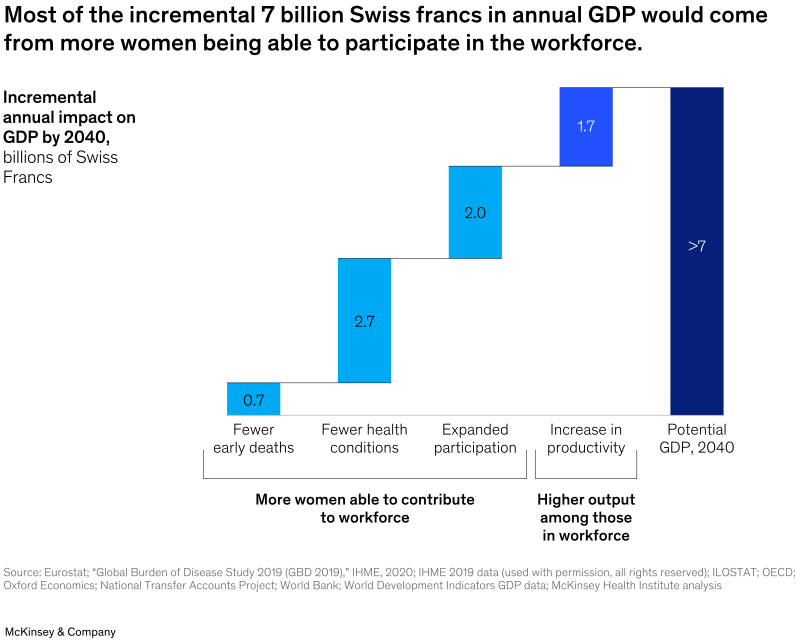
Our analysis indicates that closing the women’s health gap in Switzerland could generate more than 7 billion Swiss francs in additional annual GDP by 2040—around 1 percent of GDP, in line with the country’s historical average yearly growth5—through fewer early deaths, fewer health conditions, expanded participation, and increased productivity. It could also deliver around eight additional healthy days per woman per year.6 This positions women’s health as a substantial source of potential growth for the Swiss economy. The estimate is likely conservative, given persistent undercounting and data gaps in conditions such as endometriosis, menopause, and polyendocrine metabolic ovarian syndrome (PMOS), formerly known as polycystic ovary syndrome (PCOS), characterized by incomplete and delayed diagnoses.
Switzerland is home to one of the world’s highest concentrations of pharmaceutical, biotechnology, and medical-device companies. Ferring Pharmaceuticals, Galderma, Lonza, Novartis, Roche, Sandoz, and hundreds of medtech firms make the country a global leader in health R&D. The pharmaceutical sector is one of the country’s most important industries, accounting for approximately 5 to 6 percent of GDP and more than one-third of total Swiss exports.7 While Swiss life science companies have participated in women’s health innovation through partnerships, accelerators, and venture investments,8 the share of industry R&D and investment capital specifically dedicated to women’s health is not publicly disclosed. Globally, however, women’s health accounts for only about 5 percent of health R&D funding, suggesting substantial scope for increased investment and a similar pattern in Switzerland.9 Using Switzerland’s positioning in health innovation more proactively could meet an opportunity to deliver worldwide benefits to society and economic growth by exporting new ways of closing women’s health gaps.
A FemTech Analytics landscape shows that the number of Swiss femtech companies has grown from 33 in 2021 to 45 in 2025—rising by approximately 8.1 percent annually over four years.10This estimated growth is lower than the projected global femtech market revenue growth of approximately 14 to 16 percent annually, but it nevertheless points to increasing entrepreneurial activity in the Swiss women’s health sector, particularly considering the country’s size.11 By comparison, Germany is home to about 100 femtech start-ups serving a much larger population, so Switzerland’s ratio of femtech per capita is four times that of Germany.12
In 2024, the Swiss Federal Council adopted a report in response to a 2019 postulate that identified areas for action to address women’s health disadvantages and directed federal agencies to implement measures in research, education, prevention, and healthcare.13 However, Switzerland does not yet have a dedicated national women’s health strategy. Other high-income countries have taken steps to prioritize women’s health: Australia, Austria, Canada, and the United Kingdom, have introduced national strategies, and a few other countries, including Germany, have made investing in women’s health a national priority.14
Closing this gap is not the mandate of any single institution. It requires coordinated action from healthcare providers and clinicians, life sciences and pharmaceutical companies, employers, start-ups and femtech innovators, investors and capital allocators, policymakers and regulators, philanthropy and foundations, and insurance companies, as well as consumers and patients themselves. Each stakeholder holds a distinct role in addressing the part of the gap it is best placed to close, moving from sex-disaggregated data and research, through consistent clinical pathways and equitable access, to the incentives and capital needed to scale what works across all 26 cantons (see sidebar “Research methodology”). Shared opportunity demands shared responsibility: No actor can close the gap alone, but none is exempt from the effort.
The women’s health gap: A whole-life, whole-system challenge
Women’s biology differs from men’s at every level: in genetics (X chromosome dosage, sex-specific epigenetic regulation), in hormonal architecture that shifts across the life course, in immune function (stronger adaptive responses but higher autoimmune risk), in body composition, organ physiology, and drug metabolism. These are not marginal differences. They influence how diseases develop, how symptoms present, how treatments perform, and when conditions emerge. A woman’s cardiovascular risk profile, pain processing, cognitive patterns, gut microbiome, and pharmacokinetic response to medication all reflect sex-specific biology—which means that a health system built primarily on evidence from male-majority cohorts will, by design, serve women less well.
In public discourse and often in policy, “women’s health” defaults to reproductive health. However, this framing is too narrow. In Switzerland, only 8 percent of women’s total health burden comes from conditions unique to women, such as gynecological diseases, maternal conditions, and menopause-related burden (Exhibit 1).
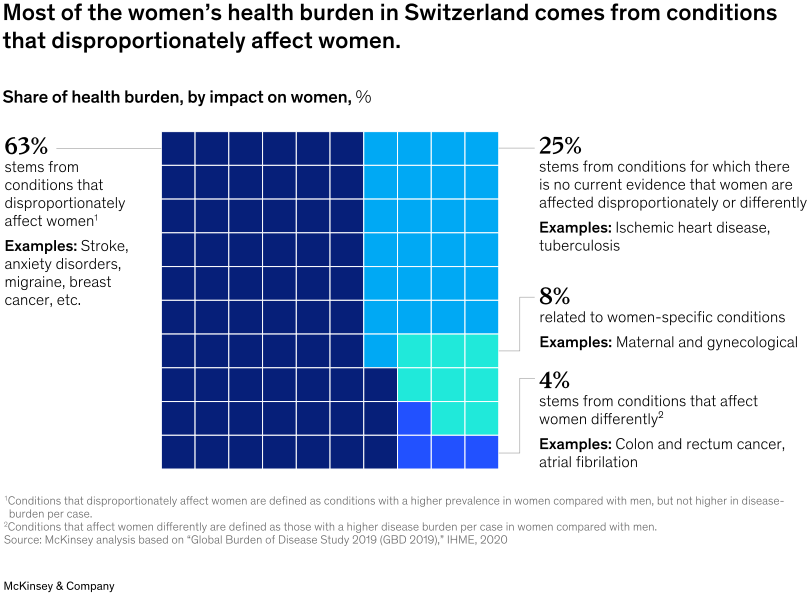
The majority of the health burden in Switzerland (63 percent) stems from conditions that affect both sexes but are more prevalent among women, including stroke, anxiety disorders, migraine, hypertensive heart disease, and breast cancer.15 A further 4 percent comes from conditions that affect women differently than men. Conditions for which there is no current evidence that women are affected disproportionately or differently account for just 25 percent of the burden in Switzerland, compared with 43 percent globally.
These differences reflect Switzerland’s epidemiological profile: Many infectious conditions, such as lower respiratory infections, and neonatal conditions—which tend to exhibit smaller sex differences—have largely been eliminated, leaving chronic conditions such as dementia, mental health disorders, musculoskeletal diseases, and cancer as the dominant drivers of ill health. Many of these conditions either disproportionately affect women or affect them differently than men, contributing to the relatively low share of conditions with no meaningful sex difference.
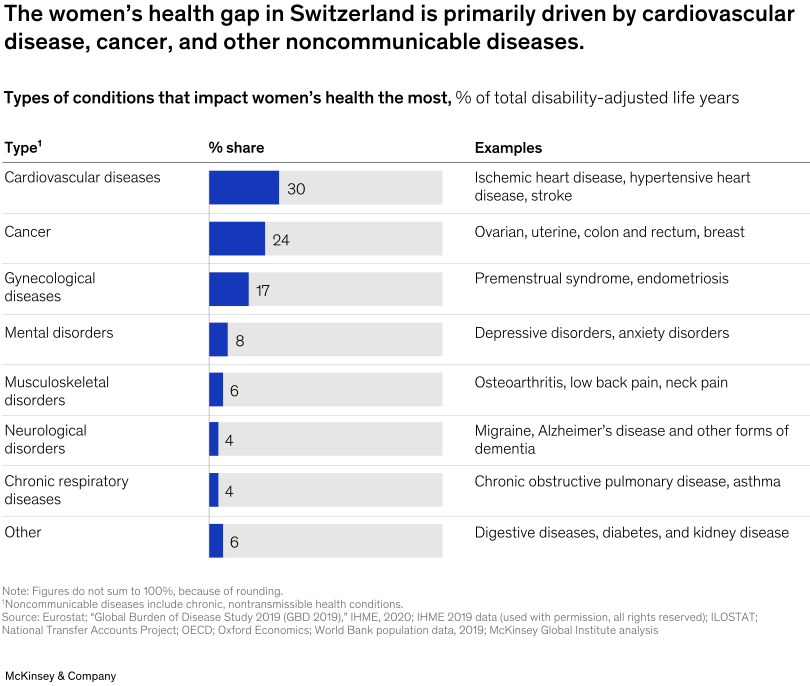
That is the picture in absolute terms. However, it does not fully capture the challenge: Compared with men across conditions, women experience a higher health burden, resulting in a persistent women’s health gap. Some of this gap reflects diseases unique to women, but most of it arises from conditions that affect both sexes, where women may experience different prevalence, presentation, and burden. Cancer and cardiovascular disease together account for more than half of the Swiss women’s health gap (24 percent and 30 percent, respectively), followed by gynecological conditions at 17 percent. Mental, musculoskeletal, and neurological disorders each contribute further to the health gap (Exhibit 2).
Several of these categories illustrate a wider point: Medicine has historically been tested on and tailored to male-default models. Considering differences in female biology would make clinical diagnoses and care more precise for everyone. The clearest example may be cardiovascular disease. While chest pain remains the most common symptom in both men and women with acute coronary syndrome, women are more likely than men to experience certain other symptoms.16 As Felix Mahfoud, chief physician of cardiology at University Hospital Basel, explains, “Women often suffer from less typical symptoms [than men] such as shortness of breath, fatigue, nausea or nonspecific chest pain, which can delay diagnosis. In addition, women are often affected by special forms of heart disease, such as dysfunction of the smallest coronary vessels or myocardial infarction without narrowing of the vessels.”17 These conditions are not rare, but recognizing them requires clinicians to look beyond the textbook presentation that was historically derived from male cohorts.
Swiss data confirm the practical consequences of the current diagnostic approaches. For example, women have 34 percent lower odds of being diagnosed with hypercholesterolemia and 23 percent lower odds of being treated once diagnosed, a gap that persisted between 2002 and 2022 despite universal coverage.18 These differences can also translate into poorer outcomes. Swiss registry data found in-hospital mortality following severe heart attacks to be about 25 percent higher among women than men (6.9 percent versus 5.5 percent).19
Mental health follows a similar pattern. Women report higher depression rates (12 percent versus 8 percent overall and 26 percent versus 13 percent among 15- to 24-year-olds), although this gap likely reflects both genuine differences in prevalence and the well-documented reluctance of men to disclose or seek help for mental health conditions. Stigma operates in both directions, discouraging women from escalating symptoms and discouraging men from reporting them at all, meaning the true burden may be underestimated for both sexes, albeit in different ways.20 In addition, Switzerland’s 26 cantons plan and fund psychiatric services independently, creating regional variation in access that affects men and women alike.21 These are not niche problems requiring new infrastructure; they are common conditions across cantons, where existing interventions could perform better for both sexes if calibrated to sex-specific biology and presentation, while accounting for the social and structural contexts in which care is delivered.
The women’s health gap is not static. It shifts across the course of life, with gynecological conditions and mental health dominating in early adulthood. Cancer, cardiovascular disease, and musculoskeletal conditions rise in midlife as hormonal transitions reshape risk profiles.22 Cardiovascular disease and cancer become dominant in later stages of life (Exhibit 3).23 Depression risk alone increases by 70 percent in perimenopausal women with a prior history.24 Mental disorders run through every life stage, from age ten to 70 and beyond.
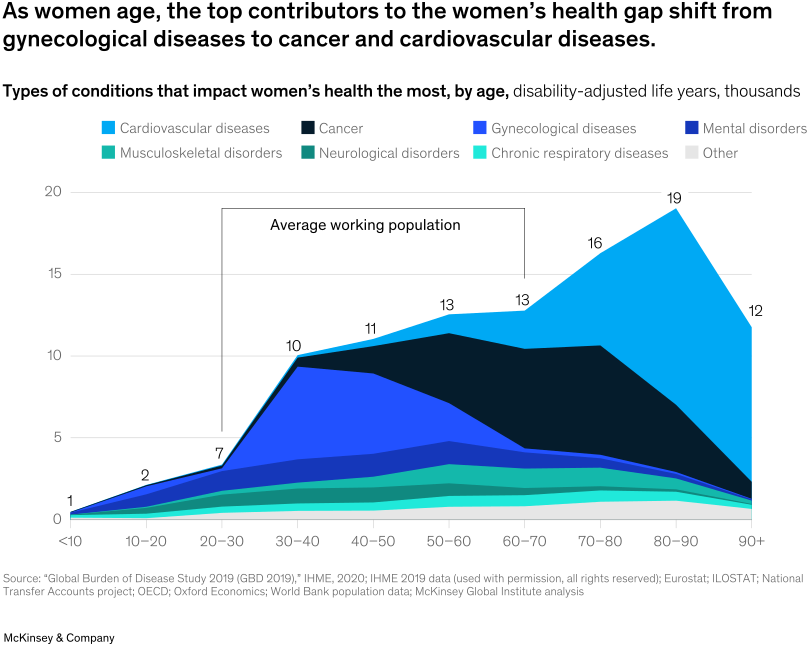
Together, these shifts illustrate a life course continuum. Health at one stage can shape risks and outcomes at the next, while decisions around work, care, and family accumulate over time. This interconnected trajectory underscores why women’s health extends far beyond reproductive health. Also, the 30 percent gap is an average and can hide important differences between women. Life circumstances such as socioeconomic status, motherhood, partnership status, working patterns, and unpaid care responsibilities may place a greater burden on some groups than others.
The economic impact: An opportunity to capture 7 billion Swiss francs
The women’s health gap shows up in lost time—hours spent in pain, months managing symptoms, and years waiting for a diagnosis. Our analysis finds that this lost time adds up to the equivalent of eight days per woman per year in Switzerland. This lost time falls heavily during women’s working years, when health most directly affects participation and ability to be at their best. Closing the gap would therefore do more than improve health outcomes. It also would enable more women to enter, remain, and thrive in the workforce, strengthening both individual well-being and national economic performance. In a country where annual GDP growth was just 1.4 percent in 2024 and skilled-labor shortages persist across sectors (for example, healthcare, construction, engineering), this is not a marginal concern.25
Switzerland’s shifting demographic outlook reinforces the relevance of women’s health for the economy. According to the Swiss Federal Statistical Office’s 2024 reference scenario, Switzerland’s working-age population is projected to increase by approximately 0.4 million by 2055 while its 65-plus population increases by about 0.9 million, leaving roughly two working-age persons per retiree.26 The demographic drag on GDP per capita is set to increase fivefold, from −0.1 percentage points per year over the past quarter century to −0.5 percentage points through 2050.27 With around one-third of Switzerland’s workforce holding a foreign nationality, labor migration contributes to mitigating the pressure.28 In this context, women represent a substantial part of Switzerland’s domestic labor reserve. Time spent in poor health is especially relevant during the working years, when participation and working time matter most. At the same time, as the senior population grows, informal care demands will rise, and women already shoulder the majority of that burden (59 percent).29 Without action, the women’s health gap risks creating a double squeeze—reducing women’s capacity to work while simultaneously increasing the care demands placed upon them. These pressures extend beyond the workplace. Childcare, eldercare, and household responsibilities make up a substantial part of women’s overall workload and can shape their capacity to participate in paid work.30
Switzerland has one of the highest female labor force participation rates: 81 percent of working-age women are economically active, compared with an EU average of 71 percent and an Organisation for Economic Co-operation and Development (OECD) average of 67 percent.31 Yet high participation goes hand in hand with widespread part-time work: About 60 percent of employed women work part-time.32 This amplifies the economic stakes. When more women are already in the workforce, each day of health-related lost productivity registers directly in national output. Women already face a higher share of this burden, with a health-related absence rate of 4.3 percent, compared with 3.6 percent for men.33 Closing the women’s health gap not only improves women’s lives but also is part of Switzerland’s answer to a tighter labor supply, weaker productivity, and therefore slower growth. Of the estimated 104,000 additional healthy life years that could be gained by closing the gap, more than half (52 percent) would occur during women’s working years, translating into approximately 77 percent of the 7 billion Swiss franc GDP opportunity (Exhibit 4). The impact peaks for those aged 40 to 50, the group where chronic conditions accumulate and presenteeism bites hardest (see sidebar “The payoff from workforce investment”).
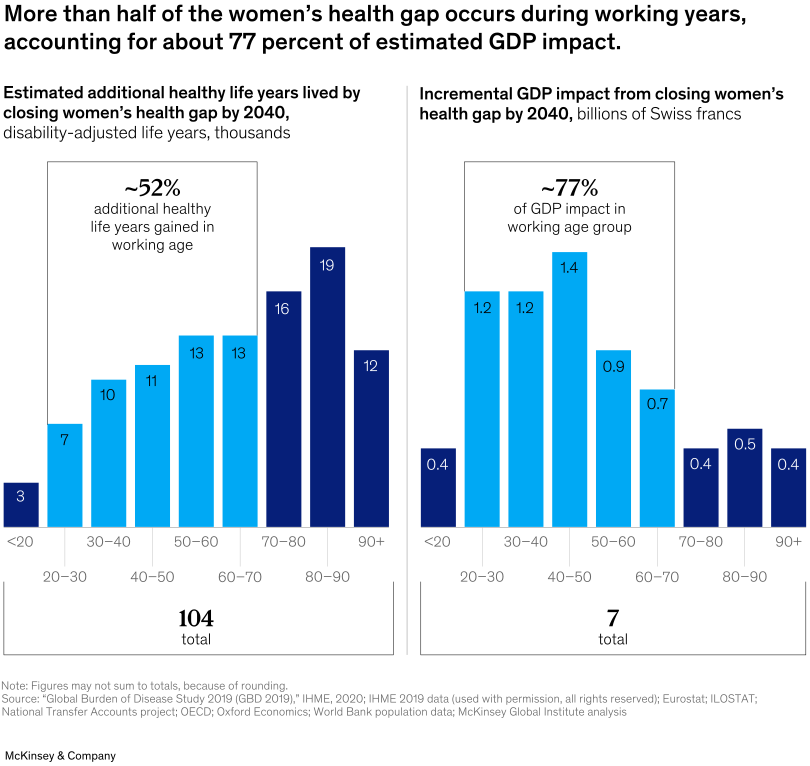
Of the total GDP opportunity, the largest share comes from enabling more women to contribute to the workforce, thanks to fewer early deaths, fewer health conditions, and expanded participation; the remainder comes from higher productivity among those already at work (Exhibit 5). Also, Switzerland is investing in initiatives that support people’s well-being and prolong their participation in the workforce. One example is the HAWK study at Bern University of Applied Sciences, launched in 2025. Over three years, the study will examine health, aging, and work among women 45 or older in Swiss healthcare settings. Its objective is to deepen understanding of gender-specific aging in the workplace, using (peri)menopause as a key example.34 Although promising, this remains isolated as an individual example. Scaling such programs across the country could lead to decisions that help close the women’s health gap by informing earlier recognition, improving access to care, and providing support calibrated to women’s needs at each life stage—reducing the likelihood that women reach a tipping point and leave the workforce.
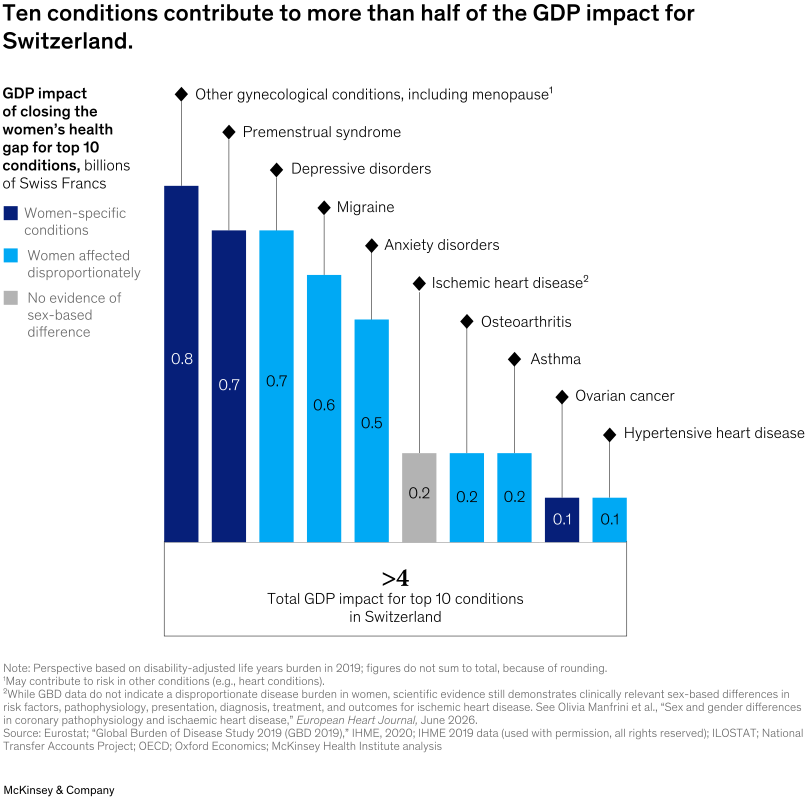
Addressing the gap before workforce exit could concentrate on ten conditions that together account for more than half of the total GDP impact (Exhibit 6). The top four conditions—gynecological conditions (including menopause), premenstrual syndrome (PMS), depressive disorders, and migraine—represent a GDP increase of 2.8 billion Swiss francs. In these four conditions, symptoms can be shaped by hormonal changes across the life course, so better measurement, understanding, and targeting of hormonal influences on symptoms could be a core component of success. This is an area where Switzerland’s life sciences ecosystem is well positioned to lead, given existing strengths in endocrinology and neuroscience.
The drivers of the gap: Efficacy, care delivery, and data
Closing the women’s health gap in Switzerland requires tackling three main drivers as the structural causes of the gap globally35:
- efficacy—interventions sometimes performing less well for women than for men
- care delivery—missed diagnoses, delayed referrals, and incomplete follow-up, which often show up as preventable underscreening, underdiagnosis, and undertreatment
- data—women remaining undercounted, understudied, and less visible in health systems and research
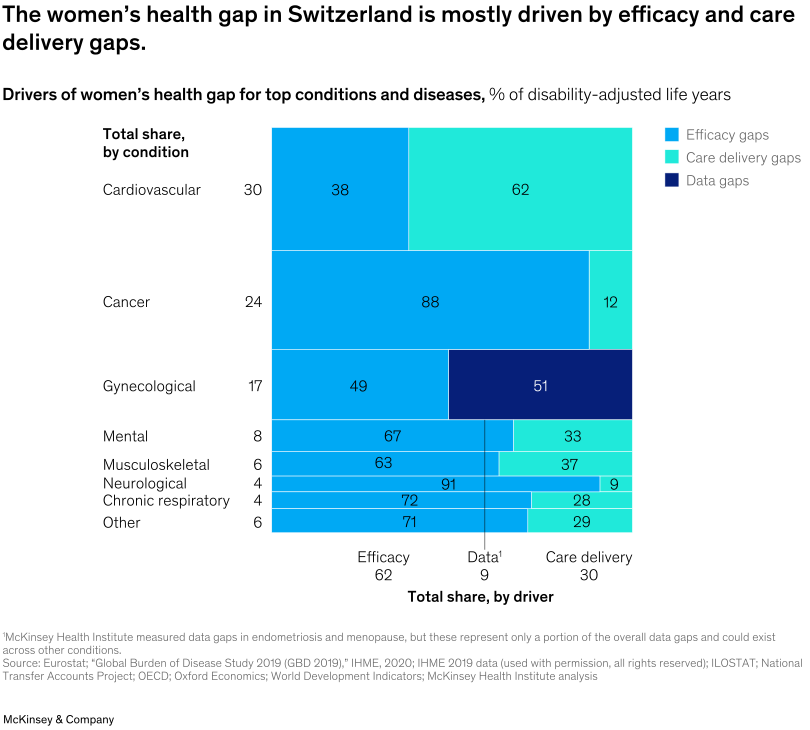
Across condition types, efficacy and care delivery account for most of the quantifiable burden (Exhibit 7). The impact of data appears smaller because it is harder to isolate and is captured more narrowly. Addressing all three will require investment and coordination but also opens opportunities for innovation, economic growth, and better outcomes.
When examining these drivers in more detail, it is worth noting that the health gap and the GDP impact reflect different dimensions of the same challenge. The health gap, measured in disability-adjusted life years (DALYs), captures both premature mortality and years lived with disability, which is why conditions such as cancer and cardiovascular disease feature prominently. The GDP impact is shaped more by conditions that affect women’s quality of life and capacity during their working years, such as gynecological diseases, mental health conditions, and migraines.
Efficacy gap: A design problem
About two-thirds (62 percent) of Switzerland’s women’s health gap is driven by an efficacy gap. The lower efficacy of some healthcare provided to women often reflects a male-default evidence base. Narrowing the gap requires research and treatment redesign to include the impact on women.
The male-default model. For decades, medical research and clinical trials disproportionately centered on male biology, creating a male-default model for evidence, thresholds, and treatment protocols. Even when women receive guideline-based care, the underlying science may not always be well calibrated to female biology, because women were underrepresented in the cohorts that shaped diagnostic cut-offs, dosing conventions, and the signs and symptoms considered “typical.”
The consequences. The result is a predictable pattern. Conditions that look different in women are more likely to be overlooked or misclassified, while gaps in the evidence base continue to limit the effectiveness of care. Moreover, innovation progresses more slowly in women-specific conditions or conditions that affect women differently or disproportionately.
The pattern is visible across condition groups. In oncology, women often tolerate standard cancer treatments less well than men, yet protocols rarely adjust for it. Across chemotherapy, immunotherapy, and targeted therapy in cancer clinical trials, women had about one-third higher odds of severe adverse events than men: 68.6 percent of women versus 62.2 percent of men experienced at least one (odds ratio 1.34). The gap was similar for severe symptomatic adverse events, such as gastrointestinal symptoms, pain, or sleep problems: 33.3 percent of women versus 27.9 percent of men (odds ratio 1.33). Both odds ratios are adjusted for age, race, obesity, disease prognosis, and decade of trial enrollment.36The gap is most pronounced among patients receiving immunotherapy, where women had 49 percent higher odds of severe adverse events overall and 66 percent higher odds of severe symptomatic adverse events. Women are also more susceptible to serious hematologic complications from fluorouracil-based chemotherapy, including leukopenia and neutropenia, making treatment interruptions and dose reductions more likely.37 Those interruptions are not benign. Each four-week delay in systemic therapy is associated with a 6 to 8 percent increased mortality for surgical indications, rising to 13 percent for adjuvant colorectal treatment.38
In mental health, sex differences in the pharmacokinetics of several antidepressants, including SSRIs, are well documented and can result in higher drug exposure in women at equivalent doses, with potential implications for tolerability and adverse effects.39 Women also receive antidepressants much more frequently than men in Switzerland (11.6 percent versus 6.3 percent in 2021).40 This may partly reflect higher rates of moderate to serious depression among women but may also be driven by selective use of antidepressants (for example, SSRIs and SNRIs) in cases of menopausal vasomotor symptoms.41 Greater consideration of sex-specific pharmacokinetics could therefore help inform more individualized prescribing.
Corrective measures in Switzerland. The good news is that Switzerland is starting to build the evidence base to understand sex-specific differences in, for example, diagnostics, treatment response, and care. In 2023, the Federal Council established a Gender Medicine and Health national research program, NRP 83, led by the Swiss National Science Foundation (spending 11 million Swiss francs on 19 research projects, operational from 2025).42
Although modest in scale relative to the efficacy gap, this is an important signal. The next step would be to connect the research insights with life science innovations, so that sex-specific findings inform the future of diagnostics, dosing, and treatment guidelines.
Care delivery gap: Shortfalls in timeliness and quality of care
About one-third (30 percent) of the women’s health gap in Switzerland is driven by a care delivery gap, meaning women are less likely to receive timely, high-quality care that is already known to work. Identifying these shortfalls can enable the identification of opportunities to strengthen the delivery of evidence-based care for women.
Uneven execution across the entire care pathway. Symptoms that present differently in women are less likely to be recognized early, referrals can be slower, and follow-ups can be fragmented across providers.43 Even when women seek help appropriately, the system may not escalate care quickly enough in time-critical conditions or may leave women cycling between general practitioners (GPs) and specialists without resolution for chronic conditions.
In Switzerland, these problems are amplified by a decentralized structure: Each of the 26 cantons governs its own health system, with no single national authority mandating consistent pathways or tracking performance across them. A cantonal system carries inherent trade-offs. On the one hand, smaller decision-making units can adopt innovations faster. For example, in 2024, Jura became the first Swiss region to pilot an integrated care network, which brings together health insurers, service providers, and public authorities to overcome traditional boundaries in the Swiss system. Patients benefit from coordinated pathways of care, including prevention services, chronic-disease management, and a dedicated gatekeeper who ensures continuity across providers.44
On the other hand, 26 parallel systems mean proven interventions take years to scale, cantonal populations are often too small to detect quality gaps statistically, and no single authority can mandate a national care pathway or enforce data standardization. For example, the electronic patient dossier, intended to bridge these gaps, has reached just 1.3 percent adoption, with most GPs still lacking compatible systems.45 The challenge is therefore more than the federal system alone. Switzerland’s cantonal structure can enable faster regional experimentation, but without common data standards, outcome measures, and scaling mechanisms, successful local models can remain difficult to spread nationally.
Swiss oncology data illustrate how care delivery gaps appear in specialized clinical settings. A 2026 study found that women with non-sex-specific cancers reported poorer care experiences, including lower reported receipt of written care plans, pre-surgery information, follow-up support, and help managing treatment side effects.46 These findings may reflect differences in patient needs and expectations as well as variation in how care is communicated and coordinated. This reinforces the need for care pathways and clinical standards that also address information, navigation, psychosocial support, and follow-up.
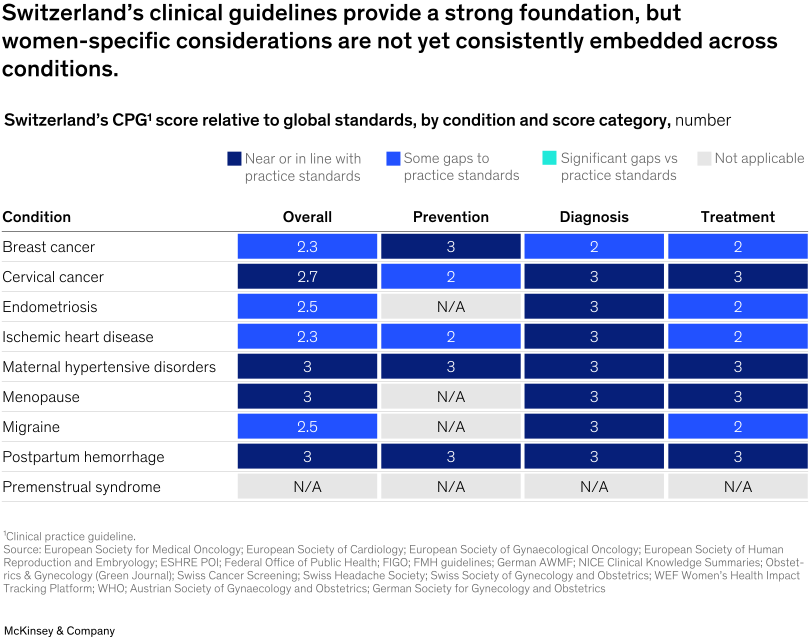
Clinical practice guidelines can help—under the right conditions. In Switzerland, clinical practice guidelines (CPGs) represent one of the strongest tools for closing women’s healthcare gaps, yet important limitations remain. Unlike more centralized systems such as that of the United Kingdom, Switzerland does not rely on a single national guideline authority. Instead, care pathways are shaped through a combination of Swiss professional societies, international guideline bodies, and established cross-border collaborations. For example, the Swiss Society of Gynecology and Obstetrics (SGGG) has participated in a joint guideline development program with its German (DGGG) and Austrian (OEGGG) counterparts since 2015.47 Switzerland also draws on international guidelines such as those of the European Society for Medical Oncology (ESMO), the European Society of Human Reproduction and Embryology (ESHRE), the European Society of Cardiology (ESC), the International Federation of Gynecology and Obstetrics (FIGO), and the International Society for the Study of Hypertension in Pregnancy (ISSHP). While many of these guidelines are clinically advanced, the extent to which they address women-specific needs varies across conditions and stages of care.
To evaluate Switzerland’s CPG landscape, we applied the methodology of the Women’s Health Impact Tracking Platform across nine women’s health conditions (Exhibit 8). Our assessment finds that guidelines are most closely aligned with global standards for maternal hypertensive disorders, postpartum hemorrhage, and menopause, with cervical cancer also scoring highly. For selected oncology and obstetric conditions, where care is highly protocolized, multidisciplinary care, accreditation systems, and hospital protocols can also help translate guideline recommendations into routine practice. However, gaps remain in several conditions, including breast cancer, where guidelines score strongly on prevention but show gaps in diagnosis and treatment, as well as ischemic heart disease and migraine. For premenstrual syndrome, no formally endorsed Swiss clinical practice guideline was identified under the assessment criteria, highlighting an opportunity for more standardized clinical guidance. Because Swiss CPGs are largely operationalized through specialist societies, hospital systems, and reimbursement structures rather than a centralized national mandate, improving the integration of sex- and gender-specific recommendations into these frameworks and supporting their consistent adoption could have a broad impact on care delivery for women across Switzerland.
Perils of the care delivery gap. When minutes matter, variation in early assessment can shape women’s outcomes within days. Women have a 50 percent higher chance than men of receiving the wrong initial diagnosis following a heart attack, and when the first decision is wrong, the consequences are substantial. Patients who receive an incorrect initial heart attack diagnosis face around a 70 percent increased risk of death within 30 days.48 A Swiss cross-sectional study found sex-related inequalities in management of acute coronary syndrome. Among younger patients admitted to Swiss hospitals with acute coronary syndrome, women under 50 had 38 percent higher adjusted odds of in-hospital death than men of the same age range.49 In Switzerland, analysis of 20 years of national health survey data found persistent sex disparities in hypercholesterolemia management. In 2022, women had 34 percent lower odds of being diagnosed and, once diagnosed, 23 percent lower odds of receiving treatment than men, with no evidence that these disparities narrowed between 2002 and 2022.50
In the weeks and months after pregnancy, gaps in continuity and follow-up can translate into elevated risk for years. Approximately 17 percent of Swiss women are affected by mental health conditions during the perinatal phase, yet barely 20 clinics across the country accept mothers together with newborns, and no national perinatal mental health program exists.51 The solutions are known and cost-effective. Modeling estimates a three- to six-times return on investment from targeted perinatal depression interventions, but they remain unscaled. A collaborative home treatment pilot involving Berner Fachhochschule, Inselspital, Universitäres Psychiatrisches Zentrum Bern, and other partners aims to address this gap but remains a single-site initiative, leaving most women to navigate the transition without coordinated support. The researchers are planning to trial the model in 2027, subject to funding.52 Cardiovascular risk follows a similar pattern. Preeclampsia and other hypertensive disorders affect up to 5 percent of pregnancies and at least double a woman’s lifetime risk of cardiovascular disease.53 Yet once the obstetric crisis resolves, Switzerland has no standardized pathway to transition these women into long-term cardiovascular follow-up, although individual hospitals such as Universitätsspital Zürich (USZ) have begun to close this gap locally through automated referral pathways. Doing so costs much less than the costs per major cardiac event averted.54
When care delays become the default over years, gynecological conditions can impose a long-run burden on women’s lives. Internationally, the average time to an endometriosis diagnosis is around four to 12 years.55 But diagnostic delay is not confined to gynecology. A population-wide analysis of 6.9 million patients found that women are diagnosed on average four years later than men across more than 700 diseases, 2.5 years later for cancer, and 4.5 years for metabolic diseases such as diabetes.56 Swiss evidence points to similar disparities. In 2022, women were more likely than men to undergo diabetes screening yet had 29 percent lower odds of being diagnosed and, once diagnosed, 44 percent lower odds of receiving treatment.57 This is not explained by less help-seeking behavior. Women consult GPs more frequently than men,58 but health systems are slower to convert disease manifestation into diagnosis when symptoms diverge from male-centered clinical patterns.
Islands of excellence. Switzerland is beginning to build the care delivery infrastructure for sex- and gender-aware medicine. The University of Zurich appointed Switzerland’s first female professor for gender medicine in May 2024, and Unisanté Lausanne hosts a dedicated gender health research unit, Unité santé et genre (Health and Gender Unit).59 University Hospital Zurich operates a dedicated Women’s Heart Clinic as part of its Women’s Heart Health Program, University Hospital Basel opened a dedicated Women’s Heart Consultation in March 2025, and HUG Geneva launched its Women’s Cardiovascular Health Center in March 2026.60 However, for now, these remain islands of excellence.
Overcoming cantonal fragmentation. Prevention depends on infrastructure, and cantonal fragmentation contributes to uneven access across the country. Switzerland has no nationally organized cervical screening program, relying instead on opportunistic screening, with uptake varying across population groups. HPV vaccination coverage remains below the World Health Organization’s (WHO’s) 90 percent target nationally, with Geneva and Schaffhausen (through school services) among the highest-performing cantons, reaching around 80 percent.61 By contrast, HPV vaccination coverage among girls in Appenzell Innerrhoden is below 30 percent, reflecting substantial disparities between Swiss cantons in vaccination uptake and access.62
Mammography screening shows how uneven the rollout has been: As of June 2026, 16 cantons ran organized programs and seven more were introducing or planning one, while Zürich, Obwalden, and Nidwalden had none, with political motions still pending.63 Where programs exist, screening is covered by basic insurance and exempt from the deductible for eligible women aged 50 to 69 (up to 74 in some cantons), who pay a small co-payment. Where programs do not exist, basic insurance usually does not cover a purely preventive mammogram unless there is a family history of breast cancer, leaving women to rely on supplementary insurance, pay out of pocket, or forgo screening entirely.64 A woman’s access to early detection depends in part on where she lives—a feature of decentralization that, in this case, works against consistent care.
The common thread across all of these is the absence of a common mechanism to scale what works across cantons. In a centralized system, a national protocol can close delivery gaps at scale. In Switzerland, each improvement must be negotiated, funded, and implemented canton by canton. This is why proven models such as the USZ Endometriosis Center, the Inselspital Menopause Center, or academic-center-based women’s heart health programs remain localized rather than becoming a national standard of care. The care delivery gap will not close through further innovation alone; it requires a nationally connected infrastructure to spread what already works and to accelerate the adoption of new evidence-based discoveries.
Data gap: A measurement problem
Research has typically not provided data sets designed to capture women’s biology and life stages as well as men’s. Consequently, women are undercounted, understudied, and less visible relative to men.
A documented lack of sex-disaggregated and longitudinal data inform women’s health research and policy in Switzerland. The consequence of incomplete or inconsistent data about women’s health is that the system cannot reliably identify where women are being missed, track how risk and outcomes evolve over the life course, or judge whether new models of care are actually improving access, quality, and outcomes. While Exhibit 7 shows an estimate of about 9 percent for the data gap’s contribution to the overall women’s health gap, this is almost certainly an underestimate. It captures only what can be measured. Sex-specific health data in Switzerland remain difficult to access and are not consistently captured and reported, limiting the ability to identify and evaluate differences in health outcomes between women and men.
Switzerland has room to expand beyond isolated research projects to routine, systemwide sex-disaggregated reporting across the full life cycle of care.
The gap can be closed with systems and standards. A more standardized data infrastructure is a prerequisite for better research, as well as for knowing whether reforms are reducing wait times, improving adherence to guidance, and narrowing cantonal inequalities. Switzerland has an opportunity to build on strong national research assets to make sex- and gender-specific evidence expectations more systematic. Some countries have taken explicit structural directions. For example, the United Kingdom’s Women’s Health Strategy has sought to strengthen women’s health data, including by exploring how data on protected characteristics such as sex can be standardized across NHS services. In the United States, the Food and Drug Administration (FDA) has strengthened expectations for sex-specific analysis across trials.65 Switzerland has room to expand beyond isolated research projects to routine, systemwide sex-disaggregated reporting across the full life cycle of care.66
Ultimately, efficacy, care delivery, and data reinforce one another. Better pathways cannot fully close outcome gaps if the underlying tests and protocols are calibrated to male biology, and better science cannot deliver impact if adoption is patchy and fragmented across cantons. The opportunity is to improve how the Swiss system works for women; to design evidence, tests, and treatments around women’s biology; to use them consistently in everyday care across all 26 cantons; and to build the adoption architecture that allows better solutions to move from discovery into routine use at scale.
Call to action: Shared opportunity, shared responsibility for all
Women’s health in Switzerland is entering a more hopeful phase. For too long, women have navigated a system that is slower to recognize their symptoms, thinner in evidence on what works best for them, and harder to access consistently across cantons and life stages. That history has created a large and persistent unmet need, but it also creates a clear opportunity. The Swiss Gender Medicine Symposium (inaugurated October 2025) and the NRP 83 signal that momentum is building.67
Switzerland’s life sciences ecosystem, research infrastructure, and deep capital markets position it to lead on three fronts—scaling proven care, pioneering sex-aware innovation that benefits the entire population, and driving breakthrough science in the women-specific conditions where unmet need is greatest.
Improving outcomes requires scaling what already works, updating diagnostic thresholds, extending screening, redesigning care pathways, and driving innovation. The 62 percent of the gap driven by efficacy demands new treatments, diagnostics, and precision approaches designed for female biology from the outset. Critically, sex-aware science benefits everyone. Dosing calibrated to body composition improves safety for all patients, and trials designed to detect sex-based differences generate more precise and generalizable findings. Closing the women’s health gap is not a zero-sum reallocation; it is an upgrade in the quality of medicine as a whole.
Switzerland’s life sciences ecosystem, research infrastructure, and deep capital markets position it to lead on three fronts—scaling proven care, pioneering sex-aware innovation that benefits the entire population, and driving breakthrough science in the women-specific conditions where unmet need is greatest. AI could accelerate this, from diagnostic algorithms to precision tools that account for hormonal variation and sex-based differences. However, the opportunity also carries an inherent risk: Research shows that potential demographic biases, including differences by sex, are not consistently assessed across clinical AI studies.68 For example, only 7 percent of migraine clinical trials included in a 2022 sample reported sex-disaggregated results, and in some documented cases, diagnostic algorithms produce substantially higher false-negative rates for women than for men.69 Using AI in this way would require intentional design, as AI risks perpetuating—or worse, amplifying—existing biases rather than correcting them.
Meeting the opportunity of closing the women’s health gap requires coordinated action by healthcare, life sciences, employers, start-ups, investors, policymakers, philanthropy, insurance companies, and consumers. No single actor can close the gap alone. But all the players together can make progress by following five linked steps, building on the framework developed by the McKinsey Health Institute and the World Economic Forum:



*Images created with the assistance of AI
Together, these five steps advance women’s health visibility, evidence, care delivery, equity, and investment, anchoring it in Switzerland’s economic and innovation agenda. The stakeholder actions that follow show where each part of the ecosystem can make a distinct contribution to the part of the gap it is best placed to close. Across these actions, innovation encompasses new products and technologies, better care delivery, patient navigation, reimbursement models, evidence generation, and collaboration across stakeholder groups.
Healthcare providers: Set standards, turn ambition into practice, and scale what works
Healthcare providers help close the efficacy and care delivery gaps when women’s health transforms from stand-alone specialty services into a feature of mainstream care. Switzerland already has centers of excellence: HUG’s Women’s Cardiovascular Health Center (Geneva, 2026), the USZ Endometriosis Center and Women’s Heart Health Program (Zurich), University Hospital Basel’s Women’s Heart Consultation (2025), and the Inselspital Menopause Centre (Bern). The next challenge is to scale these approaches beyond individual centers and embed them consistently across the country’s 26 cantonal systems. This requires integrating a holistic, life-course view of women’s health in specialties and care pathways, beginning with medical education. Programs such as the CAS in sex- and gender-specific medicine (Bern/Zurich) are training clinicians in sex-aware practice, and more are needed.70 Beyond education, providers can consider how to take ownership of clinical practice guideline updates, ensuring that sex-specific evidence generated through NRP 83 and life sciences partnerships is translated into nationally consistent care pathways.
Scaling these pathways should be supported by a more human-centered data and navigation infrastructure with women and their needs at the center. Women’s health pathways should connect primary care providers, specialists, hospitals, pharmacies, insurers, and other relevant actors across the entire patient journey to enable continuity of care, timely referral, and secure use of data.
Providers can do more than deliver care; they can act as translational platforms that connect evaluation, clinical innovation, and cross-cantonal coordination. Switzerland’s five university hospital systems (CHUV, HUG, Inselspital, USB, USZ) are natural hubs for testing new models of women’s healthcare, generating comparable outcome data, and accelerating the spread of proven approaches across cantonal boundaries. Instead of more isolated pilots within individual cantons, the priority now is a federated system that continuously listens to women, measures what matters to them, and scales what works, with the FOPH/OFSP and intercantonal conferences providing the connective tissue that Switzerland’s decentralized structure otherwise lacks.
Switzerland’s five university hospital systems could collaborate on high-burden women’s health pathways, building on existing pockets of excellence to develop nationally scalable care standards.
Life sciences: Build sex-disaggregated evidence, modernize end points, and partner for adoption
For life sciences, closing the efficacy gap starts with making sex-based biology a design input in R&D, trials, and evidence packages across all disease areas, not just women-specific conditions. This distinction matters. Only 8 percent of the women’s health burden in Switzerland stems from female-specific conditions. The majority, 63 percent, comes from conditions like cardiovascular disease, depression, migraine, and metabolic disorders that affect women disproportionately, defined as conditions with a higher prevalence in women, where sex differences in presentation, progression, and treatment response are routinely unrecognized. The question goes beyond whether Switzerland has enough women’s-health-specific companies to ask whether the country’s broader life sciences and health tech ecosystem routinely accounts for sex-based differences in the solutions it develops. For life sciences leaders, the imperative is twofold: innovate differently upstream and help close measurable gaps downstream.
Switzerland’s ecosystem—five university hospital systems, deep capital markets, and a world-class research infrastructure—provides the enabling environment. Within that ecosystem, the life sciences sector itself brings distinctive, directly relevant assets: a globally leading pharmaceutical industry, a strong diagnostics and medtech cluster, and a national research program (NRP 83) specifically dedicated to gender medicine. With overall funding of 11 million Swiss francs over five years across 19 projects, it represents an important but still modest signal, especially as several high-burden conditions, such as cardiovascular disease, menopause, and endometriosis, are not specifically listed among the funded projects.71 Swiss pharmaceutical companies are already commercially active in conditions that drive the women’s health gap: Ferring’s Reproductive Medicine franchise exceeded €1 billion in sales in 2024 (about 48 percent of group revenue).72 Roche is scaling Phesgo and Itovebi in breast cancer, Novartis’s Kisqali grew 49 percent in 2024, and Entresto showed a 33 percent reduction in hospital stays for women with heart failure with preserved ejection fraction (HFpEF).73
Yet important gaps remain. Public reporting by major Swiss life sciences companies provides limited visibility into the share of R&D specifically directed to women’s health and the extent to which sex-disaggregated analysis is embedded across pipelines.74 Trial end points are rarely designed to detect sex-based differences in efficacy or tolerability and very rarely include hormonal measures. The same gap extends beyond development: Few companies systematically use real-world data, medical affairs, diagnostics, field engagement, or healthcare professional (HCP) education to identify where women are diagnosed later, treated less often, have lower treatment adherence, or experience poorer outcomes.
One near-term opportunity is for Swiss life sciences companies to select high-burden conditions with an approved marketed product where women are affected differently or disproportionately and run a sex-disaggregated care gap diagnostic across the patient journey, using real-world data. This identifies where gaps are largest by sex, provider type, or care setting, and those findings could be translated into medical education, evidence dissemination, HCP engagement, patient support, and guideline partnerships. This type of clinical analytics approach can quantify care gaps at patient, HCP, and regional levels and then track whether medical engagement and patient education reduce the gap over time. Additionally, making this data visible—for example, through voluntary disclosure to FOPH/OFSP or structured partnerships with university hospital registries—can help identify where the diagnosis-to-treatment pathway systematically fails women.
The implication is structural, with progress requiring four structural shifts: embedding sex as a biological variable across R&D pipelines and trial designs, partnering with NRP 83 and university hospitals to generate the sex-disaggregated evidence base that informs clinical guidelines, publishing sex-disaggregated outcomes as standard reporting practice, and using commercial and medical capabilities to drive adoption of that evidence in routine care. That means training field teams and medical science liaisons on sex-based specificities, segmenting HCPs and institutions by care gap size, tailoring content to the specific diagnosis or treatment barriers women face, and measuring impact through changes in care delivery. This could have substantially more impact than women’s-health-labeled initiatives alone. Roche’s engagement with the Swiss Gender Medicine Symposium is an early signal, but industrywide adoption would help position Switzerland as a global leader in sex-aware innovation.75
Employers: Normalize access, embed women’s health into workforce strategy, and drive market maturity
Employers help close the participation and productivity gap when women’s health is embedded into both care access and the design of work. The MenoSupport Suisse finds that 33 percent of women change, pause, or reduce work due to menopausal symptoms while substantial gaps remain in workplace awareness and support.76 This points to a workforce challenge that is largely invisible to employers who do not measure it.
A critical starting point is disaggregating absenteeism and turnover data by sex and life stage. Women aged 40 to 64 represent a substantial share of Switzerland’s female workforce, while demographic aging is expected to put increasing pressure on the country’s working-age population.77 This blind spot is increasingly costly. Interventions include flexible arrangements during perimenopause, occupational health pathways, and manager training to help address the exit pattern.78 The same applies to pregnancy: Switzerland’s 14-week maternity leave is below OECD average, and approximately 65 percent of employed mothers with children under six shift to part-time, often permanently.79 Structured return pathways and perinatal mental health screening can retain talent at the life stage where Switzerland loses the most women. Early movers are emerging: the City of Zurich is evaluating paid menstrual leave, and several Swiss employers are beginning to address menstruation and menopause as workplace health issues rather than private matters.80 Scaling these approaches, particularly around menopause, where the workforce impact is largest, is a logical next step.
Swiss employers could pilot support for one high-impact life stage, such as menopause or return from maternity leave. This could include manager training, flexible work adjustments, occupational health navigation, structured return-to-work pathways, and benefits that support women across life stages. Women’s health should be embedded into workplace design as a talent-retention and productivity strategy, not treated as a private issue for women to manage alone. Done well, such support can help women participate, perform, and progress at work while avoiding assumptions about their capabilities or needs based on their life stage.81
Start-ups: Prove adoption-grade outcomes, integrate into pathways, and remove the next funder’s risk
For start-ups, whether they are labeled “femtech” or not, the opportunity to help close the gap lies in turning innovation into adoption. A digital health company addressing metabolic disease, migraine, or cardiovascular risk contributes to closing the women’s health gap if it recognizes sex-based differences in its product design, clinical validation, and outcome measurement. The opportunity extends well beyond female-specific digital health into R&D, medtech, diagnostics, and therapeutics across the full burden spectrum.
Within the women’s-health-specific segment, available data indicates that the majority of Swiss femtech companies are led by women, with mixed-gender founding teams the most common configuration. The sector remains concentrated in reproductive areas such as pregnancy, contraception, and menstrual health, while the largest GDP opportunity lies elsewhere.82
Start-ups could target the high-GDP-impact conditions in Exhibit 6—gynecological conditions including menopause, PMS, depression, and migraine—which collectively represent an opportunity valued at 2.8 billion Swiss francs. In the Swiss context, designing for real buyers means cantonal health systems, employer benefit programs, and health insurance partnerships, proving outcomes against Swiss cost-effectiveness standards regardless of category label.
Investors: Provide capital, manage adoption risk, and accelerate scale
Investors can help close the gap by repricing women’s health as core, rather than impact-only, healthcare. Globally, women’s health attracts only 6 percent of private healthcare investment, reinforcing a perception of risk that the data no longer supports.83 Exit data from 2000 to 2024 identify 276 women’s health exits totaling over $100 billion, with median capital efficiency ratios exceeding 12 times.84 Strategic M&A accounts for 91 percent of exits, with repeat buyers demonstrating sustained, long-term commitment.85 For investors, women’s health is a mispriced core growth market in healthcare, not merely an impact category.
The Swiss opportunity is to back companies that can show clear real-world results in the conditions most responsible for the gap and to work with scaling partners early so the most promising solutions can reach wider adoption through cantonal systems, employer channels, or insurance partnerships (Tables 1 and 2). Switzerland also needs specialist growth investors willing to lead larger rounds and support companies through the transition from early traction to national scale, rather than leaving them to seek late-stage capital overseas.
To derisk the next investment, companies need evidence that matches their level of maturity.
| Stage | What ‘good’ looks like | Indicative time, years | Exemplary Swiss funders | Proof points often needed for the next investment |
| Early science | Prove the biology and define a target product profile | ~1–3 | SNSF (including NRP 83, academic base), Innosuisse, ETH Pioneer Fellowship, EPFL grants | Repeatable signal: Clear use case, sample access, feasible study plan, credible regulatory route (CE/Swissmedic) |
| Seed/prototype | Turn signal into a usable prototype with early clinical plausibility | ~1–2 | Venture Kick, W.A. de Vigier, SICTIC angel networks (members invest individually) | Prototype reliability: Early end point signal, usability, defined regulatory path, evidence plan |
| Series A | Prove clinical validity and lock the first scalable use case | ~1.5–3 | Swiss VCs (Verve Ventures, HEMEX), blended capital | Validated end points: Health-economic logic for Swiss payers, identified federal reimbursement route and fallback via supplementary cover, implementation burden |
| Series B to C | Demonstrate real-world outcomes and secure repeatable purchasing | ~2–4 | HBM Healthcare Investments, international growth venture capital, growth equity | Adoption-grade evidence: Transportable multisite outcomes, unit economics against maximum reimbursement amount (MiGeL) |
| Strategics/PE/ institutional | Replicate delivery at national scale with stable outcomes and economics | ~3–7 after first adoption | PE, capital providers and strategic acquirers (Roche, Gedeon Richter), pensions/insurers | Derisked repetition: Auditable playbook, secured listing or stable self-pay economics, outcome transparency |
Source: ASPIVIX; Bayer; Biopôle; CSEM; EPFL; Gilde Healthcare; Impli; MoleSense; Pregnolia; StartupTicker; Venture Kick
Illustrative Swiss examples
| Stage | Illustrative Swiss examples |
| Early science | Molecular wearable: Noninvasive sweat patch explored to monitor biochemical markers in high-risk pregnancies (EPFL spin-off MoleSense), supported by, e.g., Biopôle Investment Programme and Venture Kick |
| Seed/prototype | Continuous hormone monitoring: Microneedle biosensor for real-time IVF hormone tracking (Impli SA, Biopôle Epalinge), Innosuise-backed CERES implant project with CSEM and Yalosys, early R&D innovation partnership with Bayer |
| Series A | Cervical stiffness measurement: CE-marked system measures cervical stiffness (Pregnolia, ETH spin-off), designed to support preterm risk diagnostic |
| Series B to C | Atraumatic cervical device: Suction-based cervical stabilizer, designed to replace the tenaculum (Aspivix), aiming to reduce pain during IUD insertion, available for commercialization in multiple countries |
| Strategics/PE/ institutional | Cervical cancer diagnostics: Roche acquisition of Heidelberg-based MTM laboratories, a cervical cancer diagnostics company, for €190 million, integration of assays into Roche Tissue Diagnostics |
Source: ASPIVIX; Bayer; Biopôle; CSEM; EPFL; Gilde Healthcare; Impli; MoleSense; Pregnolia; StartupTicker; Venture Kick
Swiss investors can lead by building a dedicated women’s health investment thesis and backing at least one growth round addressing a high-burden women’s health gap. This means prioritizing companies that can prove adoption–market fit: strong evidence, clear reimbursement or employer access, provider partnerships, and a credible path to scale across Switzerland’s decentralized health system. Corporate venture arms, pension funds, insurers, family offices, and growth equity investors can each play a role if women’s health is treated as a healthcare infrastructure and productivity opportunity, rather than a narrow femtech vertical. Investors could catalyze change by integrating sex-disaggregated clinical evidence as a standard criterion in health technology due diligence frameworks, alongside existing efficacy, safety, and reimbursement requirements, creating a commercial incentive for companies and sector peers to improve evidence standards.
Policymakers: Build the missing national architecture
Closing the gap will require that policymakers build the missing national architecture. Switzerland is one of several high-income nations without a dedicated national women’s health strategy. The policy opportunity is structural: Switzerland does not necessarily need a single centralized delivery model, but it could benefit from a shared national women’s health strategy—one that defines priorities, assigns ownership, sets minimum standards, and creates accountability across cantons, providers, insurers, employers, researchers, and industry.
A Swiss national women’s health strategy could be owned by the FOPH/OFSP, developed with cantonal health directors, and implemented through a small national women’s health task force or coordination office. Its role would not be to replace cantonal authority but to provide the connective tissue Switzerland currently lacks: aligned view on goals and priority conditions, shared metrics, funding mechanisms, clinical guideline standards, and implementation guidance that cantons and health stakeholders can adapt locally.
Switzerland could start with the commissioning of a national baseline analysis using Swiss Health Survey and cantonal insurance data and publishing Switzerland’s first sex-disaggregated women’s health outcomes comparison across all 26 cantons.
Philanthropy: Fund shared infrastructure, convene the ecosystem, and protect equity
Philanthropy helps to close the gap when it funds shared infrastructure and protects equity. Switzerland has over 13,000 foundations, but few target women’s health explicitly.86 Early movers exist: The Philas Foundation funds gender-sensitive medicine research and training, and the Larsson-Rosenquist Foundation supports maternal mental health research in Switzerland.87 What is missing is coordination. Philanthropic capital could fund what markets will not build first—namely, standardized outcome data across 26 cantons, shared registries, and independent evaluation that makes progress on women’s health measurable and comparable nationwide.
Philanthropy can also play a larger catalytic role, convening actors across sectors, building awareness and supporting early-stage ideas where public or commercial funding may be harder to mobilize. In Switzerland’s strong foundation ecosystem, this could help connect otherwise fragmented initiatives and build momentum toward a more coordinated national women’s health agenda.88 The Müller-Möhl Foundation provides one example of this catalytic role. Through taskforce4women, it has helped raise awareness of gender medicine and was among the early supporters of the inaugural Swiss Gender Medicine Symposium in Bern, serving as one of its partners.89
Philanthropists could start with cofunding a national measurement baseline or shared cross-cantonal outcomes registry for two to three women’s health conditions—endometriosis, for instance. Philanthropy can bridge the funding gap for a first-edition National Women’s Health Outcomes Report and comparable evidence base, ensuring the baseline exists regardless of political timeline.
Health insurers: Convert fragmented benefits into coordinated women’s health pathways
Health insurers can play a larger role to help close the gap by evolving from passive payers and dispensers into active care navigators, connecting prevention, early detection, and specialist referral into a single women’s-health-aware pathway. In Switzerland’s insurance-based system, these actors represent the most frequent touchpoints women have with health services. Supplementary insurance products can already cover preventive services, fertility preservation counseling, menopause consultations, and wellness checkups that the basic insurance (KVG/LAMal) does not. Contraception remains excluded from mandatory coverage entirely.90 This creates a two-tier system in which women’s access to sex-specific care depends on supplementary product design.
Insurers hold the critical enabler: utilization data that reveals patterns invisible to individual providers. Women cycle through multiple GP consultations without diagnosis, with delayed referrals for endometriosis or autoimmune conditions, and underuse of preventive screening. These patterns are visible in claims data today. Insurers that shift from retrospective reimbursement to prospective care navigation can pilot women’s healthcare models through supplementary products, demonstrating outcomes that build the case for eventual KVG adoption.
Insurers could analyze supplementary insurance claims data for patterns of diagnostic delay in at least two women’s health conditions and publish anonymized findings as a contribution to the national measurement baseline. Insurers are the only actors that can see across the full patient journey and use this perspective to directly contribute to closing the gap.
Consumers and patients: Demand sex-specific care and create the market signal for change
Consumers and patients can contribute to closing the gap by moving from recipients of standardized care to informed advocates who demand sex-specific care and create the market incentives for change. Women already consult GPs more frequently than men; the demand-side behavior exists. What changes outcomes is empowering women to ask different questions: to request sex-specific diagnostic thresholds, challenge dosing protocols designed for male physiology, and insist on differential diagnosis when symptoms are dismissed.91 Health literacy is the foundation: Understanding that heart attack symptoms, drug metabolism, and disease progression differ by sex transforms what women demand from their providers and what providers must deliver.
Consumer demand also functions as a market signal. When women choose insurers that offer integrated women’s health pathways, employers who provide sex-specific workplace health programs, and products backed by female-specific clinical evidence, they create commercial incentive for every stakeholder in the ecosystem to invest. Patient organizations and peer networks—endometriosis associations, menopause support communities, and maternal health advocacy groups—amplify this signal by reducing the normalization of symptoms, which delays diagnosis, and by channeling their collective voice into policy and product change. Empowering women with health literacy and community support does not replace systemic reform; rather, it accelerates systemic form by ensuring demand matches supply at every access point.
Close the gap, unlock the gain
Closing the women’s health gap represents one of Switzerland’s clearest opportunities to improve both population health and economic performance. Better health for women means better medicine for everyone. The entire Swiss population stands to benefit from a more gender-aware healthcare system:
- The healthcare case is clear. Scaling sex-aware care from centers of excellence into national pathways means fewer missed diagnoses, more consistent care across cantons, and more precise treatment for all patients.
- The life sciences case is clear. Embedding sex-disaggregated evidence into R&D, trials, medical education, and field engagement reduces uncertainty, strengthens benefit–risk confidence, and helps close measurable care gaps in routine practice.
- The employer case is clear. Earlier access to care and supporting high-impact life stages such as menopause, pregnancy, and return from maternity leave improve women’s participation and performance at work, talent retention, and the strengthening of workforce resilience at a time of demographic tightening.
- The start-up case is clear. Women’s health is an underserved, high-need market with rising visibility, clearer routes to adoption, and proven exits.
- The investor case is clear. Large underfunded markets with improving adoption conditions represent a timely mispriced opportunity. Leading growth rounds in companies with strong evidence and adoption–market fit can accelerate scale.
- The policymaker case is clear. A national women’s health strategy can provide the shared priorities, metrics, ownership, and accountability needed to create impact across Switzerland’s decentralized system.
- The philanthropy case is clear. Funding shared registries, national baselines, and independent evaluation builds the connective tissue that cannot yet be created by markets or decentralized government acting alone.
- The insurer case is clear. Insurers can use aggregated claims insights to improve coordinated women’s health pathways and provide supplementary products to reduce diagnostic delay, improve outcomes, and generate evidence for extended coverage.
- The consumer case is clear. Informed demand for sex-specific diagnostics, treatment, coverage, and workplace support creates the market signal that pulls every other stakeholder toward investment.
Switzerland has the assets: world-class research institutions, a globally dominant life sciences sector, high health expenditure, and a population that expects excellence. It is also home to the world’s densest concentration of global health institutions. GAVI, the Global Fund, the WHO, and the World Economic Forum are all headquartered on Swiss soil. What is lacking is connective architecture, a national strategy, harmonized data, consistent pathways from innovation to adoption, and a shared understanding that women’s health is not a niche concern but a driver of better medicine, stronger productivity, and a fairer system for everyone. A country that hosts the institutions shaping global health policy has both the credibility and the responsibility to lead by example at home. The 7-billion-Swiss-franc GDP opportunity is there, but Switzerland will need to organize to capture it through better evidence, more consistent care delivery, and broader participation in work and society.
Related Articles

Closing the women’s health gap: The United Kingdom’s £36 billion opportunity

Closing the women’s health gap: Canada’s $37 billion opportunity