The AI revolution has arrived, generating high activity but—to date—minimal financial benefits. Virtually all major companies have deployed chatbots, analytics dashboards, and AI-enabled tools across niche parts of their business, yet few have achieved meaningful enterprise-wide impact. It feels like a renaissance of the Industry 4.0 pilot purgatory, when many digital tools never fully launched. But in this case, the problem is not the technology itself—or even access to it—but the organization. Most companies are using AI to accelerate existing activities while leaving the underlying operating model, including governance, teams, and capabilities, largely unchanged. Decisions still move through the same management layers, approvals, and coordination structures that governed the pre-AI enterprise. Even worse, few companies track their return on invested capital (ROIC).
These missteps are becoming more consequential as AI capabilities become more common, with models, infrastructure, and enterprise tools now broadly accessible across industries. Companies using similar technologies are already producing very different outcomes, suggesting that competitive advantage is moving away from the tools themselves and toward the organizations that deploy them.
That shift is understandable. Although productivity gains, including those from AI, are important, history suggests that they rarely create durable advantage on their own. In fact, many efficiency gains are likely to become table stakes as AI diffuses. The larger opportunity lies in using organizational rewiring to develop operating models, specifically designed to support AI, that accelerate innovation, create new offerings, and capture a disproportionate share of emerging profit pools—the activities that often create the largest opportunities.
Unlike software or infrastructure, operating models cannot simply be purchased or replicated overnight; they develop through accumulated organizational choices about workflows, governance, people and talent, data, and decision-making. Their ability to affect coordination and cooperation among groups makes operating models a potentially critical source of organizational advantage. The best models will allow companies to build and scale competitive moats that will be difficult to replicate as AI capabilities become universal.
Why technology alone is not enough
The scale of investment helps explain why AI capabilities are becoming increasingly accessible. Since 2023, hyperscalers have invested an estimated $1.3 trillion to $1.6 trillion in AI-related capital expenditures, with roughly three-quarters directed toward AI-specific infrastructure.1 AI tools now reach an estimated 1.0 billion to 1.5 billion users globally.2 This growth has transformed AI from a frontier technology to a mainstream business tool in just a few years. History suggests, however, that the value created by a new technology does not always accrue to those who build it—or even to those who adopt it first. Instead, the biggest winners are often the companies that reorganize themselves around the opportunities that their new technology enables by making critical updates to their operating models, products, services, and ways of doing business.
The American railway boom of the 1860s through the 1890s has some parallels with the AI era. As with AI, rail infrastructure was built ahead of demand and at great expense, ultimately transforming the economy by dramatically reducing the cost of moving goods, people, and information. While the economic impact was enormous, only a small portion accrued to the railroads themselves or to the outside businesses that just used rail to ship things faster and cheaper. Instead, the biggest winners were those that created entirely new operating models, reshaped industry economics, and captured value pools that could not have existed without rail.3 The retailer Sears launched catalog sales—a direct-to-consumer model that commanded an estimated 1 percent of the US economy at its peak.4 The US meat company Swift reorganized meatpacking around refrigerated railcars, reshaping an entire industry in the process.
Now consider AI. Most organizations are using this technology only to speed up current processes—a copilot added to an existing workflow, a chatbot inserted into an unchanged hierarchy, an analytics engine feeding the same approval process. As a result, they accelerate work without eliminating the organizational constraints that limit performance. This problem is widespread, with a recent McKinsey survey finding that only 21 percent of companies had fundamentally redesigned their operating models around AI.5
Among the companies that do generate value from AI, some patterns emerge. The most successful are not merely improving productivity but redesigning workflows and operating models in ways that position them to innovate faster and build advantages that persist as AI adoption spreads. In fact, the McKinsey survey showed that top performers—companies attributing 5 percent or more of EBIT to AI—were three times more likely to pursue broad operating model redesign and twice as likely to redesign workflows before selecting AI tools.
Recent economic data support the view that some companies are benefitting from AI. US productivity growth accelerated to approximately 2.7 percent in 2025—nearly double the 1.4 percent average of the previous decade—even as the economy added fewer than 200,000 jobs and GDP grew 3.7 percent.6 According to one analysis, a relatively small cohort of AI power users is driving much of this improvement by redesigning workflows around AI.7
Most companies, however, find that changing how work gets done is far more difficult than deploying a new tool. The reason lies in the complexity that large enterprises accumulate as they scale and the institutional reluctance to address it. Arguably, the most difficult changes involve people—specifically their mindsets and capabilities.
The coordination challenge
Every CEO running a large enterprise recognizes the pattern: the company that moved quickly at $5 billion becomes slower at $20 billion and often struggles at $50 billion. As organizations grow, decisions involve more people, teams, and interdependencies. A five-person team has only ten communication links; a 50-person team has 1,225. To manage that complexity, companies add governance processes, matrix structures, and layers of management.
The complexity scissors
The economic consequences become increasingly visible as companies mature. Revenue growth typically follows an S-curve—slow growth, rapid acceleration, and then another slowdown as markets mature. But coordination costs, including those for review boards, management layers, and cross-functional committees, continue to rise. The result is a widening gap between revenue and coordination costs. Plotted visually, the two curves diverge like the blades of an open pair of scissors (Exhibit). McKinsey’s research on organizational health reflects the consequences: Fewer than one in ten large companies sustain above-cost-of-capital returns over a decade.8
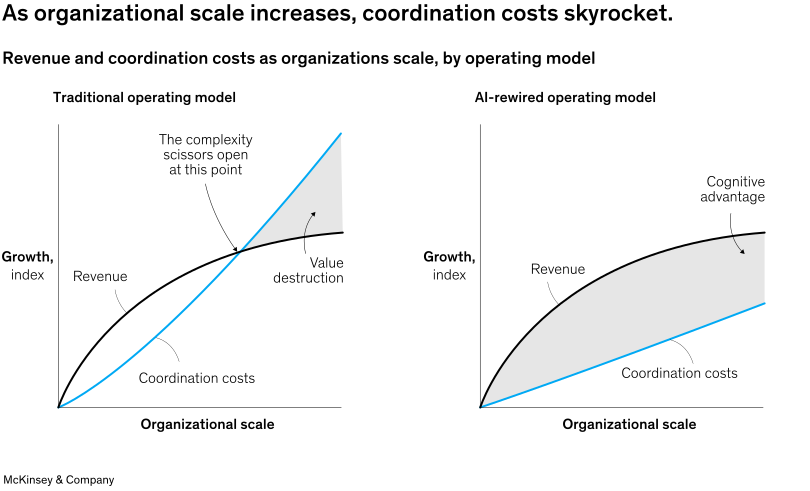
AI offers a way to change those economics. Rather than relying on growing numbers of person-to-person interactions, AI systems can route information, decisions, and workflows through centralized orchestration layers based on clear, nonpolitical, ROIC-oriented factors or governance criteria. Eliminating unnecessary meetings or interactions can accelerate decision-making and eliminate the potential for bias. A network at a large pharmaceutical company that would otherwise normally require over a thousand bilateral connections can operate through a far simpler hub-and-spoke structure. In many cases, companies can delegate decision-making responsibilities and other management tasks to AI agents.
This feature is what distinguishes AI from earlier technological waves. Business process reengineering, enterprise resource planning, and digital transformation all promised flatter, faster organizations, but they ultimately left most underlying coordination structures largely intact, with the same people and capabilities in place. AI is different because it targets the coordination layer itself. Rather than simply automating individual tasks, AI systems can synthesize information, prioritize actions, forecast outcomes, make decisions, and coordinate workflows across teams. That creates the possibility of redesigning workflows rather than simply accelerating existing processes.
Why bolt-on AI fails
Most organizations bolt AI onto existing structures and processes, expecting it will automatically deliver productivity increases. But this approach often generates little value for three reasons:
- Complexity remains largely intact. Organizations often respond to AI by adding review layers, governance processes, and oversight. McKinsey research shows that when agentic systems operate inside workflows that were not redesigned for them, errors can propagate across the organization at machine speed.9 Furthermore, team composition and roles remain static even though AI has changed how work can get done.
- Value remains trapped at the task level. Individual activities become faster, but broader workflows do not. Information still moves through the same bottlenecks, limiting enterprise-wide impact. For instance, new products may not necessarily reach the market faster.
- Organizations use the wrong metrics. They often gauge success by the number of AI-related licenses, pilots, and deployments, rather than by business outcomes such as faster decision cycles, lower coordination costs, or improved financial performance. They also overlook or minimize ROIC.
Companies that take the bolt-on approach typically regard AI as a technology procurement challenge rather than an operating model transformation. Managers often engage in lengthy decision-making processes to select platforms and vendors rather than redesign workflows and decision-making systems. This strategy is self-defeating and yields few benefits because capabilities that differentiate one platform today often become standard within months. What’s more, research suggests that most AI value comes from people and process transformation, not algorithms, technology, or data infrastructure.
The gains may be particularly significant in industries that design, engineer, manufacture, and distribute physical goods. Emirates Global Aluminium, for example, first trained thousands of employees through a dedicated digital academy before deploying AI across smelting operations.10 After a multiyear effort, the company ultimately documented more than $120 million in impact, including a 170 percent ROI and double-digit improvements in throughput and labor productivity. The mining company Freeport-McMoRan also achieved big gains by redesigning its planning cycles to suit the speed of AI (see sidebar “Case study: A copper giant finds new sources of growth”).
What makes these examples significant is not just the value they created, but the mindsets and capabilities they built. Each transformation generates organizational knowledge about how to redesign workflows, govern AI-enabled decisions, deploy talent, and manage change. Those lessons accumulate over time, making future transformations faster, less costly, and more likely to succeed.
The result is not a strategic moat in itself but a capability moat—an organizational strength that enables companies to build and scale multiple strategic moats. Competitors can deploy similar AI tools, but they cannot easily replicate years of organizational learning, experimentation, workflow redesign, and operating experience. Over time, these capabilities help companies create harder-to-replicate advantages, such as proprietary data flywheels, embedded customer workflows, faster learning cycles, and new business models. What begins as a successful AI initiative can evolve into a broader capability for transformation itself—one that becomes more valuable with each deployment and more difficult for competitors to match.
Building AI advantage: Lessons for CEOs
For leaders who have not yet reorganized their organization around AI, the challenge is often where to begin. Framing the transformation around three sequential questions can help clarify the path forward.
Where do I create strategic differentiation through AI?
McKinsey research suggests that winners concentrate AI investment in one to three high-value business domains.11 A “peanut butter” approach—spreading a thin layer of AI across numerous groups—can achieve incremental improvements but not strategic differentiation.
The most promising domains tend to share three characteristics:
- sufficient economic leverage to improve margins, accelerate growth, create new revenue streams, and strengthen competitive positioning
- proprietary data assets that become more valuable with use
- workflow complexity that exposes the limitations of coordination-heavy operating models
Companies should therefore prioritize areas where operating model redesign can create advantages competitors cannot easily replicate while delivering the highest economic returns. In many industries, the greatest opportunity may lie not in lowering costs alone but in enabling new products, services, customer experiences, and business models that expand profit pools.
A McKinsey analysis of leading AI transformations confirms the benefits of this approach. Companies that sought to improve EBITDA by 20 percent or more in priority domains achieved roughly $3 in incremental EBITDA for every dollar invested, with breakeven occurring within one to two years.12
As companies select domains, they should focus on building capabilities and allocating resources, rather than evaluating technology. The central question is where the company can create competitive advantage, and that means business and P&L (profit-and-loss) leaders—not IT functions—should be the primary decision-makers. McKinsey research suggests that AI transformations led primarily as technology programs fail at significantly higher rates—more than 80 percent—because they optimize tools rather than changing how companies work by redesigning operations. Ideally, leaders should focus on domains where organizational rewiring will create strategic moats, such as those enabled by privileged data, embedded customer workflows, network effects, customer trust, or new business models.
How do I reorganize workflows?
Once a company selects priority domains, it can begin redesigning workflows around AI-enabled coordination. That process starts by decomposing existing workflows into discrete tasks and determining which activities should shift to AI and which should remain under human control. Most organizations—roughly 79 percent—skip this step, yet McKinsey research identifies workflow redesign as the factor most strongly correlated with enterprise EBIT impact.
The specifics vary by industry and use case, but the sequence remains consistent: Redesign workflows first, build the supporting talent model second, and select technology third.
Toyota’s global resource-allocation process illustrates the shift. Matching production capacity to customer demand across suppliers, plants, and distribution channels had evolved into a coordination-heavy workflow involving dozens of spreadsheets, large planning teams, and weeks of effort. Planners manually aggregated demand signals, reconciled supply constraints across systems, and routed recommendations through multiple approval layers. Toyota replaced that process with an AI-mediated workflow that pulls demand data, evaluates supply constraints, and walks planners through scenarios in minutes. The planning team shrank by more than 80 percent—not through layoffs, but through redeployment into higher-value work that required critical thinking—while coordination layers between data and decisions compressed dramatically.
How do I rewire the operating model while keeping the business running?
This question stops many transformations before they scale. McKinsey’s Rewired framework addresses this challenge through a dual operating model (see sidebar “McKinsey’s Rewired framework”).13 While the core business continues operating largely as before, companies establish agile pods within selected transformation domains.
These pods often operate with different decision rights, performance metrics, and talent models than the broader organization. Their purpose is not simply experimentation, but demonstrating measurable results that build operational support through performance rather than mandate. Early wins within the first 12 to 18 months can generate confidence, create proprietary operational data, and help fund broader deployment efforts. Over time, subsequent transformations accelerate because the underlying capabilities, data infrastructure, and governance frameworks already exist.
The lessons emerging from early AI leaders are increasingly clear: The companies creating disproportionate value are not simply automating tasks; they are redesigning how their businesses operate in order to learn faster, innovate more effectively, and build advantages that competitors struggle to replicate. Rewiring the organization is not the source of value by itself; it is the mechanism that allows companies to create new products, strengthen customer relationships, build proprietary data assets, and capture emerging profit pools as AI reshapes competition. By rewiring, companies reduce the layers, friction, and coordination overhead that have historically slowed large enterprises as they grow. As AI becomes more accessible, the advantage will increasingly shift toward companies that can reorganize the enterprise faster and more effectively than competitors can replicate. For corporate leaders, the strategic decision is whether to start their operating model redesigns now, while AI infrastructure costs are falling and the early mover advantage is still attainable.