Japanese companies helped define the modern robotics era. Building on deep expertise in mechatronics, precision engineering, and manufacturing, the country’s original equipment manufacturers (OEMs) and component suppliers set the standard for high-performance industrial arms and became the leading suppliers worldwide.
Japan’s robotics leadership is now at risk, however, as the industry shifts from specialized, single-purpose machines to general-purpose robots powered by advanced AI—systems that can learn from experience and perform a wide range of tasks in different settings. The general-purpose robotics sector is expected to reach $370 billion in value by 2040—up from less than $1 billion in 2025. This growth is partly fueled by an accelerating demand for automation, which is especially acute in Japan, where demographic decline is exacerbating labor shortages and prompting researchers to investigate nontraditional use cases for robots, including those in elder care, food service, and agriculture.
Global trends underscore the urgency for Japan to reshape its robotics strategy. Although funding for robotics has surged over the past few years, Japan captures only a small share of the total. The country also trails both China and the United States across key indicators such as component production and patent activity. China’s ascent is especially notable: Once a minor player, it is now a leading supplier of many critical components and has accelerated robot R&D. Japanese OEMs cannot offset their limited presence in general-purpose robotics by doubling down on traditional industrial robots because that segment is expanding at a significantly slower pace.
Japan still has a path to leadership in general-purpose robotics, but success will require a decisive shift in strategy. The next wave of competition will not be won by hardware alone; it will depend on how effectively companies combine precision engineering with AI, software, data, and large-scale deployment. This article explores how Japanese OEMs and component suppliers can reposition themselves for that shift—from redesigning software platforms and service models to building smarter subsystems, pursuing new partnerships, and accelerating global expansion. It also examines the broader ecosystem changes needed to compete, including new approaches to capital allocation, talent, data strategy, and government collaboration. If Japanese companies can expand on their world-class hardware capabilities by strengthening their position in software, data, and AI, they can help define the next generation of robotics and become trusted partners to global companies.
A legacy of strength meets a new competitive reality
In 2010, five of the world’s top ten industrial robotics companies were Japanese—a testament to the country’s leadership in precision hardware. Success with industrial robots has not yet translated into general-purpose robotics, however. Consider humanoids, one of many form factors in the general-purpose robotics category. Although a team from Japan’s Waseda University built the first full-scale humanoid, WABOT-1, in the early 1970s, no Japanese companies rank among the top ten humanoid suppliers today. Humanoid patent filings in Japan now total about 1,100 annually, far below China’s 7,700 and trailing the United States’ 1,560.1 For humanoid projects now underway, most Japanese companies are still at the R&D stage while many of their Chinese and US peers are approaching commercialization. One Chinese company, AgiBot, recently produced its 10,000th humanoid.
Some Japanese OEMs might choose to maintain their focus on industrial robot arms, but this is unlikely to provide a safe haven. Historically, Japanese robotics companies benefited from a strong domestic industrial base consisting of local OEMs that often favored domestic suppliers. This stable demand enabled scale, sustained investment, and promoted innovation, which gave the robotics companies the strength to expand globally. But domestic demand is now faltering as Japan’s industrial sector steadily loses global share. For instance, China has taken the lead in areas such as heavy machinery, and new automotive entrants are challenging established Japanese OEMs worldwide.
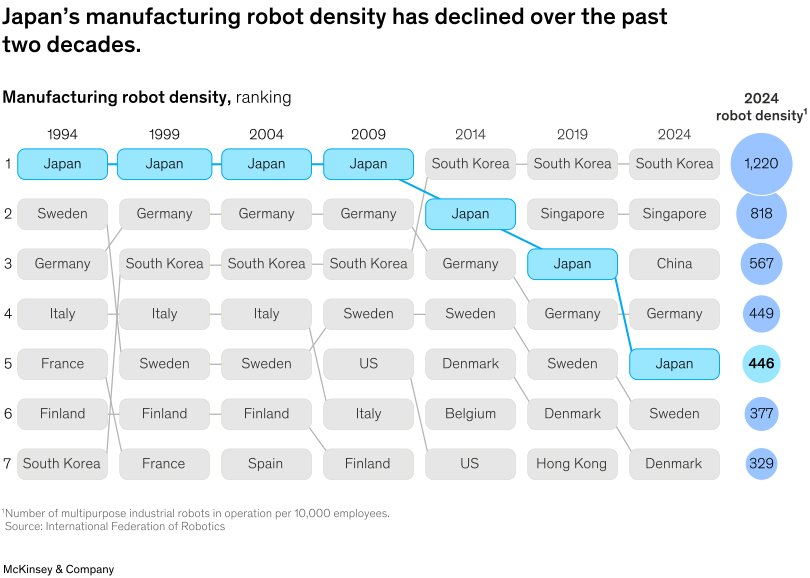
Reflecting this trend, Japan’s ranking in robot manufacturing density fell from first to fifth between 2009 and 2024 (Exhibit 1). As domestic demand weakens, Japanese robotics companies are becoming increasingly dependent on global markets where competition is intensifying. Japan’s share of global industrial-robot production has also declined, going from 54 percent in 2015 to 29 percent in 2024.
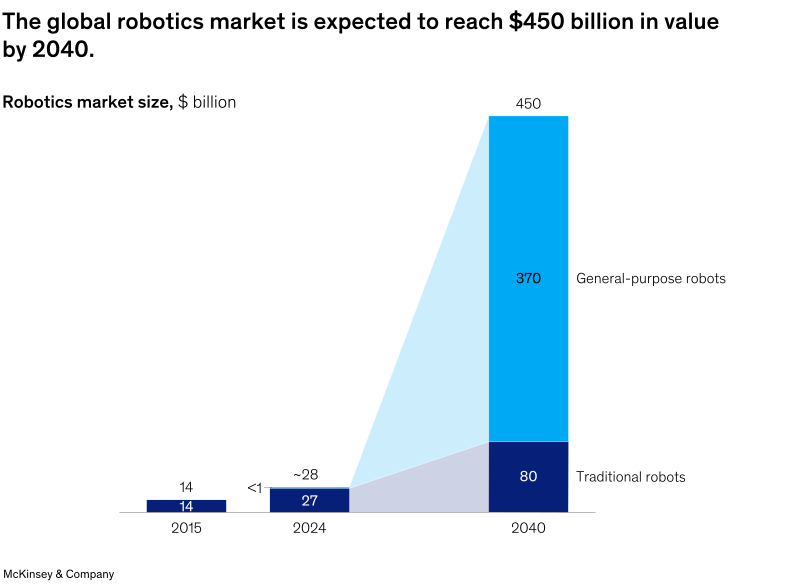
While industrial robots will remain an important revenue source, demand is projected to grow at only about 3 percent annually through 2040, reaching roughly $80 billion. By comparison, the market for general-purpose robots is expected to expand at around 70 percent annually—growing from less than $1 billion today to approximately $370 billion by 2040 (Exhibit 2). According to the Japanese Ministry of Economy, Trade, and Industry, Japan aims to capture 30 percent of the global general-purpose robotics market—about $111 billion—that year.
Competing in the age of AI-driven robotics
In markets where general-purpose robotics is more advanced, companies are beginning to converge on two distinct development approaches:
- Hardware-first. Many Chinese companies take this approach, prioritizing the development of robots for specific use cases and deploying them in the field rapidly to gather more data to train their models. This approach can lower costs through economies of scale, as Chinese suppliers can generally provide OEMs with all components required to build the robots.
- AI-centric. Many companies in the United States are pursuing this approach, which involves advancing the AI layer by investing heavily in software and autonomy, rather than focusing on hardware differentiation. From the outset, the focus is on solving broad general challenges rather than use-case specific tasks. Because the US supply chain cannot provide all the necessary components, these companies often depend on global providers.
Japanese OEMs and suppliers could take either approach, or explore other options that build on their unique strengths. For instance, Japanese companies are regarded as strong systems integrators in multiple industries because of their tradition of suriawase—the careful coordination and iterative fine-tuning of components to ensure that they work together seamlessly. OEMs could play this role in robotics by creating modules and systems with embedded software.
Japanese OEMs and suppliers could also carve out a niche in applications for general-purpose robots where quality, safety, and efficient field deployment are a top concern, such as healthcare and elder care. Some Japanese companies are already developing robots designed for such settings, including Toyota, which has created a human support robot designed to assist the elderly and individuals with disabilities.2 Given their longstanding reputation as trustworthy partners, Japanese companies could be preferred for security-critical use cases, such as those related to inspections, defense, and bomb disposal.
Although capturing the general-purpose robotics market will require significant R&D spending, Japanese firms can defend their margins by capitalizing on their highly resilient global supply chains and manufacturing networks.
Robotics OEMs: Rewiring strategy for the AI era
Japanese OEMs—even those that take an AI-centric approach—will likely continue to produce world-class hardware in the age of general-purpose robots, drawing on their exceptional capabilities in mechatronics and precision engineering. Simultaneously, however, they must develop new skills, such as the following, to pursue complementary software strategies.
Prioritize deployment and data acquisition
Robots were once differentiated based on precision mechatronics—hardware features that enabled extremely high accuracy, repeatability, and fine motion control. With general-purpose robots, however, AI models and access to large-scale, multimodal training data access will define the limits of robot capabilities, including functionality, adaptability, and capacity for improvement. Strong AI systems are especially critical when robots operate in unstructured environments, such as hospitals, logistics hubs, retail stores, and construction sites.
OEMs would do well to prioritize large-scale deployment across diverse real-world environments. By operating large fleets, they can gain access to proprietary, high-quality data that can be used to train specialized models and continuously improve performance. Rather than relying solely on a single general-purpose model, OEMs could fine-tune smaller models for specific skills, sites, customers, or regulatory requirements, improving reliability and cost-efficiency. Companies with strong autonomy stacks or development toolchains may then attract new customers, generating more data and reinforcing their advantage.
For best results, OEMs can accelerate deployment in targeted verticals, refine capabilities for data collection and labeling, and create feedback loops to train models automatically. In some cases, collaboration with other robotics companies—such as pooling operational data to co-develop shared AI models—may help overcome scale constraints. At the same time, companies must establish clear policies on data privacy, security, and usage to address customer concerns.
Would you like to learn more about our Industrials Practice?
Develop a unified, secure, and interoperable software platform
Success in the AI-native era will require robotics OEMs to move beyond fragmented, machine-specific software stacks toward unified and extensible software architectures. These platforms will serve as the operating layer for robot fleets, connecting robots, applications, data pipelines, simulation environments, safety systems, and customer workflows. In addition to enabling continuous learning, these platforms will facilitate secure deployment, third-party development, and reliable operation across heterogeneous environments.
A high-performing software platform will typically include the following:
- Standardized application programming interfaces (APIs) and middleware that enable third-party application development, integration with customer systems, and interoperability across multi-vendor environments, such as the Open Robotics Middleware Framework; these tools also reduce adoption friction and help expand the broader ecosystem.
- Robust over-the-air update capabilities, including testing, staged rollout, and rollback functionality, to support continuous performance improvements, rapid feature deployment, security patches, and ongoing skill expansion.
- Specialized skill models or task-specific robot policies that allow robots to perform recurring tasks more reliably in specific environments; this would include tasks such as unloading pallets, navigating hospital corridors, handling irregularly sized parcels, or operating around construction workers. These models can be fine-tuned or distilled from larger foundation models using proprietary fleet data, improving performance, latency, and cost-efficiency.
- Fleet orchestration and observability tools that allow customers and OEMs to monitor performance, diagnose failures, allocate tasks, manage uptime, and optimize operations across large deployed fleets.
- A secure-by-design architecture that addresses cybersecurity vulnerabilities and establishes clear data governance frameworks, including rules on what data collected in consumer, industrial, or healthcare settings can be stored, shared, or used to train models.
Anticipate aftermarket and servicing opportunities
The traditional “break-fix” service model is not viable for large, distributed robot fleets, particularly in human-centric environments where reliability is critical. A more effective approach involves expanding into aftermarket services, where Japanese companies can leverage their reputation for quality and trust. This shift requires OEMs to move toward proactive, data-driven service models that improve uptime and operational performance. By harnessing data from deployed fleets, companies can optimize predictive maintenance, remote diagnostics, and continuous system improvement.
Capturing this opportunity will also depend on building highly efficient, geographically distributed service hubs capable of rapid, on-site support. These capabilities are especially important during early deployment phases, when failure rates and operational uncertainty are higher. Beyond improving reliability and customer satisfaction, the hub model enables new revenue streams through robotics as a service (RaaS). Under this approach, OEMs provide robots to customers and generate revenues through software updates, monitoring, and maintenance over the product lifecycle. By reducing upfront costs for customers, RaaS can accelerate adoption and scale.
Modify the systems-integration business model to include orchestration and managed solutions
Although it now takes weeks to months to integrate general-purpose robots into factories, companies could eventually shrink to days or even hours as their AI capabilities advance and they adapt more quickly to new environments. Japanese companies should not assume that systems integration alone will be a viable business model, even if this is currently their primary activity. In the future, they could complement systems integration with other revenue opportunities, such as creating orchestration platforms that coordinate robot fleets and providing energy management solutions, such as battery swapping.
Component manufacturers: From parts to platforms
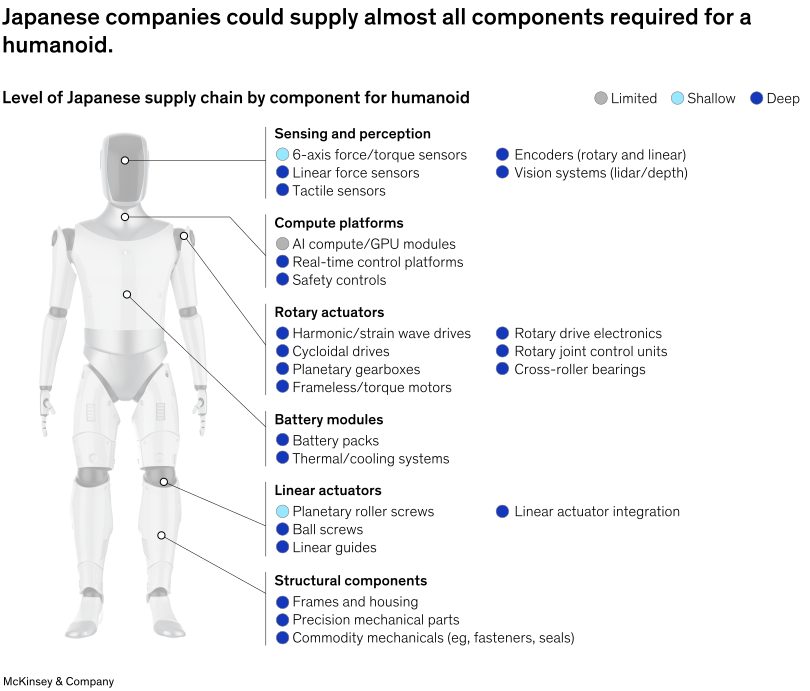
Japan’s component supply chain can already deliver nearly every part required to build a humanoid robot (Exhibit 3). Some experienced component manufacturers may draw on their existing strengths to expand into new areas that face supply chain constraints, such as harmonic and strain wave drives, planetary roller screws, robotics-grade linear guides, six-axis force/torque sensors, linear-force sensors, and tactile sensors. These new offerings might also appeal to global customers seeking to diversity their supply chains.
Competing in the global market will require more than a deep catalog of high-quality, low-cost components, however. The next phase of value creation will favor suppliers that shift their R&D focus from standalone parts to integrated modules and subsystems that combine multiple components. This transition would directly address customers’ most pressing needs: faster time to market, greater reliability, and reduced liability. Suppliers that execute well on this shift—specifically, by taking the following actions—could become indispensable partners to the world’s leading OEMs.
Become a provider of “safety in a box”
The importance of safety in enabling the scaling of robotics cannot be overstated. While all the puzzle pieces needed for safety systems already exist, no single suppler can provide all necessary components; instead, different companies specialize in certified microcontrollers, redundant power systems, or validation software. Component suppliers could remove the burden of integration for OEMs and reduce time to market by combining these separate components into one subsystem, testing it thoroughly, and bundling it with all required documentation for certifications (for instance, failure mode and effects analysis or validation reports). Providing this level of integration requires focused investment in system-level engineering and pre-certification. Component suppliers could also become safety leaders by developing proprietary, efficient AI models that run locally on devices, rather than relying on large cloud models run by other businesses—a model that can introduce concerns about safety and data privacy.
Transition from a motion core to “smart joints” with actuators
The market for simple gearboxes and motors will commoditize, reducing margins for suppliers that specialize in these areas. New opportunities might be found, however, in delivering integrated “smart joint” modules that allow OEMs to accelerate robot production. These subsystems combine high-precision motors and gears with onboard compute, a position sensor, and a force sensor in one compact unit. The most crucial feature involves built-in health monitoring, enabled by a software program in the joint that analyzes real-time data on temperature and vibration to predict failures before they cause costly downtime. By supplying sealed, high-reliability modules with standardized plug-and-play interfaces, suppliers can dramatically reduce an OEM’s engineering complexity and long-term operating costs.
A shift to smart joints will require a supplier to first build dedicated, cross-functional teams with mechanical expertise, embedded software, and firmware skills. The supplier could then secure a vision-aligned OEM partner to codevelop a minimum viable product and address early integration challenges.
Deliver certifiable perception and an AI action stack with sensors
The market for sensors is also susceptible to commoditization, but component suppliers can succeed by solving one of the industry’s core challenges: turning a digital command into reliable, repeatable physical execution. Instead of selling raw sensors, component manufacturers could provide complete “action stacks”—fused perception-and-control subsystems that are modular and standardized, making them easier to service.
To create action stacks, suppliers must integrate sensors with a dedicated system on a chip that runs a hardware-accelerated sensor fusion algorithm. Crucially, this stack would provide a library of pre-programmed, low-level control primitives—the most basic commands, such as “contact-detect,” “apply-force,” or “align-to-surface.” Execution would occur in a closed loop on the robot itself, guaranteeing that a high-level command, such as “gently grasp the object,” is translated into a verifiable physical outcome that the module’s integrated sensors can confirm. By creating a tamper-proof data log that records every action from the incoming AI command to the corresponding sensor feedback, the action stack provides OEMs with an audit trail for diagnostics and liability protection. End users may also feel more confident about the robot’s reliability if they can see records of its actions.

Turning humanoid supply chain constraints into billion-dollar wins
Drive production efficiency, solve problems for customers, and eliminate supply-chain bottlenecks across components
Component providers can strengthen the supply chain by addressing the technology issues that cause bottlenecks, ideally focusing less on optimizing individual components in isolation and more on enabling intelligent, scalable robotic systems. That means investing in the foundational technologies that will determine long-term competitiveness: miniaturized hardware, low-power compute, advanced sensing, and efficient actuators.
In robotics, intelligence must operate under real-world constraints around latency, energy consumption, connectivity, safety, and reliability. That means distributed and low-power AI will be especially important to customers. In addition, smaller, task-specific models embedded at the edge can enable faster response times, more adaptive behavior, and greater operational resilience than systems that rely entirely on centralized cloud infrastructure. Future-ready suppliers could also design components that integrate easily across platforms, generate operational data, and improve over time through software and AI updates.
For greater efficiency, component providers may ultimately need the robotics equivalent of the Toyota Production System: a highly reliable, continuously improving framework that integrates AI, hardware, manufacturing, and operations at scale. This framework would also help them surface problems, reduce waste, preserve quality, and streamline manufacturing through repeatable processes. Strategies that align with the Toyota philosophy include the following:
- implementing lights-out manufacturing and advanced robotics for process optimization
- applying next-generation lean principles, such as computer numerical control techniques, to die cast, metal stamping, and other assembly tasks for general-purpose robotics
- leveraging AI-driven quality control and predictive maintenance for machinery
- establishing highly agile, reconfigurable production lines capable of rapid product iteration
- meticulously optimizing supply chain logistics and inventory management through digital twins and real-time data analytics
Next steps for the Japanese robotics industry
Japan’s robotics opportunity is constrained not by a lack of engineering capability, but by a gap between technical excellence and the ability to deploy large-scale, AI-powered fleets at a feasible cost. Robotics companies could help close this gap by making the following moves.
Improve capital allocation to achieve scale and build new capabilities
While most Japanese companies have large cash balances, the bulk of it is directed toward existing business units. They invest relatively little in new growth areas or make small, incremental investments rather than large, aggressive ones, often because they are risk averse and conservative. A failure in a new business could hurt their reputation—for instance, an automotive OEM may worry that their current customers will think less of them if they encounter problems with quality or delivery in the robotics sector. Such risks are possible, but corporate leaders often misjudge their extent. In consequence, they tend to move slowly when contemplating opportunities. Many corporate governance structures also support a nonaggressive capital allocation strategy, even when disruptive technological shifts are underway.
This caution has some downsides. A recent McKinsey Global Institute analysis shows that standout firms—those that account for a disproportionate share of productivity growth—allocate capital and talent aggressively, quickly adopt new technologies, and continuously reinvent their business models. Overall, these companies prioritize strategy, portfolio shifts, and value creation. In many countries, the standouts gain scale while companies with lower productivity shrink or cease operations. In Japan, however, the corporate system prioritizes stability over dynamism. Relatively few firms exit the market, and underperforming companies stay in business longer, consuming capital and labor that could be more productive elsewhere. This pattern results from numerous structural and cultural factors, including a banking system that sustains weaker firms and social norms that tend to discourage failure.
For Japanese companies that aspire to capture the general-purpose robotics opportunity, a more dynamic capital allocation strategy may help them keep pace with competitors. One strategy may involve creating agile sandboxes—small, contained units that oversee new business ventures and do not have to deal with layers of corporate bureaucracy, increasing their speed of action. (For more information see sidebar, “Business sandboxes”). A more efficient capital allocation mechanism could also lead to consolidation, as well as a more vibrant start-up ecosystem.
Pursue M&A and partnerships to gain new skills
The tradition of suriawase, which proves valuable in systems integration, gives Japanese companies a distinctive advantage when forming and sustaining partnerships. By emphasizing mutual adjustment, frequent communication, and shared problem-solving, suriawase helps companies remain aligned and reduces the tensions that often derail collaborations.
Although some Japanese companies form conglomerates or engage in cross-shareholding, these practices are less common than in the past. Japanese companies are also much more active in capital markets and more frequently undertake mergers and acquisitions (M&A). These shifts give Japanese robotics OEMs and suppliers more freedom to test their boundaries by forming unconventional alliances that will help expand their capabilities, especially within the software layer. For example, an OEM, a large-scale automotive supplier, and an innovative technology leader could form a partnership to scale the next generation of smart actuators. Deals with foreign startups can give Japanese companies an opportunity to influence how technology develops, help shape the market, and gain access to highly sought-after talent.
In some cases, M&As might involve several companies specializing in key technologies, such as smart joints, safety, or perception/control action stacks. A combined entity that excels at these critical subsystems would hold a very strong market position and be preferred by top OEMs.
Take a global-native approach
Panasonic, Sony, and Toyota are among the many Japanese companies that have become successful by first winning in the Japanese market and then expanding globally. Some robotics OEMs, such as Fanuc, Kawasaki and Yaskawa, followed a similar script. But those robotics companies became leaders when Japan ranked second in global manufacturing, producing nearly a quarter of the world’s output, and local industrial companies were intent on automating their businesses. Today, with Japan’s manufacturing share declining to less than 5 percent of the global total and local demand for industrial robotics falling, Japanese robotics OEMs and suppliers must have a global mindset for all projects, beginning at the design stage.
Japanese companies may still target the domestic market first, but with products that are designed for a global market. This strategy would allow them to build on their strong brands, existing supply chains, and hardware capabilities; it would also help them avoid ending up in the same trap as Japanese laptop makers, who created products that are strong in Japan but trail those of Chinese and US companies in the global market.
Japanese companies are more likely to develop a global perspective if they combine local and global talent, build a strong overseas presence, and distribute decision-making power across regions. For example, Hitachi maintains a broad global footprint.
Reinforce the talent pipeline
Japan has fewer engineers and physical AI experts than either China or the United States. To advance their technologies as the transition to AI-centric robots continues, local OEMs and suppliers will need an influx of new talent, as well as a plan to integrate the new employees into their organizations. For instance, companies that aim to become module or subsystem providers will need expertise in embedded software, firmware, and AI.
If Japanese companies cannot find the talent required locally, they may want to increase their global hiring efforts. The country is already attractive to international job seekers, but companies could still provide incentives for relocation. For instance, Japanese companies could consider providing more competitive compensation, as salaries in Japan are typically less competitive than they once were. They could also consider new compensation schemes for top talent, such as those involving equity or stock-option packages, but they may encounter some difficulties if the same options are not offered to other employees.
Organizationally, Japanese companies may increase their appeal by adopting a more global operating model with less rigid structures and taking steps to minimize the impact of language barriers. If companies do experiment with employee incentives and organizational structures, they may want to adhere to the agile sandbox approach by first testing the changes within a small, contained unit.
Companies may also use global M&A to fill skill gaps, through so-called “acqui-hires.” Over the longer term, talent initiatives might include establishing programs that encourage students to pursue robotics or AI-related careers.
Create a strong data and foundational model strategy
With data serving as the lifeblood of AI models, Japanese companies must optimize their strategies for capturing and sharing information by creating marketplaces or models that different ecosystem participants can access. This arrangement would require a strong public-private partnership, to ensure that all businesses operated on a level playing field. Japan might be better positioned than other countries to support such arrangements than other countries because of its long tradition of government support for business. To address privacy concerns, companies could enact internal controls and mandate compliance with any external regulations before sharing data, especially sensitive information, such as patient records. In some cases, of course, companies might choose to keep data entirely private.
For the large-scale foundation models that govern AI, Japanese companies face some difficult choices. They can invest heavily in model creation, which requires massive compute power and vast stores of data, to have more control and independence. Alternatively, they could create a smaller, cheaper version of an existing large model, preserving much of the original’s capability. Another low-cost route involves fine-tuning open-source AI models using proprietary industry data from specific sectors, such as healthcare. While distillation and open-source models are less expensive options, companies have less control over the core technologies.
The next phase of robotics will be won in the field, where deployed machines learn continuously, creating a wealth of data to refine AI models. Japan’s strength in precision hardware remains a powerful advantage, but leadership will hinge on how quickly that strength is extended into data and software, and real-world deployment in complex, dynamic environments.
Maintain strong working relationships with government authorities
Success in global robotics requires strong collaboration between business, academia, and authorities. Regulatory and safety frameworks for general-purpose robots represent one potential area for cooperation.. Working together, businesses and the government might consider implementing restricted zones, or regulatory sandboxes, for real-world pilots, similar to how Waymo is operating autonomous taxis in select cities in the United States. (For more information see sidebar, “Regulatory sandboxes”).
Since Japan faces greater labor shortages than many other countries and the pool of available workers is expected to fall by 15 million over the next two decades,3 public authorities might be most open to pilots in the hardest hit sectors. The elder care market, for instance, is expected to grow from about $650 billion in 2023 to $780 billion by 2040, exacerbating an already critical shortage of caregivers. Some humanoid robotics companies are investigating opportunities in patient care, mainly for simple tasks that would free human caregivers for more complex activities. Even having them perform simple tasks, such as cleaning the floor or bringing out the trash, could provide a lot of value for people who cannot access sufficient care today. There are still many regulatory and safety hurdles to overcome before robots are deployed hospitals or other settings where they will directly interact with vulnerable patients or elderly people, however.
Another collaboration opportunity relates to strategy, since the Japanese government is revisiting its approach to building the domestic robotics sector for the first time in over a decade.4 Among other activities, it is establishing AI robotics hubs5 that would conduct R&D and support multiple industries. By participating in or partnering with these hubs, OEMs and suppliers could gain insights about robot uptake and future trends in Japan.
The government may also implement other programs or incentives to spur demand for general-purpose robots, acting as a “first customer.” For instance, authorities might purchase some for public-sector use, provide tax breaks to robotics companies, or create stimulus packages for de-risking investments, including those related to co-development projects between companies. Industry stakeholders could benefit by monitoring such developments closely.
Japan’s robotics leaders cannot rely on incremental change; the shift to AI-driven, general-purpose systems requires immediate, decisive execution. Their advantage lies in world-class precision engineering, deeply integrated supply chains, and a proven ability to coordinate complex systems—strengths that can accelerate reliable deployment at scale. The priority now is to translate these capabilities into faster field iteration, stronger software and AI integration, and sustained cost reduction through advanced manufacturing. Speed will be decisive: compressing development cycles, deploying in real-world environments, and rapidly feeding data back into performance improvements. If Japan can convert its hardware leadership into continuously learning, cost-competitive systems, it can close the gap—and set the pace—in the next era of robotics.