Humanoid robots are approaching an inflection point, with advances in AI, hardware, and investment accelerating their path from prototypes to real-world deployment. Venture capital funding for robotics surged more than threefold between 2023 and 2025, when it reached $40.7 billion annually.1 Governments have declared embodied AI a strategic priority, with China alone committing a $138 billion state venture capital guidance fund to AI and robotics, among other high-tech sectors.2 Both start-ups and established OEMs across Asia, Europe, and the United States are now scaling pilots in manufacturing, logistics, and industrial environments while training foundation models on real-world interaction data.
The strategic question is no longer whether humanoid robots will work but whether they can scale economically—and at what cost, speed, and reliability. In “Humanoid robots: Crossing the chasm from concept to commercial reality,” we identify four bridges to commercial viability: radical cost reduction, greater dexterity and mobility, sustained uptime, and safety for fenceless operation. All four—cost reduction most directly—depend on a factor that receives less attention than AI capabilities: the maturity and scale of the underlying component supply chain.
For many of the most critical and costly humanoid components, the supplier ecosystem is still at the early stage for large-scale production, creating a significant opportunity for scale build-out. But as demand for humanoid hardware rises over the next few years, both suppliers and OEMs will have a greater incentive to increase investments. How the supply chain matures will shape the pace and economics of humanoid deployment over the next decade: where bottlenecks and opportunities exist, how sourcing strategies evolve, and which players will build the platforms the industry needs.
The anatomy of a humanoid robot’s bill of materials
The core hardware stack of a humanoid spans five domains: actuators (40 to 60 percent of the bill of materials, or BOM), sensing and perception systems (10 to 20 percent), compute and control platforms (10 to 15 percent), structural components (5 to 10 percent), and battery modules (5 to 10 percent). Together, the five domains represent 85 to 90 percent of total unit costs, with the remainder coming from other areas, such as cooling systems and wiring harnesses (Exhibit 1). The impact of each domain on humanoid performance also varies.
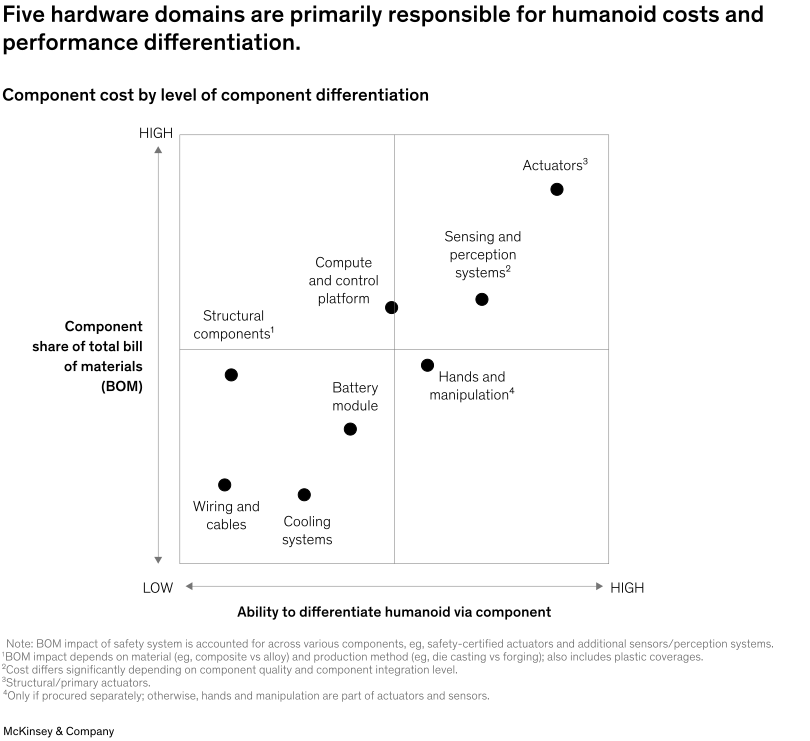
Note that the “hands and manipulation” category in the chart includes only components that are procured separately from all other humanoid elements. Typically, hands are included in the sensor and actuation category. We show hands and manipulation here as a separate category to demonstrate the importance of this subsystem as a stand-alone entity (see sidebar “Why hands are critical”).
What makes the supply chain picture distinctive is the mismatch between where value concentrates and where the supplier ecosystem is ready for high-volume production. Actuators, by far the largest cost driver and primary performance differentiator, depend on one of the least developed supplier ecosystems. Sensing, particularly force and tactile, faces similar exposure. By contrast, compute and battery components benefit from deep adjacency to the electric vehicle (EV), semiconductor, and consumer electronics industries, where production infrastructure already operates at scale.
Many high-impact humanoid components, including motors, actuator power electronics, permanent magnets, and precision bearings, overlap structurally with the EV value chain. This adjacency matters because it directly influences how quickly cost curves can compress as humanoid volumes increase. Subsystems with strong EV spillover benefit from existing tooling, supplier depth, and process maturity. Components without such adjacency, particularly robotics-grade force and tactile sensing, lack equivalent scale anchors and are more likely to face structural supply constraints.
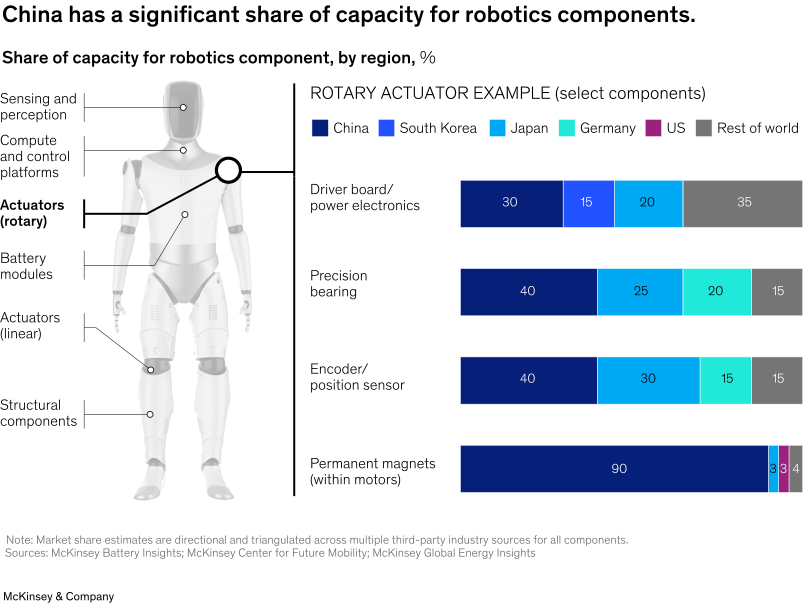
China, with its strong EV ecosystem, particularly benefits from the structural overlap and holds a significant share of capacity for several components used in humanoids (Exhibit 2). For more information on China’s ecosystem advantage, see sidebar “China’s distinctive supply chain model.”
Yet even where the underlying technology is well established in other industries, the humanoid supplier ecosystem is not ready for large-scale production. At present, suppliers have little incentive to increase production of humanoid-specific components because demand is too low to justify standardized, high-throughput manufacturing. This situation reinforces a scaling dilemma: Low volumes prevent suppliers from investing in dedicated production lines, yet without cost reductions, end user demand remains constrained. The typical humanoid BOM currently ranges from roughly $30,000 to $150,000 per unit. Costs under $20,000 are widely cited as the long-term target, implying that significant cost compression is still required to unlock mass-market demand.
In this premodular phase, most OEMs are forced into one of two paths to obtain components: vertical integration or close codevelopment with a limited number of partners in which they piece together adjacent industrial components and redesign them for humanoid requirements. Both paths accelerate development, but neither automatically translates into cost-efficient scale. Vertical integration concentrates all manufacturing overhead on a single OEM, while ad hoc codevelopment requires costly redesign that must be repeated for each platform.
Mapping supply risks and opportunities across the hardware stack
As humanoid deployments scale toward 2035, supply constraints and opportunities will not appear uniformly across the hardware stack. Instead, bottlenecks will concentrate in subsystems where high-performance requirements, supplier concentration, and limited standardization intersect and reinforce one another.
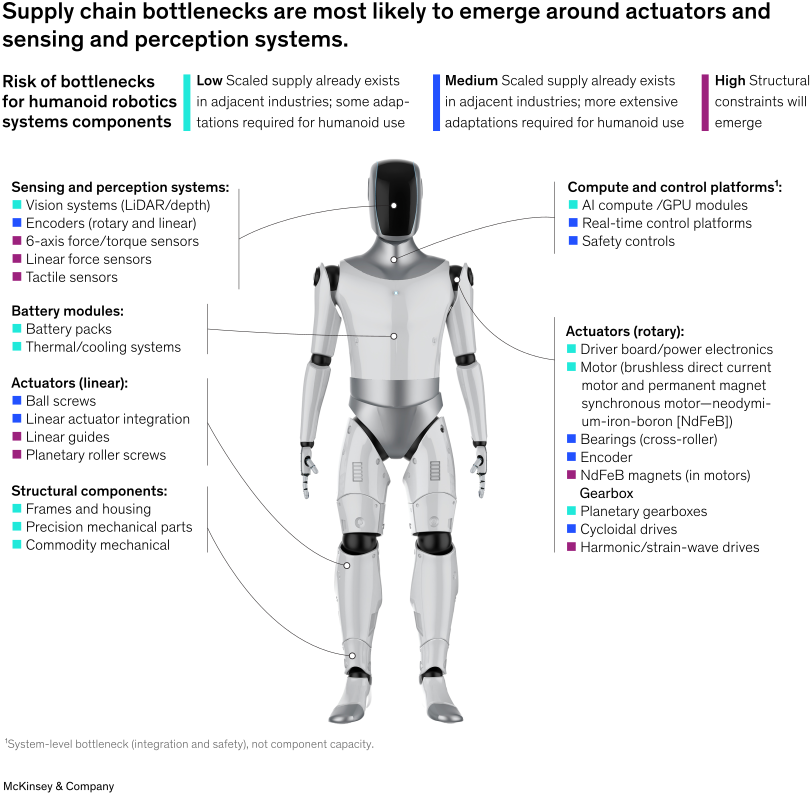
Understanding where constraints cluster and where the supplier base is already equipped for scale is essential for OEMs managing sourcing risk, suppliers prioritizing investment, and end users assessing deployment timelines. A McKinsey analysis of the current supply chain suggests that bottlenecks are likely with several critical humanoid components (Exhibit 3). Overall, components can be categorized as having a low, medium, or high risk of bottlenecks.
Low risk: Scaled supply but minor adaptations required
Brushless DC (BLDC) and permanent magnet synchronous motors (PMSM) are produced at scale for EVs, industrial automation, and consumer electronics. Power electronics, standard bearings, camera modules, and LiDAR/radar systems have similarly large and diversified supplier bases. Battery cells are supplied by global leaders such as, CATL, LG Energy Solution, Panasonic, and Samsung SDI. EV-driven scale has compressed both cost and development timelines for these suppliers. While these components are produced at scale in adjacent industries, they must be integrated and certified for humanoid applications. These adjustments are not trivial, but there is a significant opportunity for suppliers to scale these components, supported by strong existing industrial capacity.
Medium risk: Scaled supply but major adaptations required
This middle tier contains components that are produced at scale in adjacent industries but require more extensive adaptations for use in humanoids than those in the low-risk category. Encoders, certain real-time control electronics, and inertial measurement units (IMUs) are widely available across consumer, industrial, and aerospace grades, yet not all variants provide the latency, drift stability, and fault tolerance required for dynamic bipedal balance. Vision hardware from autonomous-driving programs is often overspecified, bulky, or power-hungry relative to humanoid constraints, requiring significant repackaging. As with low-risk components, the opportunity lies in adapting scaled supply to humanoid requirements: Underlying capacity is sufficient, but greater emphasis is required on qualification and configuration.
High risk: The choke points where supply struggles to meet ambitions
Three component clusters may be particularly subject to bottlenecks, but these same areas represent some of the most attractive opportunities for suppliers to scale capacity and define emerging standards. The first cluster, which contains precision motor components, includes the following:
- Harmonic and strain-wave drives. The compact, high-torque-density gearboxes used in humanoid joints remain concentrated among a small group of manufacturers, including Harmonic Drive, Nabtesco, and emerging Chinese players such as Leaderdrive. Production of these high-cost components is precision bound and capital intensive, requiring dedicated tooling, metrology infrastructure, and long qualification cycles. Unlike electronics, where capacity can be added rapidly, harmonic (strain-wave) gearboxes are structurally harder to scale. As humanoid volumes rise, demand could outpace the speed at which suppliers can add qualified capacity, creating a significant opportunity for suppliers that can scale precision manufacturing and establish early leadership positions. While alternative gearbox technologies, such as cycloidal drives, benefit from broader industrial use and more scalable manufacturing, harmonic drives remain more exposed because of tighter precision tolerances and a more concentrated supplier base.
- Planetary roller screws. These components present an even more acute risk of bottlenecks. This segment includes specialized manufacturers such as SKF, as well as select high-precision Asian suppliers. Compared with ball screws, which benefit from broad machine tool and automation demand, roller screws remain a high-load, high-precision niche with a narrow supplier base, long lead times, and limited substitution options. As humanoid OEMs pursue higher payloads and more dynamic motion profiles (shifting toward hybrid rotary and linear actuation architectures), demand for robotics-grade roller screws could exceed existing suppliers’ ability to scale—a trend that could make this segment particularly attractive for suppliers that can expand high-precision capacity early.
- Robotics-grade linear guides. The bottlenecks here arise from subtler constraints. Global players such as Bosch Rexroth, Hiwin, and THK operate at significant industrial scale, providing sufficient overall capacity, but humanoid applications often require compact, high-durability, low-clearance configurations that narrow the effective supplier pool. The primary bottleneck lies in qualifying and ramping robotics-grade subsets, rather than total volume.
- Permanent magnets. Upstream, high-torque actuators depend on rare-earth permanent magnets, especially neodymium-iron-boron (NdFeB), to achieve required power density. China controls approximately 69 percent of global rare-earth mining and 90 percent of magnet processing and refining capacity, and recent export licensing changes have already introduced volatility.3 Elon Musk has publicly noted that magnet supply constraints have affected Optimus production.
The second cluster of high-risk components includes those that enable force and tactile sensing:
- Six-axis force/torque sensors. These components, supplied by a limited number of robotics-focused vendors, including ATI Industrial Automation and OnRobot, are calibration intensive and require tight metrology and quality control, with limited automation in production. Unlike motors or control electronics, six-axis force/torque sensors benefit little from automotive or consumer spillover. Scaling depends not only on machining capacity but on expanding high-precision calibration infrastructure, a capability that remains concentrated.
- Linear-force sensors. These components face similar dynamics: a compact, high-precision niche with limited standardization and shallow supplier depth.
- Tactile sensors. Although these components are also prone to bottlenecks, the risks differ. In this category, many leading solutions originate from start-ups or research-driven companies, rather than large-scale industrial suppliers, creating a fragmented, unstandardized landscape with no dominant architecture.
For the third cluster, compute and control, the risk of bottlenecks results from the absence of cohesive, safety-certified, low-latency humanoid platforms, rather than component scarcity. Most OEMs use off-the-shelf AI compute modules (most prominently Nvidia’s Jetson series) alongside automotive-grade microcontrollers and industrial servo controllers from vendors such as Elmo, Novanta (Celera Motion), and Synapticon. These are capable components, but none was designed for humanoid-specific coordination and safety integration. The result is a heterogeneous stack: a GPU-based board for perception, distributed joint controllers, and custom middleware for communication and fault handling. There is no standardized, safety-certified “robot ECU” analogous to an automotive engine control unit.
While vertical integration is possible for compute and control, this route is uncommon. One prominent example is Tesla, which has adapted its automotive full self-driving (FSD) compute stack for Optimus and links inference, motion control, and safety logic within a unified system. Few other humanoid OEMs have the scale or semiconductor capability to replicate this model, however.
Humanoid robots: Crossing the chasm from concept to commercial reality
Rapidly evolving autonomy architectures are compounding the bottlenecks related to compute and control. As AI capabilities advance, OEMs retain tight control over firmware and system integration, making it hard for external suppliers to design against a stable specification. OEMs shoulder most of the burden for real-time coordination across 20 to 40 primary structural actuators, often at kilohertz-level control frequencies, combined with fail-operational safety logic. This makes compute a systems bottleneck (integration and certification) rather than a component supply bottleneck (capacity constraints), a distinction that matters when prioritizing investment.
From vertical integration to supplier platform ecosystems
The uneven readiness of the humanoid supply chain directly shapes how OEMs source today. In some cases, OEMs now rely on vertical integration because no viable supplier options exist, not because they have a strategic preference for keeping manufacturing in-house. As the humanoid industry scales, sourcing patterns may change.
Today’s market: OEMs build because they must
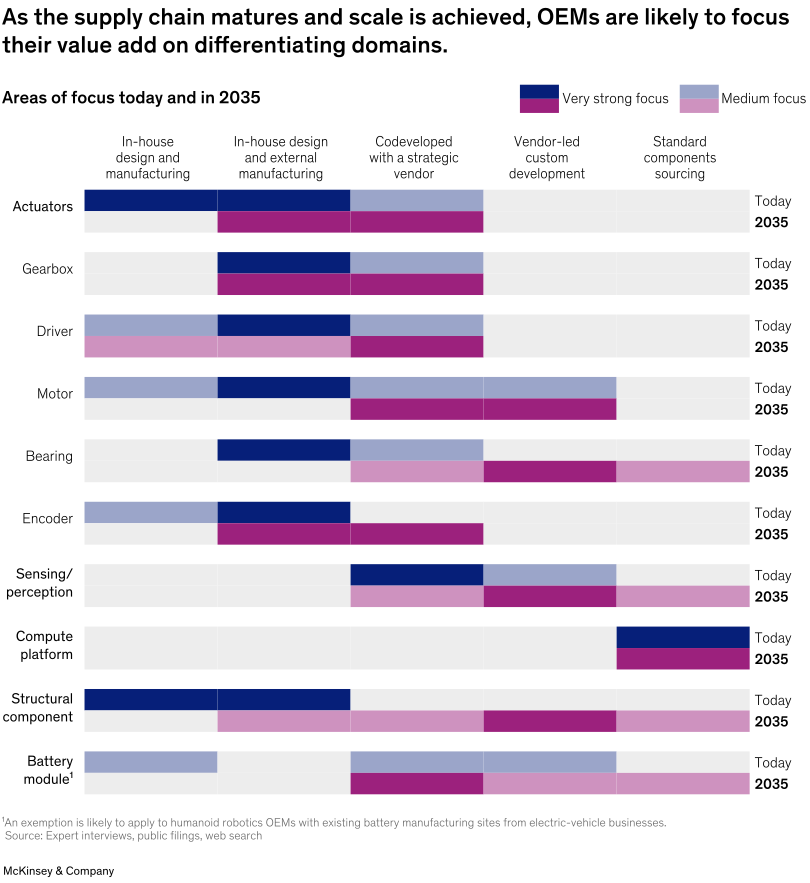
Most OEMs now redesign or tightly integrate the subsystems where performance sensitivity and supplier scarcity intersect, especially for actuation (Exhibit 4). As the largest single cost driver and primary performance differentiator, actuators concentrate the core competitive levers: torque density, backdrivability, precision, and lifetime performance (see sidebar “Inside the actuator”). Modern humanoids require dozens of actuators that must be lightweight yet powerful, efficient yet responsive. Tesla’s Optimus, for example, has 28 joint actuators in its body, plus 50 additional actuators in its Gen 3 hands.
There is no equivalent of an “engine supplier” for humanoid actuators. Instead, the industry remains in a premodular phase, with each leading project resorting to custom development. Tesla uses custom-designed frameless motors and gearboxes in its actuators; Agility Robotics initially leveraged off-the-shelf motors for Digit but had to heavily modify and integrate them into proprietary leg modules.
This vertical integration for actuation is a rational response to current conditions. It secures cost performance control, mitigates supplier concentration risk, protects emerging intellectual property (IP), and accelerates iteration. Humanoid OEMs, which have bold aspirations but still face significant tech and timing risks that need to be mastered, cannot provide the long-term volume guarantees required to trigger large-scale supplier R&D and tooling commitments. Hence, vertical integration for actuators is likely to persist until volumes become more predictable. Only then will supplier-led modularization become economically viable at scale.
By contrast, consider compute platforms and selected sensing modules, which already sit further toward the “buy” side of the sourcing spectrum. These subsystems benefit from established adjacent ecosystems and standardized architectures, making external sourcing economically rational even at today’s scale.

Industrials
Want to learn more about how we help clients in Industrials?
By 2035: Selective modularization, subsystem by subsystem
Over the next decade, the transition from in-house design toward codevelopment and vendor-led modules will not happen uniformly. Components with strong industrial spillovers or scalable manufacturing economics, particularly structural parts, battery systems, and compute/control platforms, are likely to shift toward external sourcing earlier, as safety architectures mature and interfaces standardize. Once humanoid architecture converges, structural components and batteries could become one of the fastest areas to modularize and industrialize (see sidebar “Opportunities in structural components and batteries”).
By contrast, the shift from in-house development for high-performance actuation and robotics-grade force sensing will occur more slowly. These areas combine supplier concentration, performance sensitivity, and IP leverage. Until capacity expands and interfaces stabilize, OEMs will be reluctant to relinquish architectural control. By 2035, a layered structure is likely to emerge: Tier 1 suppliers in compute and battery systems (similar to the automotive supply chain), selective consolidation in sensing, and continued OEM influence over motion architecture.
Overall, three conditions will trigger the broader shift toward industrialization: predictable multiyear volumes, stable subsystem architectures, and converging interface standards. None is fully present today. The inflection point is economic: When predictable multiyear volumes justify dedicated tooling, certification investment, and platform-level R&D, the ability to define standardized interfaces and subsystem form factors will determine who captures long-term ecosystem leverage.
That inflection point may arrive sooner than expected. Even as most OEMs remain vertically integrated, a wave of strategic partnerships over the past 18 months signals that adjacent industries are not waiting for the premodular phase to end. They are positioning now for the platform roles that will eventually define the ecosystem. This points to a broader shift in how value will be captured across the ecosystem: Advantage will concentrate less in supplying individual components and more in defining integrated subsystem platforms, such as actuator modules or compute and control stacks.
In actuation, automotive and precision-motion suppliers are staking claims to the “engine maker” role that does not yet formally exist. A large automotive and industrials supplier signed three humanoid actuator partnerships in five months (Neura Robotics,4 UK-based Humanoid, and Chinese manufacturer Leju Robotics5), becoming the preferred actuator supplier across wheeled and bipedal platforms and codeveloping next-generation strain-wave gear actuators. The company expects up to 10 percent of group sales in 2035 from new sectors, including humanoid robotics. Bosch has entered through a partnership with Neura Robotics covering component supply and motor production6, while its Boyuan Capital arm formed a joint venture with Chinese humanoid developer Galbot.7 Magna took an equity stake in Sanctuary AI and is applying its automotive manufacturing capabilities to humanoid scalability.8 The pattern is consistent: These companies are codeveloping humanoid-specific subsystems rather than adapting off-the-shelf parts.
In compute, a parallel land grab is underway. Qualcomm, for example, launched the Dragonwing IQ10, a humanoid-specific processor, and is working with players such as Figure AI and Neura Robotics to define next-generation compute architectures as humanoid platforms scale.9 Recently, Infineon, NXP Semiconductors, STMicroelectronics, and Texas Instruments all formalized humanoid-specific product integrations alongside Nvidia, covering motor control, real-time communications, sensor fusion, and safety logic. These are products ready for shipping, not research projects.
In manufacturing, Jabil has become the worldwide production partner for Apptronik’s Apollo humanoids, illustrating how contract manufacturers are positioning themselves as scalable production platforms.10 SoftBank announced its $5.4 billion acquisition of ABB’s robotics division, emphasizing that the company’s “next frontier is physical AI.” This move builds on a trend of investments in robotics—such as Midea’s acquisition of Kuka and Amazon’s targeted purchases of companies such as Fauna Robotics, Rightbot Technologies, and Rivr—and signals investor recognition that supply chain access will significantly shape the physical-AI landscape.11
The most open platform opportunity remains within sensing: No widely adopted humanoid sensor suite exists, and OEMs still assemble and calibrate disparate cameras, depth sensors, IMUs, and force/torque sensors themselves.
Strategic imperatives: What suppliers should do now
For suppliers, the window to shape the humanoid robotics supply chain is open but narrowing. Design successes at the prototype stage convert into production incumbency once architectures stabilize and volumes scale. To understand how those that move fast may be able to claim positions quickly, consider the trajectory for one large automotive and industrials supplier, which went from having no humanoid presence to becoming a key actuator supplier in under two years.
As suppliers plan their next move, five priorities stand out:
- Forging early codevelopment partnerships. Suppliers could gain an advantage by working with OEMs to embed their components into humanoids before specifications are finalized. OEMs are actively seeking such external partners and resort to vertical integration out of necessity, not preference.
- Investing in safety and certification. Humanoids operating alongside people must meet stringent standards. Suppliers that proactively build functional safety capabilities, such as SIL/ASIL certification, redundant design capabilities, or compliance with ISO robotics criteria, will lower adoption friction and become preferred choices, particularly in Western markets.
- Standardizing and designing for modularity. Suppliers could build interoperable components that serve multiple robot platforms and help define emerging interface standards. Standardization will broaden addressable demand and increase switching costs, thereby benefitting early movers.
- Proving scalable manufacturing. OEMs will prioritize suppliers that demonstrate credible volume readiness: automation, secured critical inputs (including rare-earth supply), and consistent quality control. Partnerships with automotive or EMS firms can accelerate ramp capabilities.
- Building life cycle revenue streams. Spare parts, maintenance contracts, upgrade kits, and predictive diagnostics will become material profit pools. In uptime-sensitive applications, service capability may be as decisive as hardware performance.
The humanoid value chain is forming now, and its trajectory will be shaped not by any single player but by coordinated movement across the ecosystem. OEMs will need to stabilize architectures and signal volumes credibly enough to trigger supplier investment; suppliers will need to invest ahead in modular, safety-certified capabilities to be prepared for the surge in demand; and end users can engage in real-world deployments that validate the business case and generate the operational data humanoids need to improve. None of these shifts can happen in isolation; they require close coordination along the value chain. The actions that all stakeholders take over the next few years will determine whether the humanoid supply chain matures fast enough to scale, and how quickly cost, complexity, and fragmentation can be overcome to unlock deployment.