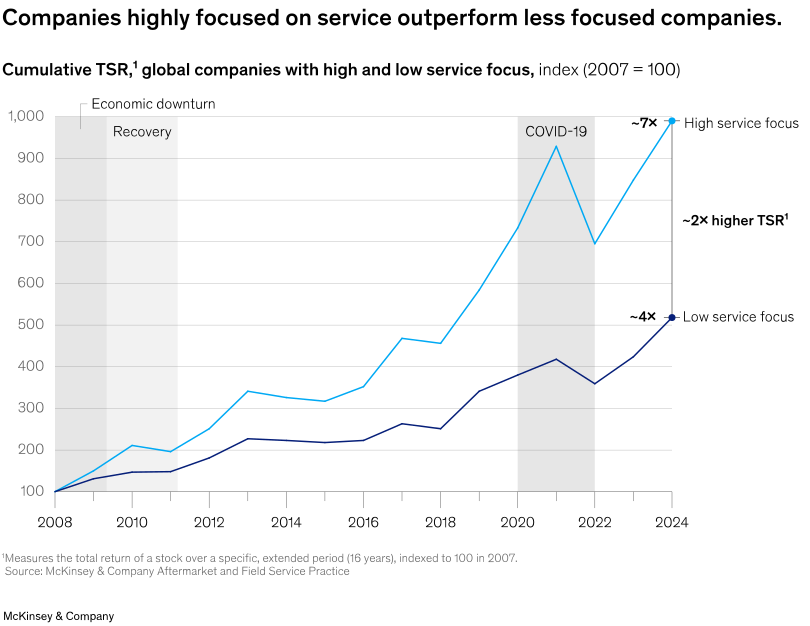
Aftermarket services have become a critical differentiator for manufacturing companies worldwide. Once considered ancillary, services now represent a central pillar of competitiveness and resilience. Firms with strong aftermarket service offerings enjoy closer relationships with their customers and more stable revenue streams. Those advantages translate into larger profits and twice the total shareholder returns (TSR).
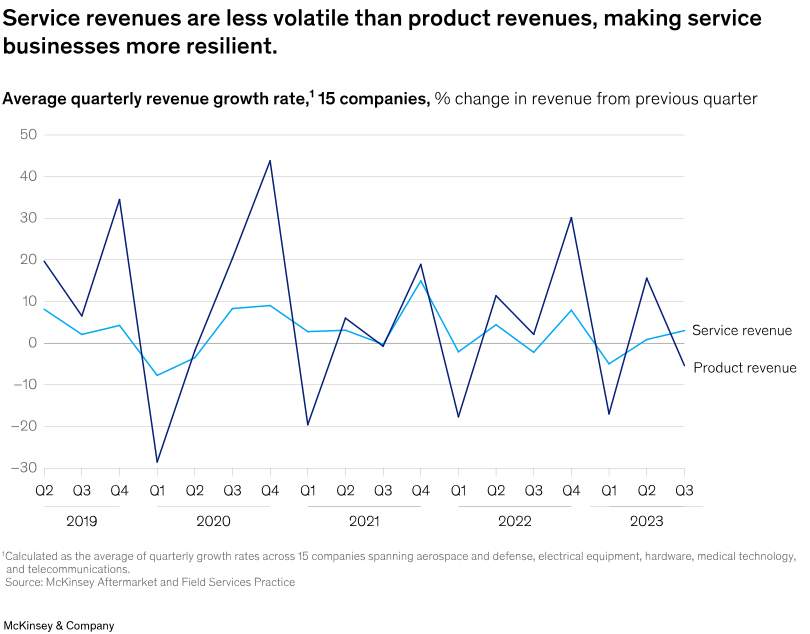
The McKinsey Service Benchmark highlights the importance of services in multiple industries. Aftermarket service revenues are less volatile than product sales, since contracts and subscriptions ensure stable demand (Exhibit 1). Service revenues are less cyclical too, with customers tending to maintain or even increase spending on services during downturns.1
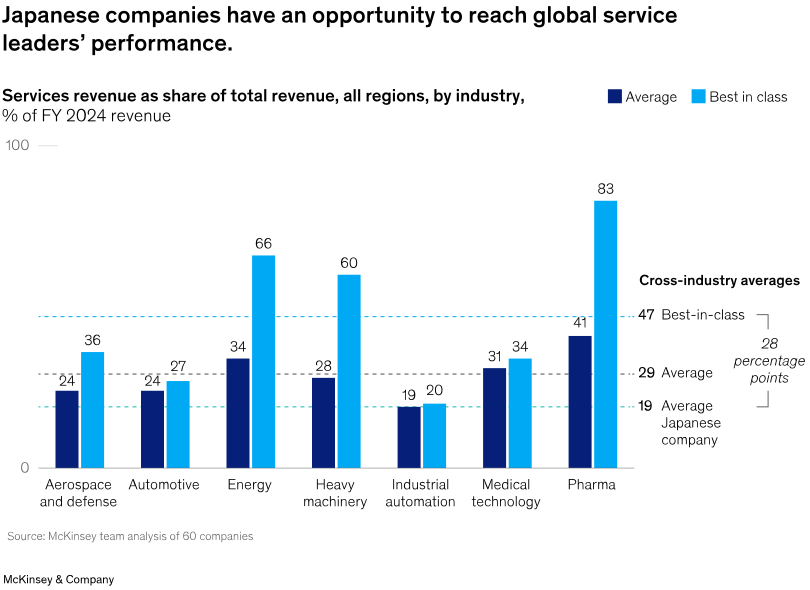
For leading industrial players, the value of aftermarket service revenues can approach the value of revenues from product sales. Companies with a high service focus tend to have a separate services business unit, a dedicated services leader, and clear services P&L reporting. McKinsey analysis has found that, on average, these companies earn 47 percent of their revenue from services. Within this sector, the aftermarket has proven to be particularly lucrative. By providing parts, maintenance, and digital support after the initial sale, manufacturers don’t just stay closer to their customers for longer, they also generate profit margins up to four times higher than those from product sales alone.
Beyond financial stability, aftermarket services offer adaptability. They allow companies to respond quickly to changing customer needs through flexible offerings and new digital solutions. Many service initiatives deliver value in as little as three to six months, with measurable bottom-line impact. Investors recognize this potential: Our analysis shows that companies with a high service focus tend to achieve nearly double the total shareholder return compared with peers that are less service focused (Exhibit 2).
Services in the digital age
The digital revolution has transformed the aftermarket service landscape, and leading global players are already reaping the rewards of this revolution. One major agricultural and construction equipment company overhauled its business model to emphasize services, establishing a new digital services division with 2,600 full-time employees. This move unlocked a $150 billion incremental opportunity and set the foundation for recurring revenue growth of 10 percent. The organization is now targeting software-driven revenues of $25 billion by 2030.
Rapid technological progress is continually expanding the frontier of aftermarket services. Companies are deploying big data, Internet of Things (IoT) sensors, machine learning, augmented reality, and energy-efficient components to deliver predictive maintenance, consulting, and productivity enhancements. Generative AI is now emerging as the next major opportunity, enabling advanced content generation, user interaction, and troubleshooting support.
A North American telecom company, for example, cut daily field service loads by up to 25 percent through AI-enabled schedule optimization, dashboards, and forecasting tools. An elevator and escalator company has reduced downtime by 50 percent through IoT-enabled predictive maintenance. A major distributor of industrial equipment has launched a gen AI copilot to help technicians troubleshoot more effectively. An energy management leader is using connected data and on-site expertise to deliver preventive, condition-based maintenance.
Japan’s service heritage
Japan has long been renowned for its service culture. Manufacturers have built reputations not only on product quality but also on their dedication to exceeding customer expectations. Around-the-clock support and attentive service personnel are hallmarks of this approach, which has created strong bonds of trust with customers.
Yet this heritage of service excellence has not translated into service-based growth. We reviewed the 2024 annual reports of 109 leading Japanese companies across seven sectors—aerospace, automotive, energy, heavy machinery, industrial automation, medical technology, and pharmaceuticals. Our analysis revealed that only 28 percent of these companies report a separate P&L for services. Among those that do, average companies’ service performance, expressed as service revenue as a percent of total revenue, is 28 percentage points below the service performance of global best-in-class companies (Exhibit 3).
The competitive picture is shifting rapidly. In the automotive industry, a leading tire maker has introduced RFID-enabled tires to improve maintenance and traceability, while equipment suppliers are targeting up to 40 percent of revenue from life cycle management services. In aviation, investments in maintenance, repair, and operations (MRO) are surging. In construction machinery, digital vehicle information systems are raising service level and efficiency standards. These innovations set new benchmarks that Japanese companies cannot ignore.
Another critical challenge is penetrating global markets. While Japanese companies have built deep customer loyalty at home, many have struggled to adapt their aftermarket service offerings to meet the needs of overseas markets. Arm’s-length commercial arrangements—typically routed through regional sales and distribution partners—limit many manufacturers’ direct visibility into their global customer base. Opportunities in international markets are increasingly being captured by competitors who are more agile in expanding their reach, so Japanese companies risk falling behind in regions experiencing rapid growth in demand for innovative services and solutions. Yet Japanese manufacturers, given their distinguished record of product innovation, quality, and impeccable services, are well positioned to meet that demand.
Winning the service game
Japan’s deep-rooted service culture provides a strong foundation for transformation. By addressing operational bottlenecks and embracing digital technologies, companies can unlock new value domestically and in international markets. The rise of artificial intelligence (AI) and digital technologies now presents Japanese manufacturers with a generational opportunity. Those that harness these tools can modernize their aftermarket and service offerings, expand profit pools, and sustain Japan’s reputation for customer-first excellence. The challenge lies in balancing technological modernization with the human touch that defines Japan’s industrial identity.
A proven approach to transformation rests on three mutually reinforcing pillars: commercial excellence, service delivery efficiency, and customer service innovation.
Commercial excellence
Service-based revenues remain an underleveraged source of profitability for Japanese manufacturers, given that aftermarket services can generate revenues up to four times higher than those from equipment sales. Capturing this opportunity requires a disciplined focus on customer segmentation, pricing, and sales execution. To build commercial excellence, companies should take a comprehensive approach:
- Identify customer segments. Conduct a granular analysis of aftermarket opportunities by product line and customer profile.
- Develop a tailored go-to-market strategy. Customize approaches by segment, combining differentiated service tiers and dynamic pricing models. Establishing clear pricing structures and aligning offerings with customer expectations prepare companies to ensure profitability while maintaining trust.
- Define opportunity targets. Establish measurable growth objectives that align with broader business priorities. These might include increased aftermarket service penetration in specific regions or for specific product groups, a focus on digitally enabled services, or capturing a share of customers’ aftermarket expenditure.
- Generate tactical leads. Translate strategic goals into actionable customer- or product-level leads. Partnerships with local players can provide valuable market insights and distribution networks, while AI-driven solutions can help generate leads and build relationships with customers outside Japan.
- Establish a “win room.” Create a centralized hub to monitor performance against targets, ensure accountability, and share best practices.
Together, these steps enable organizations to capture higher-margin opportunities while reinforcing the service excellence that underpins customer loyalty.
Service delivery efficiency
Improving the efficiency of service operations is essential for sustaining profitability at scale. Companies can increase technician productivity by introducing digital tools that enable remote support, predictive maintenance, and AI-assisted troubleshooting. Such measures can reduce service demand by 5 to 10 percent and improve productivity by 10 to 30 percent.
AI and analytics also create value behind the scenes. Companies that adopt demand-based inventory and assortment planning tools have achieved better spare-parts availability with 10 to 20 percent less inventory—delivering higher customer satisfaction and lower operating costs. Likewise, optimizing the geographic footprint of service networks, including warehouse and field technician placement, can reduce customer churn by 20 to 50 percent. Building delivery efficiency includes the following key steps:
- Assess the field service organization. Review processes, systems, and workforce capabilities through field observation and employee surveys.
- Perform a gap analysis and ideate use cases. Identify performance bottlenecks and prioritize digital and operational levers.
- Create a road map for value realization. Define a North Star vision for field service, quantify value potential, and build a robust business case for transformation.
These actions strengthen operational resilience while preserving the responsiveness and craftsmanship that customers expect from Japanese manufacturers.
Customer-centric innovation
Customer expectations are rising worldwide. In a recent survey of 250 senior executives, 70 percent reported no improvement in service provider performance over the past decade, and 20 percent expressed lower satisfaction than ten years ago. The message is clear: Incremental improvement is no longer enough.
Leading manufacturers are responding by redesigning the end-to-end customer journey and introducing innovative business models, such as equipment-as-a-service, subscription offerings, and circular-economy solutions. These models deepen engagement, extend lifetime value, and reinforce Japan’s long-standing commitment to service excellence.
By combining digital transformation with human-centered innovation, Japanese manufacturers can evolve their service models from reactive maintenance to proactive value creation. The result is not only stronger profitability but also renewed global leadership in industrial service excellence.
With global competitors accelerating their aftermarket service strategies, Japanese manufacturers cannot afford to be left behind. By leveraging their heritage of quality and trust while embracing digital and AI-driven innovation, they can redefine aftermarket services, not just as a support function but also as a decisive engine of global growth and competitiveness.