Connect with the authors and preorder the book

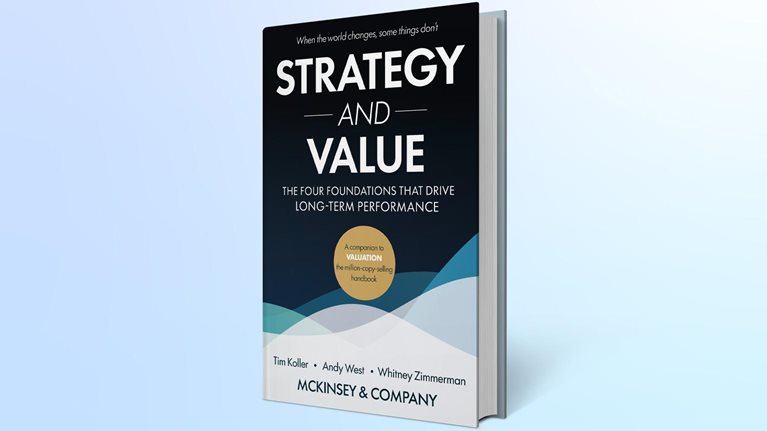
In this edition of Author Talks, McKinsey’s Andy West, Tim Koller, and Whitney Zimmerman speak with McKinsey Global Publishing’s Roberta Fusaro about their new book, Strategy and Value: The Four Foundations That Drive Long-Term Performance (Wiley, November 2026). The authors argue that strategy and corporate finance are too often handled in separate rooms (the strategy off-site and the budget meeting) and that a lot of value is lost between the two. They boil the overlap down to four foundations: return on capital and growth, the long-term view, market attractiveness, and competitive advantage. They also explain why CEOs can’t delegate resource allocation, how CFOs can give leadership teams a common language, and why AI makes these basics more important, not less. An edited version of the conversation follows.
Why did the three of you decide to write this book together, and why now?
Tim Koller: About 15 years ago, we wrote a short book called Value: The Four Cornerstones of Corporate Finance, which was adapted from our long book, Valuation. Quite a few people said we should revisit that book and have something shorter than the 900-page Valuation book that came out last year. As we started thinking about it, we thought, “This is an opportunity to link corporate finance together more closely with strategy.” It made a ton of sense.
Whitney Zimmerman: Over the past couple of years, I have counseled more than 400 CSOs [chief strategy officers], and one of the things I’ve noticed is that it’s a hard job. They really benefit when the whole organization has a basic understanding of how strategy creates value. In an uncertain world, given how quickly change is happening and the amazing opportunities technology is allowing companies to unlock, it is essential to equip organizations to raise the floor on common knowledge and share a common language around how strategy creates value.
Andy West: I would add that there are a lot of other constituents in strategy. We’ve seen that the quality of strategy has been deteriorating over time—about 40 percent over the past ten years. And it’s not just the chief strategy officer’s fault or problem. If you think about the senior executive team, the CFO has to allocate resources, and the CEO has to play a very critical role in identifying and delivering strategy. You put all these factors together, and you see that there’s a real need for simplicity. When you engage with a client, whether it’s on AI or geopolitics or what’s happening with their business or competitive dynamics, you see that so much is happening in this moment. This should feel like a golden age of strategy. But when you talk to executives, that’s not how they feel. They feel that their strategy is ineffective and that they’re not making decisions fast enough.

One of the great misconceptions around strategy and how it creates value is the belief that somehow strategy is an obligation. Strategy is not an obligation. It’s a choice.
How did you settle on the four foundations of strategy and value covered in the book?
Tim Koller: It evolved organically. What are the things that companies need to know about value creation? It’s quite simple. One, return on capital and growth drive cash flows, which drive value. Second is the observation that a lot of companies feel pressure, for whatever reason, to put more emphasis on the short term than on the long term, which usually ends up hurting them. We distilled it down to those two items from the corporate finance side. Also, in our work with clients, the fundamental question in strategy has always been where and how to compete. That leads to the other two foundations: “where to compete” is market attractiveness, and “how to compete” is how to develop a competitive advantage. It all comes down to that.
Andy West: One thing that is important about the four is the “and” in strategy and value. If you have a great strategy that isn’t translating into business outcomes, a deep understanding of value, or how you’re managing the business or allocating resources, then it’s not going to be successful. The disciplines are still incredibly different. We looked at hundreds of books and articles. The intersection is not very well covered. More important, when you look at how clients operate and how they solve problems, there is a strategy room, and there is a budget. Those two things are linked, but there’s so much leakage between the two that we thought the intersection was equally important.
What surprised you most in writing this book—whether in the research, client reactions, or debates among the three of you?
Tim Koller: What was surprising was how difficult it was to get not just my coauthors but also other colleagues around the firm to coalesce around four simple ideas. Everyone has their pet ideas. But if you dig deeper into what we all do, it boils down to the essence of what we were writing about in the book. In a lot of fields, there are foundational ideas, and everything else is a detail or an illustration of that. Strategy and value creation are the same: There are a couple of core ideas, and sometimes you need to go beyond them. Even then, you still end up with those core ideas as the drivers of how to think about long-term value creation.
Whitney Zimmerman: There are very different schools of thought about foundational ideas, such as competitive advantage, how to think about strategy generally, and how to think about market attractiveness. It took a lot of work to try to reconcile those in a way that is universally relevant.
Andy West: It was surprising that, despite how obvious the four foundations may seem, they are hard to execute. It’s not so much that people don’t know them; they’re just not executing them effectively. They’re not acting in a way that allows them to deliver great strategy and great value. That is a real gap. Very few organizations can operate effectively across all four. We wrote the book in a modular fashion so people could refresh their understanding of concepts. As you come up with a challenge in real time—having to focus on an investor call, thinking about an M&A decision, making a tough portfolio call—you can see how the four foundations are applied and choose the insights that are most relevant for you.
Who is the audience for this book—CEOs, chief strategy officers, CFOs, or all the above?
Tim Koller: The book is for everyone. The principles apply to the CEO of a company. The book applies to the CFO of a company because the CFO should be the one who brings these things together and helps the CEO. It applies to business unit leaders, and any manager working their way up should be thinking about these elements with respect to their industry. It’s also valuable for board members. I find board members often don’t have a framework for the questions that they should be asking. This book provides that framework.
Whitney Zimmerman: Absolutely, this is a book for the strategy executive. It’s a book that helps enrich someone who knows a lot about strategy or corporate finance. But the kind of person that I’m excited about reading this book is someone like me: I’m an electrical engineer. I started my career in a semiconductor fab. I worked the night shift at BMW, leading production teams. And in those roles, my team and I cared about understanding why we were doing what we were doing and about how to make great decisions. Strategy shouldn’t be a club. An understanding of strategy and value creation shouldn’t be the domain of just the top of the organization. It is something that should be shared.
Andy West: Initially, we wrote the book with the senior executive in mind. But as we got into it, we very quickly realized it is about decision-making, and the need to be able to make decisions with the four foundations in mind is only growing. We quickly realized that whether you’re an aspiring manager, whether your goal someday is to be a CEO or a CFO, or whether you’re just managing an organization that’s growing—even if it’s a virtual organization—it’s important to understand the four foundations to make great decisions.

The CEO must make the decisions, but the CFO plays a key educational role in creating a common framework, a language for the management team.
What’s the single biggest misconception that CEOs and boards have about how strategy creates value?
Tim Koller: When I think about strategy, competitive advantage, and market attractiveness, I’m always thinking, “How do those translate into an attractive return on capital? How do those translate into growth?” Typically, executives, boards, and others think only about the growth side of the equation and not what drives the return on capital. The return on capital is the piece that’s often missing in that direct linkage. The second thing that’s often missing is a balance between the short term and the long term. Often, after a period of successful performance, they tend to think, “OK, I have to continue to do what I’ve been doing from a financial-results perspective, and the only way I can do that is by cutting costs,” which usually hurts long-term growth and value creation.
Andy West: One of the biggest misconceptions is that effort somehow equals impact. We are just seeing a massive amount of work. It’s not that organizations aren’t trying to create great strategies or deliver great results. It’s that the amount of work that goes into it has increased. Whether it’s because a lot of different information is coming in because AI is making insights and information more ubiquitous, or whether it’s that people are asking more questions because the world is changing around them—all these things are conspiring to create a lot of work. We’ve realized that going deeper on the questions and the insights that matter is incredibly important. We can clear away a lot of that effort and focus more on impact.
Would you like to learn more about our Strategy & Finance Practice?
Whitney Zimmerman: One of the great misconceptions around strategy and how it creates value is the belief that somehow strategy is an obligation. Strategy is not an obligation, something that you must do every year or every five years. It’s a choice. Strategy is a tool for changing a business. It’s a tool for communicating priorities and logic and helping people make decisions about how to allocate resources. You need to choose to do it. If you don’t choose to do it with change in mind, strategy often won’t create value. You won’t hold a high enough bar for clarity. You won’t talk about what must stop. And you won’t have the debates that matter.
What are the things only the CEO can do when it comes to strategy and value creation?
Tim Koller: Many CEOs need to be more granular in the way they make decisions. If you think about a typical large company, it may have three or four divisions, each division with five or six business units and different product lines. And often those businesses have very different characteristics. If the CEO says, “We want to grow revenue faster,” they must realize that might not be the right thing to do for all the business units. Some business units with low margins or low returns on capital should focus on how to increase their returns.
Other times, CEOs say things like, “We’re going to grow profits faster than revenues,” which means our margins are going to go up. That may not be right for some of the business units. Making decisions at a granular level is something the CEO must enforce. That means going down to the level of 20 or 50 different business lines or geographies, for example. That granularity, in turn, leads to resource allocation, which also cannot be delegated. I can’t emphasize enough that resource allocation is the job of a CEO, and it’s an area where companies often falter, because they’re not aggressive enough in moving resources across business units to where they can create the most value. Often, it’s only the CEO who can make that happen.
Andy West: The CEO plays an incredibly important role in strategy. But the CEO can’t do it all. There are six different “undelegatable” roles of the CEO that we outline in the book. Mostly, it comes down to making the choices that the rest of the organization can’t make, defining your role, being clear, and making sure you set the right cadence for decision-making and pace. Sometimes organizations need to move fast, sometimes they need to slow down. All of it needs to come together in a way that’s easy for the organization to understand.
Whitney Zimmerman: In my experience working with CEOs who are exceptional at strategy and value creation, I’ve seen that they don’t just have an understanding of what it means to make a market attractive, what competitive advantage really means, how cash flow works, and what the long term means. Over their careers, they’ve also built a series of beliefs. They have made decisions, and they’ve seen them play out. They have preferences or beliefs about what works, based on their experience. And they’re able to bring those into the room and use them to raise the bar on how strategy and value are debated, decided, and delivered.

Value is created by those who act first and in unique ways.
The CFO increasingly is being asked to lean into strategy. How can this book help them do that?
Tim Koller: The CFO is the one responsible for creating a common language among the top management team. A lot of companies struggle if they don’t have a common language or framework. The CFO is really in the best position to create that language to be able to say, “We are looking at return on capital and growth, or we are looking at the long term. When you’ve developed your strategies, you should be thinking about those things. And I’m going to be asking questions about how market attractiveness and competitive advantage drive your strategies and your financial projections.” The CEO must make the decisions, but the CFO plays a key educational role in creating a common framework, a language for the management team.
Andy West: One complaint that CFOs could address immediately [with this book] is the lack of connection between the debates in strategy and what happens as part of the budgeting process and managing the business with a financial lens. There’s so much leakage there. It’s a huge opportunity for CFOs to stand up and say, “Are we funding our strategy? Does this budget meeting sound like the strategy meeting we might have had four or five months ago?” The CFO should ask those tough questions. I think it will elevate the entire organization, not just the role of the CFO.
Whitney Zimmerman: The CFO is so powerful for building a shared understanding or reality about how the business really creates value, down to return on invested capital, and down to growth. Of course, it’s a balance: You don’t want to make a strategy conversation one about accounting. But there’s a level of rigor strategy needs that the CFO is uniquely positioned to drive and unlock. That’s why we have put these foundations together, to say, “They have to go together.”
How could AI reshape the four fundamentals or the way they are applied?
Tim Koller: Most companies will be users of AI. They’re not selling AI products. They’re not building data centers. They’re not selling software. They’re selling laundry detergent or chemicals, or they’re building cars, stuff like that. The real thing that AI allows you to do is to do things better. It allows you to innovate faster, perhaps provide better customer service, lower your manufacturing costs, your distribution costs, and so on.
But it doesn’t change the four foundations. If you’re thinking about using AI as a company, there are some things you will have to do just to remain competitive. If everyone else in your industry uses AI to reduce their costs and you don’t, you’ll be left behind. Ideally, you’re thinking, “Is there something I can do with AI to differentiate myself from the competition? Is there something unique I can do that will be difficult for my competitors to copy that will allow me to earn an attractive return on capital or to grow my revenues faster?” But then we get back to the same four foundations.
You can also apply these foundations to the companies involved in creating AI—the data center companies, the software companies, the chip suppliers, and so on—and ask those same questions. We don’t yet know what the answers will be. Right now, we have a supply-and-demand imbalance that benefits data centers, but that’s probably not always going to be the case.
Whitney Zimmerman: We didn’t write this book in response to AI. But we have gotten more excited about the importance and value of the book as AI has continued to become more important. This is not the first time we’ve faced technology changes in the economy and in the business community. In the 1950s, we faced an explosion in mainframe computing. In the 1970s, ’80s, and ’90s, there was an explosion in the use of relational databases and spreadsheets. And any time these kinds of technology changes happen, history shows it becomes more important, not less, for leaders to stay in the loop, to have a shared reality, and to be ready to rise to the challenge of making more from technology, not less. That’s why I think these four foundations are so important.
Andy West: In a lot of ways, AI is creating the strategy moment that we’re talking about. It is fundamentally changing the way people work. It’s changing whole industries. It’s driving and will continue to drive a large shift in value across the economy. AI is doing a lot of things. But we think it’s putting a real premium on leadership, on the role of humans, on decision-making. As leaders, we need to be confident and grounded in the insights that matter. We need to know how to make decisions quickly and effectively and to lead our organizations. And that’s really what the book is about.
What do you hope the overall impact of the book will be?
Tim Koller: I hope the impact of this book will be that at least some companies will be more long-term oriented and that CEOs and boards will have more courage. Hopefully we’ll have convinced them that they’re better off focusing on long-term value creation rather than the short term. It’s something we’ve been talking about since the first edition of Valuation 35 years ago. Some companies are more long-term oriented. A lot depends on the CEO: You get some CEOs who are long-term oriented and create value. Then the next CEO comes into the same company and becomes short-term oriented. My hope is that more companies understand and act in a more long-term oriented way in their strategic decision-making.
Andy West: I hope it creates an anchor for great debate and that it creates a common language and frame that allows organizations to rapidly digest the changes in the world around them and reallocate resources toward the biggest opportunities. It’s an incredibly exciting time for executives. The main thing that’s holding them back is the noise. There’s so much signal out there. But we all know that value is created by those who act first and in unique ways. Hopefully this book creates the alignment and the insight required to do just that.
Whitney Zimmerman: I joined McKinsey in 2018 after several years in industry because I cared about organizations working better and being more productive—because I lived in them and saw how important and valuable it was for organizations to work well. I hope this book and the idea of these four foundations help many organizations work better. Strategy is a tool for changing a business, and we have so much need to change organizations today.

Visit Author Talks to see the full series.
Related Articles

The six strategy roles a CEO must not delegate