Do you know what your competitive advantage is? Are you sure?
Competitive advantage is the most critical yet misunderstood facet of strategy. It’s more than a company’s strengths—it’s the reason customers choose its offerings over its peers’ or why it is able to deliver higher returns than its peers through capital efficiency, price premiums, or lower costs. Competitive advantage comprises unique operating models and hard-to-replicate assets such as intellectual property and customer access that enable a company to build superior value over time.
That foundation is shaky for many businesses today, our analysis shows. To identify shifts in competitive advantage, we looked for changes in market position using a metric we call the “shuffle rate”—an industry-level marker that measures the speed of change in the positions of market leaders and laggards.1 We found that the shuffle rate has accelerated for more than 60 percent of industries in the past decade, with an 11 percent increase in median rates (Exhibit 1). This pattern suggests that the defining elements of competitive advantage are in flux, the degree of differentiation between market players is narrowing (causing more frequent positional changes), or both.
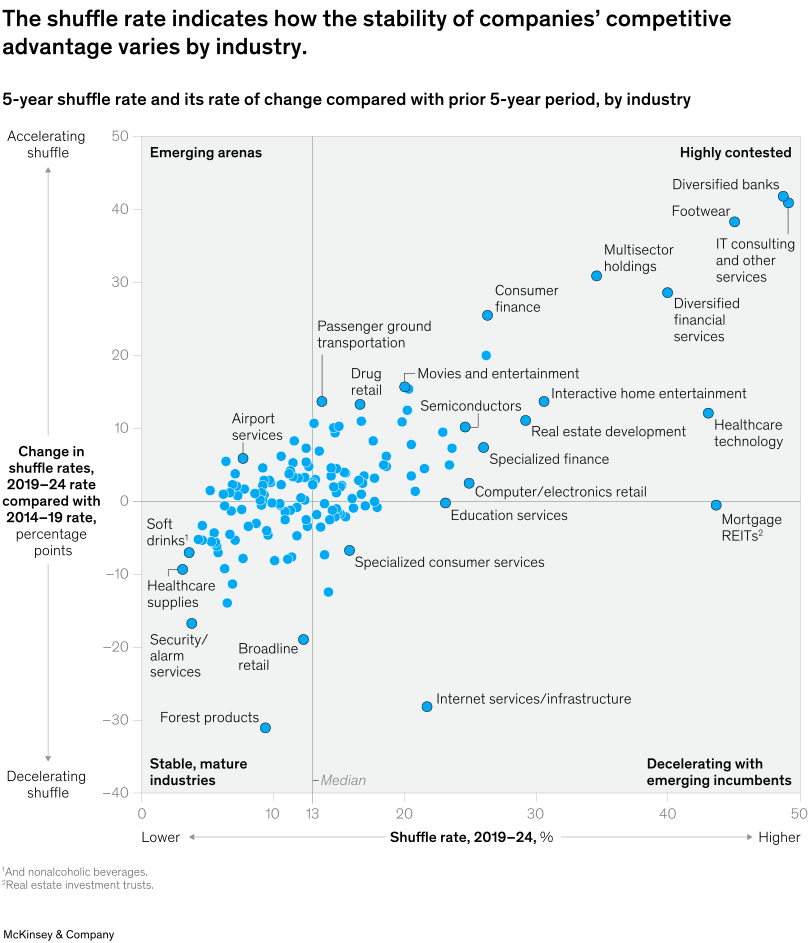
The result is an increasing erosion of competitive advantage for some companies and a critical opportunity to capture greater market share for others. Businesses in a sector with a decelerating shuffle rate may find themselves stuck in lagging positions as the industry’s top performers deepen competitive moats around their leadership. Conversely, those in an industry with an accelerating shuffle rate could find opportunities to attract customers previously locked in by their competitors.

Strategy and value in turbulent times: The four foundations that drive long-term performance
November 12, 2026, 8:30 a.m. ET / 2:30 p.m. CET Join McKinsey experts Andy West and Whitney Zimmerman for a discussion on what it takes to create and sustain value in an increasingly turbulent environment. They’ll explore four timeless foundations of strategy and how leaders can apply them to today’s hardest decisions.
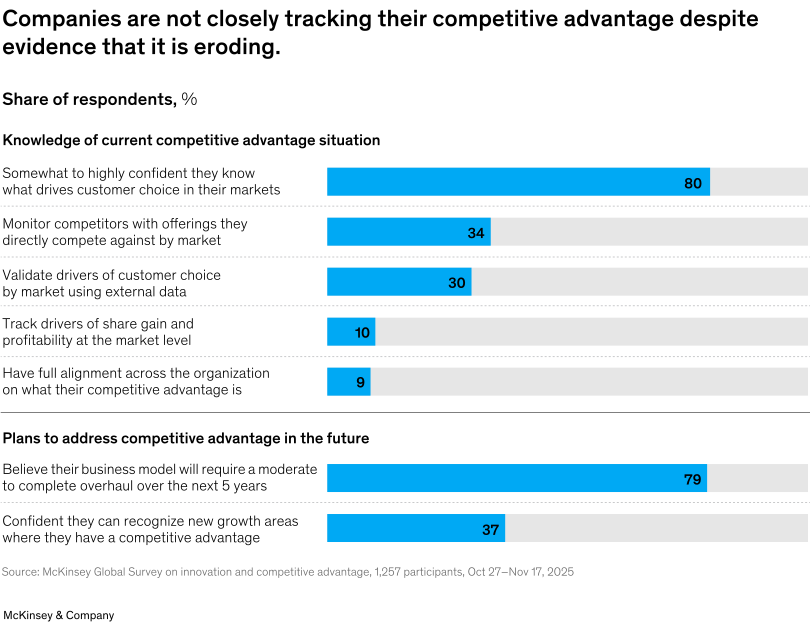
Yet despite the importance of acting on these shifts, recent research2 shows that most companies aren’t monitoring how their industry positions and competitive advantages may be changing (Exhibit 2). Despite this, most respondents report being confident that they understand what drives customer and investor choice—a confidence that may be misplaced as change accelerates. The result is a troubling reality: While the majority of respondents recognize that their advantage is not durable, their organizations are not monitoring signals that would alert them to changes in the competitive landscape.
The dynamics eroding incumbents’ competitive advantages in some industries illustrate why the shuffle rate is accelerating. For example, in entertainment, streaming services have matured, in-theater viewing has suffered a potentially permanent decline,3 and creator-driven content on video-streaming platforms is competing with traditional media companies. This realignment has been accompanied by significant M&A activity, including Netflix’s intended $83 billion acquisition of Warner Bros. Discovery and Paramount’s merger with Skydance. The footwear industry has likewise seen substantial change. Challenger brands have rapidly gained market share from incumbents, and distribution has shifted from wholesale-dominated to direct-to-consumer models, requiring significant supply chain restructuring and changing the competitive advantage needed to win.
While understanding the stability of the organization’s competitive advantage is critical, so is having a shared view of what that advantage is. When business leaders have different assumptions about their organization’s advantage, aligning on what to invest in and in which markets is challenging. And since competitive advantage is context specific, it can be hard to recognize and assess. An additional complication is that an organization’s competitive advantage is dependent on the capabilities of its competitors, and those players constantly change—both in who they are and how they choose to compete.
Not surprisingly, organizations that track their competitive advantage in each of their markets and use it to guide their growth strategies and investment choices outperform their peers. In our survey,4 respondents from companies in the top quintile of annual growth and EBIT in their sectors were more than 2.5 times as likely as others to say that their organizations are fully aligned on what their competitive advantages are and are two-thirds more likely to be tracking that advantage at the market level.
Five rules of maximizing your competitive advantage
With competitive advantage under pressure, business leaders need to actively protect their edge over peers. They can do so by following five rules:
- Develop a granular view of competitive advantage.
- Tailor the advantage to each market.
- Don’t overinvest in areas that won’t improve competitive position.
- Boost the return on competitive advantage by embedding it into strategic decision-making.
- Track metrics that can signal changes in the competitive landscape.
Develop a granular view of your competitive advantage
Companies with numerous business lines and markets often struggle to pinpoint their competitive advantage because it may differ at the enterprise, product, and market levels. For example, financial resources, corporate brand, and some partnerships are enterprise-level advantages, while R&D and customer relationships can be specific to product categories or even individual markets.
When we analyzed the competitive advantages5 of the world’s 5,000 largest companies by revenue,6 we found a wide variance in the unique attributes that constituted their advantages, even within the same industries. Those attributes ranged from broad elements, such as a strong global presence, to specific capabilities and assets, such as mineral rights in a particular country. We classified those attributes into seven categories: brand and external reputation, scale or financial strength, intellectual property or innovative offerings, go-to-market capabilities, partnerships or access to scarce resources, operational excellence, and talent or culture. Our analysis found that the source of advantage for most organizations is a complex and highly specific combination of several categories rather than a single element.
To effectively manage its sources of competitive advantage, an organization needs a granular understanding of how the attributes comprising its competitive advantage combine to differentiate it in the market. Consider scale: In and of itself, it isn’t always a competitive advantage, as the so-called conglomerate discount demonstrates. Yet scale of data and platform reach has enabled digital platforms such as Tencent to successfully enter multiple industries. Similarly, scale in R&D can be a competitive advantage if it fuels multiple business units, but usually not if the R&D expertise only applies to a single product category. Innovations in cancer treatments, for example, typically don’t port to other pharmaceutical lines and thus don’t give the overall organization a competitive advantage outside of oncology (a likely reason why many pharmaceutical companies are simplifying their portfolios).
Leading companies know which attributes affect customer choice, invest in strengthening them, embed them in their most important markets, and make them transferable so they can apply them at scale. These assets and capabilities can exist at many levels of the organization and are often combinations of attributes that are hard to replicate. Companies that operate across many markets may need to vary their competitive recipe across those markets.
A lack of a granular view of competitive advantage often leads to disagreements among leadership teams and boards on how and where the company should compete. Creating that shared view provides a common fact base for the organization’s decisions and helps it maximize returns on its investments.
Tailor your competitive advantage to each market
Once business leaders have a detailed understanding of their organization’s advantage, they need to apply that understanding to how they position their offerings in each market. Competitive advantage occurs at the intersection of offering, geography, and customer—in other words, what you’re selling, where you’re selling, and to whom you’re selling. As sector barriers erode, a company’s biggest competitors may come from outside its industry. Those competitors, in turn, may set the bar that any attribute must meet to constitute a competitive advantage. In our survey, more than 40 percent of respondents cite disruptive trends and new entrants coming from outside their industries as the greatest threats to their competitive advantage. Such disruptions have a long history, from smartphones subsuming the traditional markets of camera and film manufacturers to software firms transforming the economics of industries as diverse as hospitality, transportation, and music.
Large companies that operate across numerous geographies face additional complications due to high variance in what matters for winning in a given market. Consider the evolution of quick-service meals. In Canada and the United States, food delivery apps changed the dynamics and shifted value pools in the fast-food and casual-dining industry; premade meals and meal kits have further eroded traditional players’ market share. Yet these innovations haven’t taken off in Latin America, China, and other markets.
As the variance in what determines customer choice increases, the attributes that create a competitive advantage also change. Consequently, business leaders need to be vigilant in ensuring that a competitive advantage their organization may have enjoyed for decades can be sustained as the market evolves. For example, the location of branches and ATMs used to be a significant competitive advantage for retail banks, often determining customers’ choice of institution, but online banking has reduced the value of those physical assets.
Don’t overinvest in what doesn’t matter
In most scenarios, the ultimate authority on a company’s competitive advantage is its customers (and people who could be its customers but instead buy from competitors). Yet organizations sometimes fall into the trap of believing that their capabilities or offerings are superior to their competitors’ when customers don’t see—or don’t value—the difference. One home appliance manufacturer, for example, developed a product with sophisticated but complex features, only to discover that what customers valued most was ease of use as long as the product’s features were “good enough.” The lesson: Focus on the few factors that determine customers’ choices (and on which investors place value) and don’t overinvest in elements that won’t differentiate offerings in customers’ eyes.
A similar concept applies to addressing competition. Organizations sometimes focus too much on replicating a competitor’s source of advantage—efforts that rarely succeed. Instead, they should aim to be good enough in the competitor’s capability while reinforcing their own sources of advantage. Why? Our research has yielded an important insight about the difference between winning and not losing. When we looked at the actions of pairs of competitors, we found a good-enough threshold—the market’s expectations for basic value. Falling below this threshold due to a critical failure (a reputational crisis, for example, or a labor shortage that hampers production) can negate the benefits of investment in expanding competitive advantage. Conversely, investing more in elements that don’t differentiate the offerings in customers’ eyes will not yield returns. The key is to stay in the middle, except for the few areas that matter.
Talent can illustrate the concept of winning versus not losing on a capability. In industries where expertise is the offering (such as professional services), where critical skills are scarce, or where top-decile companies far outperform the rest (such as niches of high-tech research where having the most-skilled workers disproportionately influences success), talent is an essential competitive advantage for being a market winner.
Not losing on talent is quite different. There’s a large middle ground between not recruiting the very best talent (because it won’t pay dividends to do so) and investing enough in people and culture to operate at the minimum expected threshold for the industry, then differentiating on other attributes such as ease of doing business, reliability, or cost. The distinction between how to win and how to not lose holds true across many attributes of a company’s overall competitive advantage, including innovation, operations, and brand.
Boost your return on competitive advantage
A genuine competitive advantage is sustainable over time. An event or trend can suddenly create a growth opportunity—as the pandemic did for videoconferencing apps—but a company needs a competitive advantage to maintain a market lead as new entrants emerge and competition evolves. Successful businesses regenerate their advantages over time and apply them broadly, especially to the most attractive market opportunities. For example, investments in customer relationship management (CRM) systems targeted at capturing and feeding customer insights to R&D or a culture of internal collaboration can expand an organization’s capabilities as competition evolves.
Sources of advantage that are transferable across markets provide an additional strategic edge. Having a deep technical capability in one type of manufacturing is quite different from having a culture of engineering and operations excellence. The former helps the organization win narrowly, while the latter can enable it to expand into growing markets. Investing in renewable and transferable forms of advantage creates the highest returns and is often what determines long-term value.
You can’t manage what you can’t see
Since the risk, complexity, and dynamism around a company’s competitive advantage vary by market, business leaders need to monitor their competitive advantage at the market level. It’s a complex task, but three markers can signal the potential erosion of advantage or opportunities to expand into new spaces.
- Track the shuffle rate at the market level. Significant change in an industry’s shuffle rate—either an increase in the rate itself or in the market share separating leaders and laggards—often signals the risk of erosion of a company’s competitive advantage. It can also indicate shifts in the factors that determine customers’ purchase decisions, which may present opportunities to move into new growth areas.
- Follow the money. Shifts in start-up, patent, and investment flow activity, among other indicators, can signal the arrival of new competitors (often with very different cost structures), capacity (which can hurt industry economics), value propositions, customer needs, or technological breakthroughs. These factors can reshape industry dynamics and potentially undermine an incumbent’s advantage.
- Watch acquisitions by players outside the industry. Top performers are more than 50 percent more likely than peers to monitor noncompetitors’ acquisitions of companies whose offerings they compete with, our survey shows. Such deals can be early signs of a sea change in an industry.
Aside from tracking market-related markers, organizations can monitor internal indicators to assess the strength of their advantage. These include acquisitions that do not pay off as intended, failed entries into new regions or market categories, or unexpected losses of market share or major contracts to companies not previously viewed as threats.
While the above markers don’t cover all factors that could erode a competitive advantage, tracking them can enable business leaders to objectively recognize change underway. AI tools can help managers rapidly scan for movement in their competitive sets, potential substitutes for their products, growing or declining segments, and market niches that could present new opportunities, as many trends emerge from unstructured data that traditional analyses may not capture.
When you focus on growth in areas where you’re already strong, you can capture more customers than your peers, with a lower investment. As the erosion of competitive advantage accelerates in many markets, organizations that identify and extend their advantages enjoy both outsize growth and lower risk. Additionally, when investors can connect a move you’re making with a strength you have, they’re more likely to believe your growth projections. Even in stable market conditions, a company can miss the gradual decline in its competitive positions until it’s too late. The response of character Mike Campbell in Ernest Hemingway’s The Sun Also Rises to a question about how he went bankrupt is instructive: “Two ways. Gradually, and then suddenly.”



Related Articles

The next big arenas of competition