Our recent McKinsey Global Survey of more than 1,250 executives and managers—including 1,002 senior executives—across industries and geographies shows that the majority of their organizations are not actively validating or managing their competitive advantage.1 Companies that are top economic performers,2 however, are much more likely to try to understand, validate, and use their competitive advantage in their decision-making. In this article, we examine what they do and why it matters.
Signs that current competitive advantages are eroding
Eight in ten respondents are at least somewhat confident that their organizations understand their competitive advantage across the markets in which they operate. However, many question how stable it is. The majority also report that their organizations do not truly understand how and why they achieve competitive advantage, nor do they validate it with external data at the market level.
Despite their confidence in their companies’ current understanding of competitive advantage, one-third of respondents believe the nature of their competitive advantage will significantly or completely change over the next five years, including the areas of competitive advantage and the bar required for actual differentiation (Exhibit 1).
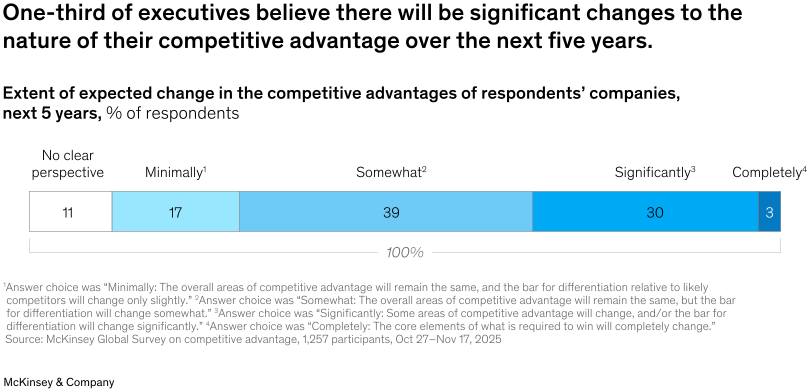
An organization’s economic viability is, at its core, dependent on its competitive advantage, and many respondents believe their organizations will need to rethink their core business models in the near future to stay competitive: Seventy-nine percent of respondents expect their organization will need to moderately or significantly change its business model in the next three years to remain economically viable. This implies that the nature of competitive advantage is shifting in those industries.
Respondents see trends from outside their industry, rather than just increased competitive pressures from “the usual suspects,” as the greatest threat to their current competitive advantage. More than 40 percent of respondents cite trends from outside their industry or risks posed by new market entrants, such as tech players, as the biggest threats. By comparison, only about one-quarter of respondents believe the main risk is from existing peers outperforming them on their current areas of competitive advantage—implying that competitive advantages are undergoing changes more profound than a simple acceleration of business as usual.
Become a member of McKinsey on Finance
Receive McKinsey’s quarterly publication for CFOs and finance professionals, including a special 25th anniversary issue coming out this summer. Members will also receive occasional bonus content that showcases the best of our experts’ corporate finance perspectives.
According to the findings, increased uncertainty is also putting organizations’ current competitive advantages at risk; this uncertainty is limiting their ability to define scenarios that would help them set strategies that defend or extend those advantages. More than half of respondents say their organizations would be unable to address the current degree of uncertainty by using only one or a few distinct scenarios. In fact, 11 percent even say that the context is so uncertain that they could not identify even a broad set of scenarios that would encompass their business context, consistent with other research we have done showing the rise in uncertainty.
Competitive advantage affects profitability (through the ability to command a price premium or reduce costs) as well as share gain, and overlooking that advantage can put both at risk. Nearly two-thirds of respondents say their organizations sometimes or often miss growth opportunities—such as launching a new product or entering a new market—because their competitors move first, even though respondents’ companies were the natural owners of those opportunities and better positioned to win.
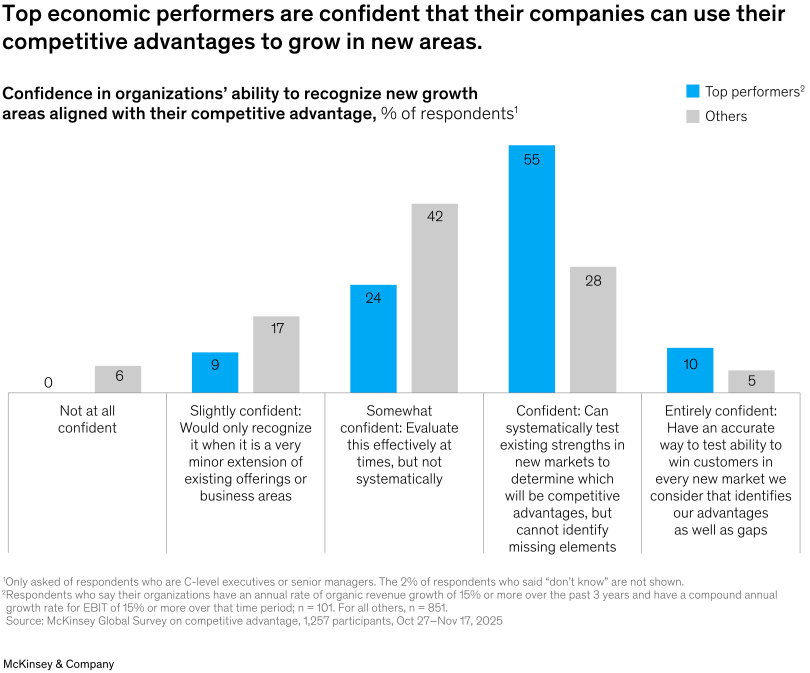
Additionally, only about a third of respondents say they are confident that their companies can find new growth where they already have a competitive advantage. Expanding into an area where a company already has a competitive advantage often requires lower investment and can deliver greater gains in market share.
Top economic performers—that is, respondents from companies in approximately the top quintile for annual growth rate and EBIT in the past three years—are significantly more confident than all other respondents in their companies’ ability to create growth, both within and outside of their core business. They are more than three times as likely as other respondents to say their growth expectations have increased significantly for both their primary industry and the businesses their company has developed in other industries over the past year.
We explored how they link growth and competitive advantage and found that they connect the two much more closely than their peers.
Top economic performers validate their competitive advantage
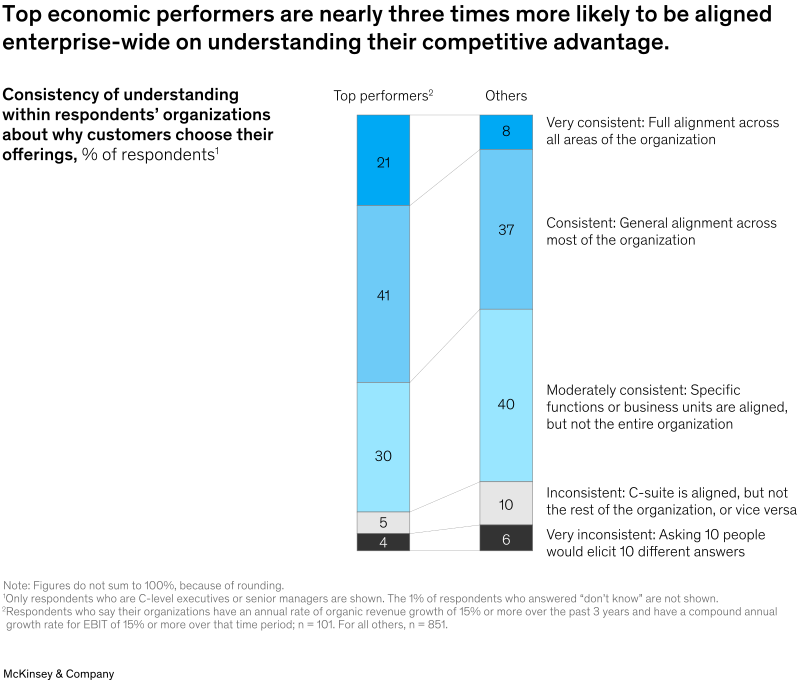
Although top economic performers represent a broad cohort across industries, geographies, and sizes, they are more likely than others to focus on competitive advantage, as well as take a rigorous approach to validating it. Top economic performers are more than 2.5 times as likely as others to say their organizations have a fully aligned understanding of their competitive advantage across all areas of their organization (Exhibit 2). When every part of a company is driving in the same direction, the company experiences less friction and avoids fragmentation of both resources and focus that can increase costs and lower returns.
Most companies still only track the drivers of their economic performance and competitive advantage at aggregate levels. By contrast, top economic performers are nearly twice as likely as peers to monitor performance measures that are more detailed than just the business unit or geography level—they look at important intersections within the business. In this way, they can better understand granular shifts in trends and stay ahead of any erosion of their competitive advantage overall. This also improves their ability to invest in the things that actually matter in a given part of their business, rather than taking a “peanut buttering” approach of spreading resources thinly across too many things. As we know from previous research, disaggregating company performance helps leaders make the right decisions about where and how to compete.
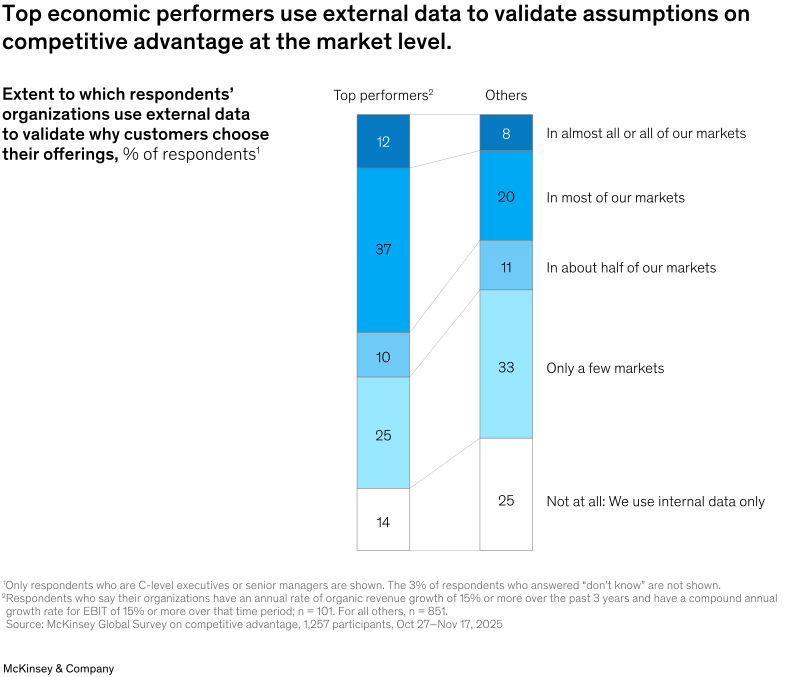
As companies face changes from outside their industry and industry barriers continue to erode, it will become increasingly risky to validate assumptions about competitive advantage based on legacy trends and norms and competitive sets. Top economic performers understand this and validate their views on competitive advantage with external data within each market. In fact, they are much more likely than other respondents to do so in most or all of their markets (Exhibit 3).
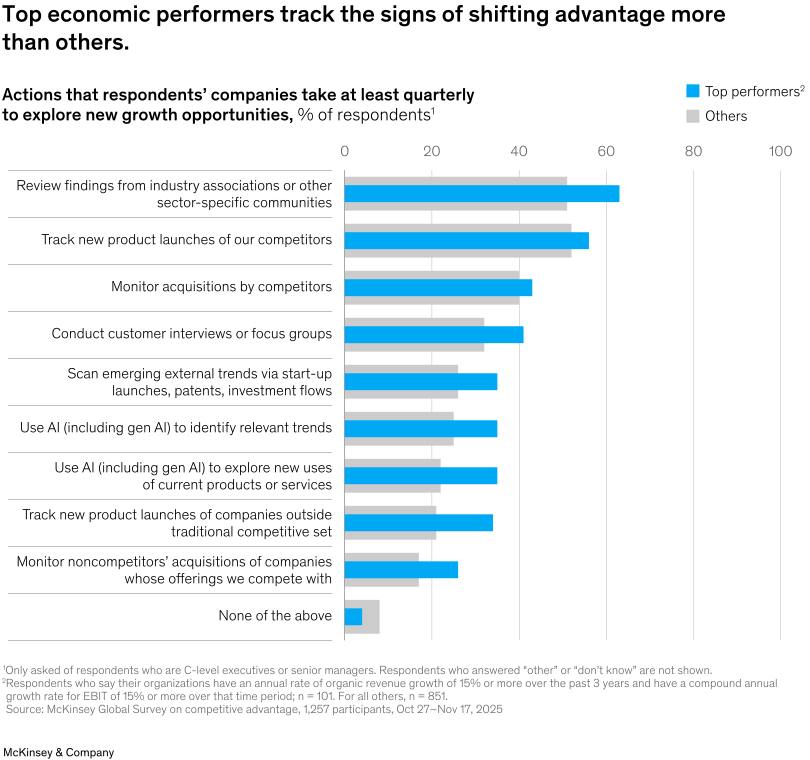
Unlike many of their peers, top economic performers are much more likely to use AI to scan for shifting patterns in investment flows, acquisitions, patents, and the number or type of start-ups or new product launches (Exhibit 4). Monitoring these patterns can identify trends that could indicate both new opportunities and emerging threats to their current competitive advantage.
Top economic performers put their competitive advantage to work on growth
The final area where we see a difference between top economic performers and others is the degree to which the top performers use their enhanced understanding of competitive advantage to inform their investment decisions and other critical strategic choices. Most respondents—including top performers—report underleveraged insights on competitive advantage. But top economic performers are more likely than others to use these insights while making strategic decisions across almost every category of new growth (Exhibit 5).
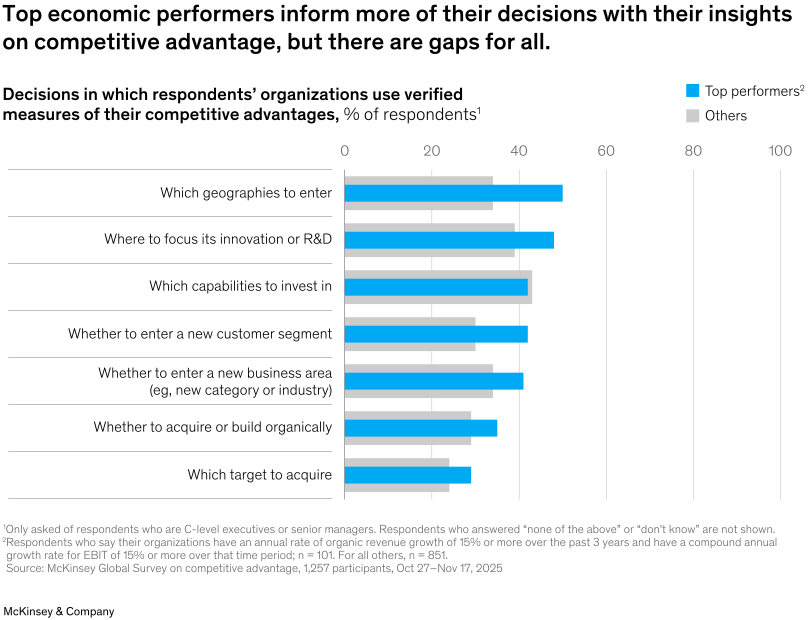
Top economic performers are much more likely to use their understanding of competitive advantage to inform decisions about where to focus R&D, which geographies to enter, or whether to build a new business area or customer segment. In our experience, major investments that have been grounded in a verified, granular understanding of competitive advantage tend to yield better results. When an investment must first address gaps in competitive advantage, it typically requires greater spending to deliver the same share gains or cost savings.
Overall, responses show that top economic performers are much more confident in their ability to use their competitive advantage to expand into new growth areas (Exhibit 6).
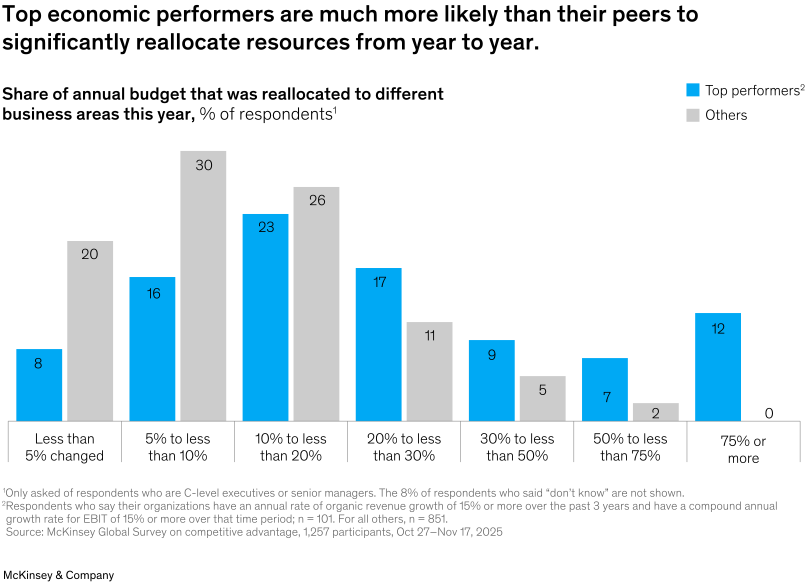
The degree to which this plays out can be seen by the relative level of resource reallocation used by top economic performers compared with that used by all others. Top economic performers shift significantly more of their budget year over year to different business units, geographies, or other major projects than do their peers (Exhibit 7).
Top performers distinguish themselves by better understanding, validating, and deploying their competitive advantage—and these differences offer three practical lessons other companies can apply to help create growth.
- Understand the drivers of your economic performance at a granular level, not at the aggregated enterprise or business unit level. Early signals of an eroding advantage can be averaged away, increasing the odds that a company might be late to respond, which can both drive up costs and increase the chance of losing to better-informed peers.
- Validate your assumptions about your company’s competitive advantage through external data, including data from outside your current competitor set. As the rate of change and uncertainty continues to accelerate and industry barriers erode, assumptions that served you well in the past might be breaking down. Technologies such as AI can make validation a more feasible task than in the past, allowing more markets to be scanned and analyzed with greater frequency. This can prevent an organization from wasting resources on trends in decline and provide data to highlight potential biases and assumptions that might be holding you back.
- Inform your investment decisions with a market-back view of what drives your performance, checking with customers about what they value and are willing to pay more for as the landscape changes at a market level. Understand the difference between a general strength and one that actually wins you business, and use this to inform your resource reallocation to break away from the “last year plus or minus 5 percent” rut that many organizations are stuck in, which erodes competitive advantage and reduces the return on your investments.



Related Articles

Have you tested your strategy lately?