For decades, manufacturers have built sprawling global networks to get closer to suppliers, customers, or hard-to-find talent or raw materials. This distributed approach can make it much easier for a manufacturer to compete—until business conditions change so much that the network needs a serious rethink. At that point, company leaders often find that the structure that had once accelerated performance has become a source of drag.
In part, that’s because transformations are typically designed at the center, where standardization is necessary, while performance is determined at the site level and can vary widely. Even when the transformation’s goals are widely understood, much can get lost in translating those objectives across dozens—or hundreds—of disparate sites.
While a central transformation team can identify broad opportunity areas, define common standards, and set initiatives in motion, it cannot fully account for the operational and cultural realities of every site. The resulting initiatives can quickly lose credibility on the ground, and execution slows.
For transformation teams, the task is to turn enterprise priorities into site-level actions that local leaders can believe in and own. Without that level of buy-in, improvements achieved at one site rarely scale to others.
The organizations that have experienced the most success in transforming distributed operations have emphasized this sense of ownership from the outset. They define the transformation’s ambition, common metrics, and overall architecture, but rely on individual sites to translate that ambition into locally grounded plans. Once the changes start to take hold, the center’s role is to encourage local leaders to exceed their targets and help close gaps.
Done well, this approach accelerates transformation—building conviction early, exposing shortfalls quickly, and enabling multiple sites to move in parallel with greater consistency. It can change the trajectory of a distributed network, not by minimizing differences across sites, but by harnessing them. Indeed, this balanced transformation approach helped bridge the gap between a single precision-machining site and the $4 billion assembly and maintenance business in which it operates.
Drawing on examples including one of the world’s largest defense-industry manufacturers, a global industrial supplier with roughly $30 billion in revenue, and a major North American equipment manufacturer, this article outlines a pragmatic sequence for the first six months of a transformation. These highly distributed organizations generated hundreds of millions of dollars in combined cost savings and revenue increases, significantly exceeding their initial transformation targets. Other organizations with far-flung networks can do the same.
Why typical improvement efforts fall short
To understand the performance challenges that distributed operations face, consider the situation at one defense manufacturer. Every year, headquarters would set network-wide targets for performance improvement. At best, only a minority of the company’s sites would exceed the targets, with an aggregate impact across the network of maybe one to two percentage points in annualized savings—far less than headquarters wanted.
Improvements at one site rarely carried over to others, and, over time, key performance metrics got worse. Most important: rising cost of poor quality (COPQ) as rates of rework, scrap, and compensation to customers all increased. In this sort of situation, countermeasures are especially tricky because the most obvious ones—slowing production or adding more workers—reduce productivity.
Many organizations would respond by launching the usual large-scale, top-down transformation. But the defense manufacturer’s leaders recognized that a heavily centralized solution could cause more problems for its far-flung network. As one leader noted, “The fragmentation across our sites made broad-based change really difficult—I looked across the network and saw at least 12 different ways to try to fix the same problem, with no real benefit to the variation. Yet I also knew that there were real operational and cultural differences between our sites, which local leaders have to navigate.”
To resolve the tension, the company needed a more flexible approach.
A transformation sequence for early impact
What does a transformation model look like when it must be both scalable across dozens—or hundreds—of sites and fast enough to deliver meaningful results within a business cycle? In distributed operations, the unit of transformation is not the initiative, the technology, or the central program management office (PMO)—it is the site leadership system itself.
In organizations with distributed operations, the most successful transformations empower local leadership to tailor change to their context while anchoring on a standardized enterprise-wide model. The corporate center provides resources, such as a repository of tested best practices, and (most important) sets overall performance objectives. But site leaders determine how to meet the targets, updating the center on progress and any problems that the center can help resolve. This model provides clear guardrails, shared metrics, and a common operational language, without stifling innovation or ownership at the site level. The result is a transformation positioned to change an organization’s performance trajectory—fast.
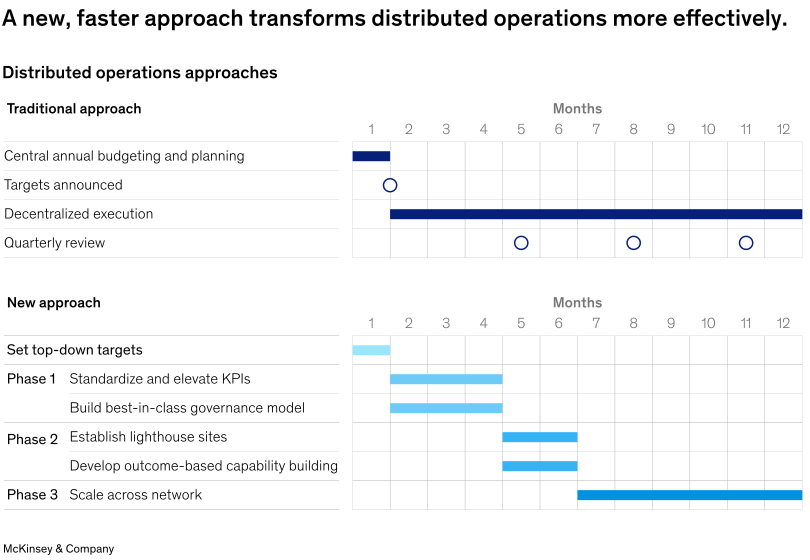
Speed is critical. In the first six months of a transformation, the top team launches two broad efforts in parallel that galvanize leaders and managers across the entire organization. The shorter effort, lasting three to four months, develops the transformation’s metrics and governance. The longer one, often lasting around six months, identifies “lighthouse” examples and builds training programs (Exhibit 1).
First three to four months: Metrics and governance
The shorter phase, ending after three to four months, produces explicit agreement on the few KPIs that define success—so activity is never confused with progress—and installs a governance model that reinforces organization-wide standards while preserving site-level accountability.
Standardize and elevate the right KPIs
Clear, comparable metrics always matter for improving performance—and when transforming distributed operations, they matter even more. A small set of high-impact indicators can define what success looks like across disparate sites; more important, it gives the organization a common basis for decisions and trade-offs—while still letting local leaders choose how best to deliver results.
Yet too often the metrics that the top team and central transformation leadership emphasize have little to do with the regular performance targets that local leaders must meet. If, for example, the company announces a transformation focused on improving quality but sites are still evaluated primarily on production goals, the transformation will start to feel like a second job. An executive at the defense company noted, “The goal with metrics is to find transformation KPIs that make the Venn diagram concentric.”
There’s no easy formula for determining which KPIs matter. Instead, it means carefully analyzing a few representative sites to see which site-level factors are most critical for meeting the transformation’s overall targets. For example, if one of the enterprise-wide targets is to increase production, the cross-site analysis could reveal that the most important site-level metric is the quantity of products shipped. Site leaders must then agree on how the metric is measured and reported—which data sources are reliable, how frequently, and at what level of detail.
Once the metric is determined, it’s up to each site leader to determine how to meet it. One of the main targets for the North American equipment manufacturer was to improve the efficiency of its maintenance operations. Through their careful evaluation of the machining operation, leaders found that the critical problem was highly variable productivity among individual technicians. “The focus on a standardized technician productivity metric was critical in helping us deliver,” an equipment-maker executive said. “We developed an improved ability to measure productivity down to the technician level, so that we could provide targeted training.” That attention to detail helped the site raise overall equipment effectiveness by more than 10 percent.
Build governance based on rigor, cadence, and role modeling
In transformations involving distributed operations, governance turns intent into implementation—but only when it is grounded in rigor. Without that discipline, it is easy for transformation plans to overstate what is achievable.
Use cadence to reinforce rigor. The heartbeat of the transformation is a tiered meeting cadence. It may sound like an administrative detail, but it determines how quickly issues are reviewed and resolved, building momentum for transformation. When reviews are slow, actions are slow—and progress is slow. In practice, the pace of a transformation almost always mirrors the pace of governance.
To successfully transform at scale, each site should convert enterprise priorities into goals that reflect its context, then into a focused portfolio of initiatives with clear milestones, owners, and timelines—supported, where needed, by additional capability and capacity from the center. But what matters most is how quickly that translation turns into action.
Governance therefore serves two purposes. The first is to track performance against commitments, treating them as firm targets, not projections. The second—and more critical—is to align on the specific actions required before the next review.
Activate local change agents through a common fact base. Alignment is possible only when everyone works from the same facts. Especially in distributed networks, teams may use multiple tools or local scorecards that can create competing views of progress. The best-performing transformations use a single, company-wide platform to track initiatives and results, creating a shared source of truth that sharpens problem-solving and keeps attention on outcomes rather than debate over how a KPI is measured or whether it applies.
A decisive success element at the defense company was active, visible transformation leadership at every site. Credibility and commitment on the part of each site’s general manager helped to sustain momentum for transformation initiatives and ensure that each site had the required resources.
A leader at the equipment company agreed: “The biggest change agents are the site leaders—full stop. If you can’t get them on board, you won’t drive lasting change.” These sorts of highly visible role models prove invaluable for demonstrating that the changes are real—and that they work on the front line.
Across transformations, a consistent pattern emerges: When site leaders treat the transformation as something they personally lead, performance improves materially and quickly.
First six months: Lighthouses and capabilities
The next phase, which ends at roughly the six-month mark, focuses on skill sets and processes—establishing lighthouse sites that show the “art of the possible,” and deploying targeted capability building to address urgent gaps.
Establish lighthouse sites to demonstrate the art of the possible
Central transformation teams can equip a small number of strategically chosen sites to lead in advanced technologies—ranging from robotics and AI to integrated digital workflows. These lighthouses provide a tangible demonstration of what’s achievable and can serve as an effective mechanism for diffusing innovation across the network.
As the World Economic Forum’s Global Lighthouse Network (GLN) illustrates, more than 220 factories worldwide have used these and other technologies to deliver step changes in productivity and agility. The defense company executive agreed: “Our lighthouse plants gave us the confidence we could scale our approach across the entire network.”
Yet “scale” does not imply uniformity: The goal is to standardize what works while letting sites adapt to their own operating conditions. Choosing a site to serve as a lighthouse is therefore more art than science, depending on a combination of improvement opportunity, strong local leadership, and a willingness to experiment. Some lighthouses start off as low performers: one was on the verge of closure when a local leader decided to stake their career on a turnaround. Others are generally high performers where managers realize that they have far more opportunity than they previously realized—such as to make dramatic cuts in water or energy usage while maintaining quality and output levels.
For a fast-moving transformation, however, the most practical option in choosing lighthouses is typically to focus on sites that show at least one major performance spike—creating a clear opening for best-practice codification and sharing. These may be easier to find than a “cleansheet” opportunity, and are often more typical of sites across the network. The industrial supplier, for example, found that one of its sites was particularly advanced in specific robotics technologies, which created a natural platform that the company could build on for robotics more generally.
Deploy targeted capability building
Lasting transformation hinges not just on tools, but on people. Too often, capability building across a network defaults to generic training, with no clear line of sight to business results. It’s no surprise that the impact is limited. Effective capability building links skills directly to the performance outcomes that matter at each site, focusing on the behaviors that improve core KPIs such as lead time, throughput, and labor productivity. This avoids one-size-fits-all programs—focusing on a consistent set of capabilities while allowing sites to build them in ways that reflect their specific needs.
The strongest efforts embed learning in daily work, reinforcing role clarity, faster decision-making, and structured routines like daily huddles and visual dashboards. When done well, these efforts yield real results and generate pull from other parts of the organization.
In distributed operations, resourcing for capability building is especially critical for three reasons. The first is lack of scale, in that local managers may have few or no people to dedicate to training. The second problem results from the first: uneven performance in training, with unclear targets and little reward for meeting them. The third is loss of momentum, particularly at sites with high turnover levels. Too many companies fail to calibrate the frequency of their training programs to vacancy rates among frontline and middle-manager roles.
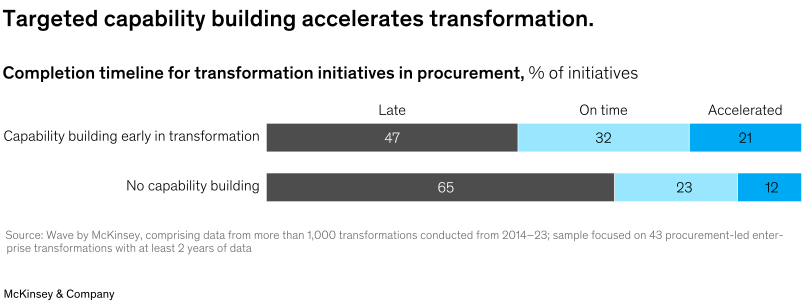
CEOs and chief transformation officers can build targeted training programs to achieve transformation aims and deliver higher-impact initiatives more quickly and predictably. McKinsey research has confirmed the value these programs can generate. For example, in transformations across sectors, companies that gave their procurement initiative owners customized training delivered significantly more initiatives on time (or early) than did their peers (Exhibit 2).
Over time, stronger capabilities can yield even greater strategic advantage by making the organization more adaptable. During crises, procurement representatives with better communication, negotiation, and problem-solving skills can more effectively identify alternative suppliers or shipping channels—easing strains on the organization and demands on leaders’ capacity. At the industrial supplier, these sorts of changes have dramatically increased the responsiveness of its supply chain, which is now better able to support increasingly complex customer demands for customization and delivery precision.
Together, this disciplined sequence can deliver a transformation at scale across a distributed network. At the industrial supplier, the outcomes included a 10 percent increase in EBIT, with the company’s share price outperforming its industry benchmark by 20 percentage points.
The ability to mobilize dozens—or hundreds—of sites as a coherent system is becoming a defining source of advantage. Companies that master this model do much more than just reduce variation; they build networks that learn faster than their competitors. That’s real resilience for the long run.