For companies that have already invested—often heavily—in global production systems, the critical question is why operational excellence hasn’t always followed. Even organizations that have defined common standards, rolled out digital tools, and launched multiple improvement initiatives across their networks too often have little to show for their efforts.
The reason, we find, is typically that the “system” is systemic in name only. A McKinsey survey of more than 100 manufacturing COOs found that while 74 percent say their company has a global production system, just 29 percent report that it is fully implemented across all sites. Instead, most organizations apply these systems only to certain plants or functions, leaving them partially adopted enterprise-wide (Exhibit 1).
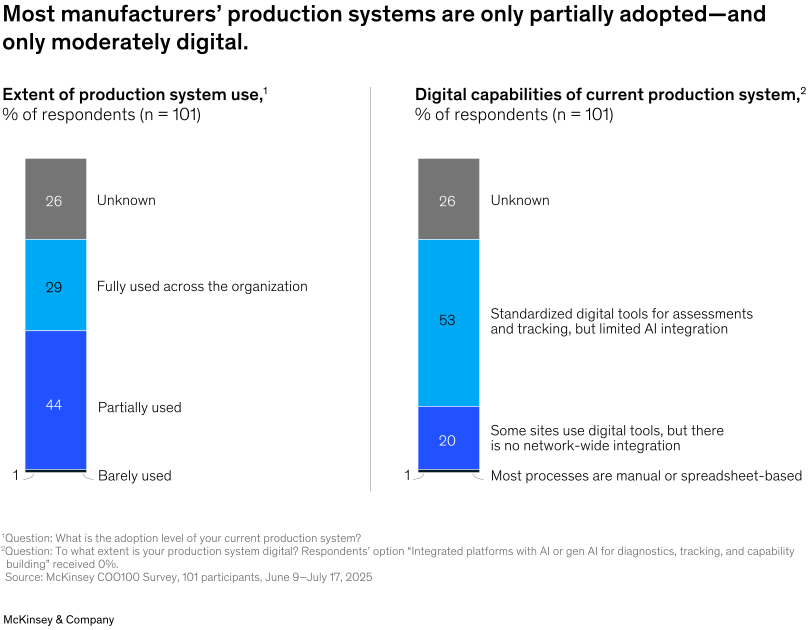
It’s a similar story with these systems’ digital capabilities. Although almost three-quarters of COOs report using standardized digital tools, many remain confined to specific locations rather than scaled across the organization. And none of the respondents say their organizations have fully integrated advanced analytics, AI, or gen AI into decision-making. As a result, companies are trying to drive continuous improvement without the continuous, connected insight that technologies such as AI can make possible.
Organizations typically end up in one of two traps. Some bolt together disconnected initiatives—production elements, analytics pilots, capability programs—that never fully cohere. Others swing to the opposite extreme, imposing heavy centralization in an attempt to drive consistency, only to find that rigid standards and top-down control prove unworkable at the local level. In both cases, feedback loops never form between performance insight and frontline action. Improvement remains episodic: gains appear in pockets but fail to scale or sustain across the network.
What makes a global production system truly a system is not just the uniformity of its tools or standards, but the way it continuously links insights to action across the network. In effective systems, performance data creates transparency about what matters most; those conclusions are translated into clear priorities and repeatable routines at the front line; and the results are fed back quickly so learning compounds across sites. Over time, the cycle of initial insight to real learning becomes self-reinforcing, accelerating transformation (Exhibit 2).
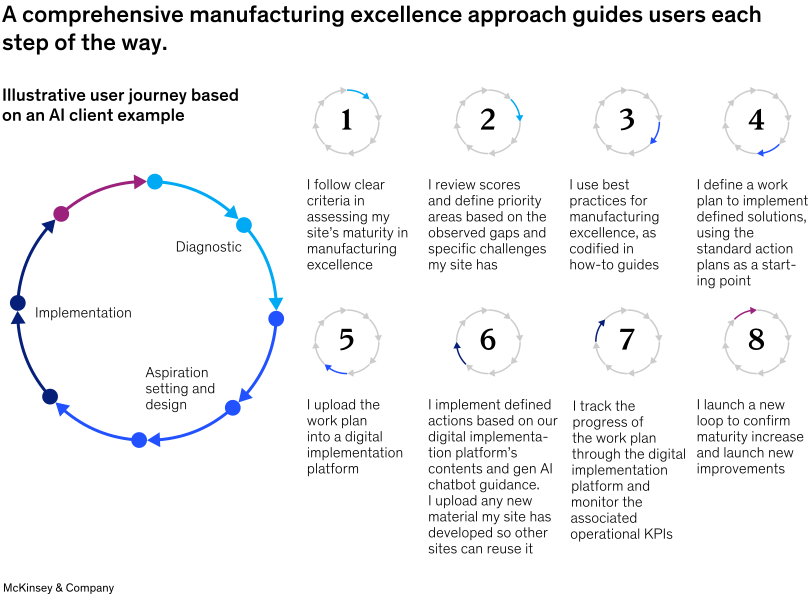
Companies at this stage can make even bolder moves. For example, some of the most advanced production systems now embed predictive analytics and generative AI assistants directly into their production systems to support operators with real-time, data-driven recommendations. Others use digital platforms to compare performance across plants, identify best practices, and suggest steps to address gaps. What distinguishes the leaders is not any single technology or methodology but an operating model that makes improvement part of the company’s daily rhythm—guided by data, enabled by digital tools, and owned by people at every level.
This article will describe how companies can make this vision a reality. For a global industrial manufacturer, these sorts of changes increased production capacity by 40 to 50 percent; at a European life sciences company, a redesigned production system has reduced costs network-wide by more than $60 million in a single year.
Putting the system in ‘global production system’
Our analysis of companies whose global production system achieves its promise shows a three-step plan: creating performance transparency, filling skill gaps, and using technology as the backbone for both initiative execution and learning.
Establishing a performance baseline
The first step in creating an effective and truly “systematic” global production system is almost always establishing transparency about current performance—because without a shared baseline, even well-intended standards drift into familiar traps. Local teams launch initiatives that cannot be compared or scaled, while central leaders impose standards without a clear fact base. Leading manufacturers address this by starting with data-driven maturity assessments (see sidebar, “A faster path to excellence in manufacturing”) that benchmark where each site truly stands—operationally, culturally, and digitally—against a common definition of “good.” This clarity shifts conversations from anecdote (or internal politics) to fact, and it does something more important: it forces choices. Leaders can see which gaps matter most, where to intervene first, and what to replicate across the network.
One multinational consumer goods company began by running a structured diagnostic across 15 sites. The results revealed wide variation in fundamentals, from inconsistent maintenance routines to unclear performance accountability. Benchmarking each plant against a common set of metrics provided, for the first time, a transparent view of relative performance and improvement potential. That visibility became the foundation for a more systematic transformation, informing the sequencing of interventions, clarifying where capabilities needed to be built first, and creating a fact base to track progress over time.
In one global pharmaceutical company, a similar assessment revealed significant variation in equipment effectiveness and problem-solving maturity across sites—evidence that performance differences were rooted not only in technology but in daily management practices.
Building capabilities—flexibly
Once performance gaps are visible, many organizations assume that capability building will follow naturally. Here, too, companies often repeat the same missteps. Some rely heavily on classroom training or one-time rollouts, expecting skills to transfer cleanly into day-to-day operations. Others distribute detailed playbooks without changing how work is managed, leaving frontline teams unsure how to translate standards into daily decisions. As a result, capability varies widely from site to site, improvement depends on individual champions, and gains erode as attention shifts elsewhere.
Organizations that build capability at scale take a more methodical approach, recognizing that transparency alone does not change outcomes. Instead, organizations need a more rigorous way to translate analysis into repeatable behaviors at the front line, no matter how many sites or people are involved—yet without centralizing the entire problem-solving process. The most effective transformations therefore provide structured playbooks, which can help reduce the time to proficiency for frontline roles, speeding improvements in productivity, quality, and safety while allowing for local adaptation.
The consumer goods company’s playbook defined what “good performance” looked like across more than 20 operational dimensions—from line leadership behaviors and problem-solving discipline to energy efficiency. A central transformation hub was established to coach local teams and monitor implementation progress. The first pilot sites quickly demonstrated the potential: Productivity rose by about 25 percent, and the visible results helped motivate other sites to adopt the same approach.
How a playbook is implemented matters at least as much as its content. Long-standing research shows that capability development is most powerful when it is embedded in the flow of work—when operators, engineers, and supervisors learn by applying new tools to real problems rather than through detached training sessions. Two global consumer-packaged-goods companies recently took this approach when scaling operational excellence across 15 to 20 sites. Each introduced a unified digital platform that standardized diagnostics, enabled teams to visualize performance gaps, and tracked progress toward site-level targets. More than 3,000 users were onboarded within months, creating a shared language for improvement across functions and regions.
Some companies amplify these efforts by investing deliberately in coaching capacity. An Asian pharmaceutical company, for example, embedded capability building into its new production system by launching a “digital accelerator” that coached more than 50 full-time employees across five sites on two continents. These individuals formed the core of a new transformation capability, helping raise overall equipment effectiveness and operational-excellence maturity scores dramatically within a year.
At scale, capability building is no longer a training exercise. It becomes an operating discipline—one that standardizes how problems are identified and solved, reinforces learning through daily routines, and ensures that insight consistently translates into action across the network.
Applying digital and AI judiciously
These cases reinforce the third critical differentiator in long-term transformation: thoughtful development of digital and AI capabilities. McKinsey’s latest research on the state of AI confirms that both generative and agentic AI capabilities are accelerating quickly, including among manufacturers. Some 88 percent of organizations now report regular use of AI in at least one business function, up from around 78 percent a year earlier. Notably, 23 percent of respondents say they are now scaling agentic AI somewhere in their enterprise; an additional 39 percent report they are experimenting with AI agents.
While enterprise scale AI remains rare—in the COO survey, only 2 percent of respondents said that their company has fully embedded AI across operations—emerging use cases suggest that AI has a growing role to play in the production system backbone. Leading companies in sectors such as automotive and defense are already implementing agentic AI tools for visual-anomaly detection in production and autonomous routing and scheduling in logistics, with smart workflow agents reducing cycle times from days to hours.
AI shows real promise in supporting learning and skill development as well. One multinational chemical company trained and coached several dozen change agents through a multisite transformation program, linking diagnostics directly to implementation plans. By combining AI-supported insights with human expertise, it moved three major sites through the diagnostic-to-implementation cycle in about ten months—a journey previously measured in years.
Digital tools also became the accelerant for the consumer goods company. To speed up deployment of new ways of working and sustain improvement, the company launched a central platform that integrated digital dashboards, best-practice libraries, and generative-AI-enabled assistants. These assistants helped teams identify quick wins, draft improvement plans, and connect with peers tackling similar challenges across the network. Local managers were able to see performance in real time, while central leaders gained a clear picture of progress and bottlenecks. The impact was tangible—a 15 to 20 percent reduction in costs and more than 85 percent employee satisfaction with the new approach.
Designing governance for the future
Once the initial transformation takes hold and performance rises, the organization faces a new risk: regression. Companies that build mechanisms for peer exchange—regular maturity reviews, digital communities of practice, and cross-site coaching—are better able to maintain progress and adapt as technologies evolve, leaders rotate, and priorities shift. Over time, consistent reinforcement turns a production system from a set of tools into a living management framework—one that continuously improves itself through data, collaboration, and human ingenuity.
For operations leaders, this shifts the nature of their role. Rather than optimizing individual sites in isolation, they orchestrate a network that can adapt and scale new practices rapidly, based on a nuanced understanding of what must be common and what must remain local. Governance becomes as important as technical design—the mechanisms that track progress, build capability, and share learning determine whether excellence remains episodic or becomes self-sustaining.
The consumer goods company’s sustaining infrastructure focused initially on quarterly maturity review, which provided a cadence for refreshing benchmarks and identifying new opportunities. Digital coaching sessions and peer learning forums helped keep the momentum, allowing sites to share lessons learned and refine their practices as new technologies and methods emerged. Today, the company’s 30-plus global sites continue to evolve together, guided by a common language of performance and a shared commitment to continuous improvement.
The experience underscores a broader lesson. Moving from fragmentation to consistent impact depends not only on tools and playbooks but also on governance and culture—the mechanisms that keep learning and improvement alive once the initial transformation has been delivered. Organizations that invest in these foundations are better positioned to capture the next waves of value from digitalization, analytics, and AI as those technologies mature.
As production networks grow more complex and digital and AI capabilities mature, the cost of operating without a true system is rising, while the window to build one is narrowing. The manufacturers that achieve long-term operational excellence are those that create a virtuous cycle—data informs priorities, people translate insight into action, and the system as a whole becomes a source of continuous improvement. In this model, excellence is no longer a program or a destination. It becomes a property of the system itself.
This piece was originally distributed in January 2026.
Related Articles