In an era defined by renewed great power competition, geopolitical distance once again matters, increasing pressure on the sprawling, globally distributed supply chains that arose after the Cold War. Yet the story is more complex than a simple retreat from globalization.
Our research reveals that the forces reshaping global manufacturing fall into three broad categories. First, a set of new, geopolitically driven factors has surged in importance, including industrial policy on a scale not seen in decades: tax incentives, export controls, investment restrictions, and tariffs designed to reshape production footprints. Second, long-standing considerations—such as labor and talent availability, energy costs, and infrastructure—have become more acute as companies reassess risk and resilience. Third, technologies ranging from AI and automation to digital supply chain management are transforming what can be produced where.
Some companies are already making bold moves, as evidenced by the evolving patterns and the current evolution of foreign direct investment flows. With a great trade rearrangement now underway, the critical question is how firms can reassess long-held assumptions about where production should take place across every tier of their supply chains.
Finding an answer requires sustained attention. A recent global survey of 100 supply chain leaders suggests that despite repeated macroeconomic crises, many companies report that the depth of their supply chain visibility has to recover fully after eroding for several years. To address the risk of shortages, companies are resorting to increasing inventory levels—a costly tactic that consumes cash and diverts limited resources from innovation and productivity improvements.
We believe there’s a better way. Rather than just reacting to the latest surprise, companies need the ability to reassess and realign their production networks on a continual basis.
To help sort through the variables that matter, we disaggregated bill-of-materials components for more than 200 finished-product types, then mapped regional concentration and trade flows of tier-one, tier-two, and tier-three suppliers by country. We then calculated location attractiveness scores, along with entry and exit pressures, across 188 KPIs.
The resulting models provide a far more detailed picture of the trade-offs companies can make. This article will review companies’ current awareness of their supply chain vulnerabilities, an industry-level view of exposure to disruption, and a case study illustrating how, with thoughtful preparation, leaders can place informed bets that yield a major first-mover advantage.
What don’t you know about your supply chain?
The most serious supply chain problem facing companies today is a lack of awareness of their true vulnerabilities, particularly beyond their tier-one vendors. The 2025 results from McKinsey’s annual survey of 100 supply chain leaders around the world confirm that across sectors, the majority of companies understand their supply chain risks only up to tier one (Exhibit 1). Moreover, comparison with earlier survey years shows that as memory of the pandemic faded, so did supply chain risk capabilities. The share of companies reporting awareness of risk at tier two and beyond fell in 2023 and 2024. Even with the threat of tariffs, companies’ risk capabilities have yet to return to 2022 levels.

Respondents acknowledge limitations in their supply chain transparency, at least at an abstract level. When asked to assess the maturity of their company’s supply chain capabilities, respondents gave their weakest scores to “supply visibility over the next five years” (Exhibit 2).
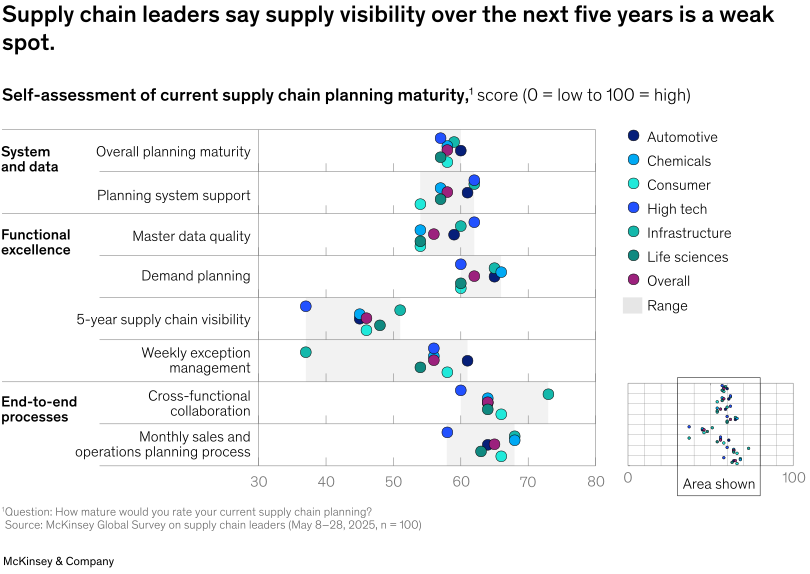
Given these weaknesses, it’s easy to understand why companies are relying on inventory buffers, even while saying they’re also working on longer-term initiatives to restructure their footprints. But the reality is that the harder work happens at a much earlier stage (Exhibit 3).

Many respondents also said that their organizations have cut back on investing in supply chain digitization efforts that are critical to building long-term capabilities. Instead, these digital initiatives are falling victim to cost pressures, competition from major tech projects such as enterprise resource planning replacement, and concern over finding the right tools.
How exposed is your industry to global realignment?
In the constant fight for internal resources, supply chain leaders might be better served by having a clearer understanding of their industry’s starting point.
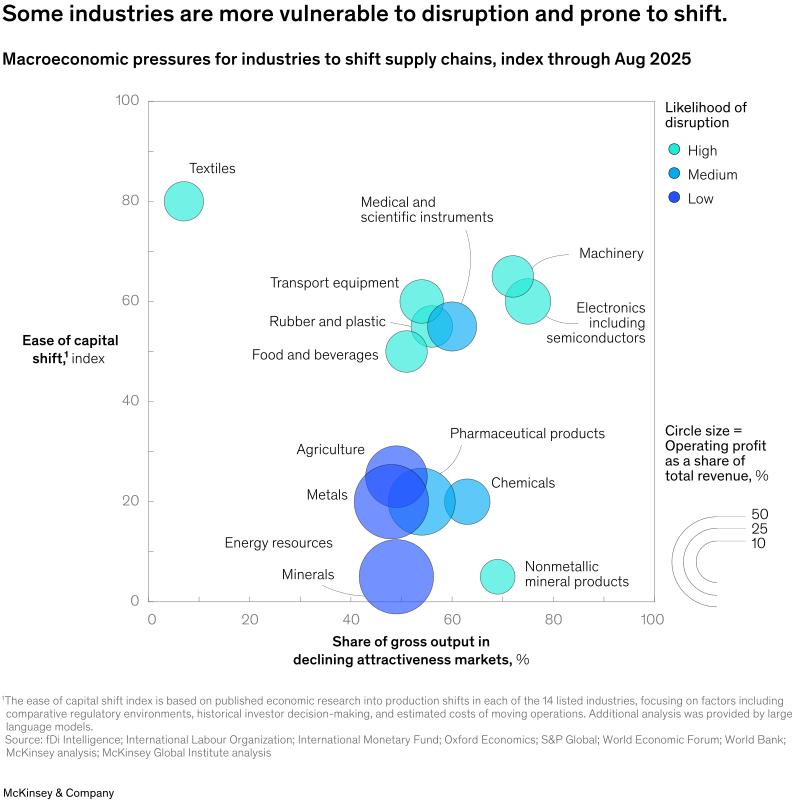
Our data analysis revealed sharp differences across industries in their exposure to global production realignment. Using a composite index that integrates country attractiveness, footprint mobility, and capital-reallocation potential, the findings show that several industries now face structural pressures to shift. Country attractiveness—driven by local labor dynamics, infrastructure constraints, and macroeconomic conditions—has declined markedly in many production hubs, reaching far beyond today’s well-publicized geopolitical risks.
Heavy-industrial sectors such as automotive and aerospace have long managed complex, globally distributed supply chains and are seasoned in mitigating geopolitical constraints, supplier concentration, and long, thin logistics networks. By contrast, many industries—such as consumer goods, chemicals, and life sciences—have historically been more insulated from supply chain pressures, at least before the COVID-19 pandemic. The pace and intensity of recent disruption, spanning more countries and deeper tiers of supply than in past cycles, are now exposing sectorwide vulnerabilities—and creating opportunities for those able to adapt most effectively.
At the same time, the ease of capital movement varies widely. Industries with simpler, modular supply chains show greater adaptability, whereas those with capital-intensive or highly integrated production systems face greater friction. Profitability adds another layer of differentiation: Sectors with higher operating margins are both better equipped and more incentivized to reconfigure their footprints.
As shown in Exhibit 4, industries positioned in the upper-right quadrant—where exposure to declining markets coincides with greater ease of capital shift—face the highest likelihood of near-term disruption and reallocation. This pattern underscores how structural and financial dynamics together define the next wave of global supply chain shifts.
High disruption: Electronics, machinery, and semiconductors
Industries such as electronics, machinery, and semiconductors face the strongest near-term pressures for change. In Europe, machinery manufacturers are contending with rising operational and input costs, coupled with limited automation maturity across their supply base—conditions that accelerate exit pressures. Within machinery, off-highway vehicles are particularly exposed because of the United States’ reliance on imports, China’s position as a leading supplier, and India’s rapid expansion. Capturing these shifts will require rapid scaling and advanced automation capabilities.
Electronics and semiconductors show similar vulnerabilities. Concentration in Asian hubs has amplified exposure to geopolitical tensions and prospective trade policy shifts favoring localization. For these industries, the challenge lies in balancing resilience with the high capital intensity of relocation.
Medium disruption: Life sciences, chemicals, and related fields
In pharmaceuticals, government interventions are reshaping production decisions: Many countries are introducing tax incentives, grants, and accelerated regulatory pathways to onshore critical drug manufacturing and strengthen domestic supply resilience. Medical and scientific instrument producers are experiencing similar dynamics as countries invest to localize elements of their healthcare and research infrastructure.
Still, the high specialization of these products, reliance on globally integrated R&D networks, and complex regulatory frameworks constrain the pace of change. Some governments may seek to combine their roles as regulators and payers—acting through their health systems—to build a truly integrated set of incentives that may be sufficient to overcome barriers.
In chemicals, sustainability mandates, evolving carbon regulations, and divergent regional energy costs are redefining competitiveness. These forces are prompting selective regionalization rather than wholesale restructuring, suggesting a gradual, uneven transformation of global production patterns.
Low disruption for now: Agriculture, energy, and minerals
At the other end of the spectrum, industries such as nonmetallic mineral products, agriculture, minerals, metals, and energy resources show a relatively low propensity for large-scale relocation. Nonmetallic minerals and agricultural commodities remain closely tied to local resource endowments and consumer proximity, limiting the strategic rationale for shifting production.
“Limited” is not “zero,” however, particularly over a longer time horizon—as illustrated by rare earth metals, whose production gradually shifted from the United States to China during the 1990s. Future investment flows are already shifting in some geographically constrained sectors. Investments in liquefied natural gas infrastructure, for example, reflect many countries’ rising concerns about energy security, as do increased investments in new oil and gas fields that could avoid transportation choke points in the Red Sea or the Strait of Malacca. Renewable power and low-emission hydrogen projects are attracting more interest as well.
Making a global production network more agile
As disruption becomes the norm, leading companies are rethinking how to design and operate their global production networks. Rather than treating footprint optimization as a one-time exercise, they are building systems that continuously sense, forecast, and adapt to change. Three priorities have emerged as central to this more dynamic approach:
- forecast and tailor network strategy models to the specific manufacturing base and build capabilities
- throttle capacity up or down to maximize near-term flexibility
- proactively manage fulfillment strategies to mitigate sourcing risk
Together, these actions allow organizations to anticipate structural shifts, redeploy resources with greater precision, and embed resilience into daily operations.
Tailor production strategy models for a new network capability
For many companies, the first step toward agility is achieving foresight. The key questions are straightforward: How will regionalization, regulation, and labor dynamics reshape the production footprint? What are the risks of maintaining the current network versus reconfiguring it?
One global advanced-industries manufacturer faced these questions amid mounting geopolitical and trade uncertainty. With a distributed network spanning several continents, the company sought to understand where its value chain was most exposed and how it could reallocate production to sustain growth. The company developed a custom forecasting model tailored to its manufacturing base. It integrated macroeconomic signals, trade flows, and sector-specific cost drivers to simulate a range of future scenarios. The analysis revealed that 10 to 20 percent of its cost of goods sold was at risk across modeled scenarios, with 5 to 15 percent of that exposure addressable through a restructured and reprioritized network.
Beyond identifying exposure, the company institutionalized the capability. More than ten leaders were trained to refresh the analysis annually, and a live model was built to alert executives in real time to emerging risks and potential counteractions. By combining analytics with capability building, the company turned a complex geopolitical challenge into a source of strategic agility so that leaders can make faster, better-informed network decisions.
Adjust network capacity on the fly
Building agility also means knowing when—and where—to adjust capacity in real time. Two questions guide this decision: Where should capacity be throttled up or down to make the most of existing assets? And where should investment be directed to prepare for tomorrow’s structural shifts?
Leading companies approach this challenge through a dual lens: optimizing near-term performance within the existing network while designing longer-term pathways to insource or scale in favorable environments. This approach has proven especially powerful in sectors under acute supply pressure, such as aerospace.
A leading aerospace provider faced persistent disruption from commodity shortages, geopolitical shocks, and lingering postpandemic effects. The company’s production system had become bogged down by excessive in-progress inventory and fragmented supplier visibility—issues that forced teams into a constant cycle of reactive problem-solving. To regain control, the company restructured its capacity model and established a centralized center of excellence to serve as an “analytic brain” for the network.
This transformation yielded striking results. By better aligning production capacity with material availability and supplier performance, the company increased shipments by 8 to 20 percent, reduced expedited-service costs by 30 to 50 percent, and achieved a 15 to 20 percent improvement in inventory turns—a clear signal of improved flow and working-capital efficiency. Beyond the metrics, the company fundamentally shifted from firefighting to foresight—building the data, analytics, and organizational muscle to manage capacity dynamically rather than reactively.
Manage fulfillment strategies to mitigate sourcing risk
Even with the right network design and capacity plan, fulfillment remains a critical lever for resilience. Companies are reexamining how sourcing risk, service-level requirements, and working-capital efficiency intersect—and how fulfillment strategies can balance these dimensions dynamically.
Key questions include: How can fulfillment models adapt to variable supplier reliability? What inventory strategy best balances resilience with efficiency?
Leading players are redesigning fulfillment around quantified sourcing risk, supplier performance, and service-level commitments. They are embedding multisourcing, long-term contracts, and advanced digital planning to strengthen resilience while minimizing excess inventory.
For instance, a global consumer goods company redesigned its supplier network and fulfillment model to include multisourcing across three continents. The result: 30 percent fewer stockouts and 20 percent lower emergency logistics costs—while maintaining target service levels and freeing working capital for growth.
The “set and forget” era of supply chain and production networks has long passed. But with the right insights and new capabilities, companies can keep reshaping their networks so that they’re always prepared for the next crisis.
Related Articles