When you’re a big manufacturer with a massive network of production sites, it can be tempting to slight the small ones in far-flung places. After all, how much energy should you spend on that 40-person shop across two oceans when your massive plants in Stuttgart account for three-quarters of your total output? But that’s a recipe for trouble, one that can be addressed in a systematic way as part of an enterprise-wide network transformation.
The challenge is that what works at larger sites often doesn’t translate to smaller locations. Initial success in a transformation often depends on a massive mobilization of resources, with dedicated, well-staffed transformation functions leading the charge in building the capabilities the transformed operation needs. This approach—usually essential for larger sites—proves difficult to follow for a long tail of smaller locations.
At a 1,000-employee plant, assembling a dedicated ten-person transformation team can be easy to justify. But at a 50-person specialty production site, where even a major improvement in performance may have only a minor effect on the enterprise-wide bottom line, reassigning even one person (one 50th of that site’s total head count) to support the transformation may appear to be more commitment than the improvement is worth.
Repeated across a network, this pattern has a consequence. Smaller locations stagnate both in their output and, more importantly, in the development of their people.
Considering that businesses now need entirely new categories of skills and cross-functional expertise, companies with complex production networks can’t afford to simply write off some of their locations as “too small to succeed.” That could mean abandoning crucial sources of specialized talent or strategic advantage.
What matters most, particularly at smaller locations, is changing responsibility for delivering transformative capability building from a specialized transformation function to middle and frontline managers. At scale, this shift in responsibility underscores each site’s ownership of performance improvement.
That means training the managers to be effective at transformation—a challenging task that traditional “train the trainer” approaches have often struggled to complete, especially across dozens of locations.
But with a few judicious tweaks, enabled by thoughtful applications of technology, an accelerated train-the-trainer approach helped a specialty chemical company increase operational performance across its global production network, strengthening resilience during a significant downturn in demand. A power-generation company replicated its performance transformation at more than two dozen smaller locations with about 1,500 employees—maintaining the company’s outperformance relative to its sector and the S&P 500. And, as discussed in more detail in the following sections, a food manufacturer transformed six times as many sites as it initially planned, resulting in 12 times the financial impact.
The human-shaped hole in scaling transformations
McKinsey research has confirmed what many leaders already intuitively understand: Successfully transforming an organization depends on building employees’ capabilities. Over the years, what counts for talent building hasn’t changed. It’s still a matter of first encouraging the right mindset—a willingness to change—and then equipping people with the right transformation, functional, and leadership skills needed to make the transformation real. A strong digital backbone then enables leaders to oversee the transformation’s progress and impact, so they can quickly resolve potential problems and identify new opportunities.
What has changed is the environment, where transforming companies is more critical than ever amid AI’s challenges, chronic macroeconomic uncertainty, and geopolitical tensions. Employees seem to agree: Nearly half say they want more training in AI skills, for example, and 42 percent express an interest in upskilling in general.
As urgent as these findings may be, they still run up against a basic reality: Changing the behavior of large numbers of people simultaneously has always been difficult and usually proves even harder to sustain over time. For organizations with highly dispersed operations, the challenge is even greater: the scale involved is the same, but with less potential for finding economies. Smaller locations are often more specialized, with even greater variability in skill levels than is typical at larger sites. Yet even though everyone agrees that skills matter, it’s often the case that no one below the corporate center is explicitly accountable for building them.
What a sustainable at-scale transformation looks like
When transforming across small sites, transformation fundamentals are even more important to get right. At a site where the workforce is measured in the dozens rather than the hundreds, even a few burnt-out, disengaged, or demotivated coworkers can have a lasting effect on a transformation’s trajectory. That makes strong early results even more essential, providing psychological assurance that the hard work is worth the effort. The challenge for leaders is to achieve the needed outcomes while bringing workers along, without falling into a common set of transformation mistakes (Table 1).
Avoid five transformation mistakes.
| Find metrics that inspire. Purely financial metrics are less motivating than other forms of enterprise-wide impact. — 3% earnings growth → Most admired brand |
| Focus on long-term change. Rather than just push people toward a goal, guide them on a journey. — Cut costs by 7% → Plan next year’s budget from a clean sheet |
| Evaluate skills needs. Since smaller locations are particularly vulnerable to capability gaps, making assumptions about skill levels is risky. — Sink or swim → Develop or strengthen |
| Plan for sustainable improvement. From steep, concentrated, and exhausting to gradual and broad. — 25% improvement in 6 months in one unit → 5% improvement enterprise-wide year after year |
| Commit to trust. From challenging employees to trusting and encouraging them. — Meet your stretch goal → What do you need to exceed your goals? |
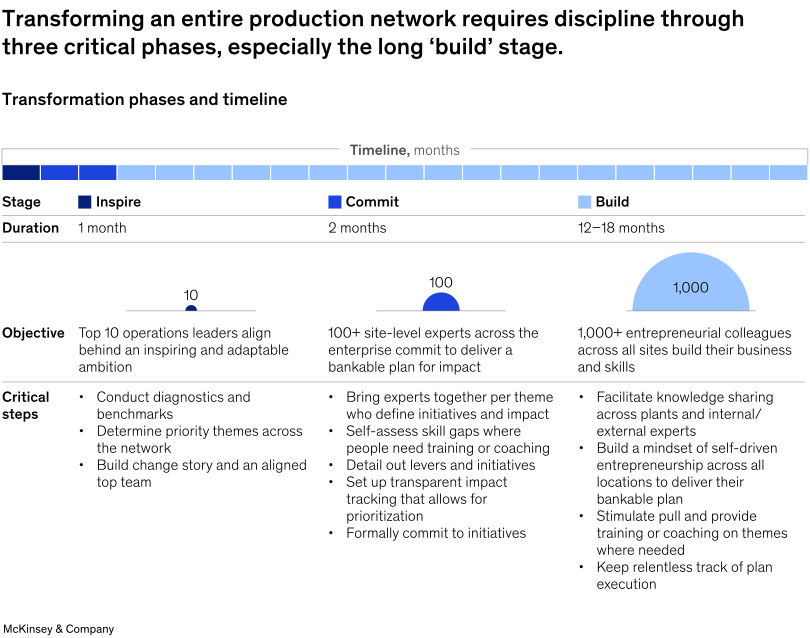
A few large organizations with sprawling networks of sites show how it’s done. These companies made critical shifts at each stage of a transformation: “inspire,” in which a few leaders set the transformation’s ambition in a way local leaders could adapt; “commit,” where a much larger group of experts across the organization plans explicit initiatives and their impact; and finally “build,” in which the company as a whole implements the plan across all sites (Exhibit 1).
Step 1: Inspire with themes
The global food manufacturer illustrates how the changes begin even at the earliest ideation stage, when a few senior leaders review the company’s opportunities for improvement to see where to focus. That’s difficult enough in businesses with only a few large-scale facilities, as is typically the case in many industries such as car batteries or commodity chemicals. On the other hand, the food company had dozens of production sites, most relatively small, with major differences in local labor pools, levels of automation, and capabilities.
Leaders quickly realized that if they followed the usual approach, piloting changes in a small number of areas and then gradually expanding the transformation site by site, the total impact would at best be only a little more than $5 million. Instead, the executives estimated that by launching across 20 sites at once, they could increase the impact to close to $40 million. The question was how to do so without overcomplicating or slowing the transformation down.
A critical innovation was to think in terms of transformational themes that would be relevant across all sites, with adaptations that site-level managers could design for local conditions. The transformation process could then follow the same basic structure across the production network, without imposing cookie-cutter changes that might be distracting (or even counterproductive) at a given site.
For the food manufacturer, one of the themes was improved line balancing to harmonize utilization rates for equipment. This broad theme can apply in very different ways at the local level. At one plant, the root cause of line-balancing issues turned out to be overly frequent changeovers between products. Local managers realized that their teams needed training in methods to identify and resolve overcomplexity. At another plant, line-balancing problems were most apparent at night, when higher absenteeism led to poor handovers and frequent production errors. Again, the solution depended on building employee skills, but the focus was on cross-training rather than mitigating complexity.
Step 2: Commit to change—and to changing skills
In the next stage, site managers across the enterprise translate the themes into concrete initiatives. For companies with large numbers of relatively small sites, a major challenge is to make expertise in the themes available at the local level: At a dairy factory with 50 workers, labor planning may be just one task on a long list for the production manager.
To reach its ambition of launching the transformation across 20 sites, the food company focused on a small number of larger “lighthouse” locations that, because of their size, employed specialists with the expertise needed to support the themes. The specialists then became the core of a train-the-managers structure to build skills at all 20 launch locations.
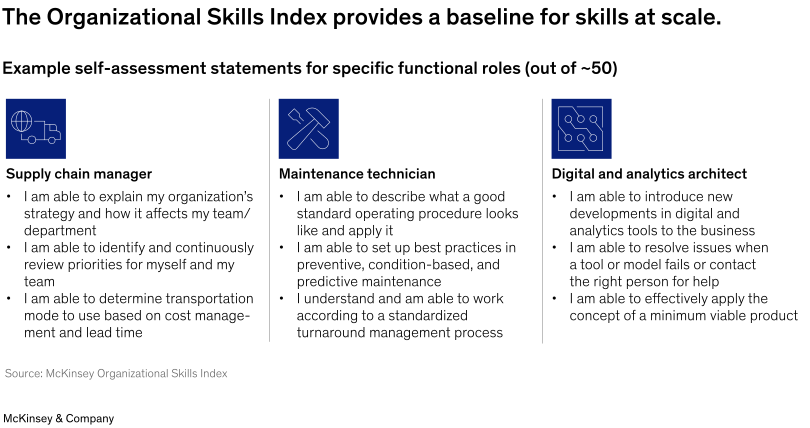
To focus the training effort, staff at each launch location took a 20- to 40-minute organizational-skills self-assessment designed to reveal gaps in capabilities that were critical to the transformation. The assessment covered three broad categories of skills: leadership, such as the ability to discover better ways of working; transformation, or the potential to accelerate execution of initiatives; and functional expertise, tailored to specific operational subfunctions such as manufacturing, procurement, or supply chain.
By providing a skills profile for each employee at the site, the results painted a picture of which capabilities were in place and which needed to be addressed with training (Exhibit 2).
Step 3: Building transformational learning journeys
Based on the assessment’s insights, site-level managers could then design learning journeys that addressed the capabilities required at each site (see sidebar, “Tailoring an operations capability-building program”). Each journey comprised four fundamental components that together improve retention and support deeper cultural change: acquire, referring to the format for learning; apply, in which the learner uses the new knowledge in the real world; assess, which encourages learners to reflect and improve on what they learned; and adhere, which develops habits that lead to new learning journeys (Table 2).
Each learning journey comprises four stages: acquire, apply, assess, and adhere.
| Stage | Example supporting tools |
|---|---|
| Acquire: Build new knowledge and skills through self-paced and facilitated trainings |
|
| Apply: Perform fieldwork and implement new mindsets and skills in the real world |
|
| Assess: Reflect on learnings and assess skill levels via self assessments, coaching, and review sessions |
|
| Adhere: Reinforce new practices and build habits that drive and sustain lasting change |
|
At the food company, lighthouse leaders developed a series of foundational courses to increase operational consistency. Modular training allowed employees to develop skills that were relevant both to their roles and to the specific needs of their sites. Each module aligned with skill gaps identified in the assessment, such as leadership skills for line managers or quality control for production teams. And the learning was available in a variety of formats, including online courses, on-site workshops, and peer-led learning groups, further allowing managers and employees to customize their experience. Real-world experimentation, such as using real-time analytics to revamp production scheduling, allowed employees to build confidence. Regular feedback sessions with managers helped employees develop real mastery, which was reflected in performance evaluations.
Rather than the $6 million gain built into the initial estimate, the food company generated $50 million in operational improvements in one year, including more than $40 million in cash. And employees put their training to use in unexpected ways—they identified an additional $50 million in improvement opportunities.
The right vision and structure can turn “subscale” sites into transformation superstars. The first step: a clear-eyed understanding that what’s really holding small locations back probably isn’t size—it’s skills. When companies transform, employees want to transform as well so they can contribute to the organization’s next step forward. That’s how transformation becomes a network capability rather than a one-time initiative.