AI is top of mind for insurance leaders, and for good reason, as the potential benefits are enticing. Together, predictive, generative, and agentic AI offer a practical way to industrialize the most expensive and judgment-intensive parts of insurance operations, not just the routine ones. It is now possible to reconfigure the underwriter’s desk, the contact center, the claims journey, and the finance close as connected, intelligent workflows in which AI agents and humans share the work.
But as AI capabilities become widely accessible, it’s likely that advantage could come less from access to the technology and more from how insurers redesign their operating models, make AI part of the day-to-day work, and build the skills and systems to scale it across the organization.
Simply put, there may not be much value in blindly including AI in insurance operations. Value is more likely to come from redesigning insurance operations around what AI and agents now make possible.
This raises the question of where to focus AI efforts. Insurance is broad. A typical multiline carrier runs about 300 core processes across personal, commercial, health, and life insurance, as well as corporate and support functions, spanning distribution operations, underwriting, policy administration, claims, finance, HR, compliance, and IT. The temptation, given that breadth, is to pursue improvements in a hundred places at once. However, the insurers seeing results tend to do the opposite. They concentrate on a set of high-impact agentic AI use cases, chosen primarily for their anticipated effect on growth and customer experience, and rewire each domain around these.
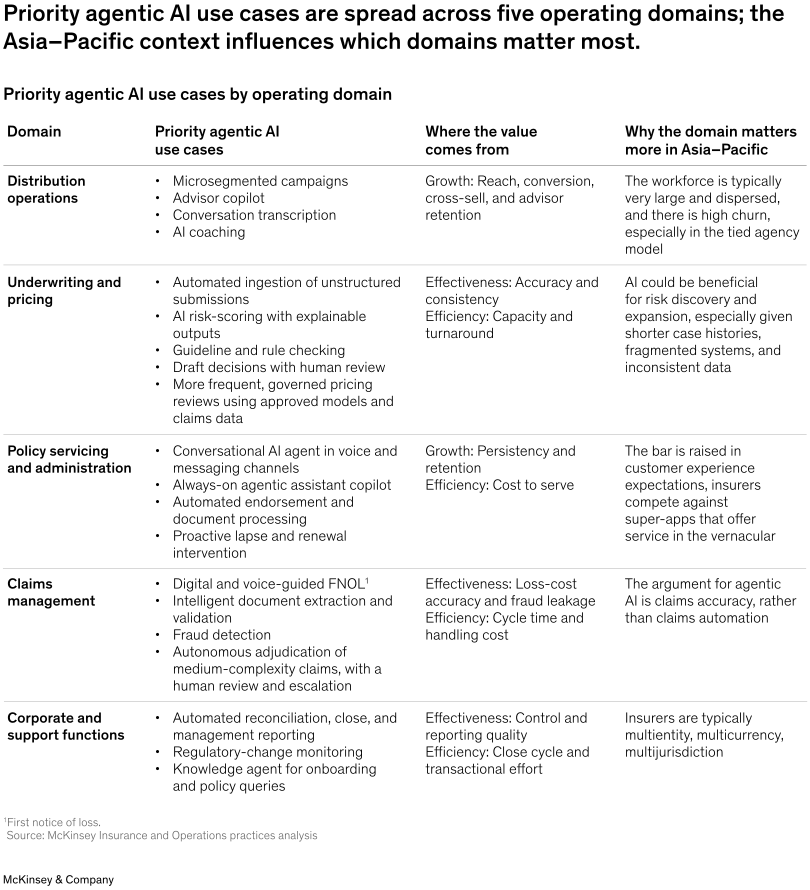
McKinsey research finds that insurers in Asia–Pacific markets looking to benefit from agentic AI can prioritize use cases and redesign five key domains around them (exhibit).
Agentic AI is particularly relevant to insurers in Asia–Pacific
Asia–Pacific insurers in next-generation growth markets often contend with greater operational complexity than their counterparts in other parts of the world. For example, they operate across multiple languages, legacy systems, distribution channels, product generations, and regulatory regimes, sometimes within a single organization. This complexity makes agentic AI potentially valuable in coordinating people, processes, and technology across the enterprise.
Given the labor-market economics of the region, many carriers already operate at a cost per policy that Western European and North American insurers cannot match. While insurers in more developed markets may be considering AI to reduce costs, those in Asia–Pacific next-generation growth markets could be looking at agentic AI to directly support an expansion agenda through simplified onboarding, multilingual engagement, assisted underwriting, faster issuance, and lower-cost servicing for mass and emerging-affluent customer segments.
Agentic AI could move the needle on new business, conversion, persistency, and loss-cost accuracy. That shifts the measure of success from cost per transaction to revenue per customer interaction and combined-ratio improvement, positioning distribution operations as a critical domain for strategic focus.
Several developments are making agentic AI increasingly relevant to insurance operations in the region:
Customer expectations in financial services have changed. In Asia–Pacific, the customer-experience bar is now set outside the industry. Customers in the region compare their insurance experience with apps, digital banks, e-commerce, and instant payments that offer instant authentication, real-time status updates, and conversational service in the local language. By contrast, insurance customers are often expected to read 70-page documents and wait 30 days for a property and casualty (P&C) claim. The next reset is already visible. Customers have moved from being passive recipients of insurance—found by an agent, sold a product, and served on the strength of a personal relationship—to active choosers who research online and pick channels to suit their wealth and sophistication. The customer journey is shifting from a vertically integrated model, in which a customer deals mainly with a single channel from discovery to claims, to a horizontal digital–physical hybrid in which customers move between channels to optimize for transparency, quality of advice, speed, and convenience.
Margins are under sustained pressure across most insurance lines. The reality is that two decades of premium growth have not translated into profit. Globally, gross written premiums expanded at about 4.9 percent a year since 2005, reaching an estimated $8.3 trillion in 2025, while profit before tax grew at about 4.3 percent a year, to about $580 billion.1
This global trend is evident in several Asia–Pacific markets. According to our analysis, between 2018 and 2024, health combined operating ratios failed to improve in half of the region’s ten largest markets, P&C combined operating ratios failed to improve in half, and after-tax return on equity in life failed to improve in two-thirds—a picture of stalled profitability rather than a cyclical downturn.
Technology is ready for wider use across the business. AI has largely been used for predictive models that work well with structured inputs, repeatable workflows, and narrow decisions. Typically, these models have been less effective when work is unstructured, judgment heavy, or conversational, as is a great deal of insurance operations work. This is where agentic AI excels.
The opportunity to gain an early advantage is shrinking. Several Asia–Pacific insurers are demonstrating what AI looks like at scale. Policies are automatically underwritten in seconds, automated case review ratios are rising, and customers receive claims payments within a day. Those that stall AI programs risk falling behind insurers that can scale at double or triple their pace, and at roughly half the unit cost.
Ultimately, an AI-enabled transformation is not a technology program. It is a strategic reinvention of the way insurance work gets done. The leaders we work with treat it as such and tackle it with the energy and discipline that a transformation demands. The early results are already visible. The window is open. The question for boards and CEOs is no longer whether to act, but how decisively.
To read the full report, download the PDF here.