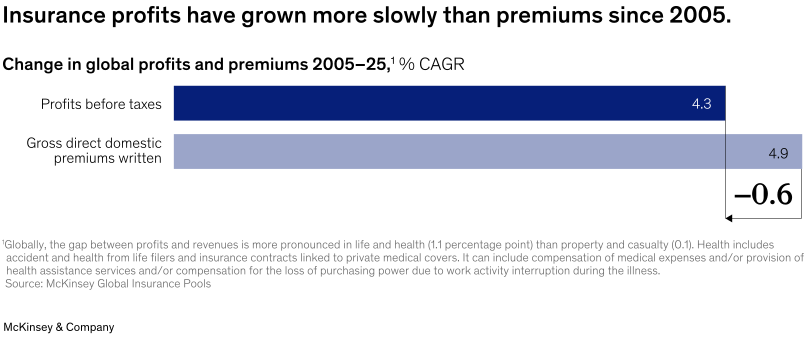
Over the past two decades, the global insurance industry has been treading water. Insurers have delivered steady growth in premiums, but operating leverage has eroded across property and casualty (P&C), life, and health (Exhibit 1). Gross written premiums have expanded at roughly 4.9 percent annually since 2005, reaching an estimated $8.3 trillion in 2025, yet profits before tax grew only approximately 4.3 percent over the same period, reaching approximately $580 billion.1 Rising capital requirements have been a factor in this underperformance.
Further, the industry has proven resistant to disruption. Major economic forces that fundamentally restructured other industries—globalization, digitization, the rise of platform economics—tested the industry’s edges but did not alter its economic architecture. Competitive positions shifted only gradually. Capital flowed slowly across geographies and lines of business. Public markets continued to treat insurance as a stable source of earnings generation with limited susceptibility to structural disruption. Private capital innovated in balance sheet and investment management, but has not touched most other parts of the business. Insurance in 2026 would be highly recognizable to farsighted executives in 2006.
This stasis hasn’t been all bad. The industry consistently leads other sectors in dividends and share buybacks. It has continued to play a vital role in the global economy and society, most recently in the global pandemic. But it is experiencing new pressures. Artificial intelligence has the potential to reshape four core industry dynamics that have marked the industry’s relative stagnation for the past two decades:
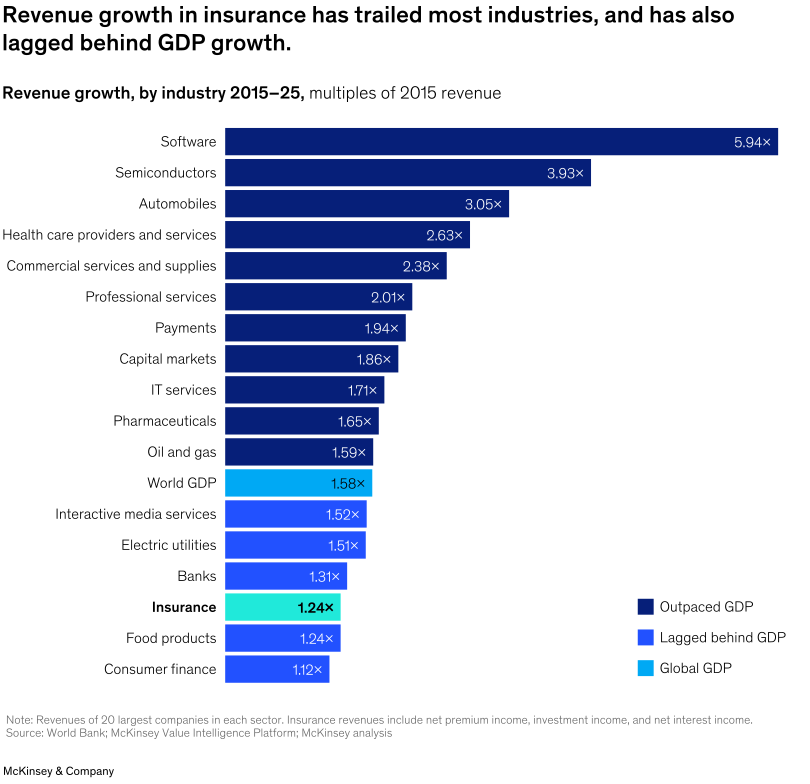
- Lagging growth and relevance. The insurance industry’s share of economic opportunity has not kept pace with the growth in underlying risk. In the past decade, revenues grew more slowly (1.24 times) than for most major industries and even global GDP (1.58 times). The global protection gap for natural catastrophes alone reached $133 billion in 2025.2 And less than 1 percent of global cyber costs are currently insured, a gap of roughly $900 billion.3
- High distribution costs. Commissions and acquisition expenses consume between ten and 25 cents of every premium dollar in P&C—and up to 80 cents of the first-year premium in life. The cost structure has changed little despite repeated waves of digital investment.
- Flat productivity. Expense ratios have remained largely stagnant for two decades. The average P&C expense ratio has hovered between 27 and 32 percent since 2005, with leaders below 22 percent and laggards at 32 percent, a gap that technology has only widened.
- Slow pace of change. While the industry has begun to move faster, it has historically lagged behind other sectors in adopting technology and innovation.

The state of AI in 2026: On the road to ROI
Organizations are deploying agentic coding tools and coming to grips with the costs of AI while still seeking to capture more of the benefits that their workers are deriving from their individual use of AI.
This article explores each of these in turn and how actors across the life, commercial lines, and personal lines insurance value chains can move past AI models (when every company uses the same models, no one has an advantage) and use the new tech to build competitive moats. We do not offer a road map; the pace and sequence of change are too uncertain. What we offer is a compass: a perspective on the direction in which each of these forces is moving, and a set of no-regrets moves that build competitive advantage regardless of how the timing plays out.
The actors best positioned will be those with the clearest thesis on the direction of change and the nimblest strategy room—like a sailboat that tacks frequently, staying closest to the optimal point of sail even when the destination is not yet visible. From insurers and reinsurers to distributors and technology providers, none are exempt from the underlying choices these forces create, and all have AI-powered potential to reset a dormant industry onto a new vector of growth.
A widening gap between rising risk and eroding relevance?
Revenue growth has trailed most major industries—and global GDP (Exhibit 2). Personal lines represented 1 percent of global GDP in 2023, down from 1.2 percent in 2019, with growth in developed markets largely the result of rate increases rather than expansion into new risks. The global protection gap for natural catastrophes is indeed vast; in another estimate, using a different methodology, the additional premium required to cover uninsured losses is $424 billion.4 Other risks are similarly underpenetrated; less than 1 percent of global cyber costs are currently insured. Insurance is, in aggregate, becoming less relevant to the risk environment even as that environment grows more complex.5
Can an AI-powered industry flip the script? The optimistic case is real, grounded in new risks, new solutions, and new market access:
- New risks: AI creates new risk categories that expand the total addressable market in ways that couldn’t be served at scale before. AI liability, nonphysical business interruption, and AI-augmented workforce transitions are pools of risk growing faster than the industry’s current product set can address. Further, AI expands cyber risk, which is already underinsured. Parametric products, embedded micro-coverage (bite-size policies integrated at the point of sale, such as travel protection offered when booking a flight or device coverage at checkout), and on-demand policies enabled by real-time data could extend coverage to segments previously uneconomic to serve.
- New solutions: AI also opens a second, less-explored path to relevance: a shift from pure risk transfer to risk partnership. Traditional insurance is fundamentally reactive—a financial instrument that responds after something goes wrong. AI makes possible something different: continuous, data-driven risk monitoring that helps customers understand, quantify, and mitigate exposures before they become claims. Consider the possibilities: telematics that coaches drivers in real time while recalculating “premium per minute” of driving. Commercial risk engineering and prevention, updated daily by satellite, telematics, and Internet of Things data. AI-enabled health coaching to improve mortality, morbidity, and longevity. These risk partnerships exist in pockets today but are not yet embedded at the core of a new insurance value proposition, one that moves insurers from the margin of customers’ risk management decisions to the center of them.
- New market access: A third path—perhaps the most consequential for market expansion—runs through underwriting and claims quality. For many risks, the barrier to broader coverage is not a lack of demand but a lack of confidence in robust pricing and the ability to reliably underwrite. Climate-exposed property, cyber, and AI-related risk share a common problem: Underwriters don’t have enough reliable data to price them precisely, and frequency and severity of claims in these lines are hard to predict. The result is high premiums, restricted coverage, or outright declines—leaving large pools of legitimate risk uninsured.
AI directly addresses both sides, underwriting and claims. Better real-time data ingestion and continuous model recalibration can sharpen pricing on volatile risks. And improved claims accuracy—more precise reserving, earlier identification of problems, better settlement decisions—reduces the cost uncertainty that forces conservative pricing in the first place. A carrier that improves its loss ratio by five points on a risk it previously underweighted can write more of it, price it more competitively, and reach customers currently priced out of the market. Indeed, even without AI, claims accuracy is already a structural priority. AI only enhances the opportunity. The carriers that build this capability earliest will have both a cost advantage and the confidence to enter markets others won’t touch.
A pessimistic case is no less real. Digital risks don’t behave like traditional insurance pools. Shared cloud infrastructure, common AI model dependencies, and interconnected supply chains mean a single failure can trigger losses across hundreds of thousands of enterprises simultaneously. AI liability and systemic cyber risk could prove correlated in ways that make them genuinely difficult to diversify and price responsibly. Alternative capital, which thrives on independent risk, may have limited appetite for highly correlated exposures that move all at once. Carriers that enter these lines without building the analytical capability to understand how losses propagate risk repeating a familiar pattern: chasing premium in a growing category before the underlying risk structure is understood. Relevance requires new underwriting capabilities, not just new products.
Questions for leaders across the value chain:
Do we have a clear view of which new risk markets AI will create—and a credible plan to capture them before competitors do?
Are we stress testing our portfolio and pricing models against AI-driven shifts in risk correlations—or are we still relying on historical independence assumptions?
Do we understand how to marry forward-looking perspectives with historical losses when developing new products and pricing them?
How are we reimagining claims management with AI as a major driver of the loss ratio and customer experience for both today’s products and future ones?
Do we have a clear plan for using AI to break free from the industry’s historical constraints (such as stagnant expense ratios and a slow pace of change)?
From agents to agentic commerce?
Insurance has always been a product that is sold, not bought, with distributors playing a critical role in managing advice, access, and friction throughout the process. They create awareness of risk, explain complex policies, guide customers through underwriting, match risk to capital, and handle service interactions often slowed by carriers’ legacy systems. That structure has persisted for decades, and distribution has been worth the cost to carriers. Today, about 85 percent of US P&C insurance and 95 percent of life insurance premiums are distributed through agents, brokers, and managing general agents. Digitization has done little to alter the dynamics overall. In some markets, aggregators have increased price transparency and shifted some personal‑lines volume to direct channels, but left the overall structure largely intact.
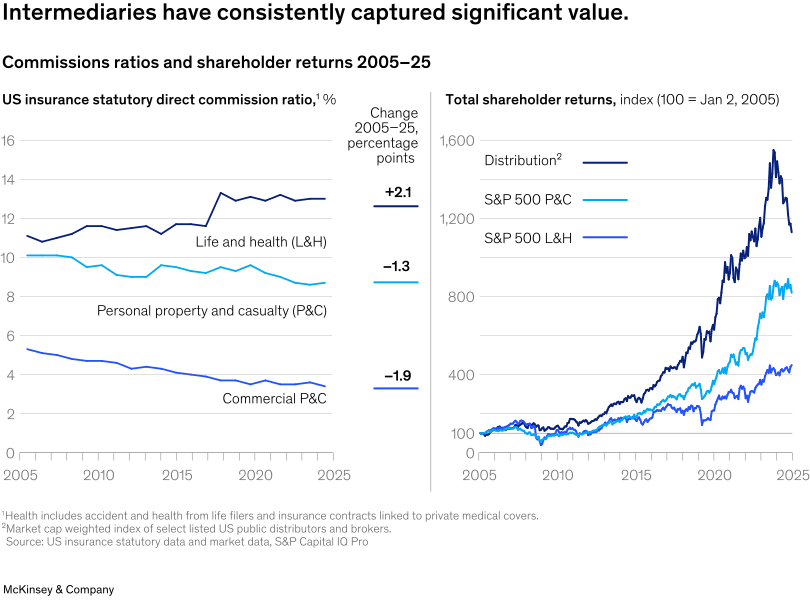
Distributors’ tenacious hold on the customer relationship shows up in industry economics. Distributors have consistently exceeded carriers in total shareholder returns (though note that this year, markets have also recognized the AI threat to these companies, with one of the largest dips in TSR in decades). In large part, that financial success is supported by commissions, which have barely budged since 2005 (Exhibit 3). After claims, distribution is the largest single cost category in P&C insurance. It’s also a big cost in life. Our research shows that multichannel P&C incumbents have cost ratios at least 30 percent higher than those of pure direct players, with the gap attributable almost entirely to sales and distribution costs.6
AI is the first technology with the potential to create a true paradigm shift. New AI platforms have entered the picture and will compete for crucial control points such as ownership of customer data, privileged access to demand, and the ability to orchestrate complex ecosystems. Nearly half of customers in North America already use AI in their personal insurance-buying journeys. As these same customers go on to adopt AI for research, advice, and the purchase of other complex services, what about today’s experience of buying insurance is durable enough to keep them in current channels? For buyers of more complex risks, how likely is it that AI will not at least remove friction and effort from structuring, placing, and monitoring risk—and begin to change the economics? Three dynamics will shape how this story unfolds:
- The interface is up for grabs, especially for simpler risks. On behalf of customers, agentic AI now has the capability to watch renewal dates, query carrier APIs in real time, compare coverage and price across multiple products, and recommend switches well before the customer initiates the process. AI health coaches and financial copilots extend this further, folding insurance into broader advice on health, wealth, and risk. Embedded insurance goes further still: The customer is not even shopping for insurance but buys coverage at the moment of need, whether when buying a car, closing on a home, or booking a flight. In this world—especially for simpler, high‑frequency risks—the “front door” to the customer is no longer the agent’s office or the carrier’s website, but whichever AI assistant, platform, or ecosystem the customer trusts to act on their behalf. The strategic risks are a new form of obscurity and loss of influence: When AI intermediaries decide which options to surface, being top of mind for agents or spending more on advertising no longer guarantees you are even in the consideration set in the customer’s AI. Traditional strategies to market, push, and secure prominence lose much of their power; the contest shifts to shaping the criteria and data that drive AI recommendations. For carriers and brokers alike, the logic of recommendation becomes the new battleground for growth.
- The information advantage may be shifting. Insurance has always been an information business. The carrier’s edge was knowing more about the risk than the customer, based on decades of loss causation records, repair cost trajectories, and litigation outcomes. Brokers have put that edge under pressure by aggregating multicarrier data to develop comparative intelligence that no single carrier possesses. AI elevates the stakes even further. AI platforms observing cross-market behavior and data providers holding consumer and financial data could build customer profiles that are more predictive than underwriting histories in high-frequency lines, while brokers with multicarrier data can use AI to accumulate comparative intelligence that no single carrier possesses. Current players that assume their data advantage is proprietary and intact may be the last to recognize that it is not.
- Trust has always been the gatekeeper, but it is splintering. Insurance is a promise, evaluated under stress. Historically, trust operated as a retention tool: It kept customers renewing and held relationships together through friction. But trust in insurance is not one thing. It has at least three components that AI will affect differently. Trust in the relationship—the human connection in complex claims, difficult advice, moments of genuine distress—is something AI cannot yet replicate, and players that invest in it deliberately will find it compounds. Trust in credentials—licensing, institutional credibility, solvency ratings—has historically been an incumbent’s advantage, but as platforms and AI-native players accumulate their own forms of credibility, that advantage is up for grabs. Trust in explanation and advice—the ability of humans to help a customer understand what they are covered for, why their claim was decided the way it was, and what they should do next—is an area where AI may actually outperform the traditional model: It is patient, nonjudgmental, available at any hour, and does not make customers feel foolish for asking. The carriers that treat all three dimensions deliberately will be better positioned than those treating trust as a single compliance checkbox.
While these shifts are real and already visible, the future of distribution will not be monolithic. Disintermediation will advance quickly in some products and segments, and much more gradually or not at all in others. In commoditized personal lines, AI agents and platforms are likely to sit between customers and carriers, rerouting volume as more activity passes through their interfaces rather than traditional channels. In more complex segments (midmarket commercial, specialty, and high‑net‑worth personal lines), where advice, bespoke structuring, and claims advocacy matter more, AI is more likely to show up first as a force for cost compression and capability uplift, making it materially cheaper and easier for agents and brokers to quote, explain, and service, rather than displacing them outright. In those segments, there is a scenario in which commissions compress, carriers may recapture some margin, and intermediation may drift down modestly rather than collapse. The strategic question is less “will AI replace distribution?” and more “who captures the evolving value—carriers, distributors, or customers—and who ultimately owns the customer relationship as these dynamics play out?” Today, that answer is largely distributors; tomorrow, it might still be distributors, but over the next decade, AI could put the question back on the table.
Questions for leaders:
For carriers:
When your best customer’s AI agent goes shopping for coverage, will it find you—and on what terms?
In complex risks, who is your real customer: the distributor’s AI, the large language model (LLM), or the insured?
For brokers and agents:
Is your value proposition built on access or advice, and how are you building either or both for the AI future?
How will you use the efficiency dividend that AI creates for you—to make producers two to three times more productive, lift margins, or deepen capability and service?
For platforms:
Your behavioral data may be more predictive of customer needs than any carrier’s underwriting history.
Which will create more value: partnerships or underwriting risk directly?
Who controls your insurance recommendation logic, and whose interests does it serve first?
Will AI realize the long-delayed promise of productivity?
In contrast to most industries, insurance has failed to improve its cost efficiency in the past two decades (Exhibit 4). Our analysis of large global companies shows that while the telecommunications, automotive, and airline industries have reduced their cost ratios (SG&A to revenues) materially since 2005, insurance cost ratios are 10 percent higher globally, even as the industry invested heavily in automation and digital tooling.
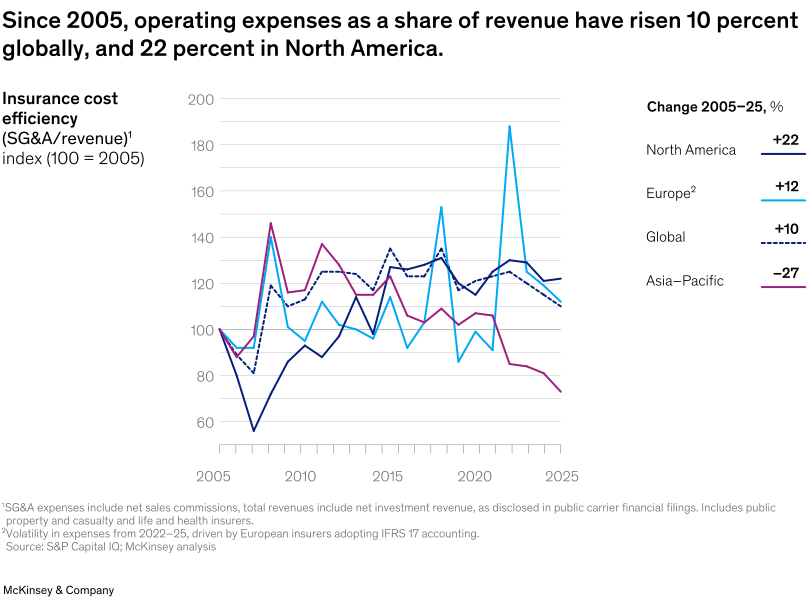
The explanation is not that technology failed to improve labor productivity—it did, by 14 percent in P&C and 24 percent in life, across claims, servicing, and policy issuance.7 The problem is structural: Gains were consistently offset by rising IT costs, compliance overhead, and the complexity introduced by layering new digital tools onto legacy operating models. Efficiency improved. Average industry costs increased.
AI changes the equation in two ways. First, it can apply to and operate on the entire cost structure in a way that prior technologies (such as robotic process automation) could not, creating the potential to collapse marginal costs in underwriting, claims, and servicing simultaneously. Today, domain-level transformations are already producing reductions of 20 to 40 percent in customer onboarding costs and improvements of 10 to 20 percent in insurance agent productivity.8
Second, and more consequentially, AI reshapes scale economics. While AI is not costless—there are real costs for compute, models, and orchestration, and indeed these costs are already ringing alarm bells at some companies9—it has the potential to materially lower the unit cost of many underwriting, servicing, and claims tasks below today’s human‑ and rules‑based approaches. That allows AI‑first carriers to grow volume much faster than cost, achieving levels of productivity and operating leverage that are very difficult for laggards to match.
That shift has a competitive consequence and suggests two viable paths for insurers:
- Scale: Carriers and brokers with sufficient premium volume to amortize the up-front capital required for data infrastructure, model development, and technology platforms will operate at expense ratios that midsize generalists struggle to match, not because vastly lower unit costs are out of reach, but because the investment required to get there favors those who can spread it across a larger base.
- Deep specialization: As AI reduces the friction of connecting specialized underwriting capability to distribution platforms, capital providers, and claims infrastructure, a firm that does one thing with genuine distinction and accesses everything else through partners could be equally well positioned. The growth of AI-native managing general agents (MGAs) plugging into platform infrastructure rather than building it is an early expression of that pattern.
What is not defensible is deferral or the middle ground. The choice between owning the full AI stack and accessing it through partnerships is increasingly urgent. Firms need clarity on two questions simultaneously: where they are competing—through scale or deep specialization—and how they will leverage technology to get there. Without that clarity, firms become takers twice over: accepting the competitive position the market assigns them, and accepting the technology stack they currently have or one offered by vendors. Firms that treat AI as a gradual modernization program running alongside the business, rather than as a competitive disruption, may find the gap to industry leadership has widened too far by the time it surfaces in the P&L.
Questions for leaders across the value chain:
Where do we sit on the cost curve today, and what happens to our competitive position if the scale required to be cost-competitive is cut in half over the next five years?
If we choose to specialize, where do we have a durable edge—customer access and insight, risk selection and modeling, or something else—and what gives us confidence that advantage will hold?
Can insurers build a tech-speed operating model?
Insurance operates on timescales calibrated to the risks it covers. Product development cycles are measured in years. Actuarial reviews are tied to the length of the claims “tail.” Underwriting guidelines are often updated annually. These cycle times are not irrational—they reflect the nature of long-duration risk and the consequences of pricing errors in a business where mistakes take years to surface in loss ratios. But they create a structural disadvantage in a competitive environment now moving at technology speed. AI-native MGAs build, test, and refine products in weeks. Digital platforms update recommendation algorithms in hours. The pace at which competitive positions can shift is accelerating—and most incumbents’ operating models were designed for a different tempo entirely.
The competitive risk here is not primarily about AI capability—most carriers (brokers too) can access similar models and tools. It is about whether the operating system is designed to use them at the speed the market now requires. Players that layer AI onto legacy operating systems find the gap between AI deployment and their actual competitive response growing wider over time. Three constraints most commonly define that gap, starting with the one most immediately affected by slow cycle times:
- Decision velocity. Without clear decision rights and ownership, structural decisions about AI strategy, application, and approach get absorbed into annual or longer planning cycles, infrequent governance reviews, and approval chains built for a different pace. The result is an organization that cannot move with the continuity and speed that iterative AI deployment requires.
- Data architecture. Most carriers’ data is organized around historical loss events and product lines, silos that are optimized for actuarial review rather than real-time signal detection. Within a line that structure is often defensible, but it becomes a constraint wherever AI needs to cross boundaries: distribution cross-sell, cross-product fraud detection, or customer-level retention and pricing. AI-native systems require a different architecture for rapid model training and iteration.
- Delivery operating model. Most firms have not yet built a delivery model in which technical talent—AI engineers, architects, and data scientists—are truly embedded in business functions and working collaboratively at pace and at scale. Instead, technology and business remain separate, such that AI development too often means throwing solutions over a wall rather than building together. Closing that gap requires more than hiring; it requires redesigning how technical and business teams work together.
As we have argued in our recent work on AI transformation in insurance10, these are not isolated technical problems. Rather, they are symptoms of a broader organizational challenge that spans all six dimensions of a rewired enterprise: a strategy that hasn’t committed to enterprise-wide transformation; talent concentrated in centers of excellence rather than embedded in business functions; an operating model with slow change cycles; technology infrastructure too rigid to support rapid deployment; data not architected for real-time learning; and adoption and change management that treat AI as a project or widget rather than a new way of working.
Most carriers have gaps in more than one dimension. The carriers generating disproportionate returns from AI have addressed all six simultaneously. These leaders have rebuilt how they operate around their capabilities, not just deployed new capabilities into existing operations. As our cross-sector research makes clear,11 the ability to test, learn, and scale faster than competitors is itself a structural moat. Faster iteration generates more data, better data improves models, and a compounding dynamic continually widens the gap between leaders and laggards. In insurance, the widening of the gap is already visible: AI leaders have created six times greater TSR than laggards.12
Questions for leaders across the value chain:
Mapped against the six dimensions of a rewired enterprise—strategy, talent, operating model, technology, data, and adoption—which are the constraints keeping you from moving at the speed of tech natives?
Have you successfully moved from pilots to industrialization in at least one part of the business, or are you still accumulating proofs of concept while competitors build production-grade advantages?
Strategic agility in the age of AI
We have argued that AI will likely reshape four dynamics—fading relevance, high distribution costs, flat productivity, and a slow pace of change—that have characterized insurance for the past 20 years. Another plausible version of this story would be more comfortable for insurance leaders. It goes like this: AI improves productivity at the margins. Distribution economics remain largely stable (as agents and brokers deepen relationships with customers and broaden the services they provide). The fundamental architecture of who owns risk, who distributes it, and who profits remains largely intact.
As we said at the outset, we’re not offering a road map. A five-year AI plan built on assumed capabilities risks being obsolete before it is implemented. Leaders can determine which future is more likely if they wish. But the practical challenge for executives is how to act strategically when the precise trajectory is unknowable. Firms that build the capacity for rapid, repeated course correction, rather than betting on a single strategic plan, will have opportunities to add to their advantage as the environment shifts.
Our work with companies worldwide increasingly confirms that leaders are not waiting for a clear picture. They are investing now in the capabilities, data, and operating-model changes that will define their position regardless of how the specifics play out. Here are three no-regrets moves all CEOs can take today:
First, decide your ambition, and put someone in charge of getting there. The firms generating the most durable value from AI start with a sharp thesis: What kind of company are we building, and what business problem are we trying to solve? Are we going to use AI primarily to strengthen the “front of house”—owning and defending access to customers and distributors—or to become the strongest risk and product engine that potentially delivers on others’ customer relationships (agents, platforms, ecosystems)? Will we use AI to win mainly on scale and cost, or on depth of specialization in a domain no one else can match?
The goal is not to pick only one or two and abandon the others, but to be explicit about where to place your biggest AI bets and design your operating model to truly win first in chosen areas. Many directions can be attractive, but trying to pursue all of them at once—without the conviction and investment to lead in any of them—almost never works. Every month without a clear answer is a month of underinvestment in whichever path leaders ultimately choose.
Clarity of direction is only half of it. The firms that actually move at pace and reach scale are led by a CEO who visibly owns the AI transformation and has named a senior leader fully accountable for delivering it. That leader needs the authority, resources, and mandate to drive the AI agenda end to end, working in lockstep with business, technology, and HR leaders rather than diffusing responsibility across a committee. In parallel, business leaders should define the AI ambition for their domains, in coordination with and in service of the transformation of the broader enterprise. In an environment where the temptation to pilot, hedge, and defer is constant, this kind of clear, top‑level ownership is what converts strategic intent into competitive gain.
Second, build the engine that will actually deliver it—and keep delivering as the market shifts. A clear strategy only creates value if the organization can execute against it at pace and pivot rapidly when the landscape changes. That means investing in three things simultaneously and treating all three as equally foundational:
- The technology backbone. What’s needed is an architecture designed for continuous learning, rapid deployment, and iterative improvement, not a collection of pilots layered onto legacy infrastructure. The most effective approach is to select two or three of the highest-value business problems, build real capability there, and let the organization learn what it means to operate at technology speed before scaling further. The lessons from those early domains are as important as the results.
- The operating model. In those same priority domains, the design of how people and technology work together day to day has to change alongside the technology itself. Most transformations do not fail because the technology underperforms. They fail because the business surrounding it does not change. Approval structures, decision rights, and governance cycles built for a slower era do not bend automatically to new tools. The firms getting this right are deliberately redesigning those structures within their priority domains first, keeping human judgment in the loop where it matters most, and letting automation take over where it performs better. What gets built in those domains becomes the template for everything that follows.
- Talent. Concentrate your best people in those same priority domains, working fluently at the intersection of deep business knowledge and AI capability, embedded in the functions where the work happens rather than sitting at a remove in a center of excellence. These people are the industry’s scarcest resource today, and the scarcity will not be solved by hiring alone. Building talent depth where you are investing hardest accelerates both the results and the learning, and the capability developed in early domains becomes the foundation and blueprint for scaling across the rest of the business.
Third, change the way you change. Most organizations underestimate how hard it is to move hundreds or thousands of people into genuinely new ways of working. Deploying a model or tool is not the same as changing behavior, and behavioral change at scale requires a fundamentally different approach than the industry has historically applied to technology rollouts. The firms pulling ahead are treating adoption as a strategic capability in its own right. They start by helping employees see how AI enables the organization to deliver on its core purpose for customers and communities, then design activation programs and management systems that engage frontline teams at scale; equip people with new capabilities in ways that are precise, immediate, and practical rather than theoretical; and build the feedback infrastructure to track progress in real time.
That last point matters more than most leaders expect. Without real visibility into how adoption is unfolding, organizations are flying blind. Teams that appear to be transforming may have quietly reverted to familiar habits; domains that should be generating economic gains may be falling short; change efforts that feel sufficient from the top may need to be redesigned entirely at the front line. Achieving a high degree of transparency is not a reporting exercise. It is what allows the organization to course correct quickly enough to stay ahead in a market that is not waiting.
Taken together, these three commitments describe something more than an AI strategy. They describe a rewired enterprise: one that knows what it is, has built the capability to deliver it, and has developed the organizational muscle to keep adapting as the wind shifts and the currently unknowable path and powers of AI are revealed.